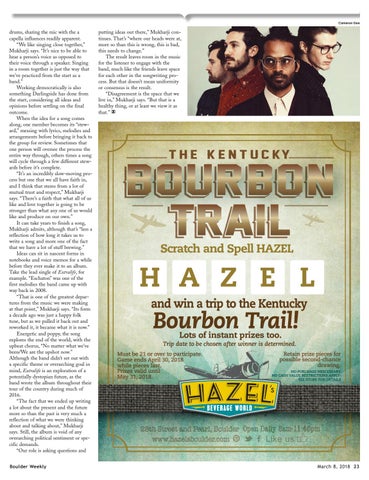
Cameron Gee
drums, sharing the mic with the a capella influences readily apparent. “We like singing close together,” Mukharji says. “It’s nice to be able to hear a person’s voice as opposed to their voice through a speaker. Singing in a room together is just the way that we’ve practiced from the start as a band.” Working democratically is also something Darlingside has done from the start, considering all ideas and opinions before settling on the final outcome. When the idea for a song comes along, one member becomes its “steward,” messing with lyrics, melodies and arrangements before bringing it back to the group for review. Sometimes that one person will oversee the process the entire way through, others times a song will cycle through a few different stewards before it’s complete. “It’s an incredibly slow-moving process but one that we all have faith in, and I think that stems from a lot of mutual trust and respect,” Mukharji says. “There’s a faith that what all of us like and love together is going to be stronger than what any one of us would like and produce on our own.” It can take years to finish a song, Mukharji admits, although that’s “less a reflection of how long it takes us to write a song and more one of the fact that we have a lot of stuff brewing.” Ideas can sit in nascent forms in notebooks and voice memos for a while before they ever make it to an album. Take the lead single of Extralife, for example. “Eschaton” was one of the first melodies the band came up with way back in 2008. “That is one of the greatest departures from the music we were making at that point,” Mukharji says. “Its form a decade ago was just a happy folk tune, but as we pulled it back out and reworked it, it became what it is now.” Energetic and poppy, the song explores the end of the world, with the upbeat chorus, “No matter what we’ve been/We are the upshot now.” Although the band didn’t set out with a specific theme or overarching goal in mind, Extralife is an exploration of a potentially dystopian future, as the band wrote the album throughout their tour of the country during much of 2016. “The fact that we ended up writing a lot about the present and the future more so than the past is very much a reflection of what we were thinking about and talking about,” Mukharji says. Still, the album is void of any overarching political sentiment or specific demands. “Our role is asking questions and Boulder Weekly
putting ideas out there,” Mukharji continues. That’s “where our heads were at, more so than this is wrong, this is bad, this needs to change.” The result leaves room in the music for the listener to engage with the band, much like the friends leave space for each other in the songwriting process. But that doesn’t mean uniformity or consensus is the result. “Disagreement is the space that we live in,” Mukharji says. “But that is a healthy thing, or at least we view it as that.”
T H E K E N T U C KY
Scratch and Spell HAZEL
H A Z E L and win a trip to the Kentucky
Bourbon Trail! Lots of instant prizes too.
Trip date to be chosen after winner is determined. Retain prize pieces for possible second-chance drawing.
Must be 21 or over to participate. Game ends April 30, 2018 while pieces last. Prizes valid until May 31, 2018.
NO PURCHASE NESCESSARY. NO CASH VALUE RESTRICTIONS APPLYSEE STORE FOR DETAILS
®
March 8 , 2018 23