CONTRIBUTING WRITERS: Rob Brezsny, Michael J. Casey, Dan Savage
SALES AND MARKETING
MARKET DEVELOPMENT MANAGER:
Kellie Robinson
SENIOR ACCOUNT EXECUTIVE: Matthew Fischer
ACCOUNT EXECUTIVES:
Chris Allred, Tony Camarda, Austen Lopp
SPECIAL PROJECTS MANAGER: Carter Ferryman
MRS. BOULDER WEEKLY: Mari Nevar
PRODUCTION
CREATIVE DIRECTOR: Erik Wogen
GRAPHIC DESIGNER: Chris Sawyer
CIRCULATION
CIRCULATION MANAGER: Cal Winn
CIRCULATION TEAM: Sue Butcher, Ken Rott, Chris Bauer
BUSINESS OFFICE
BOOKKEEPER: Austen Lopp
FOUNDER / CEO: Stewart Sallo
As Boulder County’s only independently owned newspaper, Boulder Weekly is dedicated to illuminating truth, advancing justice and protecting the First Amendment through ethical, no-holds-barred journalism and thought-provoking opinion writing. Free every Thursday since 1993, the Weekly also offers the county’s most comprehensive arts and entertainment coverage. Read the print version, or visit boulderweekly.com. Boulder Weekly does not accept unsolicited editorial submissions. If you’re interested in writing for the paper, please send queries to: editorial@ boulderweekly.com. Any materials sent to Boulder Weekly become the property of the newspaper.
1495 Canyon Boulevard, Suite CO 1, Boulder, CO 80302
Boulder Weekly welcomes your correspondence via email (letters@boulderweekly.com). Preference will be given to short letters (under 300 words) that deal with recent stories or local issues, and letters may be edited for style, length and libel. Letters should include your name, address and telephone number for verification. We do not publish anonymous letters or those signed with pseudonyms. Letters become the property of Boulder Weekly and will be published on our website.
EDITOR’S NOTE
WHO OWNS THE NEWS? YOU CAN!
Boulder Weekly is going co-op
BY SHAY CASTLE
In 2018, local journalist Dave Krieger asked, “Who owns the news?”
It was a timely question as the Daily Camera, where Krieger was the opinion editor, suffered under its vulture capitalist owner, Alden Global Capital. I was lucky enough to overlap with Krieger and many other talented journalists during my 6.5 years at the Camera, but my time there was mostly marked by shrinking staff and expanding workloads. We never heard from our corporate overlords until it came time to make budget cuts, but we — and the community — felt the impacts of their ownership as we were continually asked to do more with less.
Boulder Weekly is fortunate to have been locally owned since its founding in 1994. We are backed exclusively by readers and local small businesses: no corporate donors or owners.
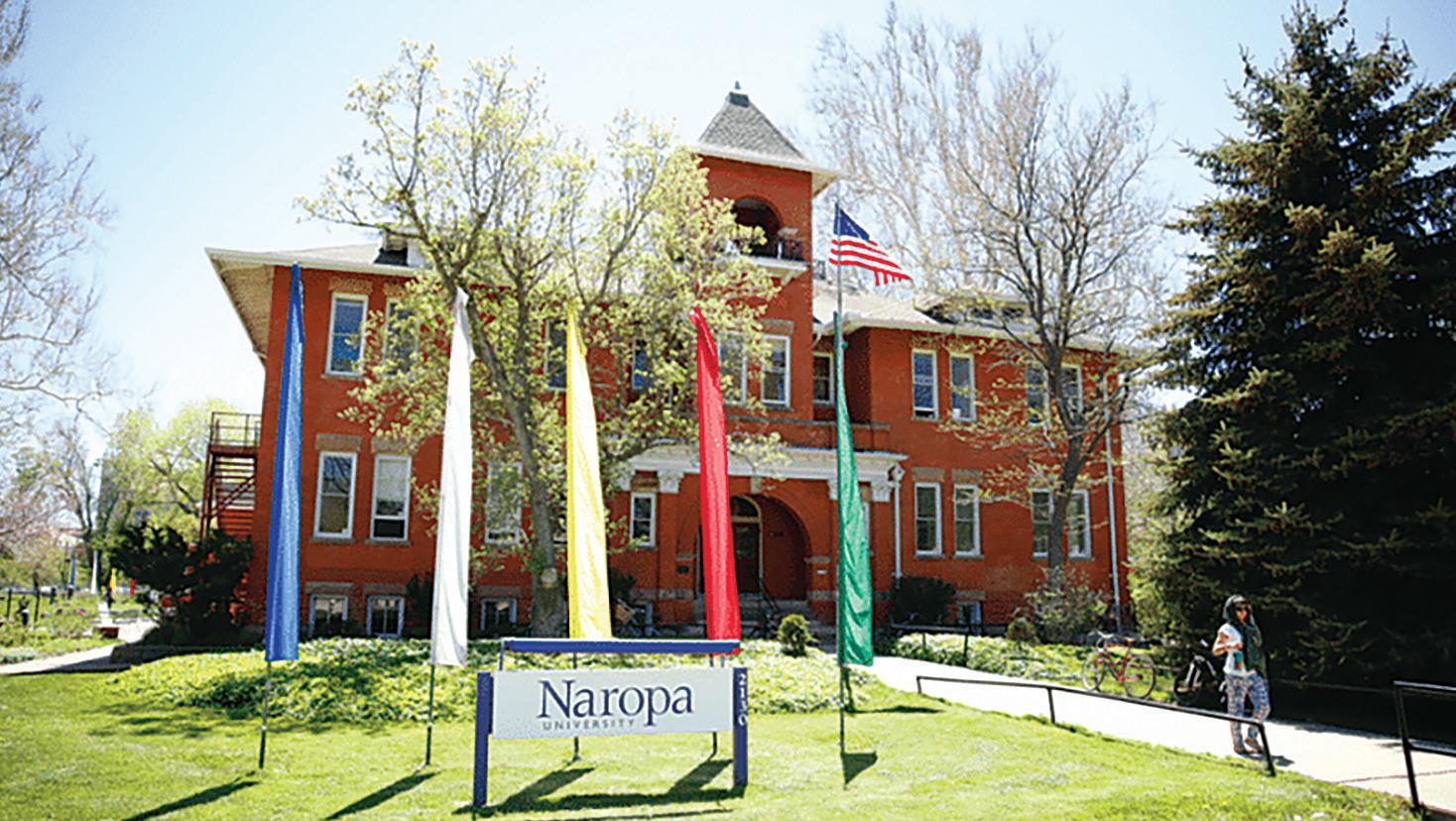
This independence has allowed us to produce some truly remarkable journalism. This year alone, we were the first to cover the spread of private equity money into childcare. We broke the news of Naropa selling its preschool and main campus, along with the delayed rollout of its psychedelic training program. We’re the only outlet to cover the fallout from a renter protection law that makes it harder to house homeless folks, and the only outlet to cover local elections in every. single. Boulder County. city.
Looking for a regular column focused on people with disabilities? You’ll only find that in Boulder Weekly. We’ve nabbed exclusive interviews with artists and filmmakers, and when the Longmont Leader pulled out of town, we stepped up by hiring a Longmont reporter.
We provide all of this and more for free, every week, to thousands of readers.
Today, we find ourselves with an exciting possibility. Our founder and owner, Stewart Sallo, is looking to retire. Rather than sell to the highest bidder, Stew has graciously decided to work with the Boulder Weekly team on a transition to employee ownership.
We’re fundraising now for the first step, a feasibility study to outline the operational and financial requirements for such a venture. Thankfully, we’re being guided by experts at the nonprofit Rocky Mountain Employee Ownership Center.
The hope is that Boulder Weekly will be in the hands of the folks who know it best. For us, that means involving community members.
We’re exploring a co-op model that would put workers and community members in charge of business decisions. (For
ethical reasons, editorial power would remain with the editorial team.)
It’s still early days, and there are many questions to be answered. But we are excited about keeping Boulder Weekly independent and locally owned, carrying on the proud tradition that Stew has kept alive for three decades.
Throughout December, we’re hoping to raise $10,000 to fund the feasibility study. Thanks to Colorado Gives and the generous sponsorship of the nonprofit Alternative Newsweekly Foundation, your donation will be tax deductible through Dec. 31.
Thank you for standing by us for over 30 years. With your help, we’ll keep going for 30 more with an even greater commitment to being news by the people and for the people.
WANT TO MAKE SURE BOULDER WEEKLY STAYS LOCALLY OWNED?
Donate to our campaign to become an employee- and community-owned co-op! coloradogives.org/ story/99mptf
THE YEAR IN NEWS
BY BOULDER WEEKLY STAFF
We wouldn’t blame anyone who avoided reading too much news this year; it was a rough one. For the benefit of your mental health and for anyone who skimmed the headlines, we present this annual recap of the good, the bad and the downright troubling Boulder County news from 2024.
If you can’t stomach even this quickand-dirty roundup, we suggest skipping to the stories we’re watching for next year: There are faint glimmers of hope on the horizon for at least a few folks.
STORIES OF THE YEAR
NAROPA UNIVERSITY
SELLS ITS PRESCHOOL, MAIN CAMPUS
As tech bros and monied interests have increasingly gained ground in Boulder, the crunchy, ski-bum vibes of yesteryear have given way to a milquetoast homogeny. Naropa, the Buddhist university founded in 1974, is one of the few institutions keeping the flavor of Old Boulder alive. Which is why we anxiously watched its evolution this year as the private institute of higher learning announced plans to sell
its preschool, Alaya, and main campus, after having offloaded its Paramita outpost in 2019.
The sales came amid a pandemicfueled shift away from in-person learning. University president Charles “Chuck” Lief said the money helped the university keep paying its faculty and staff and transition to a more hybrid future.
A bright spot was Naropa’s development of psychedelic training curriculum, the first in the state to receive regulators’ OK. Reporter Kaylee Harter explored its formation in March, and Tyler Hickman broke the news in November that insurers had pulled the plug on the promising program.
The psychedelic studies center is now independent of the university and will be run by former faculty and a group of local therapists. Read more on page 30.
MARCIA MARTIN RESIGNS FROM LONGMONT COUNCIL
Longmont’s city council chambers have been brimming with drama in the past several months, and the saga came to a climax during December’s first meeting.
Marcia Martin, Longmont’s two-term Ward 2 representative, announced her resignation effective at the end of 2024,
It was a big year for Naropa University, with the sale of its main campus, the pending sale of an associated preschool and the launch and spinoff of its psychedelic training program. Courtesy: Naropa University
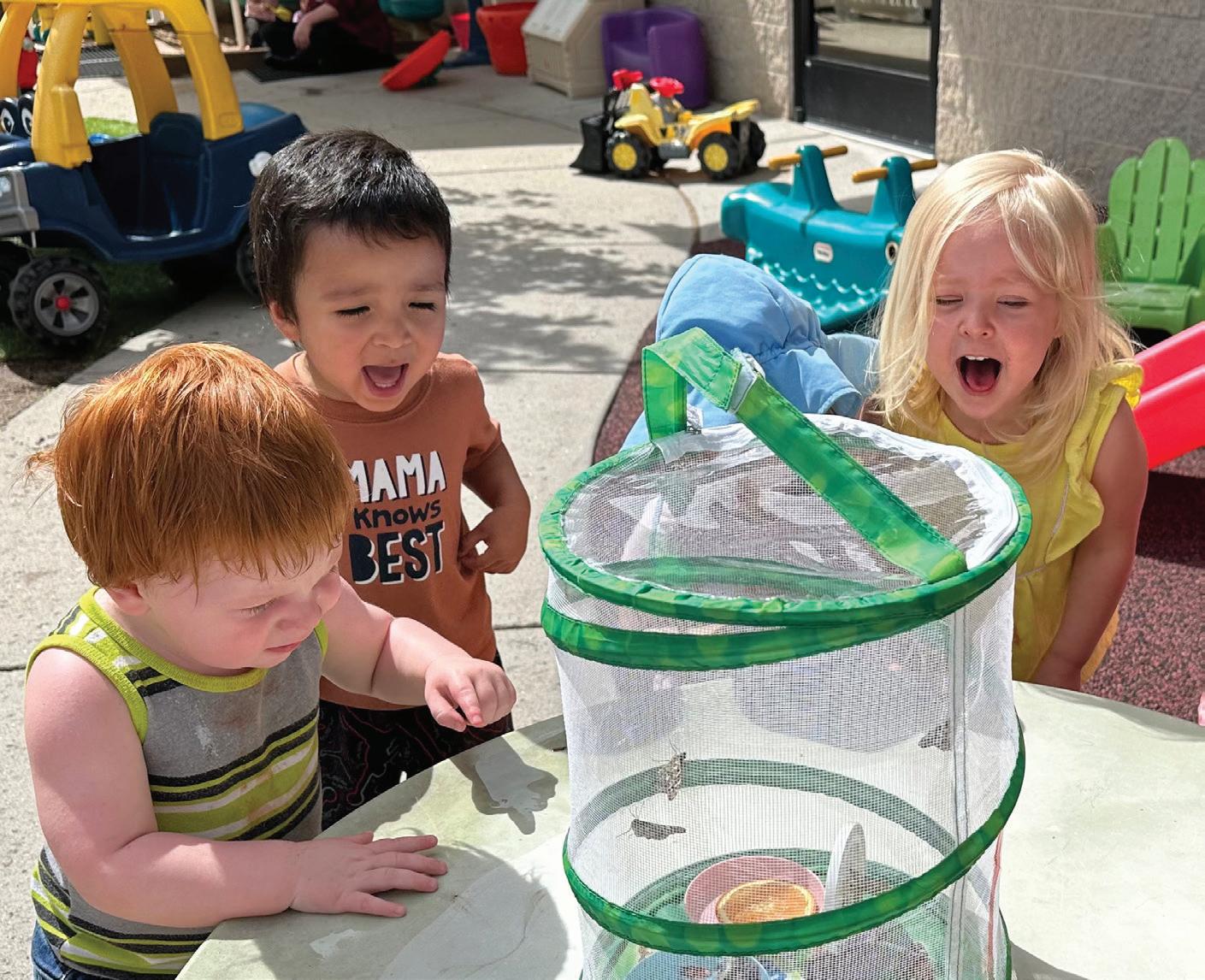
Nonprofit providers of child care, homeless shelters and other essential human services were scrambling after Boulder County cut grant funding by $4.4 million. Courtesy: TLC Learning Center
Marcia Martin
and now council will need to find a replacement to carry out the rest of her term, which ends in 2025.
Martin has been participating in meetings virtually from New York for months while she cares for her daughter, who is experiencing a mental health crisis. At first, council supported her remote participation until she returned, but were caught by surprise when Martin revealed she had signed a 13-month lease in New York — and her intent to come back to Longmont was called into question.
Now, council has to hand-pick a replacement to serve out the rest of her term because Martin’s official resignation missed the window that would trigger a special election, so Ward 2 voters will have to wait until November to have a say in their elected official.
Residents came out to multiple meetings over the course of her remote participation to express their support for her, but the representative was not without her critics. Council expressed concerns over the “horrible precedent” her absence set, and an incident where she unnecessarily called city police to an Airport Advisory Board Meeting characterized her final few months in office.
The new council member will have big shoes to fill, so keep your eyes out as the appointment process unfolds over the next few weeks.
BOULDER COUNTY CUTS HUMAN SERVICES GRANT BY $4.4M
Human service providers like homeless shelters, food pantries and child care centers are already
straining to meet the community’s needs, so local organizations were understandably worried when the county announced it would cut one source of funding for those services by more than 30%.
In the wake of the $4.4 million slash, nearly a dozen organizations lost their Community Partnership Grant funding entirely, while others saw cuts between 10% and 30%.
County officials have stressed to the community that these are only cuts to one funding source (All Roads, formerly Boulder Shelter for the Homeless, for example, receives another $900,000 from the county not attached to the fund), but many providers have still said loud and clear that they’re going to feel the burn — and will have to cut services as a result.
This all comes as other state and federal funding for human services is drying up, which the county says is partially to blame for the cuts in the first place.
We’re planning to up our coverage of the county in the New Year, and following the impacts of budget decisions like this will most definitely be part of that.
STORIES WE’RE WATCHING FOR
2025
MINIMUM WAGE WHISPERS
While it may seem like discussions about raising local minimum wages petered out, the conversations are far from over. After a regional effort to raise wages across five cities fell apart early this fall, Boulder alone moved forward with an increase, but the possibility wasn’t ruled out by other BoCo municipalities.
Longmont is still looking at raising wages — mayor Joan Peck and several other council members expressed that the current floor is too low at an October meeting and plan to revisit the issue after further community engagement — so expect to see this on the menu for council in 2025.
SUNDANCE MAKING MOVES?
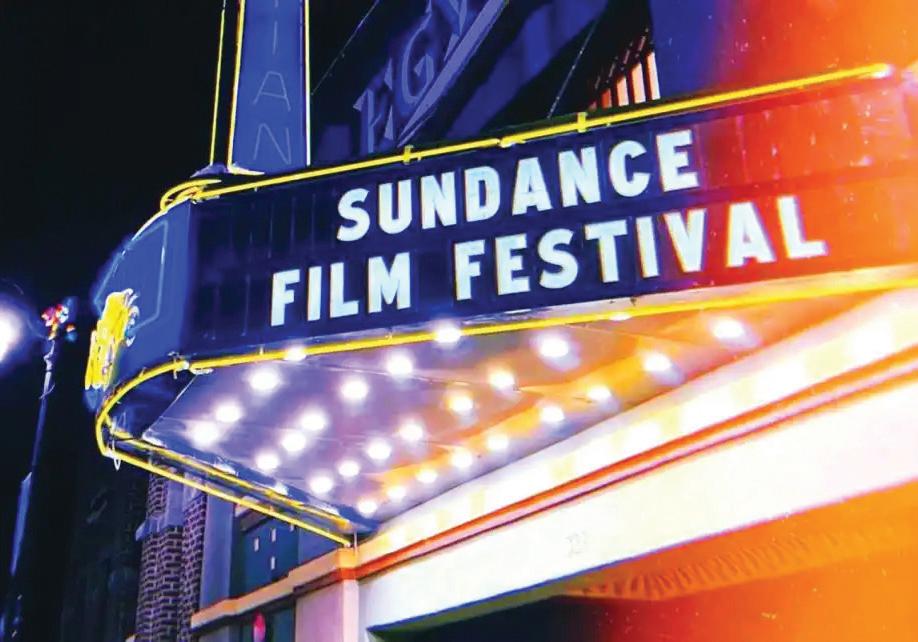
We’re not the only ones awaiting news about whether or not the iconic yearly film festival will relocate to Boulder. An announcement should come fairly soon in the new year, according to Sundance organizers.
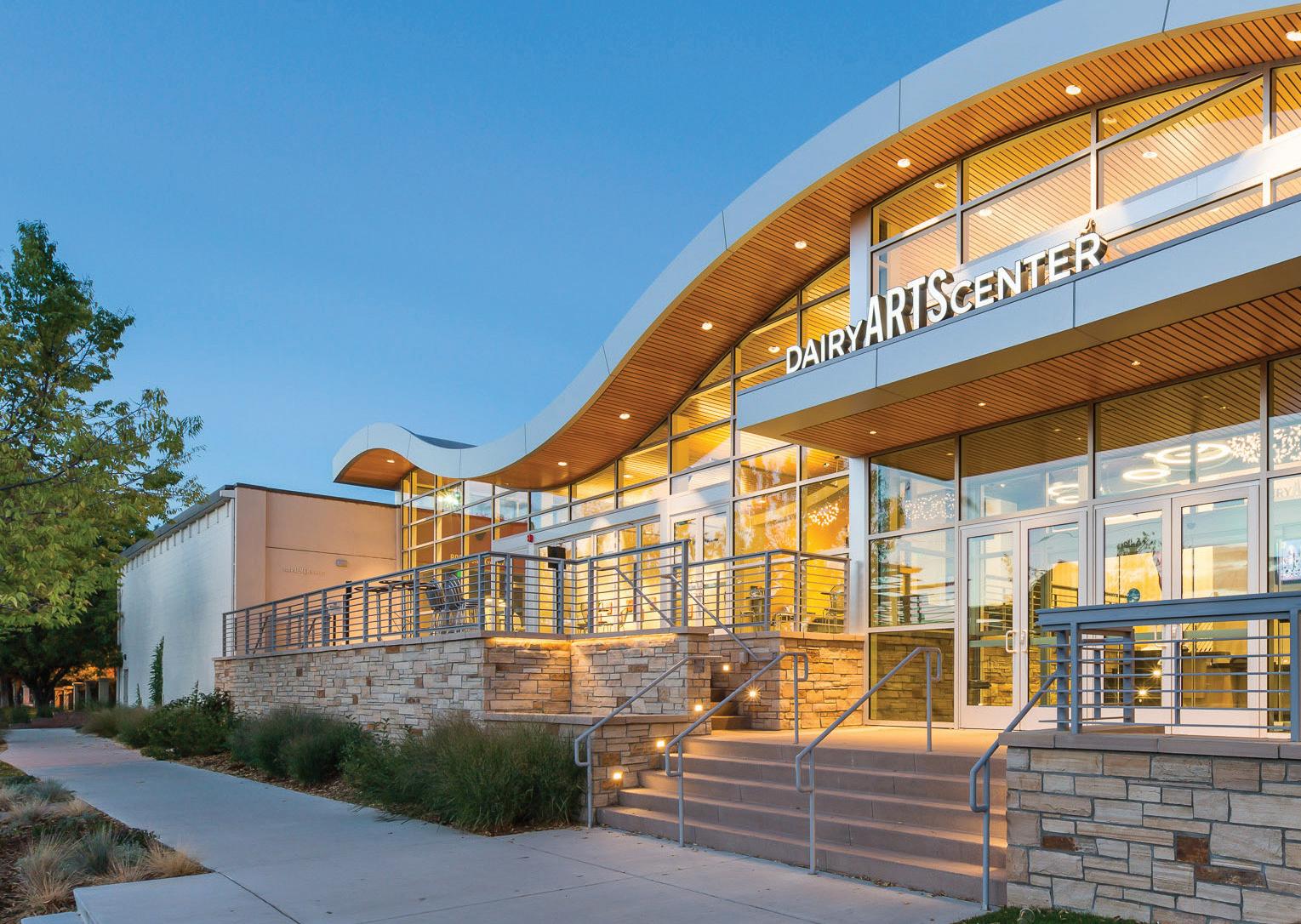
Boulder is putting up a good fight against fellow finalists Cincinnati and Park City/Salt Lake. Sources have spotted Sundance officials on multiple visits to The People’s Republic in recent months: being wooed by a delegation of state and city leaders (alongside dancers and other performers) on the Pearl Street Mall; appearing at the annual Warren Miller Film Tour; and exploring the inner workings of The Dairy.
Whatever happens, you will read about it in the Weekly
NEDERLAND BUYING ELDORA?
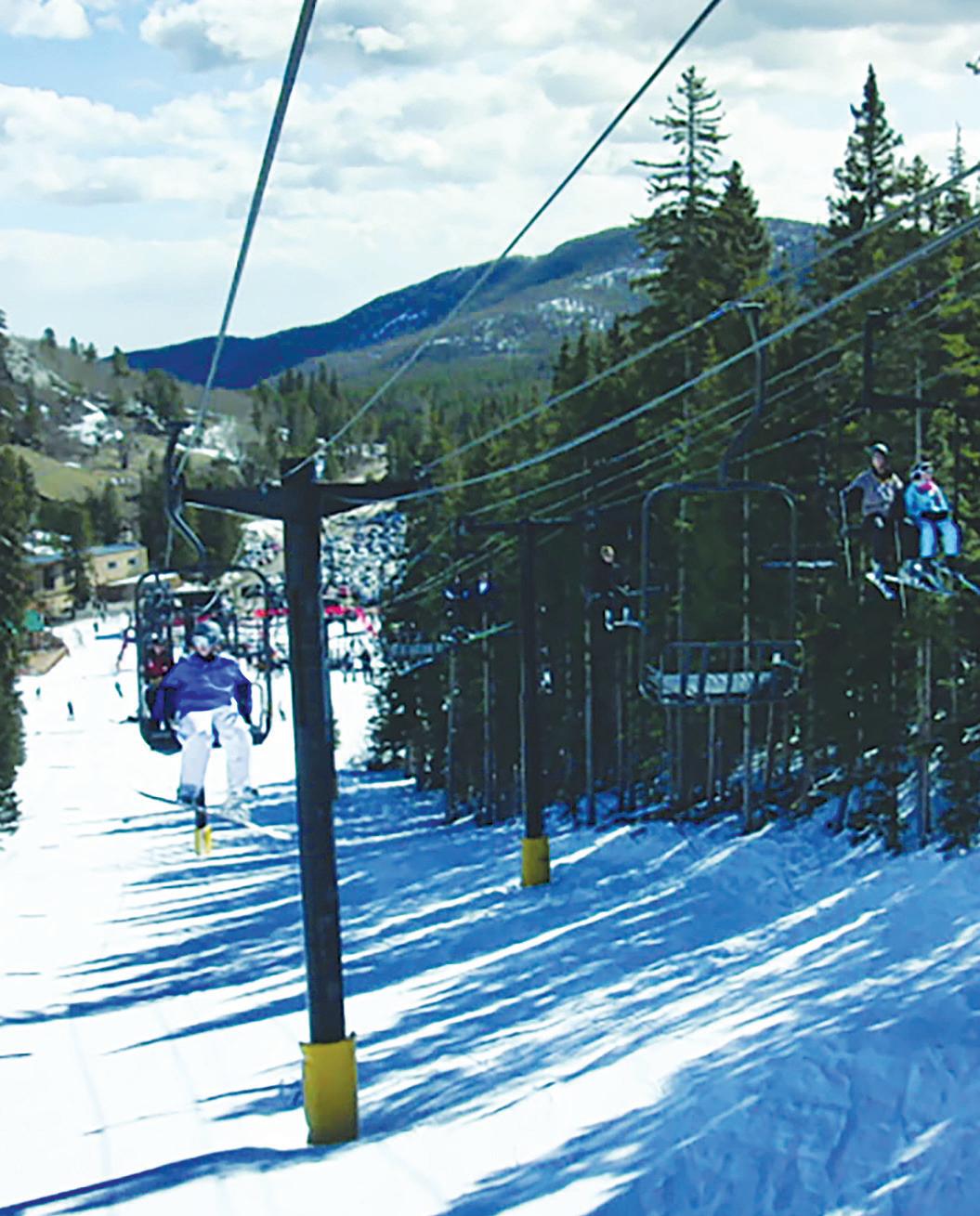
When the Town of Nederland announced the possibility of buying Eldora Ski Resort from POWDR, the prospect sounded exciting, if not far-fetched for a town with a yearly budget of $3.2 million.
In a world where the massive conglomerates like Alterra and Vail are buying up ski resorts left and right, a ski area owned by the town most impacted by it could be a welcome twist. Here at BW, we’re feeling particularly invested in non-traditional ownership models (shameless plug for our efforts to become a co-op), so we’re excited to see how this shakes out.
We have questions about its feasibility as well as what it would mean for both the town and the mountain, so stay tuned in 2025 for more coverage on the sale of BoCo’s only ski area.
The Town of Nederland is exploring a purchase of Eldora Mountain Resort. Credit: Kamen G.
The iconic Sundance Film Festival may find a new home in Boulder. Credit: Arthur Mola/Invision/AP
CULTURE
CLOSING THE DOOR ON ’24
Boulder Weekly staff and contributors share our favorite stuff of the year
BY BOULDER WEEKLY STAFF
We’re suckers for a good yearend list here at Boulder Weekly. As enthusiastic (some might say obsessive) consumers of culture, there’s no shortage of opinions around the newsroom when it comes to our favorite movies, music, performances and experiences in BoCo and beyond. So while we’re taking stock of 2024 and looking ahead to the new year, we asked staff and contributors to share their picks for the best of the year that was.
Shay Castle, editor-in-chief
BW story of the year
“Ticket masters: Why are concerts so expensive?” by Kaylee Harter
This one got lost in the post-election malaise, but BW reporter Kaylee Harter’s exploration of how and why concerts got so damn expensive is worth revisiting any time of year.
Year of the Pop Girlies
Chappell, Charli, Olivia, et al.
In 2024, I saw only women (or women-led groups) in concert. I started strong with Chappell Roan at Boulder Theater, one of the last small venues she played before blowing up in a big way. The venue was packed; the drag queens were slaying and the vibe was queer joy. I followed that up with Caroline Rose at The Fox, Santigold at Mission and La Femme at The Gothic Women dominated my Spotify this year, too. Chappell’s The Rise and Fall of a
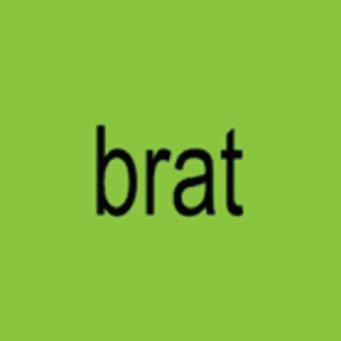
Midwest Princess, brat by Charli XCX and Short n’ Sweet by Sabrina Carpenter were on near-constant rotation alongside the latest from T Swift and Beyoncé
The pop girlie who got the most play was Olivia Rodrigo. Her album GUTS might have dropped last year, but it was the soundtrack to my 2024.
Carter Ferryman, special projects manager
Album of the year
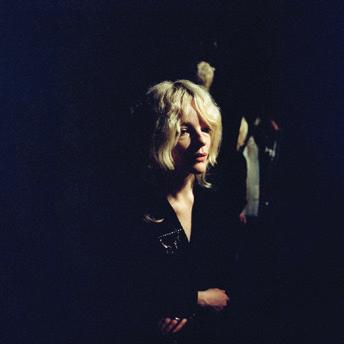
Here in the Pitch by Jessica Pratt
For the first decade of her career, you’d come up empty finding an official release by Jessica Pratt that includes more than two instruments: her voice and a guitar. That’s all she needed to draw me into her hazy, mysterious catalog, always centered around the concept of time: wasting it, savoring it, getting bored with it.
So when a drummer and bassist made themselves heard on “Life Is,” the lead single from Here in the Pitch, I was hypnotized. It felt like cheating — adding such buttery instrumentation to the toolbelt of an artist who never needed it. On “Empires Never Know,” distorted piano keys ooze in pockets between Pratt’s echoed crooning. “By Hook or by Crook” sounds like a b-side from the PunchDrunk Love soundtrack — playing on faded speakers in the lobby of a hotel in Honolulu. Whatever the vibe, Here in the Pitch cements an already alluring songwriter as a titan of both psychedelic and folk music.
Song of the year
“2122 - Live” by Geese
Did the studio recording of “2122” release in 2023? Yes, but the live recording didn’t drop until 2024 — and this version makes me want to run through a brick wall, so I’m rolling with it.
When it dropped, “2122,” the incendiary intro to Geese’s 3D Country, dominated my music rotation. The live version from Alive & In Person, however, is on a different planet entirely. It’s the musical
equivalent of witnessing a fist fight on the subway: objectively fucked up and confusing, but a polarizing moment you secretly hope you’ll one day see again, simply for that feeling you got in your gut when shit hit the fan.
Lead singer Cameron Winter is a madman. He possesses a voice I can only describe as “Sinatra meets angry cowboy,” belting lines about Kali Yuga, Osiris, Balarama and other gods. The band is nothing short of spectacular, jumping between tempos and levels of fury, stopping and starting, descending into madness and hopping back out again for a quick guitar lick or drum fill. It’s chaos, and I love it.
Jezy J. Gray, arts and culture editor
Concert of the year
Blood Incantation album release show at Boulder Theater, Oct. 4
Forbes isn’t exactly known for its extreme music coverage, so it was a surprise when the straight-laced business news outlet hailed the latest from local psychedelic death metal outfit Blood Incantation “one of the greatest albums of the 2020s, and possibly of this century.”
That spirit of revery was in the air when the Boulder-born, Denver-based act took
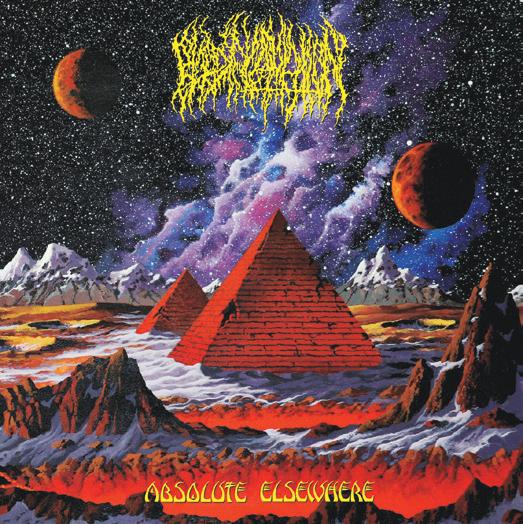
the stage at Boulder Theater on Oct. 4 to mark the release of Absolute Elsewhere, the band’s out-of-this-world fourth LP. The sold-out crowd was practically levitating with excitement as the cosmic quintet ripped through the record’s brainy, blistering universe of blast beats and synth-drenched side quests. It was one of those shows you know will ring in your head forever — the perfect band at the perfect time and place.
BW arts story of the year
“Camp royalty: Queer pop superstar Chappell Roan chronicles The Rise and Fall of a Midwest Princess” by Lauren Hill
“It’s Chappell Roan’s sparkly, glitzed-out world, and we’re just living in it.” When former BW intern Lauren Hill kicked off her human-level profile on the queer pop queen with these prophetic words, we didn’t know how true they were.
Publishing ahead of Roan’s sold-out Boulder Theater performance last April, the interview came what seemed like seconds before the Missouri native catapulted into the stratosphere as one of the biggest pop stars in the world.
Paired with profiles on the local drag queens opening the bill, this story wasn’t just a stroke of luck in bagging a big-time phoner at the last possible second the artist’s management team would let her
Credit: Ryan Clemens
speak to a humble alt-weekly such as ours — for my money, it’s the best artist profile I read this year.
Local album of the year how we dig in the earth by A Place for Owls
When I called up A Place for Owls frontman Ben Sooy ahead of the band’s performance at Southwest Emo Fest this summer, he put it simply: “You’re going to feel big feelings when you listen to our band.”
Big feelings abound on the Front Range quintet’s sophomore LP, how we dig in the earth, recorded earlier this year at Lafayette’s Coalesce Audio From the unexpected uplift of “broken open seed” to the warm and wistful “tattoo of a candle,” the latest from the Denver emo standard bearers is a must-listen for anyone with a beating heart.
Kaylee Harter, reporter
Audiobook of the year
There’s Always This Year: On Basketball and Ascension by Hanif Abdurraqib
This book technically centers around basketball, but even if you’re not a Sports
Person (I’m not), it’s worth your time. Like everything poet and essayist Hanif Abdurraqib writes, it’s also about culture, race, grief, belonging and the people who make us who we are. It’s beautifully written, and hearing it read by the author makes it all the more moving.
Hanif is one of my favorite writers of all time (and gets extra points for being a fellow Ohioan) — 10/10 recommend any of his stuff.
HONORABLE MENTION: Down the Drain by Julia Fox — a wild ride and very brat.
Concert of the year
Violent Femmes at Copper Mountain
The Violent Femmes were my mom’s second concert ever sometime in the mid-80s, and I always loved listening to her CD of the band’s eponymous debut album as a kid. So when I saw the folkpunk group was playing a free show at the base of Copper Mountain, it was only right to head up with her.
The show was swimming with college kids, and one older dude griped preshow that anyone who wasn’t alive in the ’80s should kindly fuck off to the back of the crowd. But once the Violent Femmes took the stage, an intergenerational mosh pit began and everyone sang along. There has never been
greater peace between Gen Z kids and their elders.
My mom and I got a spot on the rail, and they played that first album we both love from front to back. I had never been to a concert with my mom before, and I couldn’t imagine a more special and fitting first.
BW arts story of the year
“Ska City, USA: Understanding a maligned genre ahead of inaugural Front Range fest” by Jezy J. Gray
This story explored the history and current moment of a decidedly “unserious, undignified and — perhaps worst of all — uncool” genre ahead of Denver Ska Fest in June. The result was a sort of You’re Wrong About look at the subculture that was in equal parts funny, fascinating and heartwarming.
The cover for this story, created by BW graphic designer Chris Sawyer, was also my favorite of the year — pick it up, pick it up, pick it up!
page is unparalleled. His profile of John Moreland was a fresh look at why the Oklahoma folk darling unplugged from the world to create his new record, Visitor Jezy doesn’t always have time to write lengthier pieces for us because his editing duties can be all-consuming, but when he does it’s always a mustread.
Pizza slice of the year
Crosscut in Nederland
I’ll be upfront here: I have eaten at Crosscut Pizzeria and Taphouse many times before this year. But as someone who hails from the pizza capital of the world — otherwise known as New Haven, Connecticut — I feel obligated to give respect where it’s due.
The best pizza I had this year was the Giardiniera. Spicy pepperoni and housemade pickled garden veggies with a vodka sauce base: This blend of classic Italian-American staples on my favorite disc-shaped food brought me back to my East Coast roots. Salvatore Consiglio, founder of the world renowned Sally’s Apizza in New Haven, would be impressed by these alpine pies. Read more best bites of the year on p. 27.
Chris Sawyer, graphic designer
Concert of the year
Ginger Root at Summit Music Hall
Tyler Hickman, reporter
BW arts story of the year
“Hold the world hostage: John Moreland comes back to life” by
Jezy J. Gray
Our arts and culture editor’s ability to create space for a character on the
The absolute obsession that consumed me after seeing Ginger Root live is something to be studied. I had listened to the band here and there throughout the year, but after this show … BRUH! I was absolutely hooked. The performance was so good I went on a nonstop bender, catapulting GR to my Spotify Top Artist of the Year. Somehow, from the show in mid-October until the end of October (the last full month of data collection for Spotify Wrapped) I logged 2,994 minutes of just Ginger Root. The concert was just that good.
Courtesy: A Place for Owls
Credit: Chris Sawyer
CULTURE
Movie of the year
Digimon: The Movie
OK, so I know this may seem like a bit of a troll pick, buuuuut they just happened to re-release the Digimon movie for the first time on Blu-ray this year. Not only did this ’00s classic get an HD upscale, but it also got some brand new English dubs.
Lindsay Temple, freelance contributor
Time for useless knowledge about the anime industry in the early 2000s: The original Digimon movie came out on the heels of Pokémon: The Movie However, unlike the first Pokémon movie — a 1:1 English dub of the Japanese release — the English dub of Digimon: The Movie is an amalgamation of three separate films. 20th Century Fox wanted one full-length feature, so the studio did their best to create a cohesive plot between three separate, unrelated Digimon movies. For the first time ever, Digimon fans in the West got new English dubs of these three movies (with the original cast) as well as an upgraded version of the U.S. release.
Concert of the year
Soul Glo at Bluebird (May 4) and The Aggie (May 5)
My boyfriend is a jazz drummer specializing in Cuban and West African diasporic styles, but back in the day, he was a follower of grunge and ’90s alternative sounds. This spring, we went to see Mannequin Pussy and their opener Soul Glo at the Bluebird Theatre in Denver. I expected him to observe while I let loose in the crowd… but guess who started the mosh pit immediately? My boyfriend! I couldn’t decide if I wanted to film the band
or him, bouncing around the pit with the biggest grin on his face.
The next evening, I rode to Fort Collins with friends to catch the bands again. I texted the group chat, saying I’d be taking it easy. That lasted for moments. Inspired by my boyfriend’s joyous display the night before, I was the one sprinting to the front of the stage, thrashing and screeching with the rest of ’em. Soul Glo vocalist Pierce Jordan even crouched in front of me on stage and dapped me up!
Toni Tresca, freelance contributor
Concert of the year
Chappell Roan at Boulder Theater, April 9
This concert was the same day Shay and I interviewed Nuria RiveraVandermyde and her team for the Ballot Issue 2A story; that evening, we both made our way to worship at the altar of Chappell Roan
My friend Mac and I purchased our tickets in 2023, before Chappell’s meteoric rise in 2024 from Olivia Rodrigo’s GUTS tour and her late-night appearance. However, we heard from other attendees who paid over $1,000 for the same standing-room-only tickets.
While waiting in line, multiple people offered us an insane amount of money to sell them our seats.
The atmosphere inside the theater was electrifying, starting with performances by local drag artists.
Chappell performed what felt like her entire discography in a raucous set lasting just over two hours. After the concert, my friend and I went to Taco Bell and then returned to my apartment to watch more of her videos online in an attempt to recreate the feeling of the show.
Theatrical production of the year
The Android’s New Soul by
Dana Cain
The world premiere of the original scifi musical The Android’s New Soul
has been in the works for 50 years … yes, really! Dana Cain wrote the score for this campy, absurdist post-apocalyptic rock opera when she was a teenage girl and has been fighting to get the show staged for decades. She finally fulfilled her dream in September at the Bug Theatre in Denver, and what an experience!
Opening night was a spectacle from the moment the audience arrived, with a line out the door and quirky “Android Boyfriend Survival Kits” containing kitschy stickers and Atomic Fireball candies. The 100-year-old theater had been transformed into a post-apocalyptic wasteland, with elevated production values rarely seen in smaller venues.
The plot revolves around Dr. Stacy Starr, a scientist who works in an android factory. After a devastating bomb falls, she reprograms an android to be her romantic companion and help her navigate the radium-poisoned world and battle clones. My favorite scene was the “Funky Disco Andriod Sex Song,” which, while not high art, is a lot of fun. It is a testament to the team’s dedication that the dramatic beats in the second act work so well. If there is any justice in the world, we will see a lot more of this musical.
Favorite TV Show
The Penguin on HBO
When it was first announced that Colin Farrell would be reprising his role as the villainous Penguin from the 2022 film
The Batman, I responded with a massive eye roll. Is creativity in Hollywood so dead that they are making a mini-series about a corny Batman villain?
Boy, was I wrong. Showrunner Lauren LeFranc pitched this eight-part series not as a vehicle for gratuitous fan-boy cameos, but rather as a meditation on how a shady crime boss can exploit a failing political system to line their own pockets and secure power. Add in a star-making turn from Cristin Milioti as the misunderstood Sofia Falcone (er, Gigante), mommy issues, gorgeous world-building and dysfunctional relationships galore, and you’ve got the formula for the next HBO smash hit that I devoured in realtime each Sunday as new episodes dropped.
Courtesy: Crosscut Pizzeria and Taphouse
Courtesy: 20th Century Fox
An eclectic mix of regionally sourced food
Our h O memade gluten-free bread makes all the difference
(720) 487-2571 • 11809 N 75th Street, Longmont
ABO’S PIZZA NIWOT
Fresh comes first at Abo’s. Everything is prepared daily, so whichever pie you choose is going to be tasty. Order off the menu or customize your pizza to your heart’s and stomach’s content. Why is Abo’s better?
“Definitely, it’s the ingredients!” The dough is fresher, and the sauce is some of the best I’ve tasted. And I’m from New York, I know the difference.”
FOUR PAWS & CO
Since opening in 2003, Four Paws & Co. has specialized in premium natural foods and treats, including frozen diets and raw bones. Along with the excellent choices in food for cats and dogs, we carry supplements, grooming supplies, leashes & collars, toys, beds, and cat condos. It’s safe to say there is something for every pet in the store. There is also the Friends of Four Paws Frequent Buyer Program. You receive a punch card and once that is filled, you will receive a $10 Four Paws gift card. Last, but certainly not least, Four Paws
The ovens start up at around 10 am and before lunchtime, hungry Abo-ites start coming in for a four-dollar slice (a meal in itself) or just give in and order a whole pie.”
Locally Owned & Operated
Abo’s Niwot 7960 Niwot Rd. Unit B5 303-652-0830
Abosniwot.com
offers two special services. We can deliver the food you need to your door, and we have a pet sitting service. Stop in soon and see how Four Paws & Co. can help you care for your best friend.
1225 Ken Pratt Blvd. #108 Longmont, CO 303-485-1565 www.fourpawsandco.com
MOUNTAIN FOUNTAIN COUNTRY STORE
At The Mountain Fountain, there’s a little something for everyone. Located smack dab in the center of Hygiene, our eclectic market and deli sources meats from local pastures, and homemade gluten-free bread to die for — combine the two, and you’ve got one of Boulder County’s best gluten-free sandwiches. As a matter of fact, everything at our bakery is homemade — and it makes all the difference — resulting in an airy, light bite across all
products: banana bread, brownies, pies, countryloafs, and so much more. Our butcher shop is many local’s little secret, but the word is out — you will walk out with the best, locally-sourced meat in the area. Grab a coffee, a sandwich and and a seat at The Mountain Fountain— we’ve got what you need.
11809 N. 75th Street, Longmont, CO 80503
(720) 487-2571 mtnftnmarket@gmail.com
By Louisa May Alcott
Adapted and Directed by Jessica
Robblee
Bring your family to the Dairy this holiday season and spend some time with the March family. Relive their adventures, their passionate loves, their ups and downs and their joy in being together.
Dec. 5 – Dec. 29
Dairy Arts Center | Boulder
SUBSCRIPTIONS & TICKETS at BETC.ORG
FOUND SOUNDS
The year’s bestselling new music in Boulder
BY BOULDER WEEKLY STAFF
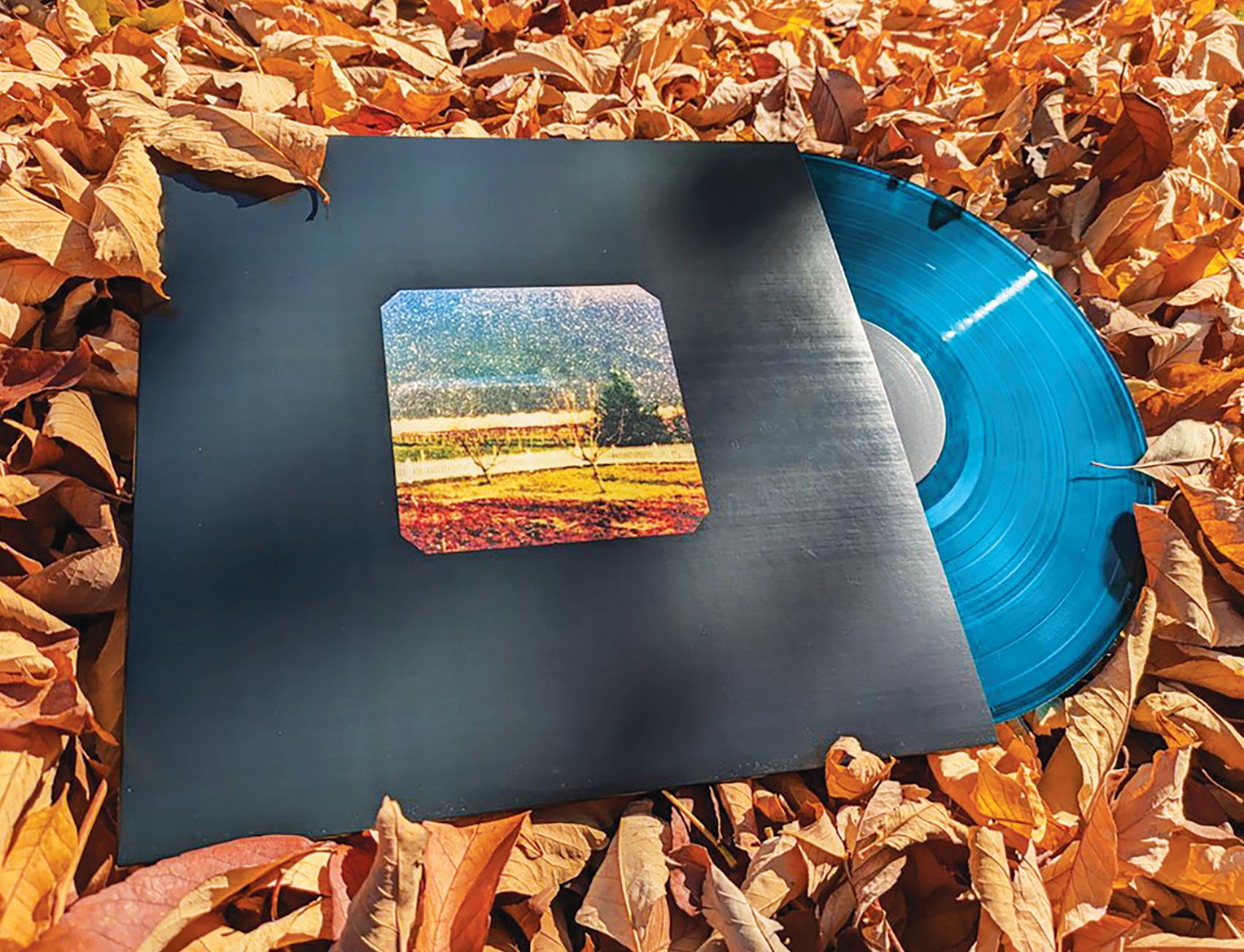
It seems our beleaguered nation was given two options in 2024: a non-horrifying presidential election, or a treasure trove of top-tier pop girlies. We made our choice. That much is clear upon a quick scan of the bestselling new vinyl releases at Paradise Found Records and Music (1646 Pearl St.), which finds all the big names — Charli, Billie, Taylor, et al. — holding down most of the major real estate. Presidents may come and go, but brat is forever.
STAFF PICKS
PRELUDE TO ECSTASY by The Last Dinner Party Shay Castle, editor-in-chief
IN THE PITCH by Jessica Pratt
Carter Ferryman, special projects manager
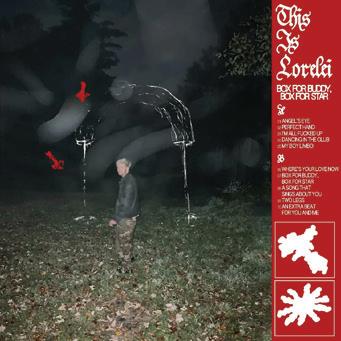
FOR BUDDY, BOX FOR STAR by This Is Lorelei
Jezy J. Gray, arts and culture editor BRAT by Charli XCX Kaylee Harter, reporter
From Chappell Roan to Brooks and Dunn, scan the QR code for a playlist featuring (almost) every music artist interviewed in the pages of Boulder
in
1. TAYLOR SWIFT The Tortured Poets Department
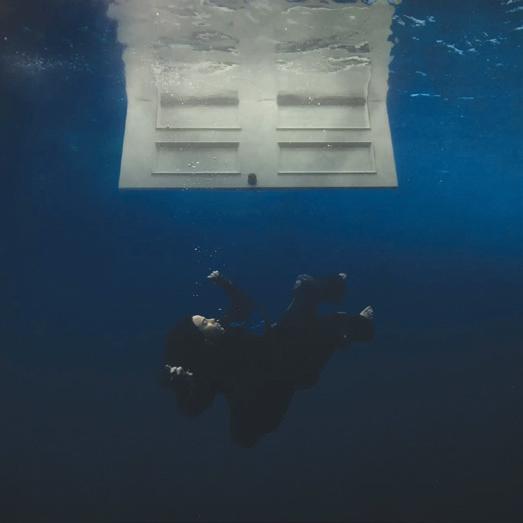
2. BILLIE EILISH Hit Me Hard And Soft
3. CHARLI XCX brat
4. SABRINA CARPENTER Short n’ Sweet
5. BLOOD INCANTATION Absolute Elsewhere
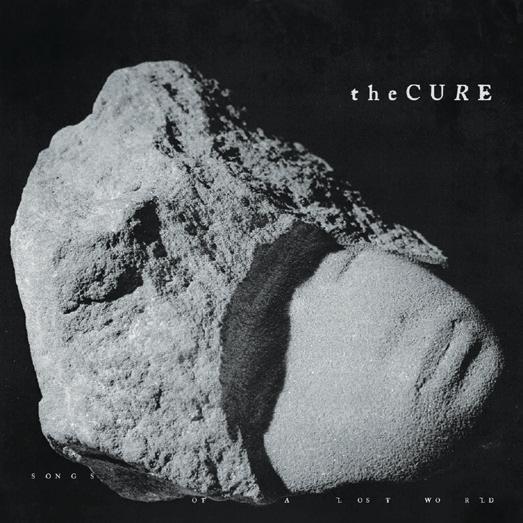
6. THE CURE Songs of a Lost World
7. JOHNNY BLUE SKIES Passage Du Desir
8. THE SMILE Cutouts
9. BILLY STRINGS Highway Prayers
10. JACK WHITE No Name
Weekly
2024.
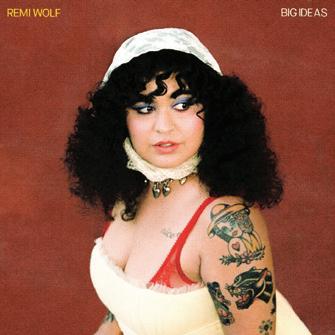
BIG IDEAS by Remi Wolf
Tyler Hickman, reporter
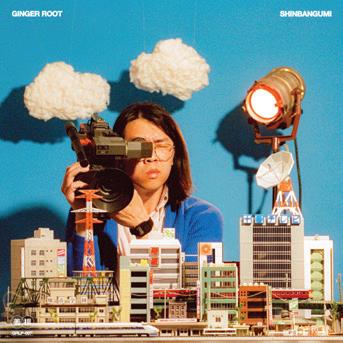
SHINBANGUMI by Ginger Root
Chris Sawyer, graphic designer
THE END HAS NO END
Reconciling 2024 through cinema
BY MICHAEL J. CASEY
The call came around 8:30 on a Friday morning. As these things do, it came without presage or pageantry. A friend had died.
It happened while he was on a typical bike ride — nothing nefarious, nothing significant, just a simple fall, and that was all. He left behind two small children and a wife. She was the one who called my spouse to let us know that her husband was gone. Then she hung up, and my wife and I went about our day.
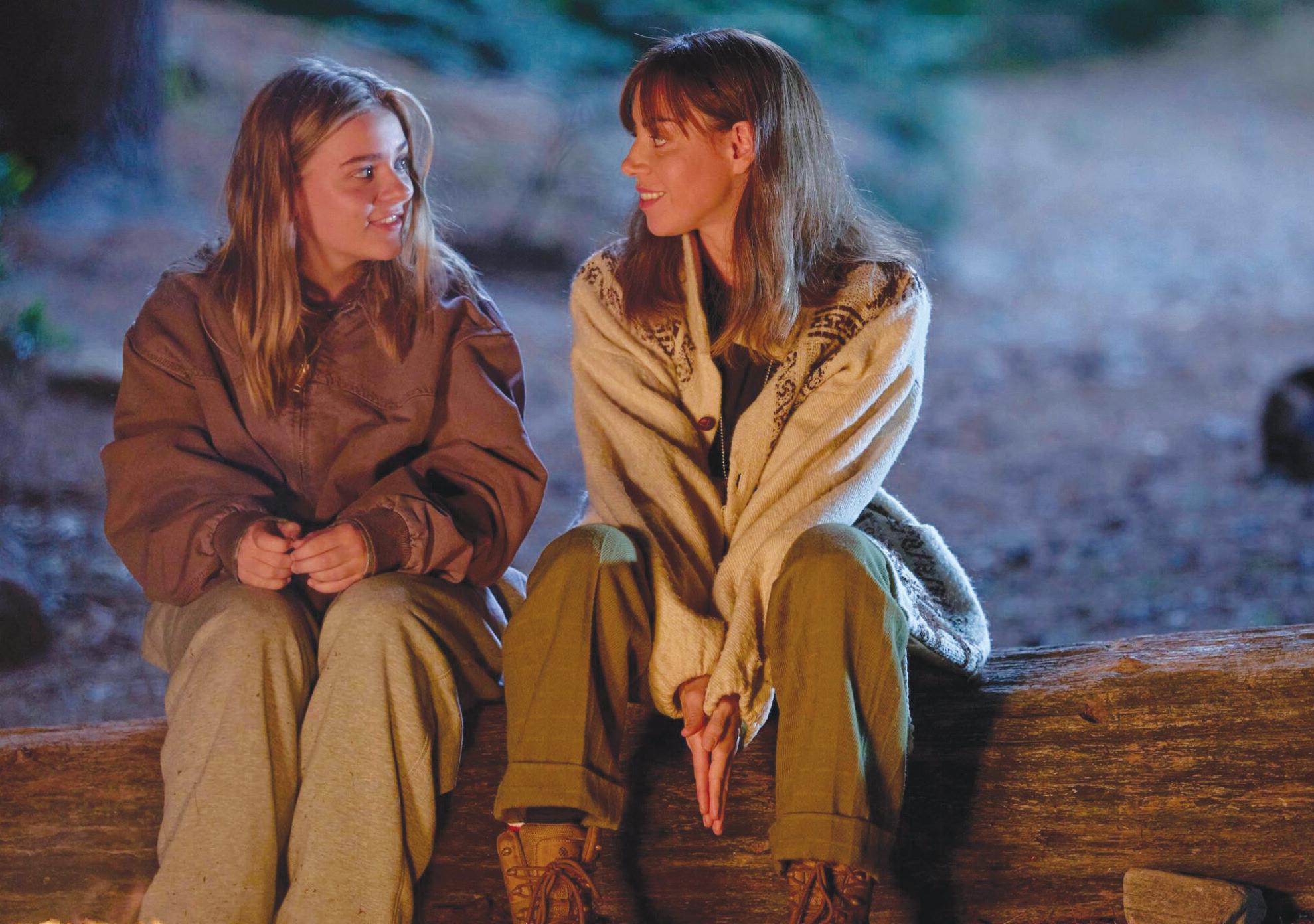
Four days later, I saw My Old Ass — a thoughtful coming-of-age story that plays by the rules but never feels derivative or stupid. It charmed me, disarmed me,
brought me under its spell and then socked me in the gut.
I don’t want to give away the diabolical twist to writer-director Megan Park’s heartfelt story, though you can probably guess through association that My Old Ass has to do with the death of a loved one. It does. But Park constructs it in such a way that I hope my friend, the wife who lives, never sees the movie. It might be too much for her. Hell, it was too much for me to see it when I did. It’s been months, and I still don’t know if I’ve recovered.
EMOTION V. EMPATHY
This will go down as the year I stopped watching stories and started watching people. That might sound simple to you, but it’s been a watershed moment for me.
It’s easy to get swept up in movies. The form is inherently kinetic and undeniably exciting. Even when nothing is happening on screen, the mere presence of a camera invites possibilities. And then there’s the narrative. Sometimes, I haven’t a clue where the movie is taking me, and it’s thrilling. Other times, I know exactly where it’s going and can’t wait for it to get there. But now and then, those emotions come at the detriment of empathy.
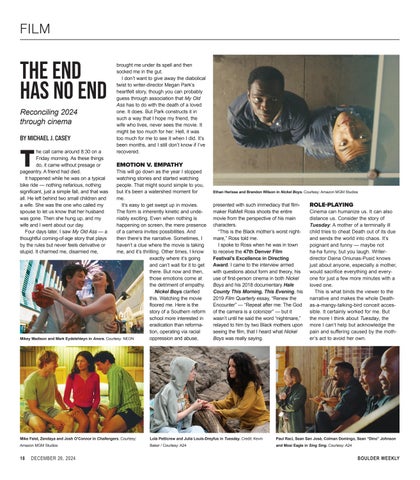
Nickel Boys clarified this. Watching the movie floored me. Here is the story of a Southern reform school more interested in eradication than reformation, operating via racial oppression and abuse,
presented with such immediacy that filmmaker RaMell Ross shoots the entire movie from the perspective of his main characters.
“This is the Black mother’s worst nightmare,” Ross told me.
I spoke to Ross when he was in town to receive the 47th Denver Film Festival’s Excellence in Directing Award. I came to the interview armed with questions about form and theory, his use of first-person cinema in both Nickel Boys and his 2018 documentary Hale County This Morning, This Evening, his 2019 Film Quarterly essay, “Renew the Encounter” — “Repeat after me: The God of the camera is a colonizer” — but it wasn’t until he said the word “nightmare,” relayed to him by two Black mothers upon seeing the film, that I heard what Nickel Boys was really saying.
ROLE-PLAYING
Cinema can humanize us. It can also distance us. Consider the story of Tuesday: A mother of a terminally ill child tries to cheat Death out of its due and sends the world into chaos. It’s poignant and funny — maybe not ha-ha funny, but you laugh. Writerdirector Daina Oniunas-Pusić knows just about anyone, especially a mother, would sacrifice everything and everyone for just a few more minutes with a loved one.
This is what binds the viewer to the narrative and makes the whole Deathas-a-mangy-talking-bird conceit accessible. It certainly worked for me. But the more I think about Tuesday, the more I can’t help but acknowledge the pain and suffering caused by the mother’s act to avoid her own.
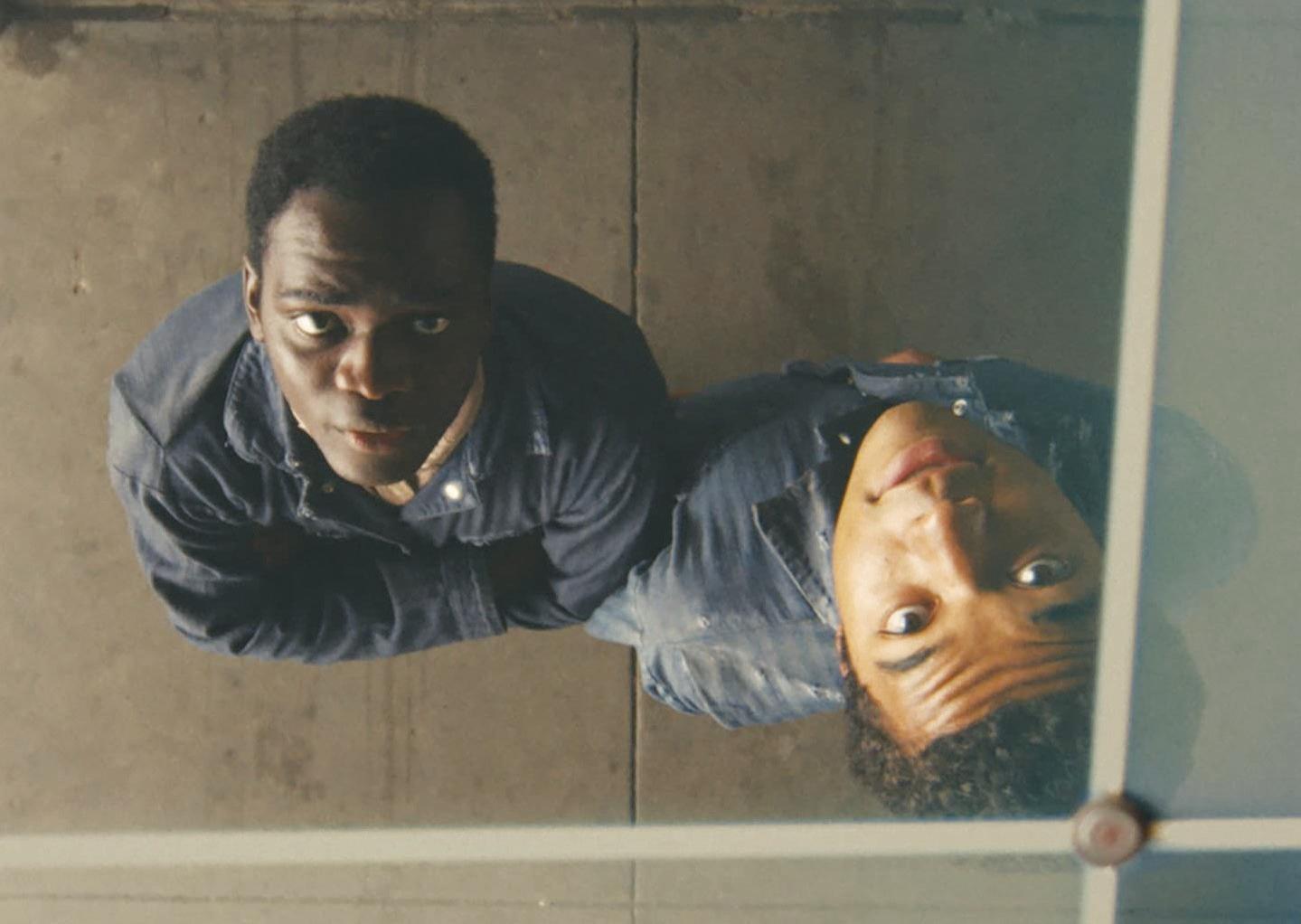
Ethan Herisse and Brandon Wilson in Nickel Boys Courtesy: Amazon MGM Studios
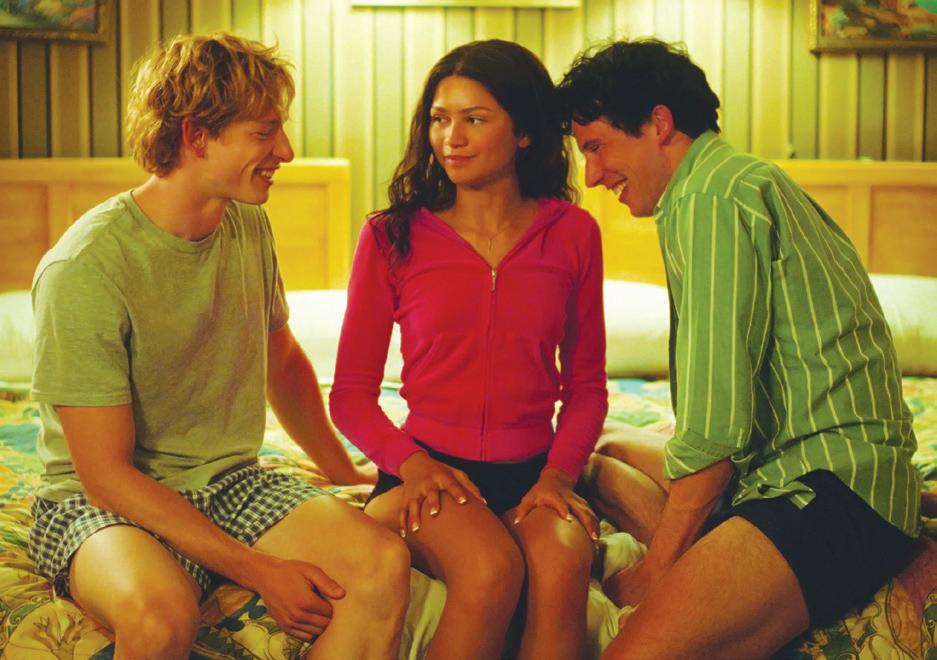
Mike Feist, Zendaya and Josh O’Connor in Challengers Courtesy: Amazon MGM Studios
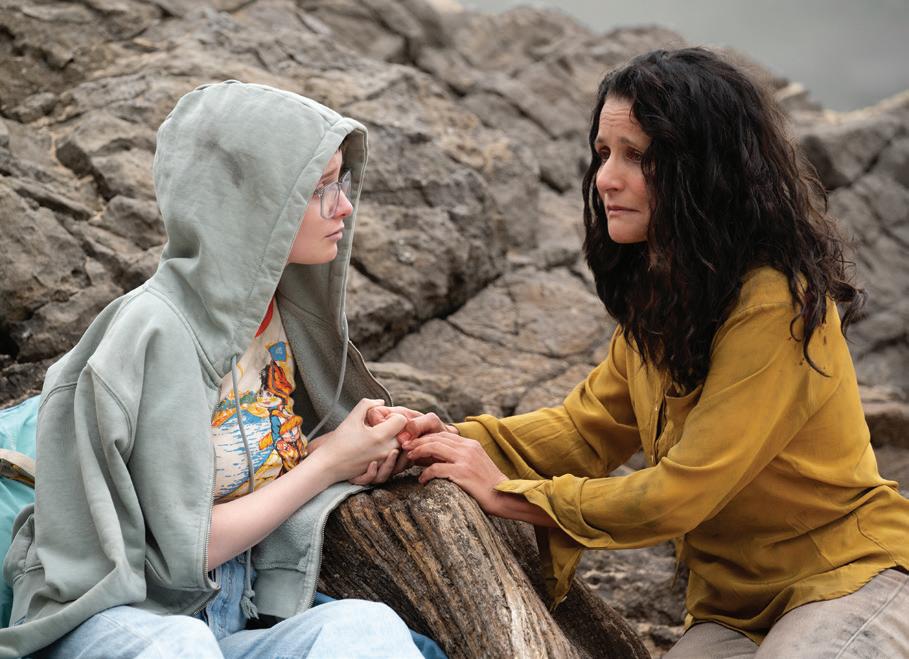
Lola Petticrew and Julia Louis-Dreyfus in Tuesday. Credit: Kevin Baker / Courtesy: A24
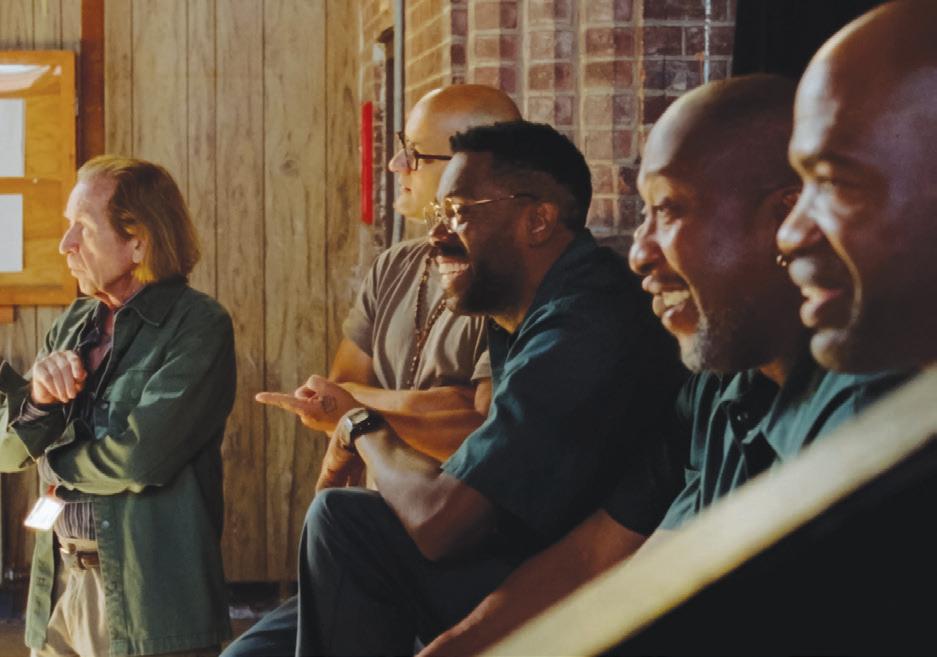
Paul Raci, Sean San José, Colman Domingo, Sean “Dino” Johnson and Mosi Eagle in Sing Sing Courtesy: A24
Mikey Madison and Mark Eydelshteyn in Anora Courtesy: NEON
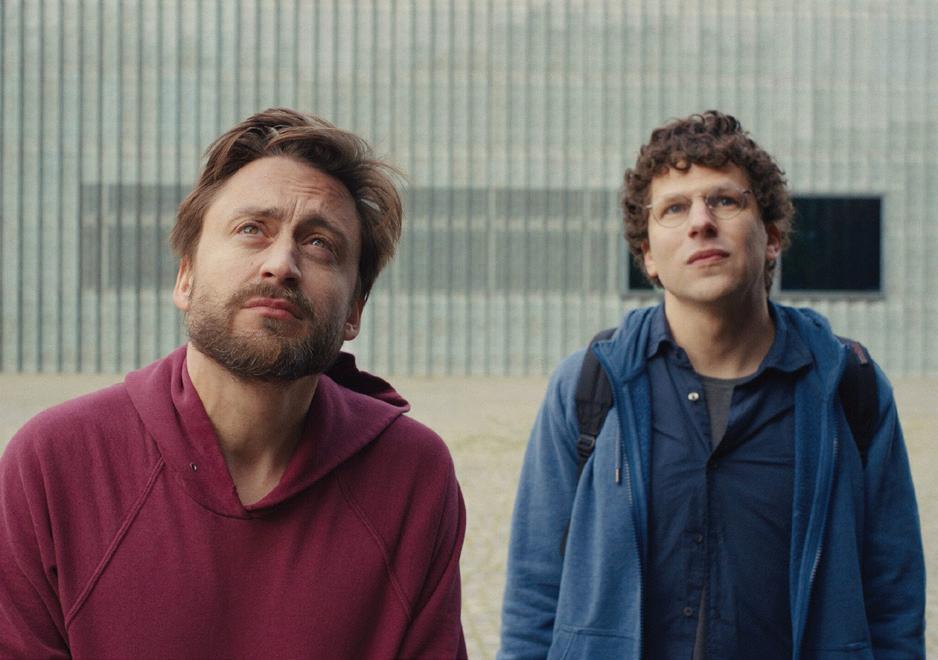
There’s a similar selfishness in My Old Ass — an attempt to control the past to de-pain the present — that is equally understandable, even if the goals of both protagonists are destructive. A Real Pain also flirts with destruction, but more through the act of casting pretense aside and embracing the authentic version of yourself, which some find to be refreshing while others find selfish. Funny how these things go.
Humorous but in a different key, the inmates-slash-performers of Sing Sing find a way forward by donning new roles while letting go of the people they once were. That’s something easier said than done — especially in Sean Baker’s Anora, where the roles these characters were cast in so long ago show that, at some point, the performance becomes the person. Ditto for No Other Land,
where the embrace of a role and the refusal to let go is no laughing matter.
played so many roles in his life that he’s slipping in and out of them whether he wants to or not.
THIS ONE’S OPTIMISTIC
describes her favorite TV show as “more real than real life,” I can’t help but think of Nickel Boys again and my fixation on the form over the fact. Am I interested in the experience or the simulacrum?
1. Nickel Boys
2. My Old Ass
3. Anora
4. Oh, Canada
5. Challengers
6. Tuesday
7. Sing Sing
8. A Real Pain
9. The People’s Joker
10. No Other Land
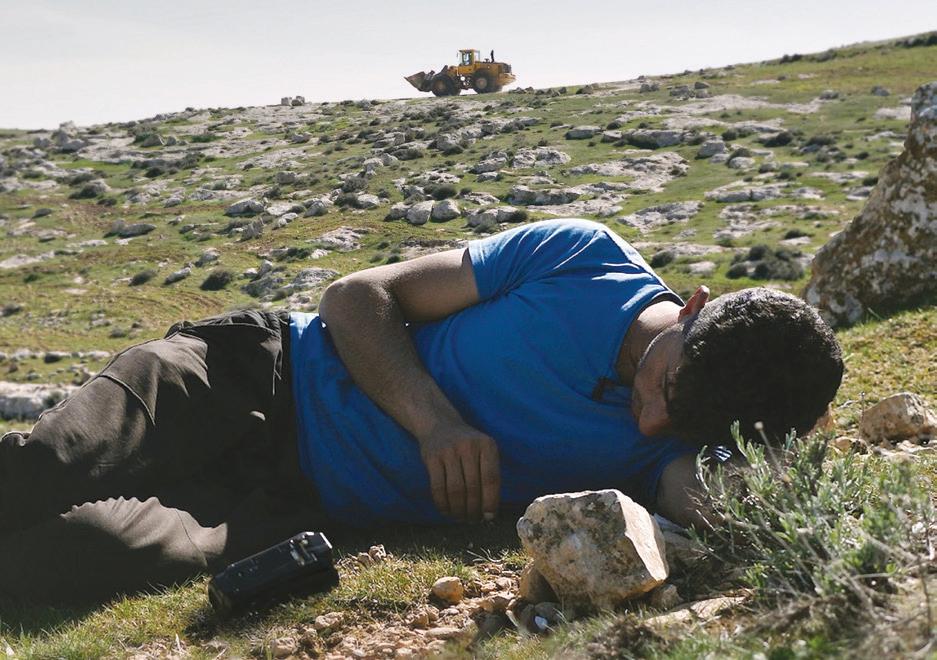
If Nickel Boys is the Black mother’s nightmare, then No Other Land — a boots-on-the-ground documentary about Israeli soldiers annexing land and evicting the Palestinians living there — is an international one. It’s also about what happens when we stop trying to be people and start accepting the roles we’re assigned. As Kurt Vonnegut put it: “We are what we pretend to be, so we must be careful about what we pretend to be.”
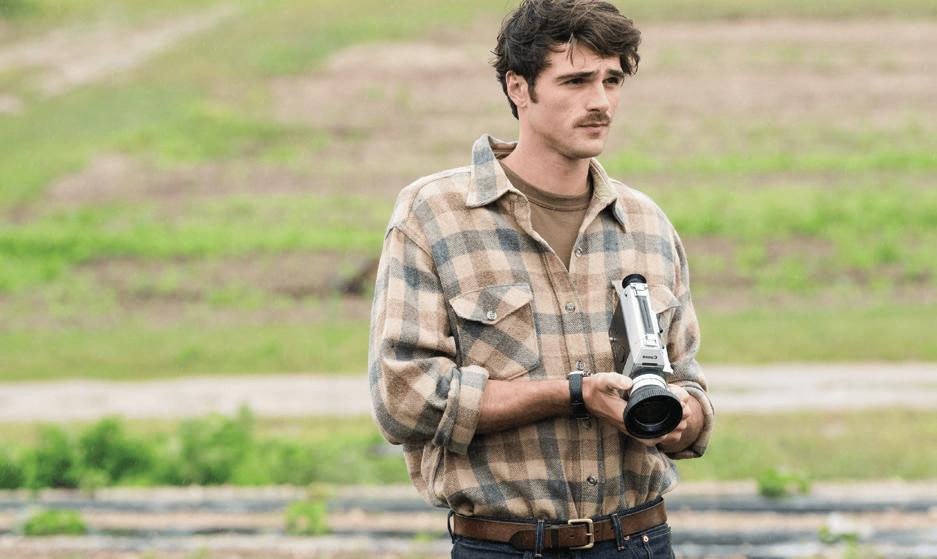
The inmates of Sing Sing know that all too well. So does Anora’s Ani and Vera Drew, the writer, director and star of The People’s Joker — easily one of the most anarchic movies I saw this year. And then there’s Oh, Canada’s Leo Fife, who has
I keep looking for trends. Connective tissues that illuminate what the world is going through, what I am going through, and the disconnect in between. Movies are the mirror held up to society; the reflections within are endless. Some are crystal clear, others are distorted and fractured, and I can’t help but see pieces of myself in all. In other years, I would count this as a positive — proof that there is space in this world, and I am still participating in it. But this year, my reflection elicits a different reaction. Now I see myself in the screen and wonder: Is the ghost in the machine me? I’ve written this damn essay five times now. In each version, I keep circling the same question without asking it. Here it is: Am I still equipped to do this job? If my friend hadn’t died, would My Old Ass have resonated? Is Challengers a better movie than I Saw the TV Glow, or is it because the me watching Challengers is held at a safe distance while the me watching I Saw the TV Glow feels uncomfortably close? When TV Glow’s Maddy
These kinds of questions tend to arise when we get comfortable, and I’ve been pretty comfortable lately. I doubt that comfort is going to carry over into 2025. Maybe its absence will make space for clarity. That’s my hope, at least.
All movies are made by optimists — it takes entirely too much time, money, labor and chance for pessimists to succeed in this game — and I think that’s true of moviegoers, too. The dark screen presents endless possibilities. But it also presents endless dead ends. I ran into a couple of those dead ends this year. They were fruitful trips in other capacities, but they’ve also come at an expense.
But here’s where the optimist part comes in: I keep returning to them. It’s been months since I first watched some of these movies, and they remain fresh in my mind while I continue to turn them over for aspects I overlooked. Some day, I’ll figure out where they want to take me and enjoy the ride.
Maisy Stella and Aubrey Plaza in My Old Ass Courtesy: Amazon MGM Studios
Kieran Culkin and Jesse Eisenberg in A Real Pain Courtesy: Searchlight Pictures
Vera Drew in The People’s Joker. Courtesy: Altered Innocence
No Other Land. Courtesy: Antipode Films
Jacob Elordi as the young Leo Fife in Oh, Canada Courtesy: Kino Lorber
Nosh on delicious potato pancakes while you get down to the sounds of klezmer and Yiddish fusion by Hal Aqua and The Lost Tribe. We can’t put it better than the organizers: “Their songs draw equally from the Yiddish tradition of social action, the spiritual fervor of Chasidic music, and the get-off-yourbutt-and-dance party vibe of a Jewish wedding.”
Blow off some holiday steam or take that new paddle from Santa for a spin at this weekly happy hour exclusively for pickleball players. With discounted brews and a healthy spirit of competition, the Sanitas Taproom is an ideal place to perfect your dink and practice your backspin.
26 – 29
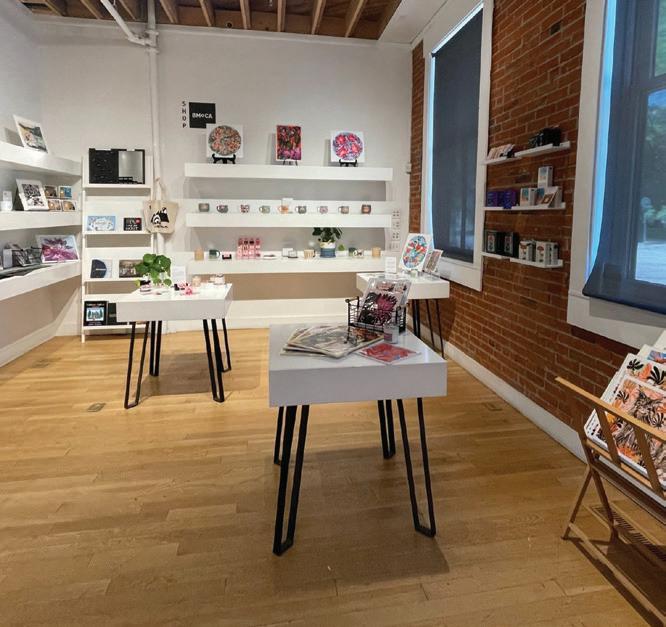
BMOCA POP-UP SHOP
11 a.m. to 5 p.m. Dec. 26-29, Boulder Museum of Contemporary Art, 1750 13th St. Free
Blank on buying gifts for that ever-forgettable cousin? It’s not too late! Head to BMoCA to catch the last few days of its holiday pop-up shop, featuring art and creations from Boulder and Colorado artists. Members receive discounts, but hurry up — there’s a limited selection and the shop closes on Dec. 29.
26 & 28
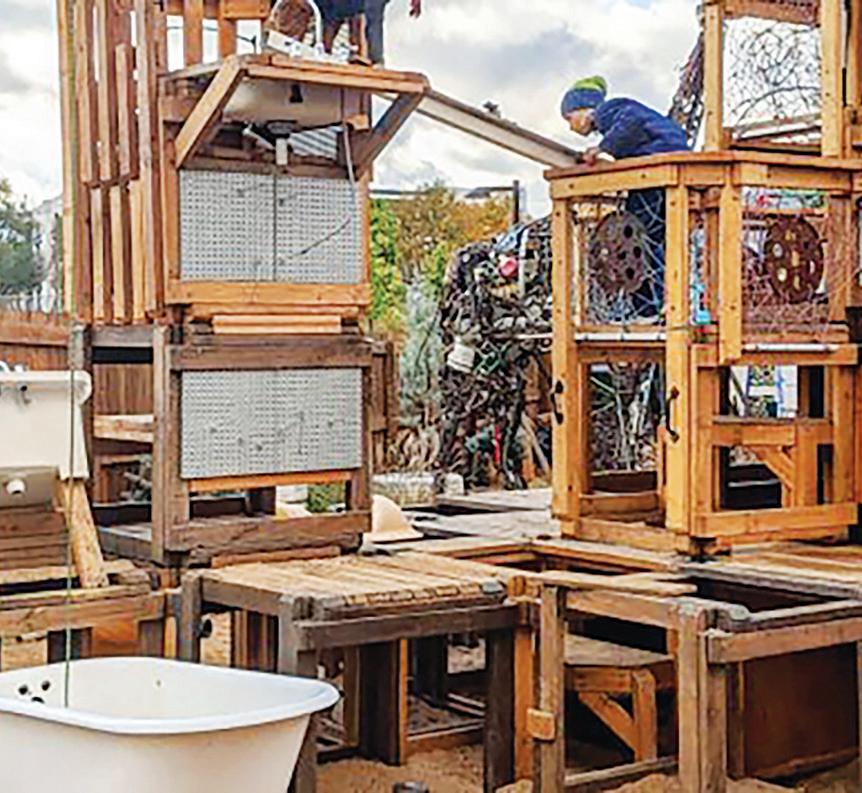
JUNKYARD SOCIAL: OPEN PLAY
10 a.m. to 6 p.m. Thursday, Dec. 26 and Saturday, Dec. 28, 2525 Frontier Ave., Unit A, Boulder. Kids (2+): $10 | Adults: $5
Let your little ones “get their wiggles out” during this regular open-play session at Junkyard Social Club in Boulder. Set the kiddos loose in the play area while you hop on the wifi, grab snacks or enjoy a drink from the bar.
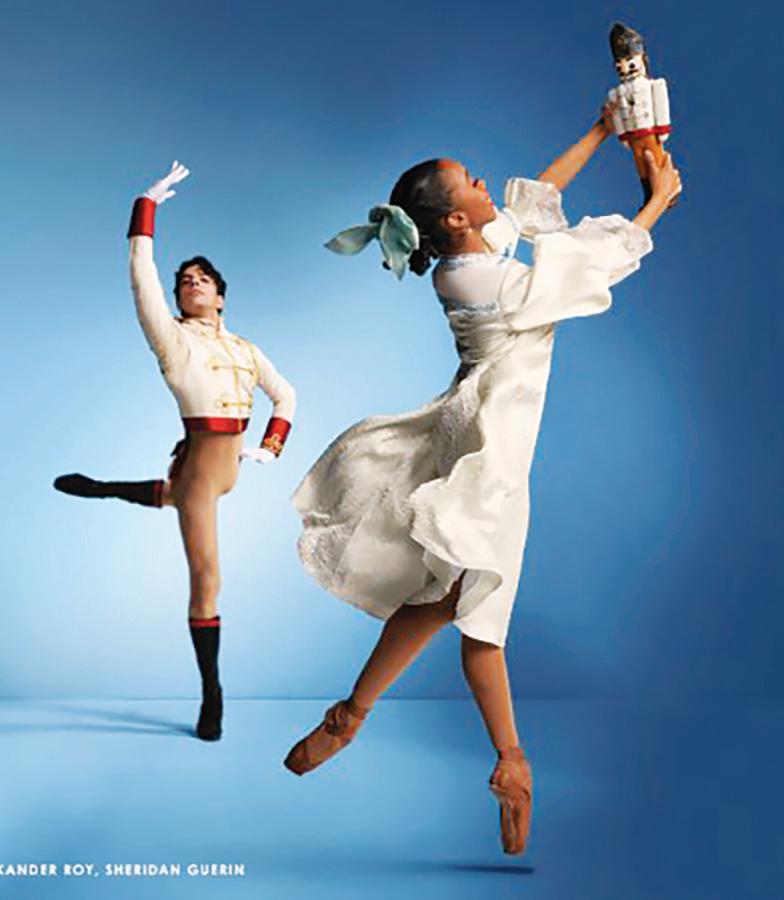
Nothing says Christmas like pirouetting mice and waltzing snowflakes. And what better time to see The Nutcracker than after the holiday craze has subsided? If you’re still in a festive mood, Colorado Ballet has the perfect show to put a bow on the Christmas season.
28
GENEALOGICAL SOCIETY HELP SESSIONS
10 a.m. to noon. Saturday, Dec. 28, Longmont Public Library, 409 4th Ave. Free
Explore the branches of your family tree alongside volunteers from the Longmont Genealogical Society during this monthly event at Longmont Public Library. Gather any information you have and come see what you can discover about your ancestors.
28
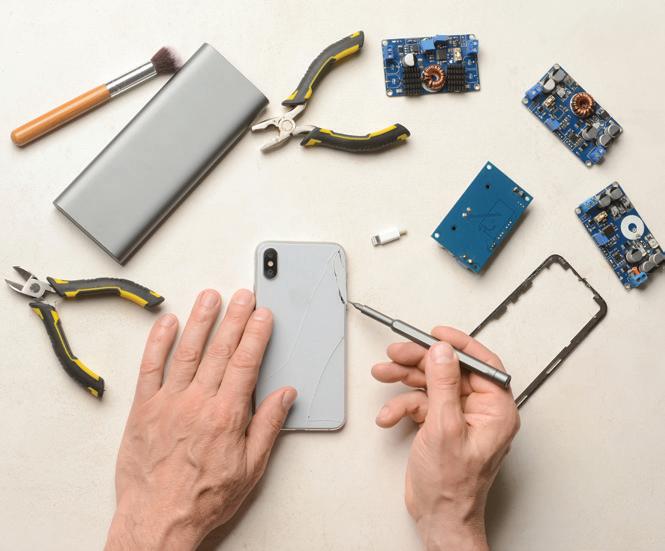
TAKE APART ELECTRONICS MEET UP
11 a.m. to noon. Saturday, Dec. 28, Neurodiversity Community Center, 100 W. Cleveland St., Lafayette. $20 donation suggested
“Deconstruct, transform and create” during this fun hands-on event for folks on the spectrum at the Neurodiversity Community Center in Lafayette. Admission is free, but there is a suggested donation of $20 per family.
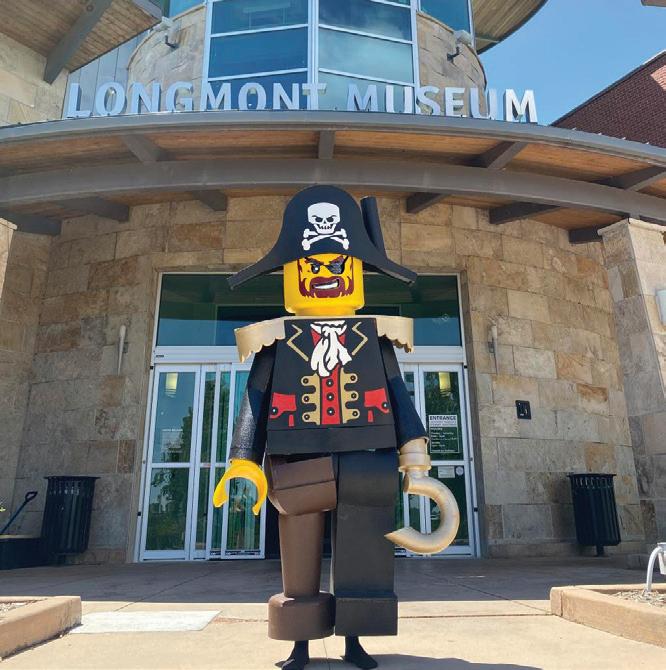
Get creative with the whole family this weekend at Longmont Museum’s interactive LEGO exhibit. No matter how old you are, let your imagination go ‘brick’ wild as you build race cars, create world-saving inventions and solve architectural puzzles. The exhibit goes away for good on Jan. 12, so make sure you stop in before the magic is gone.
29
NAMASTE FOR A BEER
11 a.m. to noon. Sunday, Dec. 29, Odd13 Brewing, 301 E. Simpson St., Lafayette. $20
Stretch off that holiday ham or limber up for your NYE dance party. Either way, this yoga sesh — led by longtime yogi and massage therapist Debbie Asmus — is beginner friendly. (That means you can probably do it beer-inhand.) Twenty bucks gets you one hour of yoga and a drink token.
29
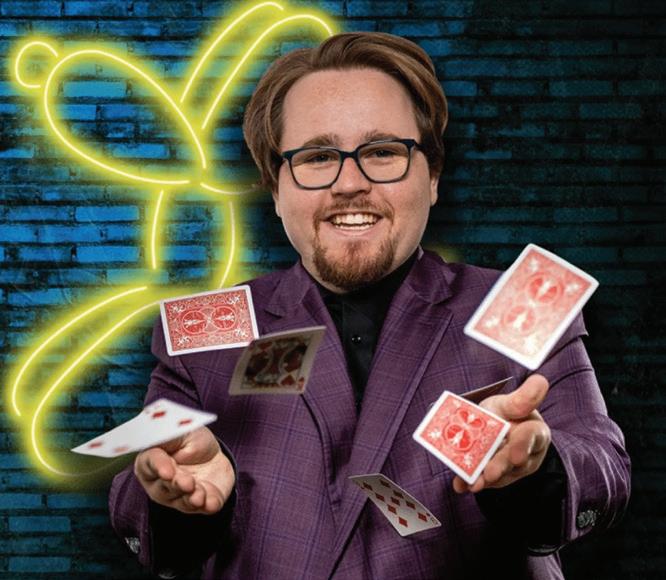
BOULDER MAGIC SHOW: HAPPY NEW YEAR!
2 p.m. Sunday, Dec. 29, Dairy Arts Center, Gordon Gamm Theater, 2590 Walnut St., Boulder. $15-20
“You’ve seen a rabbit get pulled out of a hat, but have you seen a man swallow a balloon larger than a small child?”
Head to the Dairy Arts Center for some literal holiday magic at this family-friendly show from magician Braden Carlisle. Developed with a “Pixar mindset,” the performance promises to be both aweinspiring and funny for all ages.
30
CHANUKAH ON PEARL
5:30-7 p.m. Monday, Dec. 30, 1300 block of the Pearl Street Mall, Boulder. Free
Gelt (chocolate coins wrapped in gold) will rain from the sky at Boulder County’s largest menorah lighting. Enjoy fresh sufganiyot (jelly donuts) and hot latkes while you sing along to classic tunes. Register online at boulderjcc. org or boulderjudaism.com and receive the perfect Festival of Lights swag: a snazzy Chanukah beanie.
30
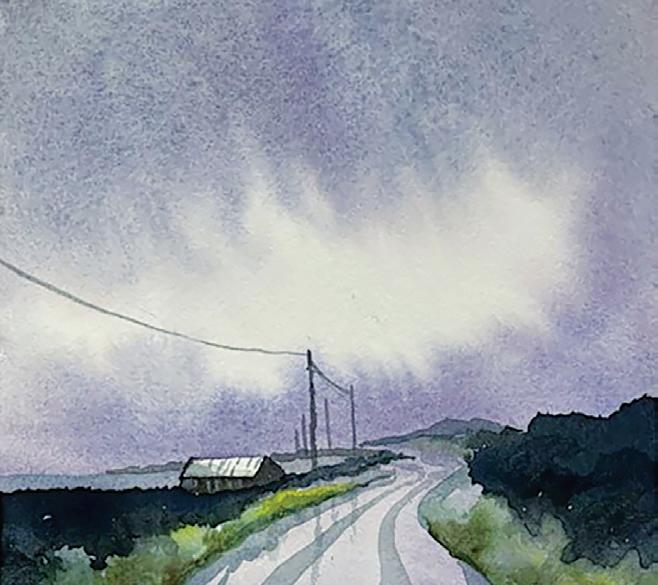
FAST WATERCOLOR LANDSCAPES
2-4:30 p.m. Monday, Dec. 30, pARTiculars Art Gallery and Teaching Studio, 401 S. Public Road, Lafayette. $45
Brush up on your watercolor skills in this stepping-stone class aimed at teaching a fast and loose style. You’ll complete a small landscape painting over the course of the class that could be anything from a simple beach scene to misty mountains. Previous watercolor experience is encouraged but not required. Paint, brushes and paper will be provided. JAZZ SUPPER CLUB
FRIDAY • 12/27
SUNDAY • 12/29
LIVE MUSIC
THURSDAY, DEC. 26
ANDY EPPLER. 6 p.m. Bricks on Main, 471 Main St., Longmont. Free
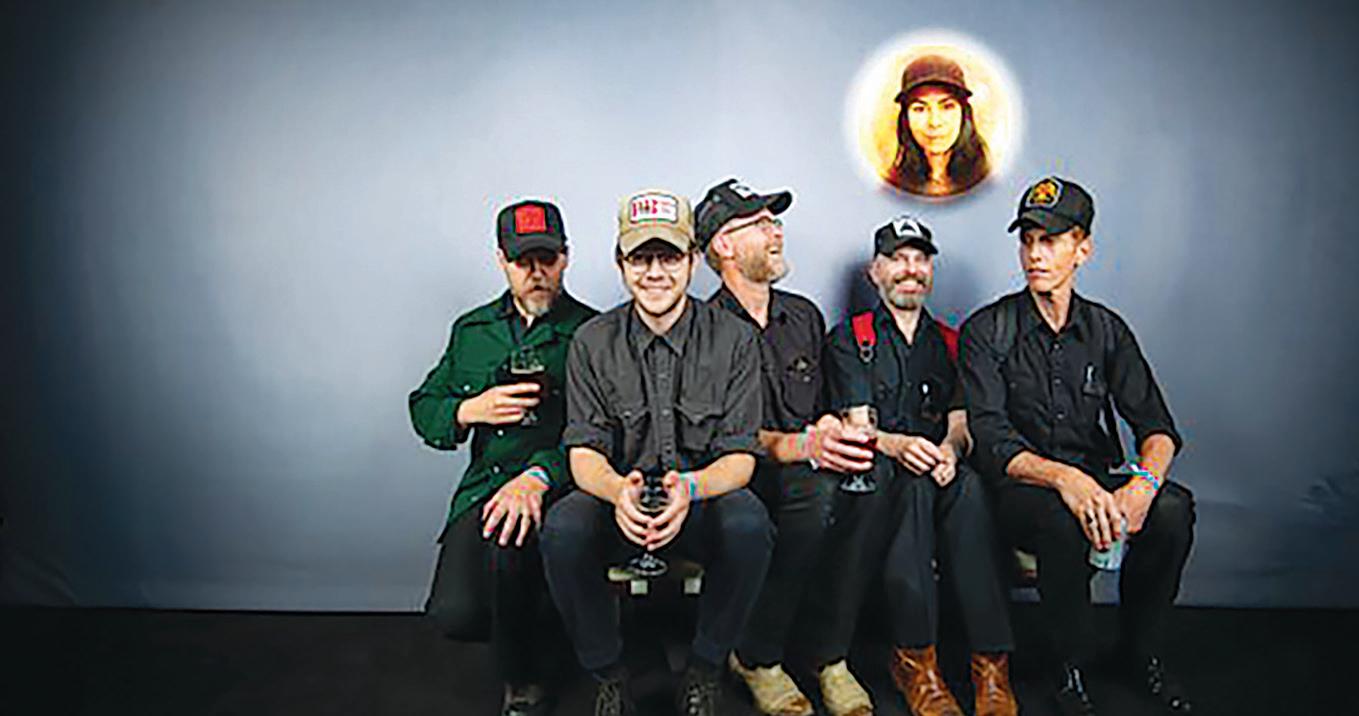
Welcome 2025 with the gothic cow-punk stylings of “Denver sound” pioneers Slim Cessna’s Auto Club, as they return to the Hi-Dive in Denver for their annual two-night NYE run with locals Rattlesnake Milk and DJ Ryan Wong. Scan the QR code for a Boulder Weekly feature on the band before you go. See listing for details.
SLIM CESSNA’S AUTO CLUB WITH RATTLESNAKE MILK AND DJ RYAN WONG (NIGHT 1) 8 p.m. Hi-Dive, 7 S. Broadway, Denver. $20 BW PICK OF THE WEEK
BOULDER OLD-TIME JAM 6 p.m. Trident Cafe, 940 Pearl St., Boulder. Free
Want more Boulder County events? Check out the complete listings online by scanning this QR code.
ASTROLOGY
BY ROB BREZSNY
ARIES (MARCH 21-APRIL 19): In 2025, I would love for you to specialize in making new connections and deepening your existing connections. I hope you will summon extra creativity and panache as you regularly blend your beautiful energies with others’ beautiful energies. I predict you will thrive on linking elements that should be linked but have never been before. What do you think, Aries? Does it sound fun to become a playful master of mixing and combining? Would you enjoy generating splashy unifications that serve your dreams?
TAURUS (APRIL 20-MAY 20): “Confidence is 10% hard work and 90% delusion,” declared Taurus comedian Tina Fey. But I believe you will disprove that assessment in the coming months. The work you do will be unusually replete with grace and dynamism. It will be focused and diligent work, yes, but more importantly, it will be smart work that’s largely free of delusion. That’s why I’m inclined to revise Fey’s formula for your sake. In 2025, your brimming levels of confidence will be primarily due to your fine, conscientious, effective work.
GEMINI (MAY 21-JUNE 20): In the 1960s, a Swedish journalist tried an experiment. He wanted to see if art critics could distinguish between abstract paintings made by skilled artists and those created by a four-year-old chimpanzee whose pseudonym was Pierre Brassau. Surprise! Many of the critics treated all the paintings with equal respect. One even gave special praise to Pierre Brassau, describing his strokes of color as having “the delicacy of a ballet dancer.” I’m authorizing you to unleash your inner Pierre Brassau in the coming months, Gemini. Be an innocent rookie, a newcomer with great instincts, an exuberant amateur who specializes in fun experiments. Do you know what “beginner’s mind” is? You approach every experience with zero assumptions or expectations, as if you were seeing everything for the first time. For more, read this: wikipedia.org/wiki/Shoshin
CANCER (JUNE 21-JULY 22): Ohio’s Cuyahoga River used to catch on fire regularly. The cause was pollution. For a hundred years, industries had poured their wastes into the waterway. The surface was often dotted with oil slicks. But after a notorious river fire in 1969, the locals decided to remedy the situation, aided by the newly established Environmental Protection Agency. Today, the Cuyahoga still isn’t 100% clean, but it’s far better. It hosts kayaking, fishing and paddle boarding. I propose we use its rehabilitation as a symbol for you in 2025. You will have welcome opportunities to clean up messes that have lingered for far too long. Please take full advantage of these cosmic invitations to sweep karmic debris out of your life.
LEO (JULY 23-AUG. 22): Steve Jobs, founder of Apple, said, “The people who are crazy enough to think they can change the world are the ones who do.” I propose that you make this one of your mottoes in 2025. More than ever before, you will have exceptional power to transform the environments you share with others. You will have an enhanced ability to revise and reinvigorate the systems and the rules you use. Don’t underestimate your influence during the coming months, Leo. Assume that people will be listening especially closely to your ideas and are extra receptive to being affected by you.
VIRGO (AUG. 23-SEPT. 22): I will give you four related terms to describe your key motif in 2025: 1. Your Soul’s Code. 2. Your Master Plan. 3. Your Destiny’s Blueprint. 4. Your Mission Statement. All four are rooted in this epic question: What is your overarching purpose here on earth, and how are you fulfilling it? The coming months will be a time when you can make dramatic progress in formulating vivid, detailed visions of the life you want to live. You can also undertake robust action steps to make those visions more of a practical reality. I encourage you to write your big-picture, long-range dreams in a special notebook or a file on your tech device. Keep adding to the text throughout the coming months.
LIBRA (SEPT. 23-OCT. 22): People in India were the first to discover diamonds buried in the earth. Most historians believe it happened in the 4th century BCE. For the next two millennia, India remained the only source of diamonds. Finally, new stashes were found in Brazil in 1725 and in South Africa in the 1870s. Let’s use this 2,000-year gap as a metaphor for your life. I suspect that far too many months have passed since you have located a fresh source of a certain treasure or bounty you crave. That will change in 2025. Here come long-delayed blessings!
SCORPIO (OCT. 23-NOV. 21): In my vision of your life in 2025, you will dramatically enhance how togetherness works for you. Below are four questions to help guide your explorations and breakthroughs. 1. Is it feasible to change yourself in ways that enable you to have a more satisfying relationship with romantic love? 2. Will you include your intimate relationships as an essential part of your spiritual path — and vice versa? 3. What work on yourself can you do to heal your old wounds and thereby make yourself a better partner and collaborator? 4. Can you help your best allies to heal their wounds and thereby become better partners and collaborators?
SAGITTARIUS (NOV. 22-DEC. 21): In Japanese, the word for “frog” sounds similar to the word meaning “to return.” That’s one reason frogs have been lucky in some circles of Japanese culture. They symbolize the blessing that occurs when travelers return home safely, when health is restored or when spent money is replenished. I bring this to your attention, Sagittarius, because I suspect 2025 will be a time when satisfying and enjoyable returns will be a key theme. Consider keeping the likeness of a lovable frog in your living space.
CAPRICORN (DEC. 22-JAN. 19): Since 1985, musician David Gilmour has led Pink Floyd. The band has sold over 250 million records. He’s in the Rock and Roll Hall of Fame in both the U.K. and the U.S. But my favorite thing about Gilmour is that he’s a passionate activist who has crusaded for animal rights, environmentalism, poverty and human rights. A few years ago, he auctioned off 120 of his guitars, raising over $21 million for an environmentalist charity. In accordance with astrological omens, I propose we make him one of your inspirational role models in 2025, Capricorn. May he mobilize you to use your stature and clout to perform an array of good works that are of service to your world.
AQUARIUS (JAN. 20-FEB. 18):
Aquarian author Virginia Woolf extolled the virtues of cultivating a supple soul that thrives on change. She pledged to be relentless in her commitment to be authentically herself and not succumb to groupthink. I recommend you make these two of your featured themes in 2025. To inspire your efforts, I will quote her radical perspective at length: “Movement and change are the essence of our being; rigidity is death; conformity is death: let us say what comes into our heads, repeat ourselves, contradict ourselves, fling out the wildest nonsense, and follow the most fantastic fancies without caring what the world does or thinks or says.”
PISCES (FEB. 19-MARCH 20): In 1992, two friends promised each other that if either of them ever won the lottery, they would share it with the other. Twenty-eight years later, that’s exactly what happened. In 2020, Thomas Cook bought a ticket that turned out to be the winner of the Powerhouse jackpot in Wisconsin. He called Joseph Feeney with the good news. After paying taxes, both men were $5.7 million richer. I am not predicting the exact same sequence for your future, Pisces. But like Cook and Feeney, I expect you will glean pleasing rewards generated from seeds planted in the past.
Q: Just went exclusive with a new partner last night and this morning an old sexy fling hit me up. For fuck’s sake! What do I do?
A: If a single text message from a longago fling was all it took to make you regret going exclusive with your new partner last night… it was quite obviously a mistake to go exclusive with your new partner at all.
Q: What websites should I use to post my foot photos to make $$$?
A: “I’ve done it — I’ve sold some foot pics — and there can be some money in it,” said Tyler Tanner, who has been creating, sharing and monetizing his adult content online for three years. “The best places to post foot photos would be OnlyFans and maybe Feetfinder. But whether you make money or not really depends on how good you are at marketing, just like any other product!” (Tyler Tanner is on Instagram and YouTube @ TylerTannerX.)
Q: How to keep the sex life alive on the long, hard road to conceiving with infertility issues?
A: If you’ve been trying to conceive the old-fashioned way for a while, vaginal intercourse may feel like a chore. If you’ve moved on to fertility treatments like IUI or IVF, vaginal intercourse — at least for the moment — may symbolize your failure to conceive without assistance.
My advice: take PIV off the menu and enjoy other kinds of sex that symbolize (and provide) pure pleasure, i.e., oral sex, mutual masturbation, frottage, anal play (if you’re into that), etc.
Q: A friend drunkenly confessed having feelings for me. This person happens to be a close childhood friend’s ex-partner. We actually met through my childhood friend.
Part of me feels giddy about this confession (I like this person!), but I would never want to hurt or betray my childhood friend. Should I tell my childhood friend what happened and seek their blessing? Or should I distance myself from the friend that confessed feelings?
A. If you wanna date this person, you should date this person. You should give
SAVAGE LOVE
BY DAN SAVAGE
your close childhood friend a heads up — as a courtesy — but your childhood friend doesn’t have a veto and, if they’re a good friend, they won’t want a veto.
Q: His libido is much lower than mine. Could this work over the long term? I feel rejected.
A: If what you were feeling was deprived, opening the relationship up could resolve those feelings, since being with your partner wouldn’t mean being deprived of sex, allowing the relationship — barring other issues — to work over the long term.
But if what you’re feeling is rejected, opening things up is unlikely to make you feel better in the short or long term, since your primary partner wouldn’t be any more interested in fucking you than they already are.
Q: I’m a 35-year-old married transgender man. I started my transition when I was in my 20s.
I’ve recently started being open about being queer and being attracted to men. As I get older, I keep finding myself longing to fuck a cis man. At times it’s the only thought that gets me turned on.
I’ve been married for 10 years. My wife is 100% straight and pretty uptight. Open relationships and ENM is NOT an option. What do I do?
Suck it up?
A: You have exactly three options: Honor the monogamous commitment you made (and suck it the fuck up), dishonor the monogamous commitment you made (and risk getting caught) or issue an ultimatum and demand some degree of openness (and risk getting divorced).
I wish there were another option — people write every day hoping that I’ll find a magical fourth option that doesn’t involve going without, becoming a cheating piece of shit or issuing painful ultimatums that could blow up their marriages — but there are only these three options.
Email your question for the column to mailbox@savage.love or record your question for the Savage Lovecast at savage.love/askdan. Podcasts, columns and more at Savage.Love
12 MONTHS OF YUM
The best local restaurant tastes from 2024
Iadmit that I can’t recall much about most of the restaurant meals I ate in 2024. Sometimes breakfast or lunch is just eating, not dining.
Certain dishes, however, were unforgettable — like the okonomiyaki at Osaka’s of Boulder and cherry pie at Goodfella’s Diner in Longmont.
The following dining diary is packed with favorites I’ve tasted locally in the past 12 months. Many have been spotlighted in Nibbles, in Boulder Weekly special sections, and on KGNU’s Radio Nibbles.
I couldn’t include the Korean fried chicken at Mono Mono, Asian sausage at Casian Seafood, or fried clams at Reelfish Fish & Chips because these eateries and others are shuttered. But they would have made the list.
Here are a few recommended local tastes of 2024:
Gochujang chicken saam
Velvet Elk Lounge, Boulder
Thanks to the kitchen it shares with The Post Chicken and Beer, Velvet Elk dishes a near-perfect bar treat. Sweet, spicy, salty and fermented gochujang
sauce coats fried boneless chicken wrapped in lettuce leaves with pickled onion, cilantro and mint.
Melanzane Parmigiana
Bucatino Trattoria Romana, Lafayette
This new Italian eatery plates a serious upgrade on hockey players’ lucky meal. Here, eggplant Parmesan is tender, fried organic eggplant slices baked with mozzarella and tomato basil sauce served over penne alfredo. You’ll want some fresh focaccia.
Choy sum and baked bao
Zoe Ma Ma, Boulder
The much-loved Asian street food menu at the James Beard Award-nominated, Michelin-recommended Zoe Ma Ma has added new pleasures. Choy sum is deceptively simple but delicious: fresh greens wok-fried with garlic. The Taiwanese baked bao sesame seeded buns are tasty bites filled with peppery minced beef.
shine on Rosario’s menu, including this alfredo variation. Noodles are robed in a queso fresco cheese sauce amped up with ají amarillo chilies. Desserts include meringue-topped passion fruit cream.
Tropical Storm taco
McDevitt Taco Supply, Boulder
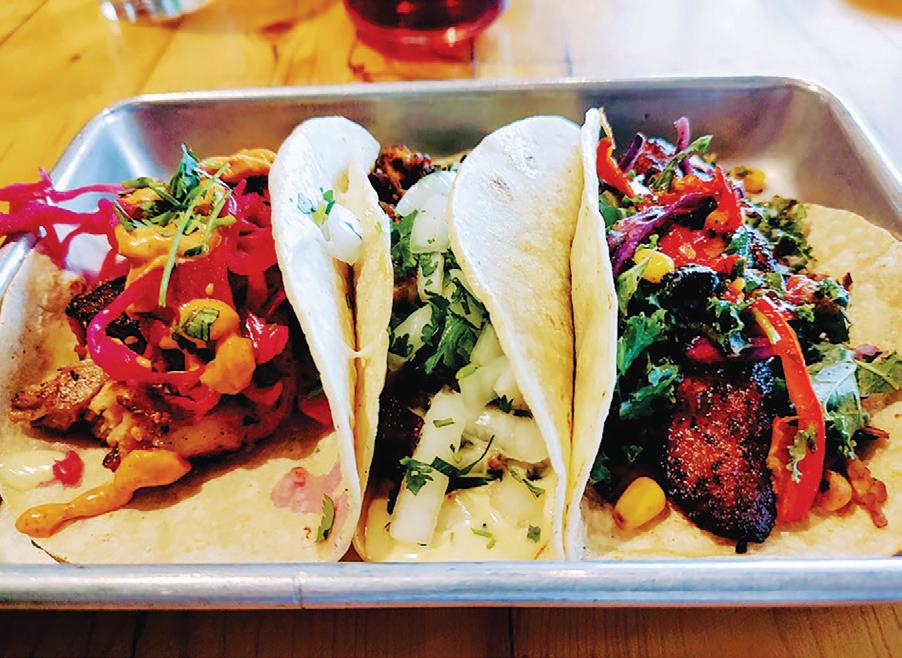
I like the pork chorizo tacos and praise the version filled with crispy pork, but my new craving is the Tropical Storm. Soft griddled corn tortillas are stuffed with fried plantains topped with kale salad and hot honey. Cilantro, onions and avocadotomatillo salsa give it extra zest.
Sii cheh kao sweh
Urban Burma, Aurora
Mango House is a remarkable shared community center for resettled Denverarea refugees featuring food stalls and international shops. The Urban Burma counter offers big-flavored South Asia dishes including sii cheh kao sweh, flat rice noodles with fried garlic, sesame oil, green onions and crispy pork or chicken. Don’t miss the fermented tea leaf slaw.
St. Louis-style ribs
Wayne’s Smoke Shack, Superior
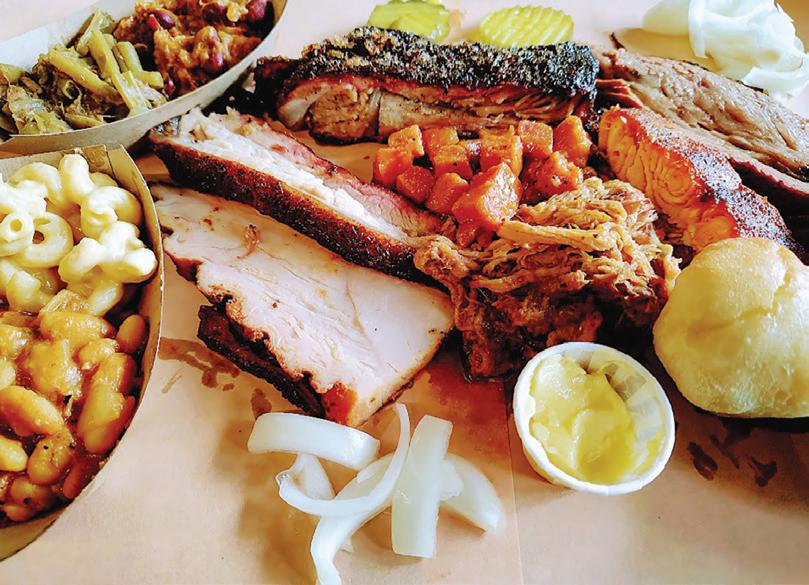
Lots of local eateries sell ribs, but Wayne’s wins my vote. The oak-smoked St. Louis-style ribs feature juicy fall-offthe-bone pork under a chewy bark. Add tart-hot mustard BBQ sauce for a little bite. Don’t miss the house-baked rolls brushed with beef fat and butter.
Jaegerschnitzel
Prost Brewing Co., Northglenn Prost’s gleaming new Biergarten and brewery is winning prizes for its pilsner and a menu of German comforters. It’s easy to love the pork cutlets sided with ham-and-cheesy spaetzle dumplings, as well as chewy pretzels and locally made sausages with red cabbage.
Saag paneer
Mountain Bites, Lafayette
Hidden in a gas station, the family-run Mountain Bites crafts all my must-have, take-out Indian and Nepali dishes including spicy spinach saag with plenty of chewy paneer cheese. It’s heaven with basmati and garlic cheese naan. Hit the road with a cup of milky chai.
STORY AND PHOTOS BY JOHN LEHNDORFF
Brunch at Jamestown Mercantile. Okonomiyaki at Osaka’s of Boulder.
Snow bingsu at Bowl Izakaya in Longmont.
A taco sampler at McDevitt Taco Supply in Boulder.
Wayne’s Smoke Shack in Superior.
NIBBLES
Pizza okonomiyaki
Osaka’s, Boulder
Participating Businesses:
Alpaca Connection
Ana’s Art Gallery
Apocalypse
Art + Soul Gallery
Art Source International
Barbara & Company
Bliss
Boulder Bookstore
Boulder Olive Oil Company
Canova Home
Charlie’s T-Shirts
Classic Facets
Colorado Glass Works
Gypsy Jewel
Helly Hansen
We spell taste bud satisfaction “okonomiyaki,” the savory Japanese cabbage or kale pancakes. Some are topped with beef or seafood, but I’m a fan of the pancake topped with melted cheeses. The restaurant’s Osaka Burger sliders use small okonomiyaki as “buns.”
The Magdalena
Süti & Co., Boulder
Brooklyn Bridge
The cozy downtown coffee shop specializes in exquisite shortbread creations made with imported Danish butter. I’m fond of the Magdalena, a vanilla shortbread fig jam sandwich and candied walnuts, and The Lilly: chocolate-dipped, ganache-filled cookies.
Brunch
Jamestown Mercantile, Jamestown
The drive into the foothills is rewarded with a changing and satisfying Sunday brunch menu ranging from pastries to breakfast sandwiches. Try the hard-tobeat crispy chile and cheese rellenos with eggs and an edgy green chile sauce plus roasted yukon gold spuds drenched in lemony hollandaise.
Snow Bingsu
Hurdle’s Jewelry
Jackalope & Co. International
La Sportiva Retail Store
Lush Cosmetics
Pedestrian Shops
Pendleton
prAna
Ragstock
Savvy on Pearl
Stride Lab
Teton Gravity Research
Two Hands Paperie
Where the Buffalo Roam
Zeal Optics ...and more!
BoulderSidewalkSale.com
Supported by
Don't forget every Saturday and Sunday, City of Boulder Parking Garages are FREE! BoulderParking.com
Bowl Izakaya, Longmont
This impressive creamy Korean dessert offers a big bowl of riced ice cream topped with cheesecake chunks, almonds, caramel sauce and chocolate cookies.
THE TASTIEST SQUARE PIZZAS
A 2024 research project required sampling some of the best square Detroitstyle pizzas in various forms along the Front Range. These were some of my favorites.
Detroit-style Hawaiian pizza
Ghost Box Pizza, Lafayette Crispy Detroit-style twice-baked crust is crowned with Canadian bacon, pineapple, red onion, mozzarella and a simple tomato sauce.
Wild Shroom
Blue Pan Pizza, Golden Blue Pan’s exceptional bready crust is topped with pecorino romano, mozzarella, brick and fresh ricotta cheeses with tomato sauce, pepperoni, Italian sausage, garlic and oregano. The crunchy, cheesy edges are a joy.
Arrabiata Detroit-style pizza
Urban Field and Market, Longmont
Perfectly crispy outside, tender inside, the Detroit-inspired crust is flavor-layered with tomato sauce, cheese, cup pepperoni, red onion, pepperoncini, garlic, Calabrian chiles, hot honey and fresh basil. On concert nights at the Boulder Theater, Urban Field serves in The Lounge.
OTHER BOULDER COUNTY TASTY TREATS
• Burnt beef ends and well-smoked ribs, H3rsh3r BBQ Co. at Parkway Food Hall, Longmont.
• Breakfast rice square with pork belly and eggs, Skratch Labs Cafe, Boulder
• Cherry pie a la mode, Goodfella’s Diner, Longmont
• Spinach gnocchi, River & Woods, Boulder
• Corned beef hash and eggs, Home Cookin’ Cafe, Louisville
• Croque Madame, Jeannot’s Patisserie, Lafayette
• Beef brisket sandwich with fries, Blue Sky Bistro, inside Rocky Mountain Metropolitan Airport terminal, Broomfield
John Lehndorff is the former Dining Critic of the Rocky Mountain News. He hosts Radio Nibbles and Kitchen Table Talk on KGNU. Podcasts: kgnu.org/ category/radio-nibbles
Rock City Pie & Ice, Broomfield Detroit-inspired focaccia-like squares are graced with marinated roasted Colorado mushrooms and a multitude of cheeses: goat, brick, provolone, cheddar, ricotta, fresh mozzarella and parmesan — plus fresh basil and tomato sauce.
ON DRUGS
THE YEAR IN DRUGS
From MDMA to magic mushrooms, here’s what happened — and didn’t — in 2024
BY SHAY CASTLE
LEGAL WEED, COUNTRYWIDE
It was 2023 when news first broke that the Biden Administration was recommending a reclassification of cannabis, which would essentially decriminalize it nationwide.
Progress on that front was slow but steady in 2024. In March, the Department of Justice got on board, followed by the Drug Enforcement Agency (DEA) in April. A DEA hearing, initially scheduled for December, was delayed until January or February of next year.
Though incoming president Donald Trump has expressed support for rescheduling reform in the past, his pick for attorney general — former Florida AG Pam Bondi — was part of a commission that linked cannabis to opioid addiction and challenged efforts to legalize medical marijuana.
Bondi will be responsible for picking the new head of the DEA.
FEDS DENY MDMA
Drug Administration (FDA) in August.
The drug had promising results in clinical trials, with 71% of participants reporting improvement. But regulators were squeamish about greenlighting it, given the role psychotherapy plays in recovery, among other concerns.
Regulators told Lykos to come back with more data. Another clinical trial is
cal trial in Boulder, and Poulter was one of my practitioners.)
“It’s gonna be three to four years” before Lykos can take another stab at FDA approval, he said. “It’s completely heartbreaking that we’re not able to offer [this] right now.”
BOULDER MOMS PUSH FOR DAB BAN
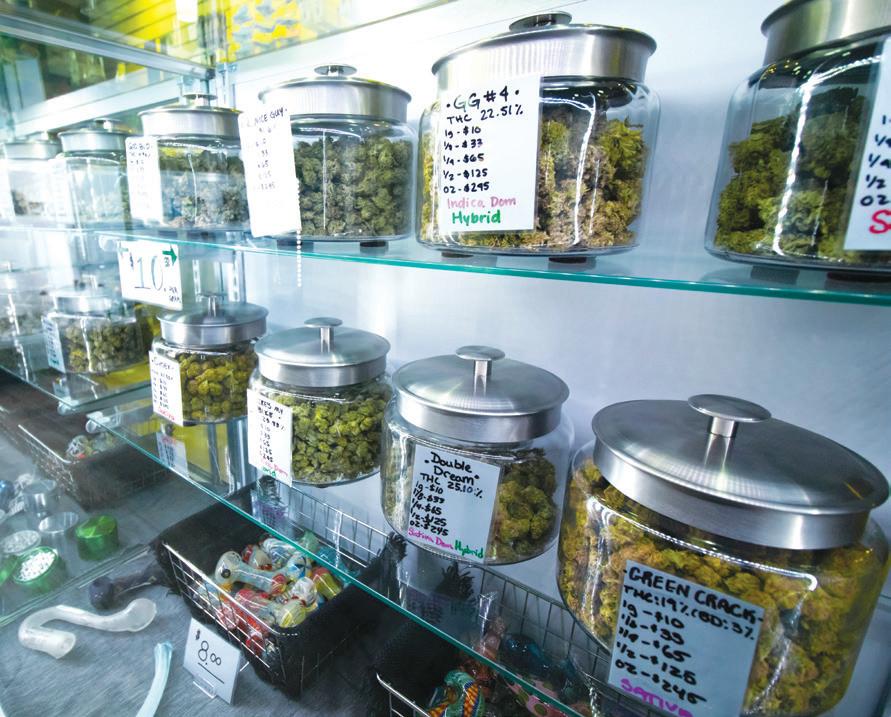
Anxious parents and health care providers asked Boulder’s Cannabis Licensing and Advisory Board (CLAB) to ban marijuana concentrates and put mandatory warnings on high-potency THC products, worried about the potential impacts to young people’s mental and physical health.
Though the issue was raised at an August meeting, CLAB did not make any recommendations regarding a ban or warning labels. According to city licensing specialist Kristen Changaris, as of Dec. 16, highpotency cannabis products are not on CLAB’s 2025 agenda.
Hopeful therapists and their patients were dejected after Lykos Therapeutics’ application for MDMA-assisted therapy was rejected as a treatment for post-traumatic stress disorder (PTSD) by the Food and
being planned, according to Bruce Poulter, a researcher with the Multidisciplinary Association for Psychedelic Studies (MAPS), which ran the clinical trial before spinning off Lykos, as well as Lykos’ lead trainer. (Disclosure: I participated in MAPS’ clini-
The cannabis industry is strongly opposed to a ban on concentrates, which make up more than a third of all marijuana sales in Colorado. Truman Bradley, executive director of the Marijuana Industry Group, told Boulder Weekly in October that keeping products legal and regulated was “the hill we will die on.”
PSYCHEDELIC ROLLOUT
Colorado had a busy year preparing for the launch of natural medicine healing centers and institutions to train future psychedelic facilitators. Training programs are already receiving the state’s green
light, while commercial healing centers can begin applying for licenses Dec. 31. Naropa, Boulder’s Buddhist university, was the first licensed psychedelic educator in the state, but the launch of its program was delayed after insurers forced the university to distance itself from psychedelics.
That program will now be run by Memoru Center for Visionary Healing Arts, headed by former university faculty and a group of local therapists and researchers who worked with Lykos and MAPS, including Poulter.
The “next step” for Memoru is finding a physical location, Poulter said. If progress continues at the state level, “in May we can actually start providing psilocybin services.”
Memoru is one of three Boulder County operations that have received state regulators’ OK.
Local towns, too, had to decide where healing centers could go, when they could operate, etc. Boulder, Lafayette and Louisville all updated their zoning regulations, or are somewhere in the process; Longmont does not appear to have discussed the issue yet, according to a review of city council agendas for 2024.
In 2025, healing centers will be limited to using psilocybin and psilocin. But lawmakers have the option of expanding allowed substances beginning in 2026 to include DMT, mescaline and ibogaine.
The latter, which is legal in New Zealand, has a great potential for treating substance use disorder, Poulter said.
“That could really change people’s lives in a very powerful way,” he said. “What Colorado is doing is really interesting.”