Rewilding the West Gray wolves are back in Colorado. Are we ready to live with them? P. 8
FRESH FINDS IN HYGIENE P. 15
DOCTOR’S ORDERS: NEVER EAT ALONE P. 27
SUPER-DUPER GARAGE SALE P. 19
CONTENTS 01.18. 2024
08 Courtesy: Colorado Parks and Wildlife
08 COVER Gray wolves are back in Colorado. Are we ready
to live with them? BY WILL MATUSKA
05 OPINION Will the real Jared Polis please stand up? BY DAVE ANDERSON
16 THEATER Miners Alley thrills with chilling adaptation
of Stephen Kings’ Misery BY TONI TRESCA
27 NIBBLES A Boulder cafe for athletes (and other sweaty people) BY JOHN LEHNDORFF
DEPARTMENTS 06 OPINION Trump is due his due process
07 LETTERS
A love/hate relationship with rules
07 NEWS
What’s your local gov’t up to?
13 MUSIC
Squirrel Flower keeps it fresh
BOULDER WEEKLY
15
COMMUNITY Fresh finds in Hygiene
23 SCREEN
Hometown playwright ‘does right’ by Denver
24
17 FILM
ASTROLOGY
18 EVENTS
25 SAVAGE LOVE
Origin: A mid adaptation
Where to go and what to do
22 BOOKS Get the kids and go outside
Gather ye role models while ye may, Gemini
It’s never too late to do the right thing
31 WEED
Study: Pot makes exercise more fun
A Boulder Institution. “I’ve been going to Twig for almost 5 years now and can confidently say I never have to look for another salon. Beautiful space right on Pearl, friendly staff, the most comfortable sinks I’ve ever laid my head in and the quality of cut and color is fantastic.” Monday-Friday 8a-8p Saturday 8a-6p Sunday Closed
1831 Pearl St Boulder, CO 303-447-0880
www.twighairsalon.com JANUARY 18, 2024
3
COMMENTARY JANUARY 18, 2024
Volume 31, Number 22 PUBLISHER: Francis Zankowski
E DIT ORIAL EDITOR-IN-CHIEF: Shay Castle ARTS & CULTURE EDITOR: Jezy J. Gray REPORTERS: Kaylee Harter, Will Matuska FOOD EDITOR: John Lehndorff INTERN: Lauren Hill CONTRIBUTING WRITERS: Dave Anderson, Rob Brezsny, Michael J. Casey, Dan Savage, Bart Schaneman, Alan Sculley, Toni Tresca, Charlie Danaher Gregory Wakeman, Kalene McCort
S A LE S AND MARKET I NG MARKET DEVELOPMENT MANAGER: Kellie Robinson SENIOR ACCOUNT EXECUTIVE: Matthew Fischer ACCOUNT EXECUTIVES: Chris Allred, Holden Hauke SPECIAL PROJECTS MANAGER: Carter Ferryman MRS. BOULDER WEEKLY: Mari Nevar
P ROD UCTION CREATIVE DIRECTOR: Erik Wogen SENIOR GRAPHIC DESIGNER: Mark Goodman
C I RC UL ATION CIRCULATION MANAGER: Cal Winn CIRCULATION TEAM: Sue Butcher, Ken Rott, Chris Bauer
B US I NESS OFFICE
THE ANDERSON FILES
BOOKKEEPER: Emily Weinberg FOUNDER / CEO: Stewart Sallo As Boulder County’s only independently owned newspaper, Boulder Weekly is dedicated to illuminating truth, advancing justice and protecting the First Amendment through ethical, no-holdsbarred journalism and thought-provoking opinion writing. Free every Thursday since 1993, the Weekly also offers the county’s most comprehensive arts and entertainment coverage. Read the print version, or visit boulderweekly. com. Boulder Weekly does not accept unsolicited editorial submissions. If you’re interested in writing for the paper, please send queries to: editorial@boulderweekly.com. Any materials sent to Boulder Weekly become the property of the newspaper. 690 South Lashley Lane, Boulder, CO 80305 Phone: 303.494.5511, FAX: 303.494.2585 editorial@boulderweekly.com www.boulderweekly.com Boulder Weekly is published every Thursday. No portion may be reproduced in any form without written permission from the publisher. ©2024 Boulder Weekly, Inc., all rights reserved. Boulder Weekly welcomes your correspondence via email (letters@boulderweekly. com). Preference will be given to short letters (under 300 words) that deal with recent stories or local issues, and letters may be edited for style, length and libel. Letters should include your name, address and telephone number for verification. We do not publish anonymous letters or those signed with pseudonyms. Letters become the property of Boulder Weekly and will be published on our website.
BOULDER WEEKLY
WILL THE REAL JARED POLIS PLEASE STAND UP Democratic governor embraces regressive tax policy BY DAVE ANDERSON
D
uring his State of the State address, Governor Jared Polis called for huge government spending for mass transit, education, job training and crime fighting. But he emphatically called for an income tax cut that would mostly benefit the well-off. He challenged the Democratic majority and Republicans cheered. John Frank of Axios reports that Democrats were “fuming.” “I’m befuddled,” said Scott Wasserman of the Bell Policy Center,
a progressive fiscal think tank. “This is completely inconsistent with everything else in the speech. A flat income tax cut will end up benefiting the wealthy and undercutting the services that low-income and middle-income people rely on.” The state legislature’s non-partisan researchers came to the same conclusion. Most states have a progressive income tax where tax rates increase along with one’s level of income. That was the case in Colorado for decades,
but that changed in 1987 when the state legislature instituted a regressive flat tax, taxing all income at the same rate. In 1992, it was put in the Colorado Constitution with passage of the so-called Taxpayer Bill of Rights (TABOR). If we were to return to a progressive income tax, voters would need to pass a ballot measure. Polis would like to get rid of Colorado income tax altogether, as nine other states have done. In 2021, he was a speaker at the conservative JANUARY 18, 2024
5
OPINION Steamboat Institute’s Freedom Conference in Beaver Creek. The event’s moderator asked him what he thought the state’s income tax rate should be. Polis said, “It should be zero” to the cheering crowd. He proposed substituting it with a tax on pollution or cigarettes. Personal income taxes provide about two-thirds of the money in the Colorado General Fund, the part that covers K-12 education, higher education, parks, the courts, public health and safety. Polis subscribes to the Reaganera “supply-side” or trickle down economic theory which claims that a lower income tax will boost the economy. He has been friends with the leading proponent of the theory, economist Arthur Laffer, for three decades. Laffer served on the boards of several of Polis’ businesses over the years. They appeared together as speakers at the Freedom Conference. Laffer became famous as a leading economist in the Reagan administration. He was also an economic advisor to Donald Trump’s 2016 presidential campaign. In 2019, Trump awarded Laffer the Presidential Medal of Freedom for his contributions in the field of economics. Laffer was also the co-author of Trumponomics: Inside the America First Plan to Revive Our Economy. In 2021, ProPublica, a Pultizer Prize winning investigative newsroom, revealed that many wealthy political figures have been able to slash their taxes by means of perfectly legal schemes. One of them was Polis. The report by Ellis Simani, Robert Faturechi and Ken Ward Jr. said: “Despite a net worth estimated to be in the hundreds of millions, Polis paid nothing in federal income taxes in 2013, 2014 and 2015. From 2010 to 2018, his overall rate was just 8.2% — less than half of the 19% paid by a worker making $45,000 in 2018.”
6
JANUARY 18, 2024
Nevertheless, Polis’ politics are hard to pin down. He has a libertarian bent, and that’s great at a time when reproductive rights and LGBTQ folks are under ferocious attack. He has been a supporter of single payer health care. Polis was the U.S. congressman for Colorado’s Second District from 2009 to 2019. Alex Burness, in his excellent biography of Polis for The Colorado Independent in 2018, noted: “A review of Polis’s voting record in Congress shows his is a reliably blue vote — he’s sided against Donald Trump 84% of the time — but also that he has an above-average appetite for bipartisan legislation...” Congressman Jim McGovern (Dem-Massachusetts) and several others told Burness that “Polis isn’t exactly the type to cut backroom deals or twist arms, but rather that he’s opportunistic, and gets his way by forging unlikely partnerships.” McGovern said, “He’s someone who is good at convincing you that it’s in your interest to favor a particular issue. He has the skill to persuade people, to try to build relationships with people nobody thinks he would.” Polis is very smart but unpredictable. However, he is willing to change his mind. For instance, he opposed a ban on assault weapons after the Sandy Hook massacre but now supports gun control. Let’s hope he shows similar flexibility when it comes to rethinking tax policy. This opinion does not necessarily reflect the views of Boulder Weekly.
Read the full text of Gov. Polis’ State of the State address at bit.ly/readstateofthestate Or watch it at bit.ly/watchstateofthestate
DESTROYING DEMOCRACY Colorado Supreme Court disregards due process BY CHARLIE DANAHER
I
n ruling that Trump should be removed from the primary ballot, the Colorado Supreme Court furthers and promotes the legal madness, while pretending to defend democracy. In the opinion, the majority states, “We are also cognizant that we travel in uncharted territory…” One might ask if, upon finding themselves in “uncharted territory,” they just happened to pause and reflect on over a thousand of years of western jurisprudence, and at least ponder the idea of presumed innocence until proven guilty? Apparently not. It’s important to note that this is the same court who, in 2016, could not even find it in themselves to bother taking up the Masterpiece Cakeshop case. That case went to the SCOTUS, who slapped down the Colorado Appeals Court in a 7-2 ruling. To get a sense of how ridiculous and dangerous the Colorado Supreme Court ruling was, let’s review a few of its flaws. First, the court continues the perversion of historical ideas. Until three years ago, the only place that anyone had ever seen the term “insurrection” was in their homeowner’s insurance policy. My Webster’s Dictionary defines the term as “a rising up of individuals to prevent the execution of law, by force of arms.” Let’s be clear, what occurred at the Capitol on Jan. 6 was outrageous and unacceptable, without a doubt. But an “insurrection?” Get real. After he realized what was taking place at the Capitol, Trump’s behavior was reckless and irresponsible. And his inaction toward peacefully resolving the situation is inexcusable. However, it’s farcical to claim that Trump engaged in an insurrection due to a speech he gave. Have we lost any ability to nuance between reckless, irresponsible
behavior and insurrection? Good grief. Second, the blatant disregarding of the due process. Since when did it become acceptable to simply declare someone guilty of a crime and then treat such a declaration as an actual conviction? And this coming from the highest court in our state. How pathetic! And how troubling, for anyone who values a society that honors the rule of law. For the majority on the Colorado Supreme Court, it must be nice to know that you can grandstand and show your dedication to the antiTrump tribe and know that, at the end of the day, your opinion has zero effect on Trump’s being on the primary ballot. Zilch. However, you will surely reap tribal rewards amongst the crowd whose primary principle is “by whatever means necessary.” I wonder, can those cheering this ruling not imagine what such misuses of the law do to our society? Can they not conclude that this “stop Trump at any cost” mindset will surely not be limited to Trump? That we’ve now sown the wind and we will reap the whirlwind? Let’s just be damn glad that the U.S. Supreme Court exists and will put an end to such insanity. But we can only take modest solace from the inevitable overturning. Because, unfortunately, the damaging ramifications of this witch hunt will long haunt us. Charlie Danaher is a mechanical engineer and libertarian columnist. He has lived in Boulder for 30-plus years. He seeks a peaceful world where, instead of acting on our tribal instincts, we engage in rational conversations and honor the rule of law. This opinion does not necessarily reflect the views of Boulder Weekly.
BOULDER WEEKLY
LETTERS CIVIL DEBATE
For several years now, a group of old and aging Boulder-area men have met each Wednesday morning to discuss anything other than football, which took considerable restraint when Coach Prime came on the scene. We range in age from early 70s to mid-90s. Our discussions are friendly and supportive, often illuminating, never boring. We have scientists, investment professionals, an historian, a physician and psychiatrist, a musician, professors, teachers, newspaper owners and publishers, a mathematician — even a Rhodes Scholar — among our ranks. There always is something to hear, something to learn, something to respect. Interestingly, it isn’t so much credential that makes our people enjoyable as it is respect for each other. To be sure, we are diverse in our political views and wide-ranging in our chosen careers. Apart from the topic limitation mentioned above, we have only a couple of other rules: 1. Ad hominem attacks are forbidden and grounds for expulsion. 2. One conversation at a time, please.
I notice your new editor, Shay Castle, has established the first as a rule for letters to the editor and for op-ed submissions (“Strong opinions, loosely held,” Jan. 4, 2024). With this civilized ground rule, I suspect Boulder Weekly will collect and publish thoughtful, constructive commentary, and I for one look forward to supporting the effort. We are sorely in need of respectful idea sharing in these times. As Ms. Castle has said, attack the idea but not the person. — Ron Stewart, Lafayette
BREAKING THE RULES
Dear Boulder Weekly, Donald J. Trump is a stupid and evil person who hates poor people. Regards. — Peter Aretin, Boulder Editor’s note: We used this exact line (albeit with a different name) in our recently published op-ed guidelines as an example of the kind of thing we wouldn’t print. We appreciate your cheekiness, Peter. Some rules are meant to be broken.
NEWS
GOV’T WATCH What your local elected officials are up to BY BOULDER WEEKLY STAFF BOULDER CITY COUNCIL
At the Jan. 25 study session, Council will: • Receive an updated on key flood protection projects • Receive an update on the Colorado Legislative session and discuss the City’s lobbying plans and process Council meets Thursdays at 6 p.m. Watch on YouTube or Channel 8 (TV).
BOULDER COUNTY COMMISSIONERS
The Boulder County Commissioners will hold public hearings and make decisions on Prairie Run Open Space (Jan. 25, 9:30 a.m.) and a driveway east of the intersection of Magnolia Road and Old Whiskey Road where the property is zoned for forestry (Jan. 23, 1 p.m.). The management plan for the 1,377 acres of public land that will be Prairie Run Open Space includes “protection of wildlife habitat, the continuation of sustainable agriculture, and the restoration of wetlands and stream corridors” as well as a range of recreational activities, according to the advance agenda. The commissioners will also hear a monthly update from the Head Start division in a public meeting (Jan. 23, 11:30 a.m) and meet with Mental Health Partners (Jan. 25, 3:30 p.m.).
SIGNED, SEALED, DELIVERED: YOUR VIEWS You’ve got opinions, we’ve got newsprint.
Send your letters to letters@boulderweekly.com.
SERVING BOULDER SCRATCH-MADE DAMN GOOD TACOS, AWARD-WINNING GREEN CHILE QUESO AND FRESHLY-SQUEEZED MARGARITAS SINCE 2020 JOIN US FOR DINE-IN OR ORDER ONLINE FOR PICKUP AND DELIVERY AT
TORCHYS.COM!
BOULDER WEEKLY
JANUARY 18, 2024
7
COVER
Courtesy: National Park Service
Rewilding the West Gray wolves are roaming wild in Colorado following an unprecedented reintroduction effort. Are we ready? BY WILL MATUSKA
W
e tell children stories — like Aesop’s Fables, Little Red Riding Hood or the Big Bad Wolf — that implicitly teach us how to think about wolves. Many of these myths portray them as conniving, cunning or deceitful. “Expect no reward for serving the wicked,” writes Aesop after a wolf fools a crane. He calls the canine “the terrible wolf,” in another fable. Stories of the opposite sentiment are also true. The wolf is central to some Indigenous tribes’ creation stories around the country, where they are associated with characteristics like courage and loyalty. A female wolf is said to have cared for Romulus and Remus before the former founded the city of Rome. Aldo Leopold’s observation of a fading “fierce green fire” in a dying wolf’s eye gave birth to his famous conservation values. Mike Phillips, one of the foremost experts on wolf restoration, says the “mythical wolf” could be “nothing further from the truth.” “Gray wolves are not the devil incarnate, and they certainly aren’t angelic 8
JANUARY 18, 2024
and float two inches above the ground and never cause any problems,” he says. “The real wolf is firmly situated between the two. With time, a lot of Coloradans will come to see the real wolf more clearly.” That’s because, as of a month ago, wolves are no longer relegated to legends or history books. After being systematically extirpated more than 75 years ago, the release of five gray wolves in Grand County on Dec. 18 marked the beginning of the canine’s unprecedented voter-mandated reintroduction to its native range. Never before has direct democracy led to an endangered species’ reintroduction, and it’s the first wolf-focused initiative led by a state agency. Colorado Parks and Wildlife has released 10 of them, and more are on the way. Some champion the reintroduction as a triumph of democracy and environmental prosperity. Others say it risks their livelihoods or way of life. These perspectives often align with other riffs along societal divides core to people’s identities, such as political ideology, culture and tradition. That means discussions around
canis lupus are about the ecological impacts of reintroducing an apex predator and, perhaps moreso, the resulting social implications. “A lot of the arguments around wolves and about wolves aren’t necessarily solely about wolves,” says Kevin Crooks, director of the Center for Human-Carnivore Coexistence at Colorado State University. “They’re about deeper underlying societal conflicts. Wolves are just a symbol of those deeper conflicts.” Now with wolves living on the landscape, people are focusing their attention on what it takes for a successful reintroduction effort — for both wolves and humans. But with recent lawsuits, claims of fractured trust and desire for more transparency, it’s clear that just because wolves are roaming free doesn’t mean the job is done. “I don’t think that Colorado is ready for wolves,” says Robin Young, the Archuleta County Extension director at the CSU Extension Service. “I don’t think that anything to this magnitude you’re ever ready for. … There’s still a lot of work to do. There’s still a lot of knowledge that needs to be gained
when the wolves get here and to know really how to manage them.” Co-existence experts say one of the most important factors for a successful reintroduction hangs on meeting people across the aisle to build trust. For a creature steeped in everything from myth to politics to culture in a polarized country, that might be easier said than done.
HOME ON THE RANGE
Don Gittleson feeds his cows everyday in the wintertime. He owns a ranch in Jackson County, also known as North Park, near the town of Walden. Because he sees them so often, especially when temperatures drop and daylight dwindles, he knows his livestock well and is keyed in to their whereabouts, mood and behavior. In December 2021, he knew wolves were in the area even before the depredations started. “[The cows] were fine in the evening,” he says. “Next morning when I came out, she was lying there and quite a bit of her was eaten.” The wolves on Gittleson’s ranch migrated into the state before last BOULDER WEEKLY
COVER month’s reintroduction and established a home range in the area. As of midDecember, CPW knows two are still in the area. According to Gittleson, he’s lost four of his livestock since 2021 that were compensated by CPW. A few more were confirmed to be injured by wolves. He remembers walking up on one injured cow stuck in deep snow. “She was kind of in shock. So she could only go a little ways before she’d have to lay down and rest,” he says. “And she was just shivering, you know, shaking. And she was chewed up on her legs and flank beside her tail and back end. I knew she needed to get put down. “That one was by far the hardest one to deal with. Because you knew the cow was in a lot of pain, and they chewed her up pretty bad.” Confirmed or probable wolf dispersals into Colorado have occurred seven times since 2004, yet wolves kill livestock infrequently. In fact, CSU Extension estimates the percentage of cattle killed by wolves in Montana, Idaho and Wyoming is under 1% (although the exact number is unknown). There’s a loss of revenue, but CSU estimates it’s a “small economic cost to the livestock industry as a whole.” Once wolves figure out livestock are vulnerable, they are known to hit the same area again, and it can become a problem for individual producers. There’s a suite of determent methods available, many of which Gittleson used on his ranch, including ranger riders, lights and fladry (colored fabric that hangs from fence lines), but he says once wolves find their way around them, the methods are inconsistent, expensive and time consuming. What might be more prevalent, and harder to track, are indirect costs both to livestock and ranchers. Gittleson says the cattle losses he’s faced are “more than you want,” but the high cost of nonlethal determinants and the ongoing psychological stress are bigger problems. “Everything you see on the landscape after, it’s a wolf,” he says. “You see something move by the corner of your eye, it’s a wolf. And it takes you a minute to realize it’s not. BOULDER WEEKLY
“It’s extremely stressful. And that might be an understatement.” Despite the low probability of wolf predation on livestock, it’s the reality some ranchers will face. Young says that uncertainty can lead to fear and anxiety. “You’re not just talking about someone’s job, you’re talking about a livelihood — their way of life,” she says. “And something that’s a threat to your way of life is fearful, because you don’t know what’s going to happen. And that’s the definition of fear, right, the fear of the unknown.”
WOLF COUNTRY
CPW’s plan, finalized last May, is to introduce 30-50 wolves to the state over the next 3-5 years on the Western Slope to create a self-sus-
nearly to the western border with Utah and north into Wyoming, depending on the exact release site. The effect these apex predators will have on the landscape could vary, according to Crooks. For example, there might be local impacts on herds and hunting opportunities where wolves are in higher numbers, he says. Both Crooks and Joanna Lambert, a scientist who studies wolves, say the statewide ecological impact will likely be limited. “Drought, wildfire and habitat loss from development: those are the things that are shaping Colorado’s ecology and biodiversity,” Lambert says. “It’s not going to be 50 wolves.” As environmental impacts play out, Lambert’s ongoing work will focus on
Courtesy: Colorado Parks and Wildlife
taining population and “minimize wolfrelated conflicts.” Multiple studies have shown that Colorado, especially the Western Slope, is suitable for wolves. Phillips says “the western half of Colorado represents the best unoccupied wolf habitat in the world” in part because of the state’s 24 million acres of public lands (mostly in western Colorado) and abundant prey (over 430,000 mule deer and nearly 300,000 elk). Wolves are expected to cross the Continental Divide. Wolves released in Yellowstone and central Idaho moved from 22 to 140 miles away from their release site. From Grand County, that’s potentially as far east as Fort Morgan, south to Saguache,
helping people relearn how to live with wolves on the landscape — like humans did in much of our evolutionary history — something she says revolves around the tools, knowledge and eventual habituation.
‘HEELS OUTTA THE DIRT’
People in northern Montana’s Blackfoot Watershed have lived with grizzly bears since the early 2000s and gray wolves since 2007. A nonprofit called Blackfoot Challenge was founded to find solutions for living with large carnivores on the premise that collaboration is central to effective coexistence. Seth Wilson, the executive director of the organization, says residents
were worried about wolves when they came to the area, especially livestock producers, but they’ve become accustomed to living with wolves and have learned a lot about their behavior. “It’s not always easy to live with wolves, but they are part of our system,” Wilson says. “When we can figure out ways and strategies of having both people and wildlife share these same spaces, I think that is what makes a rural way of life special in a place like Montana.” While it isn’t clear how co-existence can be compared across state lines, in some ways, efforts in Montana might provide a small glimpse into the future of Colorado, especially when it comes to mitigating social conflict. Denny Iverson lives in the Blackfoot region and has been ranching for 50 years. He is very clear he’s not “pro wolf” — he’d “rather not deal with them” — but he understands they have a place on the landscape. “I’m sure not an environmentalist,” he says. “And I’m not sure I’m even a very good rancher.” He considers himself a “moderate” and “pro balance” — something he says has helped him bridge different perspectives on living with wolves. “If you’re gonna make any strides in managing and having that balance on the landscape, you gotta get everybody’s heels outta the dirt and stand flat footed and look each other in the eye and have a conversation,” he says. That conversation is even harder to have when you’re crossing political divides, which is often the case in discussions about wolves. In fact, one study found “presidential voting patterns had the largest effect on support for wolf restoration,” specifically in the 2020 election, where Biden’s supporters were more likely to vote pro-restoration. Further, the 2020 statewide wolf reintroduction ballot measure — Proposition 114 — passed by a margin of less than 2%. While there are pockets of areas that voted for reintroduction on the Western Slope, the region generally opposed the measure (especially ranchers and hunters), yet it will bear the majority of the costs of coexistence. JANUARY 18, 2024
9
FROM THE DIVIDE TO YOUR DOOR! Offering Glass Bottle Options
INTRODUCTORY OFFER: Free Two 5-Gallon Bottles of Water & One Months Rental on the Dispenser of Your Choice 303.440.0432 • www.IndianPeaksSpringWater.com LOOK FOR OUR SOLAR WATER CART AT BOULDER EVENTS
COVER owners, ranchers and citizens question their relationships with CPW because the agency did not inform some public officials or residents “on what was happening with the release.” The final Colorado Wolf Restoration and Management Plan states specific release locations won’t be public “to protect private landowner information and sensitive species locations, but targeted outreach will occur with potentially affected stakeholders prior to release.” Skylar Fischer, who operates a ranch near the first wolf release site, voiced disappointment in The Denver Post about the agency’s communication and said that local ranchers felt “blindsided by agents of change without warning of the introduction to their backyard.” “While Radium is within the area that the CPW announced as a favorable environment for wolf introduction,” Fischer wrote, “there hasn’t been meaningful contact from the organization to livestock owners in the area since.” The flurry of recent comments came after multiple lawsuits — one from the Gunnison County Stockgrowers’ and the Colorado Cattlemen’s associations and another from the Colorado Conservation Alliance — were filed mid-December over the reintroduction. The Cattlemans’ lawsuit was dismissed by a federal judge, Modeling CPW used to determine release according to multilocations. Releases in the first year will occur only in the northern ple media outlets. area. Green indicates high ecological suitability and low conflict With underlying political ideologies added to the mix, Iverson says transparency, honesty and building relationships between ranchers and biologists helped him and others in the area progress toward a “productive conversation.” He specifically remembers trust strengthening when the location of wolves were shared with ranchers. Colorado currently doesn’t publicize that information. Reid DeWalt, assistant director for aquatic, terrestrial and natural resources at CPW, said in a Jan. 11 CPW Commission meeting that the agency is working on sharing where those animals are “generally located” on its website. But Iverson says trust has to be built and rebuilt over time. “We’ve been through building trust and then losing it, building it, losing it, and it’s always over communication,” he says. “It’s always over communication where we lose trust.” Colorado is on the front end of that cycle. In a Jan. 10 CPW Commission meeting, two commissioners — Marie Haskett and Duke Phillips IV — called for greater transparency and communication from the agency, claiming more people, including themselves, should have known about the initial release. In the meeting, Haskett said the lack of transparency has made land-
risk. Courtesy: Colorado Parks and Wildlife
10
JANUARY 18, 2024
BOULDER WEEKLY
COVER
• Gifts for any cook • Fun and colorful kitchenware • Specialty foods, local and imported • Gadgets, cookware, and kitchen essentials • Louisville’s one-of-a-kind kitchen shop 728 Main Street • Louisville • 720.484.6825 www.SingingCookStore.com Courtesy: Colorado Parks and Wildlife
Gittleson says he and other ranchers are getting wolves whether they like it or not. Now he wants to move past that and figure out “how to deal with them.” “The only way you’re ever going to fix it is if everybody’s talking about what’s working and what’s not working,” he says.
BUILDING TRUST
Progress is being made to limit the amount of livestock and wolf losses while maintaining fragile relationships between parties. CSU’s Wolf Conflict Reduction Fund supports livestock producers and communities in regions with wolves with nonlethal tools like fladry, guardian dogs or range riders that are proven to prevent conflict. The Wolf Depredation Compensation Fund, signed into law last May, appropriates $525,000 over the next two years to help cover livestock losses. Ranchers can receive up to $15,000 for slain animals. More funding is also coming to the Western Landowners Alliance and the Heart of the Rockies Initiative from the USDA for conflict reduction. The December implementation of the 10(j) rule of the Endangered Species Act, which gives Colorado authority to manage and kill wolves in certain circumstances, was widely supported by livestock producers and is supposed to help rural communities. Previously, the Act kept anyone from harming or harassing wolves in the state.
BOULDER WEEKLY
There haven’t been any reported wolf-related conflicts in Colorado to date since the release, although they are sure to happen. Each released animal is still alive, according to CPW. Lambert says difficult conversations between people with differing opinions will continue to happen, but it’s important to “keep showing up” and listen. “I’ve seen this in action many times, and it’s a wonderful thing about the human spirit and the human ability to grow and learn is that with individual interaction, through time, trust does build,” she says. “And then as soon as a trust builds, fear and anger gets stamped down, and then you can start working together.” The grand experiment of canis lupus reintroduction is ecologically and culturally significant, but the costs and benefits aren’t evenly distributed. While there are fissures of debate behind the initiative, perhaps there’s an opportunity to show the foundational unity of a polarized people. “The voters of Colorado find and declare,” reads the beginning of the statute that brought wolves back to the Centennial State. Like any democratic motion, it won’t be perfect — it’s not designed to be. “The conflict is never going to be resolved,” Young says about the initiative. “But at least we can come to some agreement on how we can manage and make this successful.” Or perhaps it will become another story of the mythical wolf we’ll pass to the next generation.
JANUARY 18, 2024
11
STAY CONNECTED Check us out on Facebook and Twitter for events, local news, and ticket giveaways. facebook.com/theboulderweekly twitter.com/boulderweekly
boulderweekly.com
The one thing that sets us apart from our competition is the highest results you get from us. The results were so high NREL flew in the EPA, Dept of Energy and Dept of Weatherization to teach them our methods. We know how to compress fiberglass in walls and reblow with cellulose to stop the wind penetration, heat and cold transference so you get the same affect as foam without the toxicity or flammability.
303-469-0808 Energy Audits & Rebates Available Xcel Rules and Regulations Apply
INSULATION SERVICE
Using Recycled newspapeRs foR oveR 40 yeaRs! Best wayInsulation.com
MUSIC says. “I think my experience at the Dunes and experiencing this area that has this gorgeous protected natural area that’s literally right next door to steel factories, Squirrel Flower comes to Denver oil refineries, nuclear power with a new ‘grittier’ sound plants, that sort of dichotomy very much encapsulates this country in my mind and definitely BY ALAN SCULLEY encapsulates the uniqueness of the Midwest. I don’t know if that really exactly ended up in the “I thought I was going to make an lla Williams, who makes music narratives of my songs, but it defunder the name Squirrel Flower, experimental, kind of ambient folk initely influenced the sound in album. That’s what I had in my has always had a dichotomy to terms of trying to capture this mind.” her music. Many of her songs could be more kind of industrial-like grindThe type of songs Williams startdescribed as indie folk, with lots of ing sound next to organic spaed writing turned Tomorrow’s Fire acoustic instrumentation but with a cious qualities.” on its ear. moody, atmospheric edge and some Tomorrow’s Fire also repre“I wrote all of these songs that arrangement twists that take songs Squirrel Flower comes to Denver’s Larimer Lounge on Jan. sents a step forward for Williams sounded like classic rock songs,” away from traditional structures. Then 23. Credit: Alexa Viscius in showing her studio chops. she says, “and I felt like I needed to there’s also a side to her that likes to After using outside producers for treat it as such and lean into the plug in the electric guitars and rock it her previous albums I Was Born rock elements of it.” up. that included a father who is a profesSwimming and Planet (i), she self-proTomorrow’s Fire is very much a “I think part of it is not wanting to be sional bassist and siblings who play duced the new album, with Alex Farrar plugged-in rock album. Songs like boxed in by any sort of genre expectainstruments. “We jam together every handling the engineering. “Finally Rain,” “Full Time Job” and tions,” Williams says. “I don’t make diftime we’re together pretty much,” she “I felt such a strong urge to be at the “Intheskatepark” feature walls of electric says. ferent types of music just to push out of helm of it in every way,” she says. “With guitar that cascade around Williams’ a box. I make it because it’s what feels Williams began making music as this record, I had a new confidence melodic, frequently layered vocals. true to me. I think being able to explore Squirrel Flower in 2014, after she startfrom it being my third time … making a different sides of music, different realms ed attending Grinnell College in Iowa. and different sounds is what music is all There, she found an active music scene full studio record. I got to the point where I fully had the knowledge and about. and a different pace to life. Williams the skills and the ability and the vision “Having people who only make, like, said the move from the big city to the to make it happen, so I wanted to try one very distinctive sounding type of rural Midwest very much informed the my hand at it. I think it went very well. sound, I think it’s sort of antithetical to music on her early EPs, 2015’s Early the purpose of music. It’s important to Winter Songs From America and 2016’s The record turned out pretty much exactly how I thought it would.” not be restrictive.” Contact Sports. The songs from Tomorrow’s Fire fig“The landscape and the pace of life ure to bring a further jolt of energy to [in Iowa] really found its way into my NEW DIRECTION the shows Williams is playing on tour music,” she says. “[I] sort of discovered The dichotomy has perhaps been most as she fronts a band with a second guithis way that I could recreate my envipronounced on Williams’ two most tarist, bassist and drummer. The song ronment through sound and not just recent albums as Squirrel Flower, selections won’t be static from show to songwriting — not just narrative, but the 2021’s Planet (i) and the recently Squirrel Flower’s self-produced Tomorrow’s show. sound itself. Then as the content matter released Tomorrow’s Fire. Fire was released in October 2023. “I really like to switch it up a bit from of my songs changed — and my secWith the former album, Williams, who ond EP that I made was more about the night to night,” Williams says. “If you plays guitar and sings, created an intro“When A Plant Is Dying” builds to a rau- challenges of interpersonal relationships don’t do that, you get very locked in, spective and layered folk-centric set of — it felt more like I needed to be grittier, and it feels like you’re just kind of going songs that explored space and restraint. cous enough crescendo to recall Neil Young during his Rust Never Sleeps/ I needed to be louder, because the con- through the motions, and that’s never a By contrast, Tomorrow’s Fire is a rock good thing to feel. There are probably Freedom album eras. Slower songs like tent of the songs was more intense.” record, where the songs feature plenty like 20 songs I can choose from on any “Almost Pulled Away” and “Canyon” By the same token, Tomorrow’s Fire of gritty electric guitars. night. I like to keep it dynamic.” retain the guitar-drenched sound but was informed by Williams’ move to Williams went into the Planet (i) projevoke the spaciousness and atmoChicago a couple of years ago and her ect with no concept in mind and let the sphere of Williams’ more acoustic-oridiscovery of the Indiana Dunes, located songwriting naturally dictate the kind of on the Lake Michigan shores of Indiana. album she made. With Tomorrow’s Fire, ented material. ON THE BILL: Squirrel “I think living in Chicago and being she had a direction in mind — but it Flower with Goon and Lu really around the industrial Midwest, wasn’t the plugged in, electric guitar Lagoon. 8 p.m. Tuesday, Jan. ‘I NEEDED TO BE GRITTIER’ like being in the rust belt or in close centric sound she ended up crafting. 23, Larimer Lounge, 2721 Her surroundings have also influenced proximity to it, it really did influence the “Actually, I went in with the intention Larimer St., Denver. $18 Williams’ sound. A native of the Boston songs that went into this record,” she of sort of the opposite,” Williams says. area, she grew up in a musical family
DYNAMIC DICHOTOMY
E
BOULDER WEEKLY
JANUARY 18, 2024
13
COMMUNITY
HIGH VIBES AT LOW RIDER How a lifelong collector built a decor destination in the charming town of Hygiene BY KALENE McCORT
W
ithin the quaint and unincorporated town of Hygiene resides an eclectic shop teeming with a rotating selection of original art, vintage clothing that spans decades, fragrant apothecary, furniture, fine jewelry and more. Low Rider opened in November 2022 in a former gas station that sat vacant for years. The brick building near the fire station was once a welding shop and even had a stint as a video rental store. After a little over a year in business, the hub of creativity is going strong as a trusted purveyor of radiant relics and fresh finds. The woman behind the den of bohemian charm is Susan McGrady, a lifelong traveler, collector and lover of antiques. McGrady was mostly raised in Illinois, but her family moved around the lower 48 quite a bit due to her dad’s job with Exxon and the mining industry. As a child, she relished in having her cherished items close by. “When you’re moving all the time, when you’re 5, 4 or 3, you don’t have memories — so these things you collect kind of create comfort where you don’t have it,” McGrady says. While living in Chicago, she partnered with her daughter, Lauren McGrady, to create Rider for Life — a concept similar to Low Rider. Before long, visitors were seeking out the pair’s room-styling expertise to transform their homes.
TAKE THE BACK ROAD
McGrady bought the building at 7507 Hygiene Road after she discovered it while dropping another daughter’s items off at a nearby storage unit. Much like her gut-instinct to not part with an eye-catching heirloom, she felt the call to purchase the building. “I always say you have to be open to the possibilities because it totally changes your journey — if you’re willing to BOULDER WEEKLY
change your journey,” McGrady says. Low Rider only displays about 10% of what McGrady has in several storage units. She doesn’t go to estate sales, auctions or track down pieces online: the maximalist credits her many discoveries to “traveling down back roads.” It’s almost as if the pieces find her. “There’s so many little places in these dusty towns,” McGrady says. “As you can imagine, in some the population is down to 300 people. There’s probably still an antique store there and someone who has stories to tell.” McGrady plans to road-trip to Alabama soon. She is excited to see what will be added to her ever-evolving arsenal of treasures. While Low Rider welcomes patrons who have just completed a trail stroll at nearby Pella Crossing or lunch at beloved corner store and sandwichery The Mountain Fountain, the shop has also evolved into a sought-out destination for those craving the unexpected. But McGrady and her team aren’t just providing a platform for established artists — they’re also helping the next generation of creatives find footing with youth pop-up markets where kids and teens can sell their own work. From a session on styling holiday frocks to mixology lessons and a class on how to grow psilocybin mushrooms, the space also hosts an array of diverse community events. With this manifold mission in tow, Low Rider has become a place for those seeking something to enhance their space and inspire. At the root is a strong emphasis on reinvention and community that McGrady never wants the shop to lose.
‘A STYLE OF CONTRADICTION’
McGrady lives on three acres on the other side of Highway 66, and her home is just as vibrant and varied as
“When customers walk in, I want them to feel energized — but mostly, I want them to feel at home,” says Low Rider owner Susan McGrady. Photo credits: Poppy & Co. by Kelsey Huffer
the essence of Low Rider. A wild turkey named Stella pays McGrady and her husband daily visits for an offering of organic sunflower seeds — a far different scene from life in the Windy City. Much like McGrady’s personal style, Low Rider is a hodgepodge of refined and rustic. “It’s a style of contradiction, but in that contradiction you always find tension that’s calming and balanced, so it’s masculine and feminine, dark and light,” McGrady says. Many of the pieces in her shop are steeped in storytelling, and McGrady sees Low Rider offering a lending library program of art and design books in the future. She also has plans to debut a creative writing series. In addition to the main building, McGrady has extended her concept to a venue across the street that hosts pop-ups and other events with local creators.
Back at the main shop, a truly varied assortment of items are for sale: oldschool velvet-covered horse riding caps, dynamic sculptures by Margaret Josey-Parker, playful footstools designed to look like hens by The City Girl Farm and paintings by Butch Anthony. An ultra-modern chair by Dutch designer Dirk Vander Kooij can be found next to a desk from the 1800s, a thoughtful juxtaposition made by McGrady. Nostalgia radiates from each decked-out corner of the well-appointed shop, often sparking memories in patrons. “When customers walk in, I want them to feel energized,” McGrady says. “But mostly, I want them to feel at home.” Editor’s note: After a brief winter hiatus, Low Rider reopens at 7507 Hygiene Road on Jan. 24. JANUARY 18, 2024
15
THEATER
FROM PAGE TO STAGE Stephen King’s harrowing tale of an obsessive fan is coming to Miners Alley BY TONI TRESCA
A
s Coloradoans bundle up against the bitter cold, a different kind of freeze is taking place at the Miners Alley Performing Arts Center in Golden. It’s the kind that sends shivers down your spine: a chilling performance of Misery. Written by William Goldman, who also wrote the screenplay for the 1990 film adaptation of Stephen King’s novel, the play follows renowned novelist Paul Sheldon as he finds himself in a remote Colorado cabin with Annie Wilkes, his self-proclaimed “number-one fan,” after a terrifying car accident. Although Annie promises to assist Paul in his recovery, the situation quickly turns into a dark, nail-biting thriller when she discovers he killed off her favorite character in his latest book. Directed by Warren Sherrill, who recently staged Miners Alley’s 2023 smash hit Avenue Q, the play promises to balance dark comedy with psycho-
drama in a way only King can conjure. “Stephen King’s work is notoriously hard to adapt,” Sherrill says. “Because Goldman wrote the screenplay, the script is similar to the film, and the biggest challenge is to keep things moving quickly.” With 24 scenes to navigate, Sherrill aimed to create a production that felt like a roller coaster that never allowed the audience to sit back and relax. Emma Messenger, who plays the unnerving Annie, had worked on the play with Sherill in 2017 at the nowdefunct Edge Theatre in Lakewood. “I had read the book years ago, but when I read it very recently, it’s fascinating how different the play script is from the book,” Messenger says. “Because you’re so focused on Paul and Paul’s inner thoughts in the book, I feel like the play is more balanced in Annie’s favor. You get to see that it’s not just this monolithic monster that it is in the book.”
‘THIS ISN’T YOUR GRANDMA’S THEATER’
The rehearsal process in the new space at Miners Alley has played a significant role in shaping the production. “It’s a magical space,” Messenger says. “Working in a new space is different than working in a theater that has done hundreds of shows and has all those ghosts around. The space feels very well thought out and practical, which makes it very easy to just do your job as a performer. It feels very comfortable, like being in a new house.” In a play where anxiety and confinement are major themes, the actors’ comfort is essential. Jonathan Scott McKean’s set design is an important aspect of Misery. It captures the rundown state of Annie’s world as well as Paul’s claustrophobic circumstances. Sherrill wanted to create a space that felt both expansive and confining, reflecting the characters’ mental states. Torsten Hillhouse, playing Paul Sheldon, recommends the play to almost everyone. “Except for little kids,” he says with a smile. “It’s a fascinating story about Paul’s battle with addiction, and then, once he was saved, how Annie prayed on his addiction and created a new one.” Despite its dark themes, Misery
steers clear of gore, opting instead for psychological terror. “No gore or heads getting chopped off; it’s very Hitchcockian,” Sherrill confirmed. “The most important and difficult scene is the famous hobbling scene, because everyone knows and expects it. It’s like Titanic — everyone knows it’s coming, so it better be good.” As the play progresses, the suspense becomes almost unbearable. The three cast members admitted that this play was among the most physically demanding they had ever been a part of. “I feel my stomach muscles get wound up, and by the end, I’m just exhausted,” Messenger says. “It’s a challenge to keep the tension up. There’s also a lot of physical fighting, which is very challenging, so I’m lucky I have a great partner and a wonderful fight director, Amy Arpan.” Assistant director Candace Joice adds, “If you’re a fan of Black Mirror or new psychological horror, I think you’d like this. It’s very cinematic with quick scenes, which makes you feel like you’re watching a movie. Maybe young people who haven’t been to the theater in a while will come because this isn’t your grandma’s theater. I think they will discover that theater kicks ass.” The play serves as a vivid reminder that the true essence of horror lies not in the supernatural but in the depths of the human psyche. Sherrill assures King purists that they intend to “give the audience what they expect” while also incorporating some theatrical surprise. “It is easy to fall into the trap of comparison,” Joice says. “Everyone has this vision in their head, and with any story — even one as well-known as this one — I think you just have to say, ‘We are going to tell the truth.’ If people want to compare it, which they inevitably will, that is fine. “I think people are going to like our version because we told the truth.”
ON STAGE: Misery.
Jan. 19 - Feb. 11, Miners Alley Performing Arts Center, 1103 Arapahoe St., Golden. $37-$56
16
JANUARY 18, 2024
BOULDER WEEKLY
FILM
BESTSELLING BOOK, MIDLEVEL MOVIE ‘Origin’ takes a bland approach to adaptation BY MICHAEL J. CASEY
I
t’s not about race; it’s about caste — the system of injustice and subjugation that persists, generation from generation, resistant to the individuals who work to defy and shatter it. So it is in Isabel Wilkerson’s 2020 nonfiction study, Caste: The Origins of Our Discontents. Released just two months after the murder of George Floyd, at a time when the U.S. racial reckoning displaced conversations of the ongoing COVID-19 pandemic, Caste couldn’t have come at a better time. While so many searched for answers to how we got here, Wilkerson’s book didn’t just explain how we got here, she connected how so many others got here, too, and why we’re still here. Steeped in dense research, Caste may be an unusual bestseller, but it is digestible, engaging and revelatory. Wilkerson’s study links India’s ancient
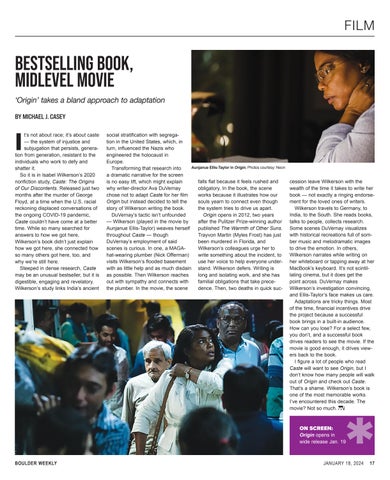
social stratification with segregation in the United States, which, in turn, influenced the Nazis who engineered the holocaust in Europe. Aunjanue Ellis-Taylor in Origin. Photos courtesy: Neon Transforming that research into a dramatic narrative for the screen falls flat because it feels rushed and is no easy lift, which might explain obligatory. In the book, the scene why writer-director Ava DuVernay works because it illustrates how our chose not to adapt Caste for her film souls yearn to connect even though Origin but instead decided to tell the the system tries to drive us apart. story of Wilkerson writing the book. Origin opens in 2012, two years DuVernay’s tactic isn’t unfounded after the Pulitzer Prize-winning author — Wilkerson (played in the movie by published The Warmth of Other Suns. Aunjanue Ellis-Taylor) weaves herself Trayvon Martin (Myles Frost) has just throughout Caste — though been murdered in Florida, and DuVernay’s employment of said Wilkerson’s colleagues urge her to scenes is curious. In one, a MAGAwrite something about the incident, to hat-wearing plumber (Nick Offerman) use her voice to help everyone undervisits Wilkerson’s flooded basement with as little help and as much disdain stand. Wilkerson defers. Writing is long and isolating work, and she has as possible. Then Wilkerson reaches familial obligations that take preceout with sympathy and connects with dence. Then, two deaths in quick sucthe plumber. In the movie, the scene
cession leave Wilkerson with the wealth of the time it takes to write her book — not exactly a ringing endorsement for the loved ones of writers. Wilkerson travels to Germany, to India, to the South. She reads books, talks to people, collects research. Some scenes DuVernay visualizes with historical recreations full of somber music and melodramatic images to drive the emotion. In others, Wilkerson narrates while writing on her whiteboard or tapping away at her MacBook’s keyboard. It’s not scintillating cinema, but it does get the point across. DuVernay makes Wilkerson’s investigation convincing, and Ellis-Taylor’s face makes us care. Adaptations are tricky things. Most of the time, financial incentives drive the project because a successful book brings in a built-in audience. How can you lose? For a select few, you don’t, and a successful book drives readers to see the movie. If the movie is good enough, it drives viewers back to the book. I figure a lot of people who read Caste will want to see Origin, but I don’t know how many people will walk out of Origin and check out Caste. That’s a shame. Wilkerson’s book is one of the most memorable works I’ve encountered this decade. The movie? Not so much.
ON SCREEN:
Origin opens in wide release Jan. 19
BOULDER WEEKLY
JANUARY 18, 2024
17
EVENTS
18
2024 BOULDER ECONOMIC FORECAST
4-7:30 p.m. Thursday, Jan. 18, Boulder JCC, 6007 Oreg Ave., Boulder. $75-$105
6:30-7:30 p.m. Thursday, Jan. 18, Dairy Arts Center, 2590 Walnut St., Boulder. Free
6:30-9 p.m. Friday, Jan. 19, Square State Skate, 5757 Arapahoe Ave., Unit B1, Boulder. $10
PARLANDO: THIRD THURSDAYS
Once a month, the lobby of the Dairy Arts Center turns into a concert hall with a special performance by students at the Parlando School of Musical Arts. Enjoy refreshments while you take in the music from this local nonprofit offering private lessons, group classes and workshops “for all instruments, ages and abilities.”
18
18
8:30-9:30 p.m. Thursday, Jan. 18, Fiske Planetarium and Science Center, 2414 Regent Drive, Boulder. $12
2-3 p.m. Thursday, Jan. 18, Boulder Public Library, 3595 Table Mesa Drive, Boulder. Free
Harry’s House Dome lights up under a sky of stars, lasers and other cosmic visuals during this immersive experience at the Fiske Planetarium. Fans of the British pop megastar won’t want to miss the show featuring hits like “Daylight,” “As It Was,” “Late Night Talking” and more.
JANUARY 18, 2024
19
Looking to start the year on the right fiscal foot? Get ahead of the curve at the 2024 Boulder Economic Forecast, with presentations on trends and statistics by nationally recognized economists and Colorado State Demographer Elizabeth Garner.
LIQUID SKY HARRY STYLES
18
18
SOCIAL STITCHERS
Got an itch to stitch? Join fellow fabric freaks and thread heads at Boulder Public Library for an hour of tea, coffee and conversation during this free community event. Knitters, crochetters, embroiderers and crossstitchers are all welcome to come work on personal projects during this monthly gathering.
GIRL SKATE NIGHT @ SQUARE STATE BOULDER
Ladies, it’s your time to shred. Come down to Square State — Boulder’s home for skateboarding camps, lessons and clubs — for a night of community building in a fun and affirming environment designed for ages 16 and up.
20
CELEBRATING COLORADO’S BLACK STREET ARTISTS
1:30-3 p.m. Saturday, Jan. 20, Museum of Boulder, 2205 Broadway, Boulder. $15 Street Wise Arts and the Museum of Boulder present this panel discussion in conjunction with the museum’s ongoing exhibition, Proclaiming Colorado’s Black History, on display through September 2025. Panelists include muralists Jahna Rae, Yazz Atmore, Devin “Speaks” Urioste, Rob Hill and Marcus Murray. BOULDER WEEKLY
EVENTS
day
Wednes
th
Jan 17
show timme 8:00p
ay
Thursd
th
Jan 18
20
MOMIX
7:30 p.m. Saturday, Jan. 20, Macky Auditorium Concert Hall, 1595 Pleasant St., Boulder. $24-$94 Moses Pendleton and his MOMIX dance troupe have been wowing audiences for more than 40 years. Now’s your chance to experience it for yourself during this local performance of Alice, inspired by Alice in Wonderland, complete with dazzling acrobatics, dance, gymnastics, mime, props and film.
show timme 8:00p
21
NICK FORSTER’S HIPPY BLUEGRASS CHURCH 10:30 a.m. Sunday, Jan. 21, eTown Hall, 1535 Spruce St., Boulder. $15
Bringing people together through music is the name of the game during Nick Forster’s Hippy Bluegrass Church. This beloved Boulder tradition features a live bluegrass band, poetry readings, storytelling and plenty of good vibes.
23
WHISKEY TASTING
6-7:30 p.m. Tuesday, Jan. 23, William Oliver’s, 201 N. Public Road, Lafayette. $23 The Brown-Forman collection stakes claim to some of the all-time classics — and you can indulge in national staples like Old Forester, Woodford Reserve and more during this tasting event with renowned connoisseur Matt Noble at William Oliver’s in Lafayette.
Friday
n 19th
Ja show timme 8:00p
ay
Saturd
0th
Jan 2
show timme 8:00p
Sunday
1st
Jan 2
show timme 8:00p
day
Wednes
4th
Jan 2
show timme 8:00p
ay
Thursd
5th
Jan 2
show timme 8:00p
Friday
6th
Jan 2
Katie Mintle In the Bar
Cris jacobs with earl nelson
ay
7th
Jan 2
20
SUPER DUPER GARAGE SALE
9 a.m.-4 p.m. Saturday, Jan. 20, Boulder County Fairgrounds, 9595 Nelson Road, Longmont. $5 Who doesn’t love a good garage sale? This annual odds-and-ends blowout features 100 vendors at the Boulder County Fairground for one day of shopping madness. Bring some cash and get ready to find that one-of-a-kind treasure you just can’t live without.
BOULDER WEEKLY
show timme 8:00p
22
DROP-IN WRITERS GROUP
6-7:30 p.m. Monday, Jan. 22, Longmont Library, 409 Fourth Ave., Longmont. Free Calling all writers! This weekly meeting group is a great way to grow your craft and connect with others in the process. Drop by the Longmont Public Library every Monday for “a thoughtful, intentional and inclusive space to gather around the art and craft of writing.”
25
PAINTED COLLAGE CLASS: FLOWER AND FAUNA 10 a.m.-2:30 p.m. Thursday, Jan. 25, The New Local, 741 Pearl St., Boulder. $150
Join instructor Carolann Wachter at the New Local in Boulder for a 18+ painting collage workshop exploring color, light, shapes and space with a floral focal point. All materials are included in the admission price, and no prior experience is needed.
Sunday
8th
Jan 2
show timme 8:00p
day
Wednes
st
Jan 31
show timme 8:00p
ay
Thursd
Fed 1st
show timme 8:00p
+ $4
Chuck sitero and liz patton In the Bar
Many Mountains In the Bar
Katie Mintle In the Bar
Matt flaherty In the Bar
Arkansauce with brandywine and the might Fines
Rootbeer Richie and
show timme the reveille with bleak mystique 8:00p
Saturd
$17 service charge
$15 + $4
service charge
$14 + $4
service charge
Lionel young duo In the Bar
Deva Yoder In the Bar
Bill Mckay In the Bar
Handmade Moments with andy babb and lara elle
$17 + $4
service charge
JANUARY 18, 2024
19
LIVE MUSIC THURSDAY, JAN. 18 just announced
just announced
mar 21 ...................................................... Próxima Parada / Oliver Hazard mar 30 ............................................................. Bear Hat + river SPell + aSter aPr 5 ................................................................................................... Kyle WatSOn aPr 19 ............................................................................................. SHadOWGraSS
mar 10 ............................................................................... HermanOS de lecHe
tHu. jan 18 urBan Field Pizza PreSentS
Sat. jan 20
tHe PamlicO SOund + izcalli
HaPPy HOur Feat. liz KHaliiFa Free at tHe lOunGe (BOulder tHeater)
liBelula FeaturinG Wrenn & ian, dj m3dium
Fri. jan 19
tHu. jan 25
tHe cOlO SOund, WeStWOrd & ParadiSe FOund PreSent
rOOSter PreSentS
dizGO
3420, tOadStOOl Fri. jan 26
StOP maKinG SenSe (mOvie) PSycHO Killer KOStume Party
rumOurS
cOlOradO SPrinGSteen
Sat. jan 27
Fri. jan 26
rOOSter PreSentS
tHunderBOOGie tHu. FeB 1
tHe rOcKy cOaStS BiG PincH, cO-Stanza Fri. FeB 2 PrOGram cOuncil PreSentS
Gimme Gimme diScO muSic OF aBBa, dOnna Summer, cHer & mOre Sat. FeB 3 rOOSter PreSentS
Steely dead
Free BeFOre 9Pm FOr 21+
WWW.FOXTHEATRE.COM
1135 13TH STREET BOULDER 720.645.2467
WINTER FEST 2.0: BRUINS WITH SPENDO, CATCH COOK, PAREDES, SOLEM, HAMI AND GASPY. 8 p.m. Fox Theatre, 1135 13th St., Boulder. $18
Sat. jan 20 WeStWOrd PreSentS: a triBute tO FleetWOOd mac
emO niGHt BrOOKlyn SQueaKy Feet & SQWerv
CRIS JACOBS WITH EARL NELSON. 8 p.m. Velvet Elk Lounge, 2037 13th St., Boulder. $17
BOULDER B-SIDES. 5 p.m. BOCO Cider, 1501 Lee Hill Drive, Unit 14, Boulder. Free
rOOSter & GrateFul WeB PreSent
SHaKedOWn Street’S 37 year anniverSary Free BeFOre 9Pm! Sat. jan 27
SILVER STEVEN WITH CELESTE ROSE. 6 p.m. Trident Cafe, 940 Pearl St., Boulder. Free
SKinny limBS, BaleK tHu. FeB 1
tHe cOlO SOund & WeStWOrd PreSent
racHael & vilray meGan Burtt
Sat. FeB 3 GOOdBye yeller BricK rOad, tHe Final tOur
leWiS BlacK
WWW.BOULDERTHEATER.COM 2032 14TH STREET BOULDER 303.786.7030
TONY CRANK. 6 p.m. Bootstrap Brewing Company, 142 Pratt St., Longmont. Free IN PLAIN AIR WITH CORSICANA, DETH RALI AND TARANTULA BILL. 8 p.m. Hi Dive, 7 S. Broadway, Denver. $12 ROB BAIRD WITH PARKER CHAPIN. 8 p.m. Globe Hall, 4483 Logan St., Denver. $16
CHARLEY CROCKETT (NIGHT 1). 8 p.m. Mission Ballroom, 4242 Wynkoop St., Denver. $45
BROKEN RECORD WITH QUITS, DESPAIR JORDAN AND HOOPER. 9 p.m. Hi Dive, 7 S. Broadway, Denver. $15 COAT CHECK COLLECTIVE. 9 p.m. Larimer Lounge, 2721 Larimer St., Denver. Free DONNERTHEGONNER. 9 p.m. Larimer Lounge, 2721 Larimer St., Denver. Free CHARLEY CROCKETT (NIGHT 2). 8 p.m. Mission Ballroom, 4242 Wynkoop St., Denver. $129
SATURDAY, JAN. 20 THE PAMLICO SOUND WITH IZCALLI, LIBELULA AND WRENN & IAN. 8 p.m. Fox Theatre, 1135 13th St., Boulder. $18 CULTURAL CARAVAN. 11 a.m. Boulder Public Library, 1001 Arapahoe Ave., Boulder. Free INTO THE NOTHING. 6 p.m. BOCO Cider, 1501 Lee Hill Drive, Unit 14, Boulder. Free
FRIDAY, JAN. 19
THE LOFTY PINES WITH DANNY RANKIN. 6 p.m. Trident Cafe, 940 Pearl St., Boulder. Free
CHUCK SITERO AND LIZ PATTON (OF HIGH LONESOME). 8 p.m. Velvet Elk Lounge, 2037 13th St., Boulder. Free
REX PEOPLES WITH XFACTR BAND. 6 p.m. Bootstrap Brewing Company, 142 Pratt St., Longmont. Free
ARI HEST. 8 p.m. Roots Music Project, 4747 Pearl, Suite V3A, Boulder. $20 DIVINO BETSATORI. 6 p.m. BOCO Cider, 1501 Lee Hill Drive, Unit 14, Boulder. Free SOPHIA ELIANA WITH SARAH ADAMS AND JOHN BREWSTER. 6 p.m. Trident Cafe, 940 Pearl St., Boulder. Free LOS CHEESIES. 6 p.m. Bootstrap Brewing Company, 142 Pratt St., Longmont. Free BW PICK OF THE WEEK MATT WIGLER BAND. 7 p.m. Muse Performance Space, 200 E. South Boulder Road, Lafayette. $20
JANUARY 18, 2024
WAVE DECAY WITH PALE SUN AND GALLERIES. 9 p.m. Hi Dive, 7 S. Broadway, Denver. $15
rOOSter & Party Guru PreSent
cHamPaGne driP
PRISMATIC WITH FIGMVNT, RAGE BOT AND X.STINCT. 8 p.m. Larimer Lounge, 2721 Larimer St., Denver. Free
20
META WEISS AND DAVID REQUIRO. 7:30 p.m. Center for Musical Arts, 200 E. Baseline Road, Lafayette. $20
RACHEL ALENA. 6:30 p.m. Oskar Blues Home Made Liquids & Solids, 1555 S. Hover St., Longmont. Free KATE FARMER WITH JONATHAN SADLER. 6:30 p.m. Stone Cottage Studios, 3091 7th St., Boulder. $30 ALLISON YOUNG QUARTET. 7 p.m. Muse Performance Space, 200 E. South Boulder Road, Lafayette. $20 TIERRO BAND WITH BRIDGET LAW AND RIVER MANN. 7 p.m. Caribou Room, 55 County Road 128W, Nederland. $20 MANY MOUNTAINS. 8 p.m. Velvet Elk Lounge, 2037 13th St., Boulder. Free
BOULDER WEEKLY
LIVE MUSIC
ON THE BILL
Say cheese! Local fun-forward fusion band Los Cheesies comes to Bootstrap Brewing Company in Longmont for a free show Jan. 19. Come see why Boulder Weekly editor-in-chief Shay Castle named the outfit as her favorite live act of 2023, and scan the QR code for an interview with bandleader Shawn Camden before you go. See listing for details.
RUMOURS WITH COLORADO SPRINGSTEEN. 8 p.m. Boulder Theater, 2032 14th St. $20 DREW DVORCHAK BAND WITH MOONRADISH AND STEPHEN LEAR BAND. 8 p.m. Globe Hall, 4483 Logan St., Denver. $15 THE TENNY MEN WITH SOUTHBOUND STRING BAND. 5 p.m. Larimer Lounge, 2721 Larimer St., Denver. $12 BEATS ANTIQUE WITH BALKAN BUMP. 8 p.m. Mission Ballroom, 4242 Wynkoop St., Denver. $35
SUNDAY, JAN. 21 NICK FORSTER’S HIPPY BLUEGRASS CHURCH. 10:30 a.m. eTown Hall, 1535 Spruce St., Boulder. $15 BEAR MORAN. 4 p.m. BOCO Cider, 1501 Lee Hill Drive, Unit 14, Boulder. Free MORPHEUS. 4 p.m. Bootstrap Brewing Company, 142 Pratt St., Longmont. Free PATRICK FRENCH WITH JACKSON MALONEY. 6 p.m. Trident Cafe, 940 Pearl St., Boulder. Free HAROLD SUMMEY (A TRIBUTE TO MAX ROACH). 7 p.m. Muse Performance Space, 200 E. South Boulder Road, Lafayette. $25
BOULDER WEEKLY
KATIE MINTLE. 8 p.m. Velvet Elk Lounge, 2037 13th St., Boulder. Free GREG KOCH WITH J.J. MURPHY. 8 p.m. Globe Hall, 4483 Logan St., Denver. $17 BLANKET SLUT WITH DRYERLINE, ANTONEGO AND THE PATRONS. 5 p.m. Larimer Lounge, 2721 Larimer St., Denver. $13 TRASH WITH BURY MIA, COMPASS & CAVERN AND CLEMENTINE. 8 p.m. Bluebird Theatre, 3317 E. Colfax Ave., Denver. $20
Winter ClearanCe Hundreds of Styles 25-50% Off!
TUESDAY, JAN. 23 SQUIRREL FLOWER WITH GOON AND LU LAGOON. 8 p.m. Larimer Lounge, 2721 Larimer St., Denver. $18. STORY ON P. 13
WEDNESDAY, JAN. 24 MATT FLAHERTY. 8 p.m. Velvet Elk Lounge, 2037 13th St., Boulder. Free TUMBLEDOWN SHACK. 6 p.m. Rosalee’s Pizza, 461 Main St., Longmont Free
Want more Boulder County events? Check out the complete listings online by scanning this QR code.
Comfortableshoes.com BOULDER On the Downtown Mall at 1425 Pearl St. 303-449-5260 & in The Village next to McGuckin 303-449-7440
DENVER Next to REI at 15th & Platte at 2368 15th St. 720-532-1084
The World’s Most Comfortable Brands of Shoes JANUARY 18, 2024
21
BOOKS
WHERE THE WILD THINGS ARE Littleton author shares tips on getting kids outside with new children’s book BY BART SCHANEMAN
B
oulder parents looking for the perfect place to take their kids outside don’t have to go farther than the National Center for Atmospheric Research (NCAR) on the southwest edge of the city. That’s according to Littleton-based author and journalist Jamie Siebrase, a trained community naturalist, mother of three and expert on exploring nature with her family. Siebrase doesn’t consider her family — which also includes her husband and a labradoodle — “super adventurous,” but they like to hike and mountain bike and climb “easy” routes. Siebrase says the NCAR area checks all the boxes for a great familyfriendly location because it has ample hiking trails of varying difficulty. And if the little hikers don’t feel like continuing, the family can change course and head inside the center for plenty of activities and interactive displays to keep everyone entertained. Having a flexible mindset is key to successful outings for parents trying to enjoy the outdoors with their children, according to Siebrase. “When I’m hiking, especially with young kids, I can’t be concerned with finishing,” she says. “I try not to have too much of a plan, because if everyone’s miserable we’re just going to turn around and do something else.” Siebrase loves NCAR so much for parents that she has an entire chapter dedicated to it in the guidebook she’s working on. She’s written two others: Hiking with Kids Colorado: 52 Great Hikes for Families and Mythbusting the Great Outdoors: What’s True and What’s Not? She freelances for local publications including The Denver Post and Westword as well. Around the Boulder area, she also recommends taking kids to the Mount Sanitas area. You can do a short, flat loop or go to the summit if the family is
22
JANUARY 18, 2024
ready for that. She enjoys Eldorado Canyon and Flatiron Vista. “I like to find places where I can find wildlife and a good view,” she says. “I also like loops better than out-andback because they entertain the kids the whole time.”
COLORADO ANIMAL FAMILIES
Siebrase’s most recent project is children’s book Tonight!: A Bedtime Book, published in 2023 by Muddy Boots, an imprint of Rowman & Littlefield. Featuring animals from the Rocky Mountain region, the book is about a little boy who imagines himself as a different critter each night as his mother attempts to put him to bed. As the boy evokes the world of mountain lions, bighorn sheep, moose and more, his mother teaches him about these animals and their habitats. “I wanted the book to have a national audience,” Siebrase says. “But also, I live in Colorado, and I love Colorado. I wanted to honor where I am geographically.” The book is illustrated by Eric Parrish, an Erie-based artist. The drawings are tender, adorable portraits of the animals in their natural environments along with poignant bedroom scenes. Siebrase says she started working on the book when her now 11-year-old son was about 2 years old and needed a story every night to get to sleep. Siebrase was stressed and tired all the time but couldn’t sleep. “I was just a mom at home with two boys,” she says. “I had really bad postpartum depression after my second son was born. I would be putting my younger son to bed, and all I wanted was to be in my own bed and be alone, and he would be doing these goofy things to keep me up. That’s where the book came from: my love
Courtesy: Jamie Siebrase
for my son and also just sheer exhaustion.” As her children got older and she had to homeschool them during the COVID-19 pandemic, Siebrase taught them more about the outdoors and wildlife. “The pandemic was what really opened me up to understanding that I don’t have to be a full-time homeschool mom to be teaching my kids stuff every day about the things I’m interested in,” she says. Siebrase is also quick to point out that this book isn’t exclusive to mothers and sons. She says the themes apply to fathers and daughters or any other parenting dynamic. Siebrase will speak about and sign her book Tuesday, Jan. 23 at 5:30 p.m. at Boulder Book Store. She’ll be bringing snacks and crafts for kids to make it a little more engaging than a typical reading. “I have had so much more fun promoting this book than any of my other ones,” she says. “Kids are just so fun to be around.”
LEAVE NO TRACE
At the back of the book, Siebrase includes wildlife viewing tips for first-timers, including how to be a “backyard explorer” and find animals close to home. “Even big cities provide habitat for
wildlife,” she writes, “and some creatures develop incredible adaptations for thriving in urban areas.” Siebrase also provides advice on how to increase the odds of catching animals being active, like paying attention to trail intersections, investigating at dawn or dusk and exploring wildlife sanctuaries or animal refuges. Joining groups such as the Audubon Society or visiting local nature centers are also good strategies for families looking to spot wildlife. Siebrase pitched a sequel to Tonight! to her editor that she’s hoping to get accepted. She also has a few other children’s book manuscripts she’s working on, as well as a novel. Her next goal is to get certified by Leave No Trace, an organization that teaches people how to minimize their impacts on the outdoors. Siebrase would like to incorporate that training into her writing. “It’s so important to enjoy the outdoors responsibly,” she says.
ON THE PAGE: Tonight!:
A Bedtime Book reading with Jamie Siebrase. 5:30 p.m. Tuesday, Jan. 23, Boulder Book Store, 1107 Pearl St., Boulder. Free
BOULDER WEEKLY
SCREEN
STAGE TURNER Playwright Steven Dietz on his Colorado roots and ‘What Happens Later’ BY GREGORY WAKEMAN
P
rolific playwright Steven Dietz has many connections with Colorado. The most obvious is that he was born and raised in southwest Denver, attended John F. Kennedy High School and went to college at the University of Northern Colorado in Greeley. Without the Denver Center for the Performing Arts Theater Company, where Dietz directed in the late ’80s and early ’90s, there wouldn’t be What Happens Later. Co-written, directed by and starring Meg Ryan, the romantic comedy is a film adaptation of Dietz’s play Shooting Star. “[The Denver Center Theater Company] commissioned Shooting Star and did the very first reading of it as part of their new play program in 2008,” Dietz says. The play ended up premiering in Austin, where Dietz now lives for half the year, spending the other half in Seattle. The big-screen adaptation was retitled What Happens Later. It tells the story of Willa (Meg Ryan) and Bill (David Duchovny), two exes who bump into each other when their flights are diverted to an airport because of a blizzard. The pair spend the night catching up, butting heads and revealing whether or not they managed to achieve their dreams. “[Ryan] really understood how magical and charged it is to be trapped with someone from your past. It’s surreal to reunite with someone who knew you so well. They knew your dreams and they’re still holding you to that. They’re rooting for you,” Dietz says. “She saw that the story is about the gulf between who we were and who we are now.””
‘A DENVER BOY AT HEART’ While Dietz’s dreams of becoming a playwright and working on the stage were established in Colorado, it was only after he moved to Minneapolis BOULDER WEEKLY
with a UNC degree in theater arts that he started to make huge strides in the profession. There he worked as a writer and director of new plays at The Playwrights’ Center and at various local theaters around the city. Dietz was delighted Starring Meg Ryan and David Duchovny, What Happens Later is a rom-com film adaptation of the stage production that his works were Shooting Star by Colorado-born playwright Steven Dietz. Courtesy: Bleecker Street picked up by theater “My career has been made by Being from Colorado has had a companies across Denver, where he regional theaters. I can either be envimajor impact on Dietz’s voice as a writalso soon began to work. ous about [plays on Broadway], or I er, especially when compared to his “You don’t want to disappoint your can do my work right. I don’t have any peers from New York and Los Angeles. hometown. You want to do right by the place to be envious, because I’ve had “Playwright buddies of mine that grew place that made you,” he says. “I still such good fortune,” he says. “I think up on the East Coast have a certain have big ties to Denver. I’m there a early on, writers are going to try to edge and energy. West coast buddies couple of times a year. I have family gauge themselves on, ‘Well nothing’s have a laconic cool. I feel like I’m in the members across the state. I’m a happening to me on the coast.’ They middle. I think there’s something open Denver boy at heart.” and optimistic about [my writing]. should just do their work.” While Dietz is the first to acknowlI’ve been both praised and edge that getting arts funding is accused of being an optimist.” becoming more and more difficult, That hasn’t stopped Dietz especially after the pandemic, he from having a hugely impressive knows more than most about the career as a playwright. He has immense “artistic riches” that are availrepeatedly been listed by able in smaller cities. American Theater as one of the “I would just encourage my play20 most-produced playwrights in wright comrades to be on the radar of America. While the likes of their local theaters. I know there’s Fiction, Trust, Lonely Planet and great writers there. I would encourage God’s Country might not have them to make use of the beautiful been produced on Broadway, places where they live,” he says. Dietz’s reputation has instead been built up in regional theaters “Because the people and audiences there are dynamic, highly educated across the United States, in citand passionate. What stories haven’t ies like Chicago, Seattle, been told there? What stories need to Minneapolis, Austin, Milwaukee, be told? You have to make your work Phoenix, Pittsburgh and, of where you are.” course, Denver. Dietz is deeply grateful for “the commitment that regional theaters have made to [him] around ON SCREEN: What the country.” He also believes Happens Later is streaming that more emerging and aspiring Celebrated playwright Steven Dietz earned a degree in now on Amazon Prime. playwrights should pay attention theater arts from the University of Northern Colorado in to those local opportunities. Greeley. Courtesy: Steven Dietz JANUARY 18, 2024
23
WE ARE BOULDER COUNTY! INDEPENDENT & LOCALLY OWNED SINCE 1993 For advertising information call 303.494.5511 www.BoulderWeekly.com
ASTROLOGY BY ROB BREZSNY ARIES (MARCH 21-APRIL 19): Aries chemist Percy Julian (1899–1975) was a trailblazer in creating medicine from plants. He patented over 130 drugs and laid the foundation for the production of cortisone and birth control pills. Julian was also a Black man who had to fight relentlessly to overcome the racism he encountered everywhere. I regard him as an exemplary member of the Aries tribe, since he channeled his robust martial urges toward constructive ends again and again and again. May he inspire you in the coming weeks, dear Aries. Don’t just get angry or riled up. Harness your agitated spirit to win a series of triumphs. TAURUS (APRIL 20-MAY 20): Taurus actor Pierce Brosnan says, “You struggle with money. You struggle without money. You struggle with love. You struggle without love. But it’s how you manage. You have to keep laughing, you have to be fun to be with, and you have to live with style.” Brosnan implies that struggling is a fundamental fact of everyday life, an insistent presence that is never far from our awareness. But if you’re willing to consider the possibility that his theory may sometimes be an exaggeration, I have good news: The coming months could be less filled with struggle than ever before. As you deal with the ease and grace, I hope you will laugh, be fun to be with, and live with style — without having to be motivated by ceaseless struggle. GEMINI (MAY 21-JUNE 20): Gemini author and activist William Upski Wimsatt is one of my role models. Why? In part, because he shares my progressive political ideals and works hard to get young people to vote for enlightened candidates who promote social justice. Another reason I love him is that he aspires to have 10,000 role models. Not just a few celebrity heroes but a wide array of compassionate geniuses working to make the world more like paradise. The coming weeks will be an excellent time for you to gather new role models, dear Gemini. I also suggest you look around for new mentors, teachers and inspiring guides.
Free
Water for a Month
Taste The Difference Think all water tastes the same? See why Eldorado Natural Spring Water keeps winning awards for taste.
Try Eldorado Natural Spring Water Today! Enter code BW21 at checkout
www.EldoradoSprings.com • 303.604.3000
24
JANUARY 18, 2024
CANCER (JUNE 21-JULY 22): I want you to fulfill your desires! I want you to get what you want! I don’t think that yearnings are unspiritual indulgences that divert us from enlightenment. On the contrary, I believe our longings are sacred homing signals guiding us to our highest truths. With these thoughts in mind, here are four tips to enhance your quests in the coming months: 1. Some of your desires may be distorted or superficial versions of deeper, holier desires. Do your best to dig down and find their heart source. 2. To help manifest your desires, visualize yourself as having already accomplished them. 3. Welcome the fact that when you achieve what you want, your life will change in unpredictable ways. You may have to deal with a good kind of stress. 4. Remember that people are more likely to assist you in getting what you yearn for if you’re not greedy and grasping. LEO (JULY 23-AUG. 22): I regard Leo psychologist Carl Jung (1875–1961) as a genius with a supreme intellect. Here’s a quote from him that I want you to hear: “We should not pretend to understand the world only by the intellect; we apprehend it just as much by feeling. Therefore, the judgment of the intellect is, at best, only the half of truth, and must, if it be honest, also come to an understanding of its inadequacy.” You may already believe this wisdom in your gut, Leo. But like all of us, you live in a culture filled with authorities who value the intellect above feeling. So it’s essential to be regularly reminded of the bigger truth—especially for you right now. To make righteous decisions, you must respect your feelings as much as your intellect. VIRGO (AUG. 23-SEPT. 22): Poet Rainer Maria Rilke exalted the physical pleasure that sex brings. He mourned that so many “misuse and squander this experience and apply it as a stimulant to the tired spots of their
lives and as a distraction instead of a rallying toward exalted moments.” At its best, Rilke said, sex gives us “a knowing of the world, the fullness and the glory of all knowing.” It is a sublime prayer, an opportunity to feel sacred communion on every level of our being. That’s the erotic experience I wish for you in the coming weeks, Virgo. And I believe you will have an expanded potential for making it happen. LIBRA (SEPT. 23-OCT. 22): Even if you are currently bonded with a spouse or partner, I recommend you consider proposing matrimony to an additional person: yourself. Yes, dear Libra, I believe the coming months will be prime time for you to get married to your own precious soul. If you’re brave enough and crazy enough to carry out this daring move, devote yourself to it with lavish abandon. Get yourself a wedding ring, write your vows, conduct a ceremony, and go on a honeymoon. If you’d like inspiration, read my piece, “I Me Wed” at tinyurl. com/SelfMarriage SCORPIO (OCT. 23-NOV. 21): Talking about a problem can be healthy. But in most cases, it should be a preliminary stage that leads to practical action; it shouldn’t be a substitute for action. Now and then, however, there are exceptions to this rule. Mere dialogue, if grounded in mutual respect, may be sufficient to dissolve a logjam and make further action unnecessary. The coming days will be such a time for you, Scorpio. I believe you and your allies can talk your way out of difficulties. SAGITTARIUS (NOV. 22-DEC. 21): Sagittarian cartoonist Charles M. Schulz wrote, “My life has no purpose, no direction, no aim, no meaning, and yet I’m happy. I can’t figure it out. What am I doing right?” I suspect that in 2024, you may go through a brief phase similar to his: feeling blank yet quite content. It won’t last. Eventually, you will be driven to seek a passionate new sense of intense purpose. As you pursue this reinvention, a fresh version of happiness will bloom. For best results, be willing to outgrow your old ideas about what brings you gladness and gratification. CAPRICORN (DEC. 22-JAN. 19): We all go through phases that feel extra plodding and pedestrian. During these times, the rhythms and melodies of our lives seem drabber than usual. The good news is that I believe you Capricorns will experience fewer of these slowdowns than usual in 2024. The rest of us will be seeing you at your best and brightest on a frequent basis. In fact, the gifts and blessings you offer may flow toward us in abundance. It’s no coincidence if you feel exceptionally well-loved during the coming months. PS: The optimal way to respond to the appreciation you receive is to ratchet up your generosity even higher. AQUARIUS (JAN. 20-FEB. 18): In the fall of 1903, The New York Times published an article that scorned human efforts to develop flying machines. It prophesied that such a revolutionary technology was still at least a million years in the future — possibly 10 million years. In conclusion, it declared that there were better ways to apply our collective ingenuity than working to create such an unlikely invention. Nine weeks later, Orville and Wilbur Wright disproved that theory, completing a flight with the airplane they had made. I suspect that you, Aquarius, are also primed to refute an expectation or prediction about your supposed limitations. (Afterward, try not to gloat too much.) PISCES (FEB. 19-MARCH 20): Your sweat and tears are being rewarded with sweets and cheers. Your diligent, detailed work is leading to expansive outcomes that provide relief and release. The discipline you’ve been harnessing with such panache is spawning breakthroughs in the form of elegant liberations. Congrats, dear Pisces! Don’t be shy about welcoming in the fresh privileges flowing your way. You have earned these lush dividends.
BOULDER WEEKLY
SAVAGE LOVE BY DAN SAVAGE
Stressed Out? Think Massage! Call 720.253.4710
All credit cards accepted No text messages
I am a 34-year-old gay man who immigrated to Canada from a Latin American country a few years ago. I immigrated with my husband of eight years. We had been monogamous, and we never questioned it. However, the sex was never great. Not even at the beginning. About a year ago, I got on Grindr without my husband knowing. I met a man and his husband. Their relationship was open, and they invited me over. After that one threesome, we decided to just be friends and we even hung out as couples with my husband. I started to develop feelings for the person I originally connected with on Grindr. We continued to have mind-blowing sex, just the two of us. Four months later, both our partners discovered our affair. The other couple decided to divorce, but my husband and I decided to work through it. But the affair continued. My husband is not willing to be more sexual, he is not willing to allow me to top him, he will not go down on me, and he refuses to let me have sex elsewhere. I have been patient and mindful of his needs and struggles, but he gets annoyed each time I talk about this or ask him to read a book about open relationships. He has agreed to talk to a therapist about the possibility of being open, but I don’t know how much longer I should wait. Should I be patient with my husband since sex is the only thing that does not work between us? — Staying Over Straying
Don’t drag this out. You’ve already opened your marriage, SOS, and you have no intention of closing it again. You’re still fucking the other man. While you don’t explicitly state that your husband is unaware the affair continues, the fact that you still describe it as an affair suggests your husband doesn’t know. And based on your actions over the last year, I really don’t think you wanna stay in this marriage. To recap: You cheated on your husband with a married couple and then encouraged your husband to socialize with that couple and then started fucking one of those guys behind his husband’s back and yours. That kind of double-barreled betrayal isn’t something a marriage typically survives — your affair partner’s open marriage didn’t survive a lesser betrayal — and the fact that you’re still slamming your dick down on the self-destruct button, i.e., fucking this other guy, is evidence that what you want is out. Sexual compatibility is crucially important in sexually exclusive relationships. The sex doesn’t work between you and your husband, it never has, and it’s unlikely it ever will. You could live with that for a while — you did live with it for a while — but you’re not willing to settle anymore. You’ve been doing the wrong thing for a while now, SOS, but it’s not too late to do the right thing: Honestly ask for the divorce you clearly want, SOS, instead of manipulating your husband into giving it to you.
Send your burning questions to mailbox@savage.love Podcasts, columns and more at Savage.Love BOULDER WEEKLY
February 2 - 4, 2024
Boulder Weekly Market
New merchants and specials added regularly Check it out so you can start saving!
An online market for discounts on local dining & retail up to 30% off
bestofboulderdeals.kostizi.com Go to website to purchase JANUARY 18, 2024
25
Kanpai! E AT a taste of modern Japan in the heart of beautiful Boulder DR I N K an unmatched selection of rare whiskey, sake, and craft cocktails E NJOY the scenery on one of our 3 fireside patios, a feast alongside the jellyfish, or a front row seat at a lively bar
Sun-Thur 11am to 10pm | Fri-Sat 11am to 11pm BoulderJapango.com | 303.938.0330 | 1136 Pearl
JapangoRestaurant
JapangoBoulder
Winner of Best Slice! • BEST PIZZA SLICE • BEST FOOD DELIVERY • BEST LATE NIGHT We DeLiVeR TO GuNBARReL/ LOuiSViLLe eVeRY NiGHT! Online ordering at www.cosmospizza.com
Download our app for great deals on your favorite pizza!
659 30th Street Williams Village • Free Delivery 303-447-FAST (3278) 3117 28th Street North Boulder • Free Delivery 303-442-FAST (3278) 520 W South Boulder Rd Lafayette • Free Delivery 720-598-FAST (5123)
NIBBLES
TOUR DE SKRATCH Boulder cafe finds fresh ways to feed athletes and other sweaty people BY JOHN LEHNDORFF
D
r. Allen Lim is a study in perpetual motion as he wends his way through Skratch Labs Cafe, greeting familiar diners and delivering plates of rice cakes, salads and bowls. When he finally sits down for a meal at the downtown Boulder eatery, Lim is animated and engaged. “I definitely never set out to be in the food business,” he says. “I had no desire to be an entrepreneur. I just wanted to help athletes, which to me is anyone who works up a sweat.” In cycling circles, Lim — a longtime local athlete, exercise scientist and chef — is revered for his work feeding and coaching professionals on the Tour de France and the Pro Cycling Tour. Athletes and active people know Boulder-based Skratch Labs for its popular line of sports hydration powders, mixes and snacks, but its founder had bigger goals in mind at his year-old Pearl Street eatery. “We were making certain products for convenience,” Lim says, “but I didn’t want to ignore the fact that sports nutrition really starts in the home kitchen.”
THE POWER OF COMMENSALITY
Working with athletes, Lim came to an aha moment: “I realized that social interaction mattered as much to their performance and mental health as the chemical fuel,” he says. He became a devout believer in commensality, the power of simply gathering around the table to eat. The act of dining as a group has fallen on hard times in the United States, especially during and since the pandemic. Lim’s clients weren’t particularly enthusiastic about his Kumbaya approach on tour. “You see a lot of disordered eating,” he says. “The biggest red flag is eating by yourself. We had to make it mandatory to eat together.”
Dr. Allen Lim at Boulder’s Skratch Labs Cafe. Photo credits: Skratch Labs Cafe
Lim points to the famous Framingham Heart Study which concluded that the biggest risk factor for heart disease after smoking is loneliness. Other studies highlight the benefits to kids who regularly eat meals with their parents. “In a culture built on independence where loner-ism is celebrated, it’s hard to sell togetherness,” he says. “But we discovered that our team dinners were core to maintaining athletic performance.” Lim’s insistence that the pro cyclists dine together on the tour evolved into a food truck which he drove to cycling events, then to three cookbooks written with chef Biju Thomas, launching a company supplying products to athletes, and finally a cafe in Boulder.
A PLACE TO EAT TOGETHER
Lim opened the Skratch Labs Cafe in 2023 as a place where the community could eat together and connect. The menu features veggie and rice bowls topped with fried chicken or baked tofu, soups and coffee drinks from Boulder’s bike-oriented Coffee Ride. The sweets range from fruit-filled hand pastries to cookies infused and fortified with Skratch’s supplemental mixes. Fresh rice cakes are a unique item on the cafe’s lineup. These are not those dry, crispy crackers but rather BOULDER WEEKLY
warm squares of rice filled with a variety of ingredients. Lim says the breakfast rice square with pork belly and eggs was inspired by the banana-leaf steamed rice dishes beloved in many Asian cuisines. “I’m unabashedly in favor of highquality carbs like rice,” he says. “Those are the key to endurance.” His website and cookbooks offer simple variations on the rice cakes designed to provide cost-effective, highenergy and easy to consume portions.
INVESTING IN DINNERS TOGETHER
Like getting to the gym on a frigid January evening, enjoying the benefits of commensality is not easy. “Shopping, cooking, setting the table and cleaning up take time,” Lim says. “You have to plan and take it seriously. It’s too hard to do otherwise, because it’s a longtime commitment, not something you do once.” The way to deal with performance pressure — whether over a race or the thought of feeding people at your house — is to keep it simple. “It doesn’t need to be perfect,” he says. “It just needs to be dinner, rice and beans with friends.” Lim’s best performance hack is simple: Share more meals, whether it’s at home or a local bistro. “It brings happiness,” he says with a broad smile. For Allen Lim’s Skratch recipes, visit skratchlabs.com. JANUARY 18, 2024
27
NIBBLES
HOME COOK CLASSES WITH ESCOFFIER
LOCAL FOOD NEWS: POLLO TICO CLOSES The Oscars of the American prepared food world, the Good Food Awards, announced its 2024 finalists in various categories. Familiar local nominees include Bibamba Artisan Chocolate, Snow Capped Cider, Pastificio, Mountain Girl Pickles, Spark + Honey Granola and Full Stop Bakery. Chef Byron Gomez, the former “Top Pastaficio zucca pasta. Chef” contestant, has closed his Pollo Tico Credit: Pastaficio, Boulder spot at Boulder’s Avanti Food & Beverage. Quiero Arepas, formerly part of Avanti’s lineup, will reopen there in the spring. All three locations of Whole Sol Blend Bar, including at 29th Street in Boulder, will close Jan. 19. The original Jax Fish House will be closed through Feb. 1 for remodeling as the eatery prepares for its 30th anniversary later this year.
Sign up for your next class or book an event with us! Boulder, CO
720.457.9613
www.escoffier.edu/homecook
WORDS TO CHEW ON: BUILD A PIE LEGACY
Voted East County’s BEST Gluten Free Menu
“Nothing is better than taking the pie out of the oven. What it does for you personally, and for your family’s idea of you, is something you can’t buy.” — Martha Stewart Jan. 23 is National Pie Day, a holiday created by Charlie Papazian in Boulder in 1975. John Lehndorff was the founding Executive Director of the American Pie Council and Chief Judge at the National Pie Championships.
130 years ago, the Five Pie Pedestrian Club hiked to Boulder Falls and ate pie. Credit: Carnegie Library for Local History
Order Online at morningglorylafayette.com New Hours: Mon 7:30am - 3pm • Tuesday Closed • Wed-Sun 7:30am - 3pm
Send information about upcoming culinary events and classes to nibbles@boulderweekly.com
303.604.6351 | 1377 FOREST PARK CIRCLE, LAFAYETTE 28
JANUARY 18, 2024
BOULDER WEEKLY
S I M P L E
|
L O C A L
|
FA R M
T O
TA B L E VOTED
BEST AMERICAN RESTAUR ANT
5 7 8 B r i g g s S t re e t E r i e, C O 8 0 5 1 6 303.828.1392
BRUNCH
S AT & SU N 9 AM - 2 PM
LUNCH
TUE-FRI 11AM-2PM
DINNER
TUE-SUN 4:30PM-9PM
R E S E RVAT I O N S AVA I L A B L E ONLINE
www.24carrotbistro.com
Welcome to
Gondolier italian eatery Where going out feels like cominG Home
Gondolier Longmont 1217 South Main St. 720-442-0061
Gondolier Boulder 4800 Baseline Rd. 303-443-5015
Dine-in, Take out & Large groups
gondolieritalianeatery.com
Start 2024 with a virtual ride around the sun with
The Deadhead Cyclist The
Cyclist Without love in the dream Don’t lend your hand
We wiil survive We are on our own
The wonders of nature It ain’t never gonna end
MORE FUN TRAILS
Life Lessons on Two Wheels to the TUNES of the Grateful Dead
STEW SALLO
• Volunteer to build/maintain trail • Meet up for a Group Ride • Come out for a Skills Clinic Connect with the Boulder mountain bike community Join (BMA membership) to support our programs Join BMA today and access social events and group rides--
bouldermountainbike.org
bouldermountainbike.org
Each of the book’s 52 chapters includes a This Week In Grateful Dead History concert pick, along with a Life Lesson from a lyric performed at that concert.
Order your personalized, signed copy at the official Deadhead Cyclist website by scanning the QR Code
deadheadcyclist.com
WEED
FUN RUN Weed can make exercise more enjoyable, but it’s not a performance enhancer BY LISA MARSHALL CU BOULDER TODAY
A
bit of weed before a workout can boost motivation and make exercise more enjoyable. But if performance is the goal, it may be best to skip that joint. That’s the takeaway of the first ever study to examine how legal, commercially available cannabis shapes how exercise feels. The study of 42 runners, published Dec. 26 in the journal Sports Medicine, comes almost exactly 10 years after Colorado became the first state to commence legal sales of recreational marijuana, at a time when cannabis-users increasingly report mixing it with workouts. “The bottom-line finding is that cannabis before exercise seems to increase positive mood and enjoyment during exercise, whether you use THC or CBD. But THC products specifically may make exercise feel more effortful,” says lead author Laurel Gibson, a research fellow with CU’s Center for Health and Addiction: Neuroscience, Genes and Environment (CU Change). The findings, and previous research by the team, seem to defy long-held
BOULDER WEEKLY
stereotypes that associate cannabis with “couch-lock” and instead raise an intriguing question: Could the plant play a role in getting people moving? “We have an epidemic of sedentary lifestyle in this country, and we need new tools to try to get people to move their bodies in ways that are enjoyable,” says senior author Angela Bryan, a professor of psychology and neuroscience and co-director of CU Change. “If cannabis is one of those tools, we need to explore it, keeping in mind both the harms and the benefits.”
A FIRST-OF-A-KIND STUDY
For the study, Bryan and Gibson recruited 42 Boulder-area volunteers who already run while using cannabis. After a baseline session, in which the researchers took fitness measurements and survey data, they assigned participants to go to a dispensary and pick up either a designated flower strain that contained mostly cannabidiol (CBD) or a Tetrahydrocannabinol (THC)-dominant strain. On one follow-up visit, volunteers ran on a treadmill at a moderate pace for 30 minutes, answering questions
periodically to assess how motivated they felt, how much they were enjoying themselves, how hard the workout felt, how quickly time seemed to pass and their pain levels. On another visit, they repeated this test after using cannabis.
NOT A PERFORMANCEENHANCING DRUG
Across the board, participants reported greater enjoyment and more intense euphoria, or “runner’s high,” when exercising after using cannabis. Surprisingly, this heightened mood was even greater in the CBD group than in the THC group, suggesting athletes may be able to get some of the benefits to mood without the impairment that can come with THC. Participants in the THC group also reported that the same intensity of running felt significantly harder during the cannabis run than the sober run. This may be because THC increases heart rate, Bryan says. In a previous study conducted remotely, she and Gibson found that while runners felt more enjoyment under the influence of cannabis, they ran 31 seconds per mile slower.
A DIFFERENT KIND OF RUNNER’S HIGH
While natural, pain-killing endorphins have long been credited with the famous “runner’s high,” newer research suggests that this is a myth. Instead, naturally produced brain
WHY DO PEOPLE MIX WEED AND WORKOUTS? 90.5% say it increases enjoyment 69% say it decreases pain 59.5% say it increases focus 57.1% say it increases motivation 45.2% say it makes time go faster 28.6% say it improves performance Source: Survey of study participants
chemicals known as endogenous cannabinoids are likely at play, kicking in after an extended period of exercise to produce euphoria and alertness. By consuming CBD or THC, cannabinoids that bind to the same receptors as the cannabinoids our brain makes naturally, athletes might be able to tap into that high with a shorter workout or enhance it during a long one, Gibson says. For someone gunning for a fast 5k or marathon PR, it doesn’t really make sense to use beforehand, Bryan says. But for an ultrarunner just trying to get through the grind of a double-digit training run, it might. As a public health researcher, Bryan is most interested in how it could potentially impact those who struggle to exercise at all, either because they can’t get motivated, it hurts, or they just don’t like it. “Is there a world where taking a low-dose gummie before they go for that walk might help? It’s too early to make broad recommendations but it’s worth exploring,” she says.
JANUARY 18, 2024
31
$59
1/2 OZ OTD
PREMIER SHELF
3390 28TH ST, BOULDER
THANK YOU FOR VOTING FOR US!
BEST MOVING COMPANY
Best Thai Restaurant & Best asian fusion 8 YEARS IN A ROW
Family Owned & Operated
133 S. MCCASLIN BLVD, LOUISVILLE 303-665-0330
COME SEE WHAT WE’VE BEEN GROWING
Follow us on instagram! @freerangemovers
4800 BASELINE RD, A-110, BOULDER 1325 Dry Creek Dr. #Ste 106, 720-350-4927 Longmont, CO WWW.BUSABACO.COM
303) 834-9160 www.anchanthai.menu LIKE US ON FACEBOOK
www.freerangemovers.com
720-829-7009
GROWN
LOVE
NATIVEROOTSCANNABIS.COM
JOIN US FOR WALLEYE WEEKENDS! Direct to us from Red Lake Nation Fishery, MN (720) 630-8053 • 11am-9pm
Atlas Valley Center, SW corner of Arapahoe and 95th
www.eatreelfish.com
Met Your Soul Drum Yet?
TWENTY LOCATIONS! FIND ONE NEAR YOU
HAND DRUMS, DRUM SETS, AND LESSONS FOR$6 KIDSOTDOF ALL AGES.
Ript The Drum GummiesShop 100mg 3070 28th20% St., Boulder off 303-402-0122 Topicals
Taste for yourself Ask about our 30 day free trial 303-604-3000 www.eldoradosprings.com
JANUARY SPECIALS OCTOBER SPECIALS ALL MONTH LONG
Thursday 18 20 Sunday Sunday21 1 Monday Monday22 2 Tuesday Tuesday23 3 Wednesday Wednesday24 4 28 Friday 19 29 Saturday 30 22 for $65 Buy Buy Buy for $70 $80 $80 OTDOTD 2 for 1g for 4 for KUSH& SEED your max your max your max Bud-Buster Bud-Buster $38 MASTERS $45 OTD Ounces $16 OTD SMITH (28g) (28g) (28g) Live Resin 1G 14er& 1g Live Resin Wax Ript 2 Ounces for $50 Carts Carts Rosin SPIN THE SPIN THE SPIN THE 5 for 14er Shatter Gummies Gummies $25 2 for $50 WHEEL Select Brands WHEEL WHEEL FLOWER OTD 1/8THS CHEECH SEED && 20% off off 2g $26 5 for $25 FOR A FOR A 20% FOR A MAGIC CITY CHONG SMITH & SMITH CITY Topicals SEED Live Resin 1g Distillate PRIZE MAGIC PRIZE Topicals Suger Wax PREROLLS PRIZE Pre-rolls Carts Carts
BUY YOUR MAX (28g)
SPIN THE WHEEL FOR A PRIZE
206 720-487-9229 •• www.spacestationdispensary.com www.spacestationdispensary.com 206 South South Main Main St. St. Longmont Longmont •• 720-487-9229
Buy your your max max $80 $80 OTD OTD Buy Bud-Buster SPIN THE SPIN THE Bud-Buster Ounces WHEEL FOR FOR Ounces WHEEL AA PRIZE PRIZE $4 OTD OTD $4 SlopeSide
for $45 $45 44 for OTD OTD
Wax & & Wax Shatter Shatter 2 for
2 for $35 OTD