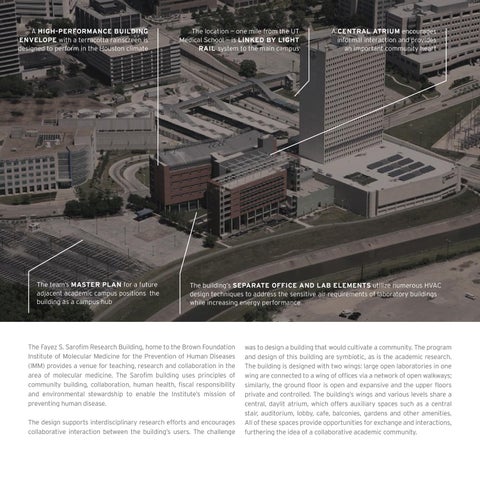
A high-performance building envelope with a terracotta rainscreen is designed to perform in the Houston climate
The team’s master plan for a future adjacent academic campus positions the building as a campus hub
The location — one mile from the UT Medical School — is linked by light rail system to the main campus
A central atrium encourages informal interaction and provides an important community heart
The building’s separate office and lab elements utilize numerous HVAC design techniques to address the sensitive air requirements of laboratory buildings while increasing energy performance
The Fayez S. Sarofim Research Building, home to the Brown Foundation Institute of Molecular Medicine for the Prevention of Human Diseases (IMM) provides a venue for teaching, research and collaboration in the area of molecular medicine. The Sarofim building uses principles of community building, collaboration, human health, fiscal responsibility and environmental stewardship to enable the Institute’s mission of preventing human disease. The design supports interdisciplinary research efforts and encourages collaborative interaction between the building’s users. The challenge
was to design a building that would cultivate a community. The program and design of this building are symbiotic, as is the academic research. The building is designed with two wings: large open laboratories in one wing are connected to a wing of offices via a network of open walkways; similarly, the ground floor is open and expansive and the upper floors private and controlled. The building’s wings and various levels share a central, daylit atrium, which offers auxiliary spaces such as a central stair, auditorium, lobby, cafe, balconies, gardens and other amenities. All of these spaces provide opportunities for exchange and interactions, furthering the idea of a collaborative academic community.