Family FELIDAE
Caracal caracal Caracal Fr. Caracal; Ger. Karakal (Wüstenluchs) Caracal caracal (Schreber, 1776). Die Säugethiere 3 (16): pl. 110 [1776]; text 3 (24): 413, 587 [1777]. ‘Vorgebirge der guten Hofnung’, restricted by J. A. Allen (1924: 281) to ‘Table Mountain, near Cape Town, South Africa’.
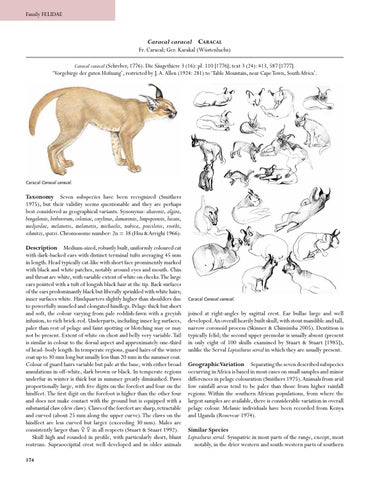
Caracal Caracal caracal.
Taxonomy Seven subspecies have been recognized (Smithers 1975), but their validity seems questionable and they are perhaps best considered as geographical variants. Synonyms: aharonii, algira, bengalensis, berberorum, coloniae, corylinus, damarensis, limpopoensis, lucani, medjerdae, melanotis, melanotix, michaelis, nubica, poecilotis, roothi, schmitzi, spatzi. Chromosome number: 2n = 38 (Hsu & Arrighi 1966). Description Medium-sized, robustly built, uniformly coloured cat with dark-backed ears with distinct terminal tufts averaging 45 mm in length. Head typically cat-like with short face prominently marked with black and white patches, notably around eyes and mouth. Chin and throat are white, with variable extent of white on cheeks.The large ears pointed with a tuft of longish black hair at the tip. Back surfaces of the ears predominantly black but liberally sprinkled with white hairs; inner surfaces white. Hindquarters slightly higher than shoulders due to powerfully muscled and elongated hindlegs. Pelage thick but short and soft, the colour varying from pale reddish-fawn with a greyish infusion, to rich brick-red. Underparts, including inner leg surfaces, paler than rest of pelage and faint spotting or blotching may or may not be present. Extent of white on chest and belly very variable. Tail is similar in colour to the dorsal aspect and approximately one-third of head–body length. In temperate regions, guard hairs of the winter coat up to 30 mm long but usually less than 20 mm in the summer coat. Colour of guard hairs variable but pale at the base, with either broad annulations in off-white, dark brown or black. In temperate regions underfur in winter is thick but in summer greatly diminished. Paws proportionally large, with five digits on the forefeet and four on the hindfeet. The first digit on the forefoot is higher than the other four and does not make contact with the ground but is equipped with a substantial claw (dew claw). Claws of the forefeet are sharp, retractable and curved (about 25 mm along the upper curve). The claws on the hindfeet are less curved but larger (exceeding 30 mm). Males are consistently larger than // in all respects (Stuart & Stuart 1992). Skull high and rounded in profile, with particularly short, blunt rostrum. Supraoccipital crest well developed and in older animals 174
Caracal Caracal caracal.
joined at right-angles by sagittal crest. Ear bullae large and well developed. An overall heavily built skull, with stout mandible and tall, narrow coronoid process (Skinner & Chimimba 2005). Dentition is typically felid; the second upper premolar is usually absent (present in only eight of 100 skulls examined by Stuart & Stuart [1985]), unlike the Serval Leptailurus serval in which they are usually present. GeographicVariation Separating the seven described subspecies occurring in Africa is based in most cases on small samples and minor differences in pelage colouration (Smithers 1975). Animals from arid low rainfall areas tend to be paler than those from higher rainfall regions. Within the southern African populations, from where the largest samples are available, there is considerable variation in overall pelage colour. Melanic individuals have been recorded from Kenya and Uganda (Rosevear 1974). Similar Species Leptailurus serval. Sympatric in most parts of the range, except, most notably, in the drier western and south-western parts of southern