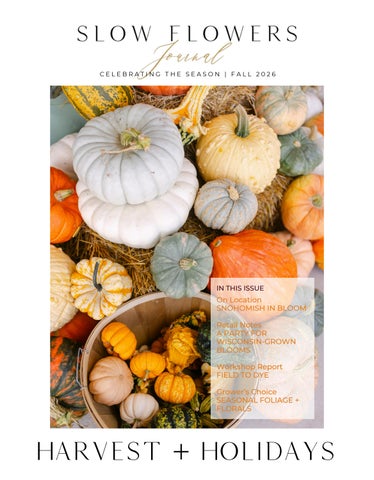
CELEBRATING THE SEASON | FALL 2026
IN THIS ISSUE
On Location SNOHOMISH IN BLOOM Retail Notes A PARTY FOR WISCONSIN-GROWN BLOOMS Workshop Report FIELD TO DYE Grower’s Choice SEASONAL FOLIAGE + FLORALS
HARVEST + HOLIDAYS
“It would be worthwhile having a cultivated garden if only to see what Autumn does to it.” -Alfred Austin
One moment the borders and flower beds are overly abundant, filled with vibrant hues and untamed, billowy perennials. Almost overnight, the days begin to shorten; nighttime lengthens. Our eyes adjust to the fading palette of spent blooms and leaves. The barren and beautiful architecture of trees and shrubs is soon revealed. There’s an intricacy to fall’s foliage, pods, seeds and branches – all of which take on a heightened importance in the vase. I’m reminded that it’s not all about blooms and I embrace the crumbling loveliness of it all. The cycle of nature has come full circle. Gifts from the wild fields and the urban fringes are readily available. I gather leaves and tie them in bunches to festoon my front porch. I fill a woven basket with pinecones, acorns or chestnuts, dropped from trees in my neighborhood. After a windstorm, I collect downed twigs and bundle them to stand upright in an urn on the fireplace threshold. The autumn bouquet created with a “slow flowers” approach is unapologetically seasonal. Petals have fallen from my favorite perennial, leaving only naked seed heads. Moss and lichen soften the rough edges of ancient-looking bark. Elderly leaves take on a burnished patina that artists have tried for years to perfect on their canvases. When observed in a new way, autumn’s spare details are a wonderful source of creativity. Debra Prinzing, SLOW FLOWERS (2014)
EDITORIAL DIRECTOR Debra Prinzing COPY EDITOR Brenda Silva CONTRIBUTORS
© JESSIE STEVENS
Annika McIntosh, Brooke Palmer, Diane Szukovathy PHOTOGRAPHERS Kateri Connolly, Jon Kaplan, Annika McIntosh, Autumn Mack, Hannah Morgan, Beth Mort, Jessie Stevens
ON THE COVER A storefront display of local specialty
just add flowers.
pumpkins welcomes shoppers at Sally Vander Wyst’s La Terre Market, where
The calendar is well into autumn, and I’m hearing reports of
seasonal flowers take center stage.
farms. Florists and growers who planned ahead for a different
COVER PHOTOGRAPER Autumn Mack, Amarie Photography @amariephotos
©2026 by SLOW FLOWERS JOURNAL All rights reserved. No part of this publication may be reproduced, stored in a retrieval system or
“Frostmas,” deep freezes, snowfall, and dormancy on many flower botanical palette are moving into their dried flower era, and we love seeing the seasonal shift. This issue of Slow Flowers Journal is a tribute to the enduring role of flowers across all of life. We have an inspiring roundup of columns and feature articles that underscore the importance of connecting people with flowers and nature. Whether through special events, workshops, botanical art installations, or the simple act of placing flowers in unexpected places, the “just add flowers” recipe feels
transmitted, in any form or by any means,
absolutely necessary these days.
electronic, mechanical, photocopying,
In these pages, you’ll read about ways that flowers are taking over
recording or otherwise, without prior written
main streets and storefront, in two historic Washington towns
permission of the publisher.
(Snohomish and Bellingham). Gain ideas from Sally Vander Wyst, whose “Local Flowers Extravaganza,” in its third year, is creating a buzz to promote Wisconsin-grown blooms in her retail store. And savor plant-based pigments and dyes moving from field to textiles at Snapdragon Farm. While autumn is upon us, my thoughts are also focused on next summer - June 20-22, 2027 - and our 10th Anniversary Slow Flowers Summit, taking place at Filoli Historic House & Garden in the San Francisco Bay area. Read our preview on pages 24-27. There’s still time to grab your Early Bird registration (and save $100) before the end of 2026.
DeBRA SLOW FLOWERS JOURNAL
3
CONTRIBUTORS
fall. ANNIKA MCINTOSH. Annika is the grower/designer behind Hazel Designs, and a founding board member with the North Sound Flower Cooperative. Her designs are seasonal, placebased and “of-the-moment.” She loves every chance to connect with clients and explore their unique design visions, whether in the realm of floral, landscape, or urban design. With an art degree and Master’s in Landscape Architecture, Annika draws equally from her experience with school gardens, community kitchens, trail crews, urban design teams, food co-ops, collaborative design projects, facilitation teams, urban homesteads, home remodels, and even parenting. She is evergrateful for opportunities to collaborate with other artists and community members, and puts great faith in the power of beauty and nourishing experiences to build the connections humans need to thrive. Hazel Designs, hazeldesigns.com @hazeldesignscapes
BROOKE PALMER. Brooke Palmer is the owner and flower farmer at Jenny Creek Flowers, a four-season flower farm near Ithaca, New York. An educator for more than 20 years, she grows specialty cut-flowers and teaches gardeners and flower farmers how to grow them too through in-person and digital flower-growing classes. Jenny Creek Flowers, jennycreekflowers.com @jennycreekflowers
DIANE SZUKOVATHY. Diane Szukovathy is the co-founder with her husband Dennis Westphall of Jello Mold Farm in Mount Vernon, Washington. A flower farmer for nearly two decades, she previously designed and maintained Seattlearea gardens through Jello Mold Landscape. Jello Mold helped establish the Seattle Growers Market in 2011. These days, Diane and Dennis say they are more “leaf farmers” than flower farmers, as their five-acre farm has matured to produce foliage, greenery, and woody flowering branches that complement botanicals from other farms. Jello Mold Farm, jellomoldfarm.com @jellomoldfarm
4
FALL 2026
7
14 11
dEPARTMENTS
7 11 14 23 30
ON LOCATION
Snohomish in Bloom. Flowering a charming historic downtown
29 19
FEATURES
19
THE BUSINESS OF FLOWERS
One Flower. Two Customers. Building a diversified dahlia business RETAIL NOTES
A party for Wisconsin flowers. The Local Flower Extravaganza TOP 5
29
WORKSHOP REPORT
Field to Dye. Snapdragon Flower Farm’s textile dying workshops engage customers with creative floral experiences while also giving new purpose to floral crops
SITE SPECIFIC
Bellingham blooms. The North Sound Flower Cooperative and partnering designers bring delight to their community with floral pop-ups and installations in the downtown core
Slow Flowers Podcast. July-October 2026 GROWER’S CHOICE
Seasonal foliage and florals. Capturing a moment in time and place SLOW FLOWERS JOURNAL
5
6
FALL 2026
ON LOCATION PHOTOGRAPHY BY JON KAPLAN
snohomish in bloom.
Farmers and designers team up to “flower” a charming historic downtown
Historic Snohomish, Washington, is known for its characteristic Main Street, antique shops galore, independent restaurants and cafes, and prolific annual baskets that hang from light posts, beautifying the sidewalks of the 150-year-old community. And now, there is a new kind of floral art along the pedestrianfriendly walkway, thanks to a collaboration called Snohomish in Bloom, A Community Flower Affaire. On September 12, flower farmers, floral designers, and gardeners came together to “flower” buildings throughout the community. Twenty-five installations adorned storefronts, historic architecture, and walkways, creating a free floral art spectacle for the public. The event included a pop-up market with two dozen vendors, educational lectures, flower-crown workshops, and an old-fashioned dahlia show with prizes and people’s choice awards. The project began when Carol Krause sent photos of London’s Chelsea in Bloom to her daughter Beth Kendall, a flower farmer and member-grower of the Snohomish County Flower Collective (SnoCo FloCo), saying, “We need to do this in Snohomish.” Krause and her family are long-time Snohomish residents who founded Swans Trail Farms, a dairy farm that has evolved into a pumpkin
Upcoming: Snohomish in Bloom’s next event is set for September 11, 2027
patch, apple orchard, corn maze, and event venue. She now grows flowers with her daughter at Flower Farmer Girls.
Details: Snohomish in Bloom snohomishinbloom.com @snohomish_in_bloom Snohomish County Flower Growers Collective snocofloco.com @snocofloco SLOW FLOWERS JOURNAL
7
The women were inspired by the success of Chelsea in Bloom, the annual free-to-attend floral art show where storefronts are adorned with botanical installations during the RHS Chelsea Flower Show each May. Last summer, Kendall, florist and educator Alicia Schwede, and a few others, formed a legal nonprofit organization to produce Snohomish in Bloom. They solicited sponsorships from local businesses (real estate agents were among the first to say “yes”) and began recruiting designers, growers, and vendors for the flower marketplace. “The town of Snohomish was behind us the whole time,” explained Schwede, creator of the Flirty Fleurs blog, whose Fleurs Creative studio houses SnoCo FloCo’s downtown Snohomish market. Schwede and SnoCo FloCo are Slow Flowers members. The first Snohomish in Bloom was scheduled to coincide with Snohomish Historic Downtown Association’s “Wine Walk.” That event attracts up to 500 ticket-buyers, so Kendall and Schwede felt confident there would be good foot traffic up and down the city streets.
8
FALL 2026
SLOW FLOWERS JOURNAL
9
Snohomish in Bloom just needed to happen once, in order for its proof-of-concept to capture the hearts (and imaginations) of the community, including local business leaders and tourists, Schwede said. At first, people couldn’t grasp the idea of flowers showing up everywhere. But in the moment, “people were coming up to us in tears, saying, ‘I had no idea what it was going to be,’” Kendall recalled. “We heard from multiple people who got emotional over just how beautiful the flowers were and the vibe that day was incredible. People were so happy. The only time I saw phones out was if they were taking pictures. Everyone was enamored with the flowers and talking about it to complete strangers.” The women marvel at how the one-day, late-summer celebration struck a chord with so many people, including local businesses who said it was one of the community’s most popular events. Perhaps its success can be explained by a convergence of gorgeous, Snohomish in Bloom’s board, from left: Rebecca Grant, Beth Kendall, Mandy Hereth, Quynh Nguyen, and Alicia Schwede.
seasonal flower crops coming from so many area growers, combined with the energy of floral creatives who contributed their design talents. “All we know is, people wanted to buy flowers. They wanted to wear flowers. They wanted to experience flowers,” Schwede said. Plans are in the works for 2027, and more businesses want to sponsor a floral installation for downtown storefronts; more florists want to create; and local growers are already brainstorming about planting extra crops for the event. The public involvement has been priceless, too, said the women. “We had people we’d never met before want to participate,” Kendall said. “One woman, a community member, showed up with 150 to 200 dahlias for us. We had a lot of people donating flowers straight from their yards.” Snohomish in Bloom’s goals were achieved, Schwede said. “People didn’t necessarily know these flowers were locally grown. That was one of our goals – to let folks know how many flower farms are here in Snohomish County. This event helped us connect the community to local flowers.”
10 FALL 2026
THE BUSINESS OF FLOWERS BY BROOKE PALMER PHOTOGRAPHY BY KATERI CONNOLLY
one flower. two customers. Building a diversified dahlia business
As I looked out at my farmer’s market customer line, I hardly recognized anyone. That was strange since I’d been attending the market regularly with cut flowers and had built a repeat customer base. That day, however, I was selling dahlia tubers instead of bouquets. I smiled at the first woman in line, noted her excitement as she gushed over the varieties she couldn’t wait to grow, and something clicked. These were gardeners. They didn’t want my bouquets; they wanted tubers for their cutting gardens. I knew there was an opportunity here for my expanding flower farm. That winter, I brainstormed about my dahlia offerings with a few goals in mind. I wanted loyal, repeat customers with a connection to my flower farm, Jenny Creek Flowers. I also wanted as many months of dahlia revenue as possible since they’re such a labor-
WHO BUYS DAHLIAS? I identified the two main customer profiles, and considered my farm’s short- and long-term goals. Just because a customer desires something doesn’t mean it’s a good fit. It made sense to build a variety of dahlia offerings aligned with my farm’s capacity. Non-Gardening Dahlia Lover Farmstand dahlia bouquets Dahlia CSA U-Pick Flower arranging workshop Photography Dahlia Lover Who Gardens Tubers Growing classes In-person workshops Flower arranging workshops U-Pick Photography
intensive crop. And I wanted to build a farm business I would enjoy running. So I asked three questions: Who wants dahlias? How do they want them? What makes sense for my flower farm now, in one to two years, later on, or never? From this, I identified two dahlia customer profiles. Customer 1: The Dahlia Lover Who Doesn’t Garden
Details:
This customer wants to enjoy dahlias during their fleeting season
Jenny Creek Flowers,
without growing them herself. She wants dahlia experiences, like a design workshop or a U-Pick, and to have cut dahlias in her home
jennycreekflowers.com @jennycreekflowers
through farmstand bouquets or weekly CSA shares.
SLOW FLOWERS JOURNAL
11
THE BUSINESS OF FLOWERS
Customer 2: The Dahlia Lover Who Gardens This customer grows dahlias or wants to start, and she wants to learn how to cut and arrange them. She wants experiences, like an in-person tuber sale, a design workshop, U-Pick, or dahlia-growing classes. I decided to go slow, make a plan, and only add things when they made sense for me. For example, I put more effort into my inperson tuber sale than my shipped sale because my ideal customer who grows dahlias is a member of my community, not necessarily someone four states away. I use my tuber sale to build relationships, chat about dahlias, put a face with a name, and share what else my farm offers. Next spring will be my fifth annual in-person tuber sale. I also started offering flower workshops, first as a practice one with friends. Now, years later, I run multiple sessions in a month, and they always sell out. Email marketing has always been a top priority for me. I use freebies or lead magnets to grow my email list then segment subscribers by local/not local and gardener/non-gardener. For gardeners, I offer a dahlia planting checklist, followed by dahlia growing blog posts. For non-gardeners, I offer a guide to keeping your bouquets fresh for longer. After that, I can send them updates that are relevant based on their profile.
12
FALL 2026
I also built in multiple price points to increase access. A tuber is $12 and a farmstand bouquet is $20, while my dahlia growing series is $260. In between are $30 U-Pick tickets and $65 workshops. Here are the two ways I built customer paths: Non-Gardener: Offering my free resource (guide to keeping bouquets fresh) leads to farmstand bouquet ($20) or Dahlia U-Pick ($35), which lead to Dahlia CSA ($89) and ultimately to becoming a repeat customer. Gardener: Offering my free resource (dahlia-planting checklist) leads to tuber sale ($12+), then to dahlia design workshop ($65) or dahlia-growing classes ($65-$260) and ultimately to becoming a repeat customer. One of my goals was a longer stretch of revenue with
Go slow to go far. No two farms have the same customer profiles or goals. I’m sharing what has worked for me to help you see what’s possible. A shipped tuber sale might make more sense for your farm. And other ideas, like on-farm events or U-Pick, may require infrastructure and insurance that you can’t justify. To start, identify who wants to buy dahlia products from you, how they want them, and what makes sense for you now or in the future. Examine your revenue goals to see where they overlap. Then start with one thing. Get successful at it before adding another. Starting with your customer in mind is the best way to build a flower business with real demand. Making decisions that build the flower business you want to grow is how you thrive throughout all of it.
dahlias. My gardening customers start buying tubers in April, with relevant offers through mid-October. Nongardeners can start enjoying dahlias in June because we grow them under cover for earlier blooms, and they can purchase flowers and experience tickets until early October. SLOW FLOWERS JOURNAL 13
RETAIL NOTES PHOTOGRAPHY BY AUTUMN MACK Amarie Photography
a party for wisconsingrown blooms. The Local Flower Extravaganza pays tribute to the season’s best What happens when you distribute your floral budget across 10 local flower farms and request the freshest, most beautiful blooms for a three-day, in-store event? It’s called the Local Flower Extravaganza, and Sally Vander Wyst and her staff at La Terre Market in Milwaukie, Wisconsin, have turned the peak of flower season into a special event that excites and engages their clientele. “It’s the best time of year for Wisconsingrown flowers, a chance for our community to experience just how
The Local Flower Extravaganza
much beauty is being grown right here, and a way to celebrate the
The event features flowers from more than 10 Wisconsin flower farms, including blooms that Vander Wyst grows in her own garden located about 15 minutes from the shop.
growers who make it all possible,” she said. Held September 24-26, the event is an annual highlight at La Terre Market. Customers shopped the Flower Bar’s rainbow of farm-fresh blooms to create their own arrangement or took home a predesigned arrangement from the cooler. Vander Wyst, who also owns Milwaukee Flower Co., a wedding and event studio founded in 2013, dove into retail when she purchased La Terre Market in 2024. Originally a 500-square-foot shop inside a specialty food hall, the business soon relocated across the street to a storefront sharing 2,400 square feet with Milwaukee Flower Co. in Mequon, a suburb of Milwaukee. There is a special, short-lived window of time between late summer
“It’s a wonderful opportunity to see just how much beauty is being grown right here in our own state,” she said. By the Numbers: Farms: 12 Days: 3 Floral varieties: 50-plus Average sale: $95.07 Bestsellers: Gomphrena, Celosia, Dahlia, Zinnia, and specialty pumpkins
and early autumn when flower farms explode with dahlias, celosia, zinnias, and other highly desired flowers, Vander Wyst said. “Dahlias kick off in late September and we only have a little bit of time before frost comes, usually around the third week of October. So I give each farm a budget and I ask them to bring us the best of their farm. That’s the only parameter.”
14
FALL 2026
Details: Milwaukee Flower Co., milwaukeeflowerco.com @milwaukeeflowerco La Terre Market, laterremarket.com @laterremarket
SLOW FLOWERS JOURNAL
15
16 FALL 2026
RETAIL NOTES Vander Wyst and her staff get excited when the farmers arrive carrying armloads of flower buckets. “They all came through the door – and it was fun and wild!” La Terre’s staff get to work, merchandising the flowers into a tiered shelving with single varieties on display. Each vase is labeled with the type of flower and the grower’s name and location. “It’s important to show off local flowers,” Vander Wyst said. “We want our customers to know that if the flowers are conditioned and cared for properly, they actually last longer when they are local.” Emily Watson, owner of Fernabelle Acres in Franksville, Wisconsin, has supplied the event since its inception. A long-time proponent of the Slow Flowers Movement, Watson is primarily a wholesale supplier to Milwaukee, Madison, and Chicago-area florists, versus
“This event attracts someone who probably has a garden of their own and who appreciates flower growing.” selling to the public, so she says it’s fun to see her flowers make their way into the hands of Vander Wyst’s customers. “Sally has a good market for this event, people who are already in the habit of buying flowers. So when you introduce something different – like local flowers – I think it’s exciting for them.”
About 10,000 customers are part of La Terre’s loyalty program, meaning they also receive the shop’s email marketing and see social media announcements. The Local Flower Extravaganza invitation reminds them that the business supports local flowers. “It’s so fun to see who comes,” Vander Wyst said. “This event attracts someone who probably has a garden of their own and who appreciates flower growing.” Most bought flowers for themselves or made their own bouquet from the Flower Bar, she added. Since the success of the Local Flower Extravaganza, La Terre Market has added another flower promotion called The Peony Party, which takes place the first week in June. “Peonies are a crowd favorite, for sure, and we’re hoping to build it into another great event,” she said.
SLOW FLOWERS JOURNAL 17
18 FALL 2026
WORKSHOP REPORT PHOTOGRAPHY BY JESSIE STEVENS
field to dye.
Growing botanical dye plants for textile and fiber workshops
Beth Mort has deep ties with her local agricultural community, having grown and managed food farms and worked for a farm-toschool program. Owner of Spokane-based Snapdragon Flower Farm, Mort is also an artist and a lover of textiles. Through farming, she’s explored connections between fiber and flowers and partnered with others to share her passion and create new markets for floral crops: coreopsis, sulfur cosmos, pink cosmos, marigold, rudbeckia, ‘Black Knight’ scabiosa, black hollyhocks, dahlia petals, and annual indigo (Persicaria tinctoria) are some of the farm’s popular pigment plants. “I first got into farming through my interest in fiber,” Mort recalled. “I’ve always been a knitter and I’m a life-long hoarder of anything that’s tactile. The collector in me wants all the fabrics, and it’s the same with flowers. I want to touch them and have all the colors.” Mort is drawn to the many ways flowers and fibers can deepen people’s relationship with nature. “I struggle with flowers as a commodity and a throwaway product. It’s hard for me to think of a big, beautiful wedding and then, afterwards, the flowers are dumped. So the connection between growing flowers and caring for the ecosystem that evolves around it is an important lesson,” she said. Asking, “what if a bouquet becomes a component of an eco-print on fabric, or something we dye for a keepsake to hold the memory longer?” has inspired a number of creative ways to address the perceived “impermanence” of flowers.
Details: Snapdragon Flower Farm, snapdragonflowerfarm.com @snapdragonflowerfarm Spokane Zero Waste, spokanezerowaste.org @spokanezerowaste Jessie Stevens, jessiestevens.com @simplyjessie
SLOW FLOWERS JOURNAL
19
20 FALL 2026
Snapdragon’s textile-dying workshop series engaged customers with creative floral experiences while also giving new purpose to flower crops. In the spring, Mort partnered with Spokane Zero Waste to teach students how to create simple dye baths with fresh and dried dye flowers. Held in the SZW classroom, the session included fabric preparation (mordanting) and resist binding, resulting in beautiful surface patterns on hand-dyed silk scarves and cotton bandanas. Mort introduced her favorite dye plants and shared how to grow, harvest, and process fresh and dried botanicals for dye projects all year long. Elyse Hochstadt, a fiber artist and director of Spokane Zero Waste, said the workshop encouraged students to explore ways to reduce textile waste, use natural fibers, and view plants as a source for artmaking. “Being an alchemist for a day, being in that transformational process with plants, and color, and cloth – there’s nothing like it,” Hochstadt said. “It’s magic and mystery and joy all rolled into one.” In July, Mort hosted a bundle-dye and eco-print workshop on her farm, again partnering with SZW. In addition to working with silk, cottons, and yarn fiber samples, students selected from SZW’s repurposed fabrics to build on new techniques for their own DIY projects at home. Mort likens making plant-based pigments to brewing a pot of tea into which fabric can be immersed. But dyeing fabric with Japanese indigo requires an entirely different process to coax amazing shades of blue from its leaves, she said. In August, her indigofocused workshop taught students how to macerate leaves with a salt extraction to activate the pigment. “It’s like kneading dough for a little bit, but then, all of a sudden, this magic happens,” she said. Later this fall, the farm’s fourth workshop of the year will go deeper into indigo vat-dyeing methods. Mort is developing a DIY dye kit that will be available for online purchase, and she has collaborated with local photographer Jessie Stevens, to tell the story of Snapdragon Farm’s Field-to-Dye projects for a new publication called Field Report.
SLOW FLOWERS JOURNAL
21
WORKSHOP REPORT
“Growing flowers (for me) has always felt like its own kind of storytelling. People buy flowers for a reason, unlike food, which has necessity behind it, but flowers have a different kind of resonance. I really want to grow flowers, but also, I want to explore the natural dye world with more focus,” Mort said. “I want to make a deeper transition into dye plants, and I want my flowers to have a longer relationship with people.”
22
FALL 2026
SLOW FLOWERS PODCAST HIGHLIGHTS
top five.
Slow Flowers Podcast Episodes (July - October 2025)
EPISODE 779 Seasonal Floral Design with Remy Brault of Labellum Flowers in Bozeman, Montana WATCH HERE
EPISODE 780 Doing It All – Flowers, Plants, and Weddings, with Corinne Bryson of Flora Good Times in Beacon, New York WATCH HERE
EPISODE 783 Science Teacher, Flower Farmer, and Floral Designer Sara Groeneweg of Bloomz Flower Farm WATCH HERE
EPISODE 784 Visit FloraWood, Where Designer Jen Wilcoxon Draws Her Inspiration for Seasonal Floral Subscriptions and Workshops WATCH HERE
EPISODE 789 Lynn and Tim Windmeyer of Homeplace Fields in St. Joseph, Missouri. WATCH HERE
SLOW FLOWERS JOURNAL
23
SLOW FLOWERS NEWS
Slow Flowers Summit 2027 – California Blooms Celebrating our 10 th annual gathering with a return to FILOLI HISTORIC HOUSE AND GARDEN SAVE $100 Early-Bird Registration Nov. 1 - Dec. 31, 2026 Full Registration Members: $799 (Early-Bird Ticket: $699) Full Registration General: $899 (Early-Bird Ticket: $799) slowflowerssummit.com @slowflowerssummit
The Slow Flowers Summit has a collective focus on floral design, flower farming, and sustainability education. It takes place live and in-person on the grounds of the famed cultural destination, Filoli Historic House and Garden in the San Francisco Bay Area.
“We’re thrilled to partner again with Filoli’s horticulture and floriculture teams by returning to the location of the successful 2021 Slow Flowers Summit. Filoli plays a leading role in horticulture and gardening education, with an emphasis on sustainability and design, and our attendees will be enriched by their involvement in the Summit,” said Debra Prinzing, founder of Slow Flowers Society.
24 FALL 2026
After two years of successful online programming as the Slow Flowers Worldwide Summit (2025 and 2026), it’s fitting that the Summit is returning to the popular live, in-person format. “We love highlighting new ideas and leading voices from our community,” she added. Attendees will experience a full immersion of the gardens, landscape, and natural areas at Filoli. “Our guests will learn from expert Slow Flowers instructors, including from Filoli’s horticulture and floriculture teams. We’re planning a number of special, hands-on experiences during which guests will learn from and engage with floral and botanical experts,” Prinzing noted. A highlight of the 2-1/2-day conference will be the ‘Floral Takeover’ of Filoli’s historic mansion as teams of designers embellish and adorn its interior rooms and exterior spaces for a unique display of locally grown botanicals. Author and designer Teresa Sabankaya has joined the Summit to serve as creative director of the Floral Takeover. The Floral Source, owned by Kelly Shore, has joined as the floral sponsor, procuring thousands of stems of California-grown and American-grown blooms and foliage for the project.
SLOW FLOWERS JOURNAL
25
SLOW FLOWERS NEWS
The Slow Flowers Summit theme for 2027 is “California Blooms,” with most speaker invitations extended to California-based designers, flower farmers, and experts from the Slow Flowers membership. The conference will be headlined by Oakland-based landscape designer Leslie Bennett, owner and principal designer of Pine House Edible Gardens. Bennett is the author of Garden Wonderland and the creator of the Black Sanctuary Gardens project. The program includes education sessions led by sustainable floral leaders, including: Melissa Olson, Penflora Designs Nichole Skalski, California Sister Floral Design Kristine Albrecht, Santa Cruz Dahlias Jacqueline Pham, Phamily Peony Garden Jennifer McClendon, JenniFlora Hannah Muller, Full Belly Farm Alana and Michael Karam, Willamette Willows In addition, the Slow Flowers Summit will feature education led by Jim Salyards, Filoli’s associate director of horticulture initiatives, and several Filoli team members.
26 FALL 2026
Learn from our inspiring lineup of floral luminaries Top Row, from left: LESLIE BENNETT, Pine House Edible Gardens; MELISSA OLSON, Penflora Designs; NICHOLE SKALSKI, California Sister Floral Design; HANNAH MULLER, Full Belly Farm Center Row: ALANA AND MICHAEL KARAM, Willamette Willows Bottom Row, from left: JACQUELINE PHAM, Phamily Peony Garden; KRISTINE ALBRECHT, Santa Cruz Dahlias; JENNIFER MCCLENDON, JenniFlora; and JIM SALYARDS, Filoli Historic House & Garden SLOW FLOWERS JOURNAL
27
GROWER’S CHOICE
a moment in time and place BY DIANE SZUKOVATHY
FLORAL DESIGN BY HANNAH MORGAN, FORTUNATE ORCHARD
“I usually choose one element I am most enticed by,” Hannah Morgan of Fortunate Orchard shared when I asked her how she goes about creating one of her signature arrangements. “For me, this time it was the crabapple. I noticed that every fruit had a different color on it, from yellow to deeper reds. Then I looked in my own garden for something that would pick up on those colors. That’s where I found that dahlia, which I grew from seed and has no name. And the Kerria foliage. And that little pop of blue salvia.” A SEASONAL MINDSET Like many Slow Flowers florists, Hannah supports local growers and also sources freely from her own garden. She has been a dynamic and dedicated customer of the Seattle Growers Market (SGM) for over a decade. I have always loved her fresh and “in the moment” style, which plays with color and form while using restraint to convey abundance. Work like hers inspires us to think of our co-op as an art supply store. When Cherisse Yanasak, SGM’s Buying Manager, sent word out
FLORAL STANDARDS
recently that Hannah was looking for “interesting fall items” for a workshop she was hosting, our farmers offered back a dizzying palette
A Practical Guide for Producing and Delivering Professional Quality Products
of possibilities: Oak Foliage, Blueberry Foliage, Eucalyptus, Aronia,
by Seattle Growers Market
“Hannah would like tall crabapple. Can you do that?” Cherisse relayed
ORDER BOOK HERE
Cranberry Viburnum, Heptacodium, Pink Snowberry, Beautyberry, Marigolds, Mums, Amaranth, Ninebark, Asters, Lisianthus, and Grasses.
back. Sometimes our customers appear to know what’s out in our fields better than we do, a very particular kind of sixth sense. My farm had stopped cutting crabapple branches by this point in the season. “Oh sure, we can get crabapple for Hannah,” I thought, relying on her instincts while dragging over the tall orchard ladder. Sure enough, they were out there and I knew just which stems she would want. Nothing motivates me more than feeding the creativity of one of our brilliant florist customers and I happily got out my chainsaw for this occasion. Stems like this - especially tall ones - don’t often make it to the market floor unless they custom-fit a particular request. A few days later, Cherisse relayed back, “Hannah just emailed me to say she squealed with delight when her cart emerged from the orders cooler.” Success!
28
FALL 2026
SLOW FLOWERS JOURNAL
29
FLORAL DESIGN AND PHOTOGRAPHY © HANNAH MORGAN
Close connections between farmers, co-op staff, and florists allow for the skillful capture of a moment in time and place such as this one. “It’s ephemeral and that’s what makes it magic,” Hannah confirmed, about her process of sourcing and creating. “I’ve had my garden for 20 years,” she told me. “When my kids were little, they would play outside while I worked in the garden and then I waited tables at night. After I transitioned out of being a waiter, they asked me to do floral arrangements for the restaurant. At first, I sourced just from my garden. Then I found out about Slow Flowers and the Seattle Growers Market. Somehow having the name “Slow Flowers” applied to me. Having that ethos made me able to embrace it like I couldn’t before when I thought of floral as what you found in the grocery stores and traditional florist shops.
Season’s Best Ingredients Crabapple ‘Evereste’ (Jello Mold Farm) Aronia arbutifolia ‘Brilliantissima’ (Jello Mold Farm) Viburnum opulus foliage (Delameter Valley Farms, DVF)
“The proximity between the florist and the farmer and the cut stems is very close. It’s a huge privilege as a florist to be connected so closely to the farmers,” she shared. As farmers and co-op staff, we aim to seamlessly deliver reliable, quality products to customers like Hannah. That isn’t easy with items rolling in from so many different farms and changing through the
Dahlias, unnamed seedling (Hannah’s garden)
seasons. Fall ups the challenge when frost can take out certain crops
Kerria japonica foliage (Hannah’s garden)
our crops and what to expect from them, including stages of harvest
Mock Orange foliage (Philadelphus sp.) (Hannah’s Garden)
30
“It’s a huge privilege as a florist to be connected so closely to the farmers.”
in a blink, while others come into their glory. Color notes on foliage and fruit can change overnight. It is vitally important that we know and vase life. For this reason, SGM created Floral Standards, A Practical Guide for Harvesting and Delivering Professional Quality Products. Published in
Ninebark ‘Coppertina’ foliage (Jello Mold Farm)
2024, Floral Standards has just recently become available as an e-
Salvia ‘Indigo Spires’ (Hannah’s Garden)
introduced to the trade. Intended originally as a guide to help
Details: Fortunate Orchard fortunate orchard.com @fortunate_orchard
embraced by many home gardeners and farmer-florists who use the
FALL
book, and contains harvest stage and vase life information for hundreds of different crops including many that our farmers have farmers provide quality products to florists, it has also been information to know what and when they can reliably cut from their own properties.
PHOTOGRAPHY © JELLO MOLD FARM The author, harvesting Aronia at Jello Mold Farm
“With so many choices, how do you restrain yourself?” I asked, drawing Hannah back into our conversation about her recent workshop and the demonstration arrangement (which illustrates this article). “It’s something that I’ve learned over time,” she offered. “Less busy is better, especially at a scale like this. That way you can pay attention to shape and line. I try to keep it to just a few things and a restrained color palette. In this case, it’s reds and yellows with just those little pops of blue. “When I do workshops, I try to offer a wide variety of items so people can have a range of things to be inspired by. I say, ‘Find something that catches your eye and use that to riff off of. You can build it from there.’” Every week hundreds of florists shop at SGM, combining stems from many different farms and sometimes their own gardens to create magic. Floral Standards acts as a unifying tool, helping us as farmers supply our customers with the best quality ingredients possible. Echoing Hannah’s words, it’s an honor and a privilege to be part of this vibrant community marketplace.
SLOW FLOWERS JOURNAL
31
32 FALL 2026
SITE-SPECIFIC IMAGES AND STORY BY ANNIKA MCINTOSH
bringing local flowers to the streets. North Sound Flower Cooperative brings seasonal floral installations to the downtown core Bellingham, Washington, boasts a stellar natural setting, diverse industry and commerce, active creative organizations, tribal communities, and a university–but it’s also a stage for urban challenges and tensions familiar to most small cities. The number of vacant storefronts in its commercial core continues to grow as businesses struggle with rent and overhead. Someday, the North Sound Flower Cooperative hopes to fill a dark storefront with its vibrant market for local flowers, but as a firstyear, shoestring operation it has settled for a more ephemeral, spontaneous approach to tell our story. Wishing to get our blooms into the community and build awareness around our new market (and local flowers in general), we applied for the City of Bellingham’s Downtown Beautification & Activation Grant to produce a series of floral pop-up events. The city’s mission in providing this funding is to “bring joy to the community in small, everyday experiences, and in new, innovative ways.” Our project, “Bellingham Blooms,” inserts local flowers, florists, and flower happenings into downtown, creating temporary bright spots and a sense of delight. We are literally taking our flowers to the streets. As a founding board member, grower, and designer, I wrote the grant application and outlined, coordinated, tracked the budget, and promoted the pop-ups, pairing florists with venues for the
About North Sound Flower Cooperative: North Sound Flower Cooperative (NSFC) is a new member-owned flower market based in Bellingham, a small city in Northwest Washington. With 15 members and consignors from Whatcom and Skagit Counties, NSFC sells flowers on Wednesdays (wholesale and retail) in a shared office space, and offers local delivery. The co-op currently runs completely on member/volunteer power. Presently, NSFC growers and designers are all female, mostly mothers, operating small businesses in Whatcom and Skagit Counties. The group is dedicated to selling collectively, supporting the local economy, building community, and stewarding the land. Details: North Sound Flower Cooperative, northsoundflowercoop.com @northsoundflowercoop
multi-month-long project. Connecting with property managers, business owners, city staff, and other community members to plan our pop-ups has allowed us to network and lay a foundation for future collaborations. SLOW FLOWERS JOURNAL
33
Growers are delighted to see their blooms celebrated and enjoyed by the public in a floral format that goes beyond market bouquets or ceremony arches. Florists who rely on event work welcome the opportunity to design outside the constraints of wedding trends and install their artistry in front of the public for longer than the typical six-hour “flash in the pan” of a private event. People out and about stop to admire and photograph our creations, and some say they feel “spoiled” to have this kind of art in their streets. The designers, growers, and creators of Bellingham Blooms believe this kind of vibrancy makes downtown a place people might want to linger. Here’s a snapshot of 2026 and what we accomplished, month by month:
JULY To celebrate Pride Week, florists created stick-on floral “tattoos” with everlasting
APRIL Starting on Bellingham’s First Friday Art Walk and lasting all month, we flowered eight vacant windows with designs by individuals and groups of designers,
flowers that were offered at a one-night pop-up event at a brew pub. People were invited to wear a tattoo or grab a bag of floral confetti to throw during the annual Pride parade.
featuring whimsical, floral tableaux, large-scale flower motifs in paper and fabric, and both dried botanicals and fresh spring flowers. MAY Four large picture frames were decorated with fresh flowers to stand in front of downtown galleries and popular storefronts, as a fun portrait/selfie stop during the annual Children’s Art Walk. People were invited to step into the frames, and lovely interactions occurred as strangers offered to take one another’s portraits. Later in the month, colorful bouquets were hidden around town for an Instagram “treasure hunt.” JUNE
When Western Washington University took over a city block for an evening to host a “Longest Table” event for hundreds of graduates, we lined the tables with flowers and installed colorful fabric and cyanotype prints of fresh flowers on the adjacent parking garage, which stayed up all summer. Florists created a shimmering “meadow” pathway through the garage plaza that lasted through commencement weekend, bringing color and interest to visitors passing through the otherwise brutalist concrete space.
34
FALL 2026
AUGUST Floral “love notes” popped up at three beloved establishments that announced their closing in August. Passersby and restaurant patrons were invited to take portraits behind a frame of lushly styled flowers at a popular restaurant, while a longer-lasting botanical installation graced the outdoor seating area of a bar and bakery. AUGUST-OCTOBER
Florists were invited to design arrangements that responded to, or complemented, a piece of art or an entire exhibit’s theme. Over three months of First Friday Art Walks, florists popped up in galleries, decorated interactive picture frames on sidewalks, and hung a flower curtain outside of a group show. Galleries and their visitors felt the magic of this collaboration. NOVEMBER-DECEMBER Decorating buildings, lamp posts, doorways, and railings with evergreens and giant ornamental wreaths will add a festive flavor to Bellingham’s shopping district as the days get shorter, darker, and wetter. An oversized wreath at street level will allow people to interact and pose for holiday photos. In vacant window spaces, dried wreaths and other floral art will speak to the season and add color to our winter streets.
SLOW FLOWERS JOURNAL
35
36 FALL