Thinking of selling your home? Contact me for a free, no-obligation, detailed market analysis. P: 250-888-5449 W:www.alexirealestate.com THURSDAY, SEPTEMBER 9, 2021
www.oakbaynews.com
Seniors Save
15%
Police called to UVic for large party
off
Your purchase every First Wednesday of every month. *Some exceptions apply. See in store for details*
LIVE WELL WITH
For Everything You & Your Family Need to Live Well
EARN POINTS & SAVE!
250-598-3380 • 2200 Oak Bay Avenue http://oakbaypharmasave.com
During the 21st Oak Bay Collector Car Show, Lisa Peterson plans to showcase the 1981 Pontiac Grand Prix she inherited from her late father, her white 1980 GMC Sierra 1500 and her son’s black 1977 Chevy Scottsdale C10. (Christine van Reeuwyk/News Staff)
Tegwyn Hughes News Staff
Family treasures buffed up for Sunday’s car show Sept. 12 show in Oak Bay Village extends up some side streets Christine van Reeuwyk News Staff
HTTPS://THEREDFERN.CA/
Lisa Peterson fondly recalls riding in the back seat of her dad’s 1963 Studebaker GT Hawk cruising up a little hill with a dip near her home. She was about five and would excitedly ask Roy Peterson to “do the racer man” that came with a throaty rev of the engine and a little lift at the bump in the dip. It’s a love of vehicles she’s cultivated her entire life, and passed
TomFraser knows tomf@vreb.bc.ca tomf@vreb.bc.ca
along to her son as well. Peterson has lived in Oak Bay for 10 years, and each of those years (except the infamous 2020 when the show was cancelled due to COVID restrictions) she parked her entourage of vehicles at the entrance to her building on Hampshire Road for the annual Oak Bay Collector Car Show. There they tend to turn the heads of the hundreds of passersby. This year, the 1981 Pontiac Grand Prix she inherited from her late father (who bought it new that year, the same year she graduated) will shine alongside her white 1980 GMC Sierra 1500 and her son’s black 1977 Chevy Scottsdale C10. Speaking of cultivating, guests will want to pop by and note the innovative container garden she has
OAK BAY
250-893-5800
Buying or selling in Oak Bay? Give me a call.
growing in the GMC Sierra. While the coronavirus pandemic has held some joy – kids birthday party parades and classic car tours of seniors homes across Greater Victoria – Peterson is thrilled for the return of the car show this September. She’s excited because it’s great for business, but also it feeds into the love of her lifelong hobby. “I get to wake up to the roar of the engines, and the rumbling,” she said with a smile. Vehicles start arriving at 7 a.m. with the $20 registration collected at the gate. Exhibitors enter near Foul Bay Road from the west end of Oak Bay Avenue and remain for viewing to 3 p.m. The 21st Oak Bay Car Collector Festival is on The Avenue Sept. 12. c.vanreeuwyk@blackpress.ca
The Saanich Police Department says a large number of unmasked University of Victoria students were seen partying on campus Sunday after 10 p.m., three days before in-person classes are set to begin. Videos taken by staff at the campus newspaper The Martlet show students standing together on residence balconies and between buildings, with others climbing into trees and onto roofs. Const. Markus Anastasiades with Saanich Police told Black Press Media there were “hundreds, if not close to 1,000, young adults” crowded around residence buildings on campus. Two Saanich officers were already assigned to help UVic Security in anticipation of large gatherings at the start of the semester, and two additional officers arrived on scene Sunday night to assist “as the crowd grew larger.” There are no current provincial restrictions regarding outdoor gatherings, mask-wearing, or physical distancing. However, Saanich Police reports two tickets were issued to individuals under the Liquor Control and Licensing Act. When asked whether Saanich Police is considering increasing its presence on campus after Sunday night’s crowds, Anastasiades said police will “continue working with UVic to determine the appropriate police response for this week and weekend.” Continued A8
PLANNING ON SELLING YOUR HOME IN THE NEAR FUTURE, OR JUST CURIOUS ON TODAY’S MARKET VALUE? Please contact me for a very knowledgeable, educated opinion of value. I have specialized my Real Estate career in Oak Bay for over 25+ years and have been involved in hundreds of sales in the area!
Area specialization does make a difference!
Royal Le Page Coast Capital Realty
A2 Thursday, September 9, 2021
Oak Bay News
Y F OR D A E R U O Y E AR
? produce BC GROWN
BC GROWN
Bartlett Pears
Sweet Mini Peppers
126 /lb
226
BC GROWN
ea
2.78 per kg
BERRYMAN BROTHERS
Ethically Raised Ham
196
/100g
Pepperoni Cheese Stick
196
ea
bakery
dairy
PORTOFINO
ISLAND FARMS
Sourdough Artisan Loaf
Chocolate Milk
26
3
CALIFORNIA
BC GROWN
Cantaloupe
Russet Potatoes
2/
3
CAKES ETC
MAYFLOWER FOODS
Oat Bar
Sausage Rolls
526 6 pack
FARMER BEN’S
Large White Eggs
4
3
246
866
1lb asst
/100g
MRS FRIDAY’S
butcher shop
Crab Cakes
4/
5
FRESH!
prv frz
Cooked and Peeled Prawn Tails
286
/100g
Natural Cheese
1196
96¢
ea
/doz
Sour Cream
Organic Whole Bean Coffee
Dill Pickle Homous
196
66
473ml
ARBUTUS RIDGE FARMS
Greek Pita Bread
FRESH! WILD!
BC GROWN
5lb bag
Halibut Fillets Steelhead SKIN ON Fillets FARM RAISED
Oatcakes, Ginger or Digestive Biscuits
FERNWOOD
5
ea
ea
ARMSTRONG
Grocery
2/
256
126
ISLAND FARMS
10 pieces asst
BC GROWN
3lb bag
VICTORIA BAKING CO.
376
visit www.peppers-Foods.com to place your order online
BC GROWN
BC GROWN
3/
585g
Free up your time this school year when you use our curbside pickup service
WASHINGTON Yellow Onions
3lb bag
deli Favourites
www.oakbaynews.com
prv frz
Wild Sockeye Salmon Wellington w/Spinach & Artichoke Hearts
556
WANT WANT
SUNRYPE
Goldfish Crackers
Rice Cracker Balls
100% Juice Boxes
296
186
180-200g asst
100g asst
2/
3
nat/orGanic
Gluten Free
ANNIE’S HOMEGROWN
ANNIE’S HOMEGROWN
Cinnamon Crunch or Gluten Free Honey Nut O’s Cereal Rice Pasta
496
+dep
5x200ml asst
RESER’S
ADAMS
Baja Café Frozen Burrito
100% Natural Peanut Butter
142g asst
/ea
prv frz
PEPPERIDGE FARM
4
626
/100g
600g asst
500ml asst
3/
336
/100g
Extra Virgin Olive Oil
KETTLE
Organic Coconut Water
Potato Chips
796
446
500g asst
750ml
1L
We reserve the right to limit quantities. Some restrictions may apply on certain promotions.
5
220g asst
PRICES IN EFFECT Sept 7th - Sept 13th, 2021
3829 Cadboro Bay Road Ask about our senior and student discounts
2/
+ dep
250-477-6513 100% Locally Owned | http://www.peppers-foods.com
170g asst
THIRSTY BUDDHA
366
Quality & Service Guaranteed | 100% Victoria Owned
Organic
235-260g asst
FILLIPO BERRIO
276
Store Hours: Monday to Friday: 7am - 8pm Saturday and Sunday: 7am - 7pm
Environmental Deposit Required
LIKEusonFacebook:www.facebook.com/PeppersFoods FOLLOWusonInstagram:peppersfoodsvictoria FOLLOWusonTwitter:@peppersfoods www.peppers-foods.com
Same Day Home Delivery! 250-477-6513 Monday - Friday. Excluding Holidays.
www.oakbaynews.com
Oak Bay News
Thursday, September 9, 2021 A3
Candidates speak out on housing, climate and COVID-19 In the runup to the Sept. 20 federal election, Black Press Media asked the candidates in Victoria a series of questions. BPM: With homeownership out of reach for too many in Greater Victoria and rent for an average one-bedroom reaching $1,700, what will your party do to stabilize housing costs? Hannah Hodson – Conservative: The Conservative Party’s Canada Recovery Plan will make homes more affordable for owners as well as renters. Our plan will see one million homes built over the next three years, will release at least 15 per cent of federal land to build on and ban foreign investors from buying homes in Victoria if they are not planning to move to the country. We will encourage foreign investment in purpose-built rental and partner with municipalities to bring new rental units into the market. We will also implement a “For Indigenous, by Indigenous” housing strategy in the spirit of reconciliation. Nikki Macdonald – Liberal: We can leverage the Liberal government’s commitment to housing by working with the province, local governments and community stakeholders to better plan for housing needs. This includes addressing the “missing middle.” A Liberal government will continue to work to stop “renovictions” by deterring unfair rent increases, require landlords to disclose, on their tax filing, the rent they receive pre- and post-renovation, and implement a proportional surtax if the increase in rent is excessive. A Liberal government will introduce a rentto-own program to make it easier for renters
Nikki Macdonald
Jordan Reichert
DistrictOakBay
Nick Loughton
Laurel Collins
Janis Zroback
to get on the path towards home ownership. It will support the creation of a stream for renters and landlords, particularly those in condo settings, to enter into a rent-to-own agreement and commit $1 billion in loans and grants to develop and scale up rent-to-own projects with private, not-for-profit, and co-op partners. Nick Loughton – Green: With homeownership out of reach for too many in Greater Victoria and rent for an average one-bedroom reaching $1,700, what will your party do to stabilize housing costs? Decades of inaction by all levels of govern-
Create a MyDistrict Account online MyDistrict enables residents and businesses to access information about their taxes, utilities, dog licence, and business licence, 24 hours a day, 7 days a week. With a MyDistrict Account you can: • View your tax payments and levies • View your home assessments • View your utility usage and payment information • View your business payment information • Pay your dog and business licenses online How to set up your account online: • Go to www.oakbay.ca/online • Select Login to MyDistrict Online • Select Don’t have a Profile? Register Now • Fill out the registration page and hit register and you will receive a registration email • Once you receive your email. Follow the link contained within the email. • You are now ready to log on and register accounts. The account information and access codes are different for each invoice type. They can be found on your invoice. www.oakbay.ca
Hannah Hodson
John Randal Phipps ment have left us in a rental housing crisis. We have consistently failed to build adequate affordable housing in Victoria. This issue has been exacerbated by stagnant wages, which have failed to increase relative to the cost of living or even inflation. The federal government must invest and produce meaningful and ambitious targets on new affordable housing, provide a Universal Basic Income, and raise wages in federally-regulated industries to be living wages. Laurel Collins – NDP: Everyone deserves a safe, affordable home. The Liberals keep talking about housing, but they have failed to
help families struggling to keep up with rising costs. The NDP has a plan to invest right now to create 500,000 units of quality, affordable housing - building the rental, cooperative, and social housing that is so desperately needed. We’ll also provide up to $5,000 in immediate relief to renters, and help put an end to speculation that’s fuelling high housing prices with a 20 per cent foreign buyer’s tax. Jordan Reichert – Animal Protection Party: The Animal Protection Party of Canada recognizes the lack of affordable, pet-friendly, and safe housing for people across Canada. We will rein in the price of housing by ending foreign and domestic speculation on real estate, investing in the construction of a diversity of housing across the country, implementing a rent cap to freeze increases while the housing supply is built, taking steps to decommodify housing, and making the home-buying process more transparent and less competitive for all to participate in equitably. Janis Zroback – Communist: What we need is social housing. The Communist Party proposes to enact a federal policy that recognizes housing as a human right, and makes housing a public utility. The mass construction of lowcost public rental units, with rent prices geared to no more than 20 per cent of tenant income, would put a huge dent in the prices of housing all across the market. We would use the latest green technologies to make units efficient and eco-friendly. This also will stimulate the economy by bringing in good jobs in construction, trades, and manufacturing. Continued A7
September Meetings Masks at Municipal Facilities As per the Provincial Health Officer’s Order, effective August 25, 2021, masks must be worn by people 12+ in all municipal facilities. There are exemptions for: • People with health conditions or with physical, cognitive or mental impairments who cannot wear one • People who cannot remove a mask on their own • Children under the age of 12 • People who need to remove their masks to communicate due to another person’s hearing impairment A face shield is not a substitute for a mask as it has an opening below the mouth. Thank you for your cooperation.
@DistrictOakBay
Committee of the Whole Meeting Monday, September 20, 2021 at 7:00 p.m. Council Meeting Monday, September 27, 2021 at 7:00 p.m.
Oak Bay Emergency Alerts Have you signed up for the District’s emergency notification system yet? By signing up at http://oakbay.ca/alerts you will receive up-to-date messaging about incidents that may affect you and those you love. Visit http://oakbay.ca/alerts for more information
Elgin Road Pathway Closure Construction to widen the path between Oak Bay Recreation Centre and Elgin Road has begun. Construction is expected to be complete the week of September 20, 2021. We apologize for the inconvenience during this time.
@DistrictofOakBay
www.connect.oakbay.ca
A4 Thursday, September 9, 2021
Oak Bay News
www.oakbaynews.com
Phone bank, website launched for B.C. COVID-19 vaccine card Tom Fletcher Black Press Media
The B.C. government has begun issuing COVID-19 online vaccination cards for entry to restaurants, sports and entertainment, with an early surge in demand that created similar backups to vaccine and other services in the long-running pandemic. The province’s technical team opened access to the website Tuesday morning, imposing a wait time as the system was tested and capacity increased. Health Minister Adrian Dix said the vaccine card is to provide additional
This is our way of keeping society going in the next few months. — Dr. Bonnie Henry confidence for people and businesses, as B.C. has passed 77 per cent of full immunization for everyone 12 years and older. Provincial health officer Dr. Bonnie Henry said the B.C. vaccine
card is needed to keep sports events, restaurants, pubs, sports and recreation activities going as the province continues to deal with a spike in new infections that took off in August. Fast food and take-out operations will not require vaccine cards. “This is our way of keeping society going in the next few months,” Henry said Sept. 7. Premier John Horgan said the Aug. 23 announcement of vaccine passports has produced a 200 per cent increase in vaccine appointments, as the province faces a surge in new coronavirus cases that is mostly among unvaccinated or partly vaccinated
people. Vaccine card access to businesses and events doesn’t take effect until Sept. 13, when it and a government identification card will be needed. While vaccine cards are issued to smartphones, computers or in the mail to people who call a toll-free number, the province is allowing the use of hand-written vaccine clinic or pharmacy record cards from Sept. 13 to 26. The website for online cards is gov. bc.ca/vaccinecard and the toll-free number is 1-833-838-2323. Applicants will need their B.C. personal health number, date of birth and date of
vaccination for either dose one or dose two. Online applicants will receive a QR code that can be saved to a phone or printed out for use at entry points for businesses and events. People 19 and older will also be required to show a government identification to match the vaccine record. The province is working on a B.C. vaccine card verifier app for businesses to reduce the need for manual verification of the cards’ QR codes. Businesses can find more information at gov.bc.ca/VaccineCard-Businesses, with a business information phone line starting Sept. 13.
Survey shows high vaccination rates among UVic staff and students
The University of Victoria has provided more details about what students should expect when they return to campus this week, amid the ongoing pandemic. A recent survey of UVic students and staff hints that the university community’s inoculation rates are well ahead of the province’s
pate in weekly rapid testing if they want to participate in activities on campus. The university is working with public health authorities to have a rapid testing program operational by Sept. 13. UVic has partnered with Thrive Health to introduce a self-declaration program that will allow students, staff and faculty to confidentially and securely declare their vaccine status. The program will be accessible on a desktop or smartphone for anyone who has a NetLink ID. Campus activities like dining, fitness centres, events, clubs and libraries will be subject to the B.C. government’s proof-of-vaccination requirement program when it takes effect on Sept. 13. The university said it will communicate with its members as more information
about the government program becomes available. Drop-in vaccination clinics will be available on campus for those needing their first or second dose starting on Sept. 7. More information about the clinics is available at bit.ly/3jLoFIZ. UVic reminded students that masks are required in all indoor public spaces, including classrooms, labs, restaurants and pubs, fitness centres and indoor events. “I am confident that all of you will adhere to current safety guidelines to demonstrate your care for the health and safety of everyone in our community,” Hall said. “We will continue to provide support for those of you with medical exemptions for masking and vaccination.” – with files from Jake Romphf
CA
LLY OWN
ED
A
OVER 30 YEARS N
D
Megan Atkins-Baker News Staff
general population. More than 95 per cent of the 8,300 students and 1,100 faculty or staff members who responded said they’re fully (92 per cent) or partially (3.4 per cent) vaccinated. Another 1.5 per cent said they aren’t currently vaccinated, but plan on getting the jab. The survey on vaccination rates received 9,400 confidential responses and represented about 38 per cent of registered students and about a quarter of faculty and staff. On Thursday, UVic president Kevin Hall provided some more clarity for how campus life will work for the remaining Vikes choosing to forego the highly-effective vaccines or those who refuse to share their vaccination status. In a news release, Hall said these students, staff and faculty will be required to partici-
LO
Recent survey shows more than 95 per cent of university community vaccinated
E D O P E R AT
Shop Local and Online for your pet supplies! A Pet’s Life offers free delivery to the Victoria area SHOP IN STORE OR ONLINE AT www.APetsLife.ca
https://apetslife.ca/
www.oakbaynews.com
Oak Bay News
Thursday, September 9, 2021 A5
Liv Age 3, born prematurely Loves books, music, and playing at the beach
Volunteers settle into new space
Renee Lorme-Gulbrandsen, executive director for Oak Bay Volunteer Services Society, is excited about the new office at 1442 Monterey Ave. (Christine van Reeuwyk/News Staff)
After a routine check-up, expectant mom Hanne was immediately sent to Victoria from her home in Tofino to give birth at only 35 weeks. And while her baby Liv stayed in the hospital for four weeks, Hanne and her husband Francis needed a place to stay. Thankfully, Children’s Health Foundation of Vancouver Island’s home away from home, Jeneece Place, was there.
Christine van Reeuwyk News Staff
Staff returning to the office at Oak Bay Volunteer Services (OBVS) found their space a far cry from the site they left. Formerly tucked in municipal hall, the volunteer organization moved to a newly renovated space below the Oak Bay branch of the Greater Victoria Public Library, adjacent to the Monterey Centre. All three now call 1442 Monterey Ave. home and that kind of synergy is uplifting for executive director Renee Lorme-Gulbrandsen. The OBVS team hasn’t worked together as a group since March 2020. Now back together in a shiny new space, the team hopes to welcome guests, with health and safety protocols in place, by mid-September. Like all similar agencies in the province, not moving to Step 4 in the reopening plan put some kinks in fall plans. Building that path forward relies on the advice and information provided by the experts in provincial health, Lorme-Gulbrandsen emphasized. It’s worked so far, with no COVID-19 infections reported among the OBVS roster. With an eye to flexibility, volunteers continue to provide the necessities they did from the start of the coronavirus pandemic. They continue with grocery and pharmacy shopping and delivery as well as wellness check phone calls. Some things will expand – medical driving continues – but now recreation and shopping are available. The organization had already returned to in-person visits, but they’re outside, so that too will need revisiting as the weather starts to turn. Adjusting to the requirements is key, Lorme-Gulbrandsen said, as some things such as Wednesday meal delivery are a highlight of the week for an isolated individual and a crucial service. “We do this for the impact. We do this to change lives,” she said. They’ll also look at new opportunities created by the new space. For example, a men’s group to get isolated individuals out and enjoying a game of billiards or time in the woodworking shop at the Monterey Recreation Centre is now an option. For more information visit oakbayvolunteers.org.
Moving? If you’d like to move, list with Jesse. He’s travelled enough highways to know what it takes to get you headin’ out fast. And don’t worry... he won’t take you for a ride.
Jesse Sawyer Personal Real Estate Corporation
REALTOR® / Property Manager
(250) 532-1270 jesse@sawyerrealestate.ca jesse@sawyerrealestate.ca
Children’s Health Foundation of Vancouver Island has invested in the health of Island kids for 95 years. We touch the lives of more than 16,000 Island kids and youth each year through our homes away from home in Victoria (Jeneece Place) and Campbell River (Q̓ ʷalayu House); our Bear Essentials program, which provides direct funding to families who need financial support to meet the immediate care needs of their child; and by investing in essential community-based services, interventions, therapies, and resources that optimize the health of our children and youth.
Island kids, like Liv, need you. Donate now at islandkidsfirst.com
A6 Thursday, September 9, 2021
Oak Bay News
www.oakbaynews.com
EDITORIAL
OAK BAYNEWS For breaking news 24/7 visit oakbaynews.com
The Oak Bay News is published by Black Press Ltd., 104B - 3550 Saanich Rd., Victoria, BC V8X 1X2 Michelle Cabana Group Publisher Janet Gairdner Associate Group Publisher
OUR VIEW
Enforcement lacking for new vaccine rules The B.C. government recently unveiled its latest plan to handle rising COVID-19 cases and plateauing vaccinations: B.C.’s vaccine card. That is all well and good, in theory, for a way to give the majority of people a path back to a more normal life. Based on recent data the majority of those getting ill and ending up in hospital are unvaccinated. Dr. Bonnie Henry says 90 per cent of new cases occur among those who are unvaccinated. If the province’s plan is to encourage more people to get vaccinated, that shows promising signs. Vaccination bookings tripled the day after the province announced the proof of vaccination system. If it is to give businesses and people who have already been vaccinated a pathway back to normalcy, it needs work. One issue is that the government has introduced this system and its new requirements, but pushed the first line of defence on to private businesses. The business community was already fraught with stories of bad behaviour directed at employees from customers. And there are already businesses saying they will not enforce this requirement. Premier Horgan has stated businesses should call police if people refuse to share their vaccination records. Yet once police are called to a scene, what authority do they have? What crimes are people committing? That is something woefully opaque. Other provinces have had similar ideas — Quebec in particular. However, that province not only implemented the requirement but attached violations to existing laws and punishments. Quebec is instituting a two-part electronic system: one part is the certificate, which contains a personalized and scannable QR code issued by the government. The other is an app that will scan the code and send a question to the government’s database on vaccination status. This move takes it out of the hands of the businesses and lets police and the government take responsibility for their rules. If the B.C. government wants its own plan to work, it needs to give the rules teeth. Otherwise, it’s just a waste of time for businesses and the police.
READER’S
PIC Arlene Antonik snapped this shot of a couple happy residents of Country Bee Honey Farm on West Saanich Road. If you have a photo you’d like to feature in the Oak Bay News, send a high-resolution .jpg image to editor@oakbaynews. com. Please include your name, contact information, where you took the photo and any other details.
YOUR VIEW
Closure of COVID assessment centres places undue strain on doctors This morning on my Telehealth appointment, my doctor looked exhausted, worn out, frustrated and struggling, particularly due to a decision that the government made to close COVID assessment centres with Island Health. If someone called the clinic with a cough or symptoms of COVID, they were told to go to the assessment centre. Now, doctors are expected to treat patients with potential COVID along with their other patients and walk-ins. She said nurses are going on stress leave, medical clinics are closing, doctors do not see how they can take this on. They and their medical staff are being verbally abused by people who call in and expect them to take
care of all of their needs when the government is not providing them with assessment centres. Besides, there is a shortage of doctors and we risk losing many more who will go on stress leave or find a new profession. We must support nurses and doctors so they can keep us healthy. They can’t do that if they are mentally and physically exhausted trying to do their best and are not supported fully. I was a secondary teacher and I often felt in the trenches. We were the face of education in the classroom and often didn’t feel supported with what we needed to educate our children. The doctors are now also in the trenches. We cannot allow this to continue. Yes, it costs
money but what is a society if it doesn’t have the means to take care of its people’s health and education? On my initiative, I told my doctor that I would do whatever I could to get the word out and I am starting with you. The assessment centre decision to close could be stopped. I care about my doctor. She has supported me for years and now it is my turn to support her along with all of the doctors, nurses and medical staff. Please contact our government leaders to insist that they better support those who support our society. Joanne Jenkins Sidney
Pianos sing out for all to hear
They gather – a cluster surprised by the instrument and the pianist’s intensity but feeling the music against the wind-stirred backdrop of an alfresco concert. Far from a Bechstein, yellow with blue flowers, its psychedelic artwork glows and cries out so loudly for Lucy in the sky with her diamonds that she has to oblige. Mission accomplished, she encores with a rip-roaring Rachmaninoff before picking up the paddle, she slips off her sandals and slides way on her board. She was not Lang Lang, Clara Schumann, Billy Joel or Carole King, but she could play … Frank Wilson Oak Bay
Sky-high prices for COVID testing
She is not Lang Lang, Clara Schumann, Billy Joel or Carole King, but she can play. Painted pianos appeared in our suburban, crow-casing, gull-splattered village, and one by the oceanside demands a visit whenever she paddles that way. On her board she is a tall, bronze, sinewy and slender moving wave – totem but over silent keys she crouches like a hunter searching for her finger-memory. No shanties, no seaweed songs – she is now part of a stable earth-element and moves from Chopin to Joplin to Elton John and back with The OAK BAY NEWS is a member of the National flying hair-flair.
Newsmedia Council, which is an independent organization established to deal with acceptable journalistic practices and ethical behaviour. If you have concerns about editorial content, please contact: editor@oakbaynews.com or call 778-7464010. If you are not satisfied with the response and wish to file a formal complaint, visit the web site at mediacouncil.ca or call toll-free 1-844-877-1163 for additional information.
Why are the places that are providing COVID-19 testing charging so much? Why are they allowed to capitalize and gauge the community on this terrible pandemic? Shouldn’t businesses be trying to help the community get back to some sort of normalcy? So if we are wanting to visit loved ones after more than a year and a half, we not only have to pay higher prices to fly but also pay an exorbitant price before travel and then upon return. It’s so frustrating and disheartening. Angela Nicolle Sidney
News Hotline If you see news happening, call our newsroom at: 778-746-4010 or email
editor@oakbaynews.com
Dale Naftel Publisher 250-480-3234 dale.naftel@oakbaynews.com
Katie Engqvist Greater Victoria Bureau Chief 778-746-4014
Christine van Reeuwyk Multimedia Journalist 250-480-3260
vnc.editorial@blackpress.ca
c.vanreeuwyk@blackpress.ca
Jake Romphf Multimedia Journalist 250-480-3214 jake.romphf@blackpress.ca
Laura Cross Circulation 250-480-3277 circulation@oakbaynews.com
www.oakbaynews.com
Oak Bay News
Thursday, September 9, 2021 A7
Oak Bay’s Local
Candidates tackle the issues Continued A3 John Randal Phipps – People’s Party: With regards to the high rental rates for housing the People’s Party members would influence the Bank of Canada to forecast and implement a slow but steady increase in the bank rate in order to increase the cost of capital for borrowing. It’s a tough but necessary measure that will ease the overheated housing market. Beyond that, more needs to be done to lessen the additional regulatory costs for developers in exchange for them to build more affordable rental units. Additionally, governments of all levels need to seriously reduce their tax/fee loads on housing and incentivize developers to increase the inventory. (Too many pigs at the trough…) BPM: What sacrifices must Canadians be willing to make in order to reach our targets for climate change? Nikki Macdonald – I believe effective climate policy recognizes that the environment and the economy go hand in hand. A fight against climate change is a fight for jobs. To be competitive in today’s global economy, we must work to meet our international climate action goals. The huge economic and social costs of failing to take climate action are the real danger. The Liberal government passed landmark climate accountability legislation and introduced a bold climate action plan that has been lauded by Nobel Prize climate scientist, Dr. Andrew Weaver. A Liberal government will continue the work to cut pollution; create green jobs; adapt and protect against the impacts of climate change; and protect our natural environment. Nick Loughton: Investing in
going Green will be a massive benefit to the Canadian economy. The cost of inaction on climate change is too great to ignore – global GDP could shrink by two per cent by 2060 with a financial cost of over $6 trillion to G7 countries. By 2050, we could have over 1 billion climate migrants globally. We must be all hands on deck in creating our Green future. Government investment in energy-efficient housing and clean energy generation will result in a rapid transition away from fossil fuels. Canadians will join this fight as we produce and shop more locally, and work to decrease the size of everyone’s carbon footprint. The sacrifices required of climate action pale in comparison to the devastating consequences of inaction. Laurel Collins: Canadians understand the importance and urgency of climate action and they want to do their part. But the Liberals continue to let big polluters off the hook. Justin Trudeau bought a pipeline and has given out billions in subsidies to big oil and gas companies. The NDP’s climate plan takes bold action on the climate crisis, creates good jobs and makes life more affordable. We will eliminate fossil fuel subsidies once and for all, retrofit all homes across the country, and create hundreds of thousands of good-paying jobs by investing in clean energy, energy efficient affordable homes, green infrastructure, zero-emission vehicles and transit. Jordan Reichert: Canadians must recognize that as much as we want politicians to solve the climate crisis, the status quo political parties have failed to take action. It is up to each and every one of us to do our part and that means changing the
way we live and consume. One of the most significant personal changes that an individual can make for the planet is to not consume animal products. Each of our candidates has made that same commitment. As a leading cause of deforestation, land and water use, biodiversity loss, and greenhouse gas emissions, animal agriculture needs to be phased out of our world. Janis Zroback: The idea that Canadians in general must make ‘sacrifices’ to curb climate change obscures the fact that it’s really a few large corporations which are responsible for the climate disaster. Let’s place the blame where it belongs. The owners of big oil, the logging companies and the arms manufacturers are profit-driven to kill life on this planet. The Communist Party will stop selling oil to the U.S.A., divest from fossil fuels, defund the military which accounts for 59 per cent of Canada’s GHG output, and enact a just transition to a green economy, with renewable energy and mass transit. John Randal Phipps: Regarding climate change, Canadians are already taxed enough already so we favour the ending of Carbon Taxation. Additionally, with 4th generation nuclear power (very clean/safe) coming online over the next decade, much of our energy needs will transition over time. (I’m a conservationist that will support clean soil, water, and air). Hannah Hodson: Protecting the environment is one of the issues I care most about as a candidate. Climate change is real and addressing it requires sustained, coordinated action across governments and between countries. Continued A9
2540 Windsor Rd. Victoria, V8S 5H3 | 778-440-2540 | https://windsorcafevictoria.ca/
ine clothing, accessories, custom tailoring and superior service have been in our family since 1917. We welcome you to our store in Victoria to discover the colors, texture and quality of our unique merchandise.
Kane Straith Fine Clothing, Sportswear & Accessories #110-735 Yates Street St. Andrews Square 250.384.8087 kstraith@shaw.ca www.kanestraithclothing.com
Marc Owen-Flood Personal Real Estate Corporation
LD
SO
Mayor’s Back Alley Snoop Join former mayor Christopher Causton and me for CNIB Night Steps at the Monterey Centre and help us create a more inclusive community and build a brighter future for everyone with sight loss. Proud to sponsor CNIB Night Steps, Saturday September 25th, 5-7PM in Oak Bay Contact Debbie at Debbie.Erb@cnib.ca for details
Open House Sat 11th Sep 1-4pm | 909 Deal Street
$1,645,000.00 Corner Lot South Oak Bay
■ South Oak Bay at its finest with 5 bedrooms & 3 bath ■ Immaculate home nestled on a quiet tree lined cul-de-sac ■ Offering 2400 Sq. Ft of living space on two levels ■ Private guest suite with ensuite bath and courtyard ■ Private tiered back garden with patio and towering oaks http://www.owen-flood.com ■ Sought after location steps to the Oak Bay Marina and Ocean ■ MLS 883951 – Visit www.owen-flood.com for more pics and floorplan
$1,365,000.00
■ Family home on corner lot offering 2,264 Sq. Ft ■ The home was renovated & expanded to 4 beds & 3 baths ■ Open plan kitchen & family room with cozy bright living ■ Retaining the charm of hardwood floors & coved ceiling accents ■ Lot enhanced by mature trees and fenced backyard ■ Tucked between the beachhttp://www.owen-flood.com & the Oak Bay Village ■ MLS 884002 – Visit www.owen-flood.com for more pics and floorplan
Visit www.owen-flood.com for pics & floorplans
http://www.owen-flood.com/
250.385.2033
Contact Marc for a complimentary Market Evaluation directly at: 250-385-2033 or via email: marc@owen-flood.com Confidentiality and discretion assured.
A8 Thursday, September 9, 2021
Oak Bay News
www.oakbaynews.com
Peter and Margaret Lake celebrate Peter’s 101st birthday in a garden on Dalhousie Street in Oak Bay. (Christine van Reeuwyk/News Staff)
Life slows just a little as Oak Bay man turns 101 Peter Lake still loves to share stories of his youth Christine van Reeuwyk News Staff
For Peter Lake’s 101st birthday Sept. 2, people filtered in and out of a backyard near Willows Beach Park. Life has moved slowly in the year since the Oak Bay News last checked in with him, during his 100th birthday. In that year, Lake gave up his licence. Though he stopped driving by late 2019, it became
official when he turned in the powerful little card in the spring of 2020. Lake decided it was too dangerous and the changes to the community and the drive were too daunting. There were a few more falls and a few more injuries in the year between 100 and 101 as well, but Lake takes some credit for that. While he can’t garden much, and expects he shouldn’t at all, he still does and even got a bumper crop of both apples and cherries this year. “Being so agile I’m a bit of a doer and I’m inclined to overreach myself too often,” he said. He can still tell the tales of
his youth, all interesting, of a life lived near Victoria Falls in Africa, Greater Victoria, and even before, to younger years in England and Borneo. He was born in Borneo on Sept. 2, 1920 and lived in England and Zimbabwe. He met his wife Margaret in Rhodesia in 1954. The two married in 1957 and had their first son in 1959, William. They left for England and had their second son, Jeffrey, in 1961. In 1972 they moved to Greater Victoria and soon purchased John McMaster Fine Clothes at 1012 Fort St., now the home of J.J. Wonton Noodle House. c.vanreeuwyk@blackpress.ca
Students asked not to gather in large numbers Quality and tradition in Turkish textiles. Natural dyes, gorgeous silk and wool. Contemporary designs for your home, made with centuries old techniques and heritage.
Vibrant handmade kilim, silk-ikat, and silk-velvet cushions.
High quality soft and absorbent Turkish towels made from 100% organic Turkish cotton.
645 Johnson Street,Victoria • 778-433-7692
rozahome.com www.rozahome.com Wednesday to Saturday 11-5.30 pm Sunday 11 - 4 pm • Closed Mon/Tues @roza_home_collection
Continued A1 In a statement posted online Monday, the University of Victoria urged students not to gather in large numbers. “By holding or attending large, unstructured parties, students increase the risk of COVID-19 transmission. Their behaviour is unacceptable,” said Jim Dunsdon, associate vice-president of student affairs. The first day of classes at UVic was Wednesday, Sept. 8.
24 / 7 We are your online news source for Oak Bay! www.OakBayNews.com #OakBayNews
www.oakbaynews.com
Oak Bay News
Thursday, September 9, 2021 A9
Victoria candidates address government response to COVID-19 Continued A7 Our Canada Recovery Plan will fight climate change and protect the environment, but it won’t do it on the backs of hard-working Canadians or by hurting our economy. Instead of sending your money to Ottawa, Low Carbon Savings Accounts will help Canadians make the greener lifestyle choices that best suit their families. We are committed to meet our Paris targets and reach net-zero by 2050. BPM: What is your view of the provincial and federal measures taken to stop the spread of COVID-19? Nick Loughton: The best policies adopted by provincial and federal governments have been those that followed the recommendations of public health experts and professionals. Everyone should get vaccinated, remain physically distant, and wear a mask when indoors. I have been dismayed by people who seek to politicize the health and safety of Canadians. From the fringe far-right to the mainstream Big 3 parties, we have seen politicians seek to score cheap points on COVID-19 instead of reiterating the advice of public health experts. We must all work together to ensure everyone gets vaccinated, remains physically distant, and wears a mask indoors. Laurel Collins: The pandemic has taken a toll on all of us. The best way to get out of the pandemic and protect everyone is for everyone to get vaccinated. The NDP would require those in federally regulated workplaces to be vaccinated and supports making them mandatory in workplaces that deal with vulnerable people - like schools, health facilities, and longterm care. It should be easy for Canadians to get a vaccine, and prove
they have one. Working with provinces, we would ensure people in communities with low vaccination uptake have easy, barrier-free access and all the information they need to feel secure in getting vaccinated, so that no one gets left behind. Jordan Reichert: Federally, I believe that the response to COVID19 has been adequate in protecting Canadians economically from the pandemic. Provincially, Vancouver Island and B.C. have been leaders in minimizing transmission, and as a health-care worker, my heartfelt thanks goes out to all my colleagues who have been on the front lines day after day giving their all. As COVID-19 is most likely a zoonotic disease transmitted from animals to humans, I believe that it is up to all levels of government to do everything possible to mitigate opportunities for future pandemics, and that means ending the global trade in wildlife, as well as transitioning away from animal agriculture. Janis Zroback: It’s been criminally negligent. All of the major parties have failed. COVID-19 hit hardest on the populations most exploited and neglected by capitalism: workers in cramped factories and warehouses, and elderly populations in for-profit care homes. Now the Delta variant is running rampant. As a hospital worker, I’ve seen how this virus has affected patients and nurses alike. Our mythologized health-care system has buckled under the pressure. Big Pharma has made massive profits off of the vaccines that we need to survive. Canada took from the COVAX program which was meant to help poor countries buy vaccines. The politicians and the profiteers should be made to pay for their criminal negligence. John Randal Phipps: Regarding
COVID, the PPC supports autonomy so we are pro choice when it comes to vaccines. We do not want Canadian society to become segregated for the sake of a virus which 99.5 per cent of those infected survive. We need to protect the elderly and go back to normal. Sweden is a perfect model to follow. Hannah Hodson: Canada must never
again be caught as unprepared as we were when COVID hit. The Liberal government wasn’t ready and when the pandemic hit, they made bad decisions that cost lives and crippled our economy. Vaccines are the most important tools in the fight against COVID-19 and I encourage everyone in Victoria to get theirs.
Nikki Macdonald: I am proud of the measures the Liberal government put in place to stop the spread and manage the impacts of the COVID-19 pandemic. The Liberal government secured enough vaccine doses for every Canadian citizen, and has committed to ensuring Canadians have a free booster vaccination, if needed.
NIKKI MACDONALD Victoria Leadership. Experience. Results.
MEET NIKKI
I believe Victoria can be Canada’s hub for climate innovation and ocean protection. Living on the Salish Sea reinforces that we need to protect our ocean, working on both sides of the border and along with the Coast Salish people who have been stewards of this place for a millennia. My Ph.D. research focus at UVIC was ocean policy where I spent a decade building Ocean Networks Canada. Real action on climate change means environmental stewardship and economic recovery. Through Canada’s Climate Action Plan, investments in clean technology and green infrastructure, the Liberal Government is making it happen. I believe by working together, we can build a cleaner, healthier, and more sustainable Canada. I am married to Ned Jackson, a social worker, I have two wonderful daughters and a dog named Aby.
“
Climate action, affordable childcare, pandemic recovery, and affordable housing. The Liberal government has a plan for all of these important priorities. A vote for me helps get it done.
Connect with me!
E @nikki4victoria Q oceansnikki D oceannikki (250) 896-3666 philip.stirton@sunlife.com
www.nikkimacdonald.ca Headquarters: 2039 Oak Bay Avenue, Victoria (250) 590-3130
liberalsinvictoria@gmail.com www. nikkimacdonald.ca
Authorized by Gordon Gunn official agent for the Nikki Macdonald campaign
A10 Thursday, September 9, 2021
www.oakbaynews.com
Oak Bay News
Advertising Feature
Meet Your 2861 Cadboro Bay Rd Estevan, Oak Bay $1,800,000 3 beds/3baths MLS 885464
*PREC
sarah.binab@theagencyre.com * P E R S O N A L R E A L E S TAT E COR PORAT I O N
50 Years
Realtor
3 Generations Oak Bay Real Estate It’s in the Family 250.385.2033
Greater Victoria Housing Market Facing Strong Consumer Demand Victoria’s Real Estate market continues to adapt to long-term limited inventory…
2861 Cadboro Bay Rd 3 B ED 3 B AT H | 2,328 S Q . F T. | 10,3 05 S Q . F T. L O T O F F ER ED AT $1,8 0 0,0 0 0 AN INDEPENDENTLY OWNED AND OPERATED LICENSEE OF UMRO REALTY CORP
JULIE RUST
As a realtor for thirteen years, Eli Mavrikos, from the Mavrikos Collective at Pemberton Holmes, enjoys an exceptional understanding of Victoria’s local market. Specializing in residential real estate services and as a realtor who believes wholeheartedly that a successful career is built with an understanding of people, Eli ensures he is educated in current market conditions. “I build and base my business on lifelong relationships and aim to educate my clients, so they feel empowered to make informed decisions,” Eli reflects.
JA S ON BIN A B P ER S O N A L R E A L E S TAT E C O R P O R AT IO N
JA S O N.BIN A B @T HE AGEN CY R E .C O M 778. 265.5552 BIN A B GR OUP.C O M
MLS stats from the Victoria Real Estate Board report 831 properties sold in August 2021, which was 15.1 per cent fewer than those 979 properties that sold in August 2020. “Looking at yearly comparisons we can see that our market is facing a long-term lack of supply,” notes Eli. 1120 active listings were recorded at the end of August 2021, which was a 56.7 per cent decrease from the total available at the end of August 2020 and 11.8 per cent less than the 1270 properties for sale at the end of July 2021. “Our consumer demand and activity are still as strong as this time last year; however, our supply is even more limited with over 1400 less listings for sale, which continues to put pressure on pricing,” says Eli. Comparing month end to month end of July and August 2021, sales of condominiums were up by 21.5 per cent and single-family home sales were down by 9.8 per cent.
The Heart of the Oak Bay Village
Personal Real Estate Corporation
250.888.1570 www.JULIERUST.CA team@modernrev.com office: 778 432 4611 modernrev.com
Year to year statistics may show a slowing of our market but it’s important to consider that our market is facing an imbalance of supply and demand. With less than half of the available inventory we saw last August it’s not surprising to see less home sales this past month. “If we had more inventory, we believe sales would have been comparable and if not higher than what we saw in August 2020, as last year we were facing wide reaching pandemic restrictions and uncertainties,” notes Eli. The previous 10-year average for sales in the month of August was 675 properties and despite limited inventory, the 831 sales last month is a clear indication that our market remains strong and in high demand. Through the
Want responsive service? With four agents and a full-time operations manager, you can expect a quick response time for you and potential buyers for your home.
g!
w Ne
tin Lis
continued re-opening of the province, we may see increased out of City buyer demand and yet the question of inventory will remain. “The minimal efforts by the government to lessen the demand have not had a substantial impact on balancing the market like we saw in 2016, however, the upcoming federal election may cause a shift depending on how it unfolds,” says Eli. MLS stats indicate that the benchmark value for a single-family home in August 2021 increased by 22.4 per cent to $1,089,400 over the August 2020 value of $889,800. The value from July to August only slightly increased by 0.7 per cent. Stats also show that the benchmark value for the condominiums rose by 11.8 per cent to $540,600. “We continue to see an increase in the condo market this year due to a few factors, most recently, the lack of supply of student housing with Universities going back to campus in the fall. Additionally, the availability and affordability of strata titled homes is appealing to consumers, especially first-time buyers” says Eli. Continued monthly increases in benchmark values throughout the course of the year is another strong indication that pressure on pricing within the local market persists. With over 400 less new listings than this time last year, the market is challenging for both buyers and sellers alike. “We hope to see more inventory come to market as we move into the fall season and as everyone settles back into routine after summer vacations,” notes Eli. At a time like this, the education, and services of your local Realtor® is invaluable. “We work daily to strategize with our clients to ensure that they are well prepared going into their home searches and/or the listing process,” says Eli. The Mavrikos Collective continues to operate with the safety of their clients and consumers as the upmost priority. His team takes a no pressure approach to their business and focuses wholeheartedly on their client’s needs. Professionally, Eli has been the No. 1 agent for Pemberton Holmes in sales volume for the last 7 years, has been an MLS Gold Award winner since 2010 and was awarded the President’s Award for achieving MLS Gold for the last ten years. For more information please visit mavrikoscollective.com
Sandi Piercy Real Estate Advisor
Eli Mavrikos PERSONAL REAL ESTATE CORPORATION
+1 250.896.3859 eli@mavrikoscollective.com
1834 Oak Bay Ave
Mobile: 250-213-7489
Luxurious Sidney Home • Stunning Brand New Home situated in the heavily sought after Sidney By The Sea! • Wonderful lifestyle presented - minutes to Sidney’s Beacon Strip • 10’ ceilings & rooftop patio with Ocean Views • 4 Beds/3 Baths - 2557 Finished sq/ft
$1,699,000
www.mavrikoscollective.com
sandi.piercy@evcanada.com
Beautiful South Oak Bay Home
Follow your dream, home.
Honest, Professional, Real Estate.
Dean Innes 250.686.0279 d i n n e s @ s o t h e b y s r e a l t y. c a http://www.VICTORIABCLUXURYHOMES.CA V I CTO R I A B C LU X U RY H O M E S .CA
www.engelvoelkers.com
Sotheby’s International Realty Canada, Independently Owned and Operated .E&O.E:
Oak Bay News
www.oakbaynews.com
Thursday, September 9, 2021 A11
UVic researcher helps confirm First Nation’s reduced biodiversity Alberta’s Whitefish Lake members knew of decreasing mammal species Jake Romphf News Staff
A University of Victoria researcher helped with a study that confirmed what members of Alberta’s Whitefish Lake First Nation (WLFN) had known for years: that industry on their traditional lands had reduced the wildlife populations they depend on. The First Nation knew that local moose and fur-bearer numbers were way down, which was concerning because two-dozen Indigenous communities in the area rely on moose for food and fur-bearers are important sources of income. But Whitefish Lake wanted to confirm what generations had observed, so they led the camera-trapping study to see how industry on their land was impacting wildlife numbers, with UVic’s Jason Fisher and the university’s Applied Conservation Macro Ecology Lab providing data analysis for the peer-reviewed study. After three-and-a-half years, the data corroborated the nation’s findings, indicating that moose were less
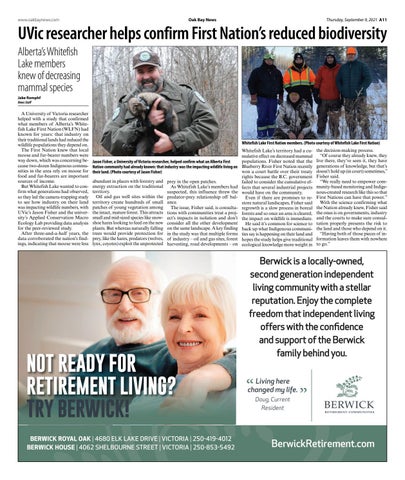
Whitefish Lake First Nation members. (Photo courtesy of Whitefish Lake First Nation)
Jason Fisher, a University of Victoria researcher, helped confirm what an Alberta First Nation community had already known: that industry was the impacting wildlife living on their land. (Photo courtesy of Jason Fisher) abundant in places with forestry and energy extraction on the traditional territory. Oil and gas well sites within the territory create hundreds of small patches of young vegetation among the intact, mature forest. This attracts small and mid-sized species like snowshoe hares looking to feed on the new plants. But whereas naturally falling trees would provide protection for prey, like the hares, predators (wolves, lynx, coyotes) exploit the unprotected
prey in the open patches. As Whitefish Lake’s members had suspected, this influence threw the predator-prey relationship off balance. The issue, Fisher said, is consultations with communities treat a project’s impacts in isolation and don’t consider all the other development on the same landscape. A key finding in the study was that multiple forms of industry – oil and gas sites, forest harvesting, road developments – on
Whitefish Lake’s territory had a cumulative effect on decreased mammal populations. Fisher noted that the Blueberry River First Nation recently won a court battle over their treaty rights because the B.C. government failed to consider the cumulative effects that several industrial projects would have on the community. Even if there are promises to restore natural landscapes, Fisher said regrowth is a slow process in boreal forests and so once an area is cleared, the impact on wildlife is immediate. He said it’s common for science to back up what Indigenous communities say is happening on their land and hopes the study helps give traditional ecological knowledge more weight in
the decision-making process. “Of course they already knew, they live there, they’ve seen it, they have generations of knowledge, but that’s doesn’t hold up (in court) sometimes,” Fisher said. “We really need to empower community-based monitoring and Indigenous-created research like this so that First Nations can have that power.” With the science confirming what the Nation already knew, Fisher said the onus is on governments, industry and the courts to make sure consultation properly presents the risk to the land and those who depend on it. “Having both of those pieces of information leaves them with nowhere to go.”
Berwick is a locally-owned, second generation independent living community with a stellar reputation. Enjoy the complete freedom that independent living offers with the confidence and support of the Berwick family behind you.
http://www.BerwickRetirement.com
A12 Thursday, September 9, 2021
Oak Bay News
SEPTEMBER 8-NOVEMBER 8, 2021
We can save more cancer patients. However, it will take team work. It will take a coalition. Local grocers have united to raise funds for life-saving technology at BC Cancer. You can help.
https://bccancerfoundation.com/for more information Visit bccancerfoundation.com and look for participating stores in your community.
www.oakbaynews.com
www.oakbaynews.com
Oak Bay News
Thursday, September 9, 2021 A13
Headliner Jesse Roper performs with his band at the All Ways Home music festival in Langford at Starlight Stadium on Sunday. (Don Descoteau/News Staff)
Don Descoteau News Staff
Headliner Jesse Roper provided a fitting end to the first All Ways Home music festival at Langford’s Starlight Stadium on Sunday. The Metchosin resident and sizzling blues guitarist with a powerful voice to match couldn’t get the smile off his face as he started his roughly 70-minute set. “I’ve missed you guys so much,” he shouted, extending his hands wide to add, I’ve missed you this much.” With festivals and large-scale concerts largely absent over the past 18 months or so, Roper
sounded ecstatic to be out playing a large venue again. The crowd responded in kind as he rolled through his eclectic original material, from blues to country rock to an A-E-IO-U didgeridoo-style chant that he prefaced with, “Now we’re gonna get weird!” Roper, who has gained solid local radio play over the years with such blues favourites as The Hurricane’s Eye, Shiny Round Nickel and Right Now, was the consummate showman, playing to the crowd and having fun on stage. He followed up an inspired, if rather hastily put-together set from Galiano Island electronic duo Funk Hunters, who filled in
at the 11th hour for Juno Award winners Snotty Nose Rez Kids. Sampling from a variety of pop hits and other well-known songs, Nick Middleton and Duncan Smith churned out infectious, danceable beats and rhythms that had the crowd movin’ and groovin’ virtually the whole time.Victoria folk rockers Jon and Roy put together a toe-tapping set of their own ahead of Funk Hunters, drawing on the acoustic-electric original material that has made them huge local favourites. Unlike the first day of the festival Saturday, Sunday’s schedule wasn’t interrupted by rain, which helped keep more of the crowd around.
Saturday, Sept 11 7:30 PM 2243 BEACON AVENUE, SIDNEY 250-656-0275 MARYWINSPEAR.CA
Re-Elect
Randall.Garrison@ndp.ca fb.com/RandallGarrisonPage @r_garrison @RandallGndp 778-265-6651
Fighting for you VOTE EARLY! Advance votes Sept 10-13 Front-row fans at the All Ways Home music festival Sunday at Starlight Stadium in Langford. (Don Descoteau/ News Staff)
Paid for and authorized by the official agent of the candidate. cope:225-xx
Jesse Roper dazzles crowd at Langford’s Starlight Stadium
A14 Thursday, September 9, 2021
Oak Bay News
www.oakbaynews.com
Fundraiser aims to go the distance for at-risk youth
CHALK ONE UP FOR THE CAMPERS
Evert Lindquist News Staff
Lucy Aitken, a leader with Recreation Oak Bay helps campers use up the chalk to fill a colourful and inspiring trail at Willows Beach Park Sept. 2. (Christine van Reeuwyk/News Staff)
Vision Matters
Missing the Signs?
Healthy Eyes. Doctor Delivered. Dr. Neil Paterson
Locals can run or cycle the City of Victoria’s 25-kilometre border this September with Do The Loop, to raise funds for at-risk youth. The event runs Sept. 18 to 26 and participants can track their progress with apps like Strava, Map My Run and RunKeeper and share it at #DoTheLoop. Registration is open until Sept. 25 and costs $25, which is donated to the Threshold Housing Society. The society is a registered charity that works to house and support vulnerable youth, owning 43 housing units and receiving over 150 youth applications annually. With $25, these youth can buy nutritious food or a counselling session. Threshold is running the fundraiser in partnership with the South Jubilee Neighbourhood Association, in whose area it operates two youth homes. The association will host a closing ceremony and festival at Redfern Park with a barbecue, live music and kids activities
Children’s Eyewear Care: A primer for parents
Hearing Loss doesn’t need to strain your relationship. BOOK YOUR FREE HEARING TEST TODAY.
OAK BAY 250.900.8026 FAIRFIELD 250.999.4553
www.nexgenhearing.com nexgenhearing.com
WorkSafeBC and other Provincial WCB Networks, VAC, BCEA and NIHB accepted Registered under the College of Speech and Hearing Health Professionals of BC
So your child is the proud owner of a pair of glasses! You should be aware that those glasses, at any given time, could be knocked to the floor, stepped on, sat on, squished in the bottom of a backpack, or even used as a sling shot.To ensure your child understands how important it is to treat his or her eyewear responsibly, here are other ideas to prolong the life of a pair of glasses: Make it an open and shut case. When the glasses aren’t in use, keep them safely tucked inside a hard case, marked with the child’s name and telephone number. Be a clean freak. Lenses should be cleaned at least once a day with warm soapy water or an appropriate lens cleaner – never wipe your lenses when they are dry! Jump in with both hands. Remind your child never to remove his or her glasses with only one hand – this is often the cause of many a misaligned and uncomfortable frame. Get adjusted. Glasses that stay in good shape are glasses that are readjusted from time to time, particularly if pressure marks appear on your child’s nose or behind his or her ears. And here’s a piece of good news: today’s eyeglasses are sturdier than ever, and meant to withstand general wear and tear.
http://www.oakbayoptometry.com Dr. Neil Paterson Dr. Suzanne Sutter Dr. Mark Paquette Dr. Rajdeep Gill
Optometrists 2075 Cadboro Bay Rd.
250.595.8500
on Sept. 26 from 11 a.m. to 4 p.m. “We need those nets in our society to catch the people who are most vulnerable,” Matt Dell, the community group’s president and event organizer. Dell, who spent a year planning the event, said he wanted to organize a community-oriented fundraiser that could “flip the housing and homelessness crisis into something that’s positive and proactive.” Route options created for the event include a scenic 25-km city border loop, a 25-km safe cycling loop sponsored by Capital Bike and a short 2.5 km scenic and accessible loop. The event is designed to be as accommodating as possible, allowing participants to complete the 25 km loops multiple times, in relay teams, over multiple days and in either direction. All registrants receive a Race Roster donation page, which is meant to assist those wishing to contribute more to Threshold than the $25 registration fee. For more information and to register, visit thresholdhousing.ca.
An outdoor music event at Prospect Lake Hall raised significant funds for community organizations that feed the community. (Photo courtesy of Deborah Price)
Jazz event swings up some cash for community groups Megan Atkins-Baker News Staff
An outdoor fundraiser concert that took place Aug. 30 outside Saanich’s Prospect Lake Hall garnered over $2,000 in donations for the Rainbow Kitchen and Living Edge. The proceeds were split between the two organizations, both of which are dedicated to feeding and serving communities in Greater Victoria that are food insecure. The event saw three different bands perform and featured genres such as big band swing classics, jazz, and rock and roll. “People were tapping their toes and smiling, there’s a certain freedom in this because people are coming back to life,” said Deborah Price adminis-
trative assistant with Living Edge and co-organizer of the event. Rainbow Kitchen is a family-friendly facility providing meals to the community, while Living Edge is a group that provides groceries on a weekly basis to those in need. Of importance to Living Edge is their emphasis on providing fresh food for seven neighbourhood freefood markets in Greater Victoria, Price said. A market runs in certain neighbourhoods every day except Sunday. “We secure perfectly good food that would otherwise end up going to waste from various donors, and we meet a different kind of market this way because they can get whatever’s in season and whatever we have a plethora of,” she said.
www.oakbaynews.com
Oak Bay News
Thursday, September 9, 2021 A15
Oak Bay cellist Lexie Krakowski living a life in music Follows up national win with placement in prestigious Toronto school Christine van Reeuwyk News Staff
The prowess of Oak Bay cellist Lexie Krakowski is a shining example for the exploration of music. In a bid to shake the old convention that a conservatory is just a place for protegees, the Victoria Conservatory of Music has long offered accessible options for people to explore and develop a relationship with music, said dean Stephen Green. Enter then seven-year-old Krakowski. During one Discovery Summer Camp at the VCM, she found herself perusing instruments and the cello stuck. “I was really inspired by the teachers at the camp, they made me want to continue learning the cello,” Krakowski said. “Over time I started getting
more involved at the VCM and their Collegium program, as well as the Greater Victoria Youth Orchestra and Greater Victoria Performing Arts Festival, and now playing cello became the most important part of my life.” Green remembers her starting to invest in herself and in her music. For the past five years she’s studied with Brian Yoon – principal cellist with the Victoria Symphony – and previously studied with Paula Kiffner and Karen Whyte. Now 18, Krakowski competed among 53 other young musicians in the 50th Federation of Canadian Music Festivals, a national festival where performers compete for a prize pool of $25,000. Krakowski was chosen among all disciplines by an international panel for the grand award of $5,000 and a performance opportunity with Symphony New Brunswick. But that has to wait, as the recent Oak Bay High grad spent her final days of summer driving east to pursue the next phase of her musical career. This fall she studies at the presti-
gious Glenn Gould School of Music with Hans Jensen and Andres Diaz, “both of whom are phenomenal pedagogues,” Krakowski added excitedly. “I’m really looking forward to focusing on improving my playing, while also learning from the musical environment in Toronto as well as my peers at school.” While he chuckles about her potential shock, moving from Oak Bay to Toronto, Green expects Krakowski to not only be fine, but to thrive. An avid member of school and community programs, she’s not one to remain quiet. “The arts isn’t something you should do in seclusion, it’s really all about having a perspective of the world and being able to share that. You need to be somebody who can connect,” Green said. Krakowski fits the bill. “The music industry has, for a long time, been very male dominated … I think Lexie’s a great advocate for women in the arts. She shows leadership qualities and I look forward to seeing how she can advocate for Recent Oak Bay High graduate Lexie Krakowski won the grand prize at the Federation of women in the arts.” Canadian Music Festivals national event for her cello playing. (Courtesy Lexie Krakowski) c.vanreeuwyk@blackpress.ca
Contact Claire
PerCuro Clinical Research Ltd.
250-382-6270 ext. 2484 Email: claire@percuro.ca
305-1120 Yates Street Victoria, BC V8V 3M9
A16 Thursday, September 9, 2021
Oak Bay News
www.doddsfurniture.com
www.doddsfurniture.com
www.oakbaynews.com
Oak Bay News
www.oakbaynews.com
Thursday, September 9, 2021 A17
Murder leaves a hole in Victoria’s arts community Jane Skrypnek News Staff
Murder victim Jeremy Gordaneer is being remembered for his personality and his mentorship in the local arts community. The noted multimedia artist Gordaneer, found around 5 a.m. Aug. 31 by police and paramedics in a building in the 1000-block of Carberry Gardens in Rockland, died from his injuries. In a Sept. 1 social media post, his wife Thea Patterson stated, “He touched so, so many people with his talent – his gentle genius – his wry sense of humour – his tender soft eyes – his ability to put people at ease. He was – he is – simply one of the very best
ones. I will always miss him.” Gordaneer, the son of Canadian painter James Gordaneer, was born in Ontario but grew up in Victoria. He nurtured his childhood love for art by attending Camosun College’s fine arts program, the University of Victoria’s theatre program, and the University of Alberta’s scenic design master’s program. His work combined painting, sculpture, dance and set design. The chair of Camosun’s visual arts department, brad muir, voiced deep shock and sadness upon hearing the news. In 2016, Gordaneer was artist in residence at the department, producing a series of paintings inspired by his wife’s performance work.
“Jeremy’s work, generosity, and spirit has encouraged and inspired many artists within our program. Our deepest empathy and heartfelt support goes out to the family and friends of Jeremy,” muir said in a statement on behalf of his department. No arrests have been made in the case. The death is being treated as a homicide by investigators from the Vancouver Island Integrated Major Crime Unit (VIIMCU). It was Victoria’s second murder of the year. Anyone with information, including dashcam or video footage of the area of the 1000-block of Carberry Gardens from Aug. 30 around 6 p.m. to Aug. 31 at 6 a.m. is asked to call the VIIMCU Local artist Jeremy Gordaneer, here with wife Thea Patterson, was found suffering serious injuries on Aug. 31 and died as a result. (Jeremy Gordaneer/Facebook) information line at 250-380-6211.
Greater Victoria’s benchmark price for single-family home tops $1 million Wolfgang Depner News Staff
Would-be buyers of the average single-family home in Greater Victoria will need at least $1 million to the table in two out of three Peninsula communities according to new figures from the Victoria Real Estate Board (VREB) detailing August sales. According to those figures,the benchmark price for a single-family home in Victoria’s core is $1.089 million and $1.005 million for all of Greater Victoria, while in the West Shore it is $869,400.
Sidney is the cheapest place on the Peninsula to buy a single-family home, as measured by VREB, with a home price index benchmark value of $901,700, followed by Central Saanich with $1.046 million and North Saanich with $1.314 million. More broadly, 831 properties of various kinds changed owners in August, a drop of 15.1 per cent compared to August 2020. Compared to July, sales declined by 0.5 per cent. These figures appear to reflect declining sales of single-family homes. Condominium sales in August were up 31.7 per cent from August 2020 with 345 units sold
and up 21.5 per cent compared to July. By comparison, sales of single-family homes in August were down 29.9 per cent from August 2020 with 357 sold and 9.8 per cent down from July. North Saanich led the Peninsula communities with 13 sales totalling $27.9 million, followed by Central Saanich with 10 sales totalling $13.89 million and Sidney with six sales totalling $5.88 million. David Langlois, VREB’s president, said sales are slowing down because of lacking inventory. “Without the significant lack of inventory we’re experiencing, sales would most certainly have been comparable to, if not greater than, last
This Is The Life. Come see for yourself. The Vista by Avenir Senior Living, is a new era in resort-style retirement living at the edge of the beautiful Saxe Point neighbourhood in Esquimalt. Here you have the ability to age in place with a wide range of Continuum Care options designed to meet your changing needs. The Vista is a pet-friendly building that features the finest construction and design with exquisite interior and exterior finishes. Dine in the sky from our 11th floor dining room. Enjoy spectacular 360-degree ocean and city views from our balcony, outstanding building amenities and activities for all interests. Life is a great adventure. Join us!.
Sales Centre Now Open | 1318 Esquimalt Road Book your appointment today 778.402.8695. For more information visit liveatvista.ca http://www.liveatvista.ca/
INDEPENDENT & SUPPORTIVE LIVING SUITES FROM $4,300 $ 0 PER P R MONTH M
August,” said Langlois. These figures appear against the backdrop of the federal election campaign and Langlois used the occasion to offer a general critique. While acknowledging various measures to curb prices, Langlois said they will not address the “systemic lack of housing supply” behind rising real estate prices. “The municipal, provincial and federal governments’ failure to support real growth and diversity in housing stocks has created the market conditions we find ourselves in today,” said Langlois, without endorsing any specific party platform.
A18 Thursday, September 9, 2021
Oak Bay News
www.oakbaynews.com
$300 OFF
any job over $2,000
on like s ll o R t a o c r e p Su steel! paint wears like / DECKS / PATIOS / DRIVEWAYS / GARAGE FLOORS / STAIRS / WALKWAYS
250.938.9969 http://www.supercoat.ca/ supercoat.ca
WE ALSO DO INTERIORS 30 YRS EXPERIENCE • FREE ESTIMATES
WesternCanadaSupercoat
Is your hearing ready to be social again? As we resume social activity, you’ll need to adjust to hearing background noise and group conversation again. A professional Audiologist can help ensure your hearing is ready.
Call today for a hearing evaluation. 1932 Oak Bay Ave. (Near Oak Bay & Foul Bay)
250.479.2921 broadmeadhearing.com
CHRISTINE STANGELAND Audiologist
SEPTEMBER 30 TH IS
ORANGE SHIRT DAY HELP SUPPORT VICTORIA ORANGE SHIRT DAY. Proceeds of the sales of our products go towards helping us to continue to create awareness of the effects of Residential Schools
25 EACH
$
CASH ONLY
FUN AT THE FAIR Lacee Sluggett of Sluggett Farms was thrilled to be back at the Saanich Fairgrounds for another year of festivities as the 152nd Saanich Fair took place over the Labour Day weekend. (Megan Atkins-Baker/News Staff)
A guide to casting your federal election ballot Residents are headed to the polls Sept. 20, while some will choose to cast their ballot far earlier. Anyone registered in the region’s four ridings – Cowichan-Malahat-Langford, Esquimalt-Saanich-Sooke, Saanich-Gulf Islands and Victoria – should receive a voter information card in the mail by Sept. 10, the day the first polls open. Bring the card and identification to make the voting process smooth. The card outlines an assigned polling station, residents can head there for advanced polls Sept. 10 to 13 from 9 a.m. to 9 p.m. Anyone unregistered, or who doesn’t receive a card can use the online registration service or call 1-800-463-6868 or 1-800361-8935 (TTY) for assistance.
Residents can also register when they go to vote, with appropriate identification. To find assigned election day or advance polling stations, use the online voter information service at elections.ca. Anyone part of a vulnerable population, a student away from home or out of town during advance votes and general election day can opt to mail in their ballot. To vote by mail, apply online or at any Elections Canada office across Canada before Tuesday, Sept. 14 at 6 p.m. Mail voters use a special ballot process and cannot change their minds and vote at advance polls or on election day. If none of the above are options, residents can vote at any Elections Canada office before Tuesday, Sept. 14 at 6 p.m. this
is also a special ballot process. Elections Canada offices are open Monday to Friday 9 a.m. to 9 p.m., Saturday 9 a.m. to 6 p.m. and Sunday noon to 4 p.m. The Elections Canada office for Victoria is in University Heights Shopping Centre in Saanich, 3970 Shelbourne St. or call toll free 1-866-723-1359. The Esquimalt-Saanich-Sooke election office is Uptown Mall, 3600 Uptown Blvd or call 1-866-546-7619. The election office for Cowichan-Malahat-Langford is in Millstream Village, 2401 Millstream Rd. or call 1 866 545-0469. The Saanich-Gulf Islands elections office is in the Mary Winspear Centre in Sidney, 2243 Beacon Ave. or call 1-866-546-7620. Find your riding and polling station information at elections. ca.
XeXe Smun’Eem (Sacred Children) VICTORY BARBER 1315 Blanshard St. IMAGINE STUDIO 31 Erie St. CAFE FANTASTICO 965 Kings Rd. PENINSULA NEWS REVIEW 103-9830 Second St. Sidney GOLDSTREAM NEWS GAZETTE 101- 847 Goldstream Ave.
SOOKE NEWS MIRROR 4 – 6631 Sooke Rd.
DELHI RESTAURANT 105-2504 Government St.
ARTISANS GARDEN 6689 Goodmere Rd.
MIGRATION BOUTIQUE Victoria 1223 Government St. Vancouver 3620 Main St.
POLITANO CAFE 7088 West Saanich Rd. DISCOVERY COFFEE All Locations
PLUTO’S RESTAURANT 2709 Quadra St. MA YOGA 539 Herald St.
Celebrating 46years yearsof 45 serving Victoria
BIG WHEEL BURGER Victoria 703 -771 Vernon Ave. 210-172 Wilson St. Nanaimo 601 Bruce Ave.
ICBC • HOME • LIFE MARINE • COMMERCIAL
AMELIA LEE BOUTIQUE 554 Yates St. 3671 Uptown
to the public Open https://www.thunderbirdinsurance.com/ 250 -385 -9795 • thunderbirdinsurance.com 250-385-9795 info@thunderbirdinsurance.com 1032 Yates Street info@thunderbirdinsurance.com •• MON – FRI 9AM – 5:30PM • SAT 10AM – 5PM thunderbirdinsurance.com https://www.thunderbirdinsurance.com/ 1032 Yates Street • MON–FRI 9AM–4PM
Our Family Serving Your Family Since 1974
www.oakbaynews.com
Oak Bay News
Thursday, September 9, 2021 A19
Monterey centre hosts week-long welcome back party After 18 months of roller coaster restrictions keeping friends and colleagues apart, the Monterey Activity Association is hosting a week-long welcome back party. Welcome Back Week runs Sept. 7 to 10 in the Monterey Recreation Centre lobby, where association board members will meet guests and serve treats. “The board members are pleased that energy is returning to the centre, programs are beginning again,
the Fern Cafe is coming alive, and the clubs are starting up,” vice-president Sandy Cotton said. Refreshments range from an ice cream parlour to sweet and savoury scones, created by chef Paul de Ridder. Entertainment includes a harp performance, the Ukulele Club Ensemble, the Concert Band Ensemble and the Monterey Avenue Minstrels. “Staff are looking forward to welcoming members, volunteers and people who visit
the centre for the first time,” said Joanne Donohue, a program planner for the centre. “Already, volunteers have been trained for reception, food services and the Coffee Express and are waiting to serve members and prospective members. This is a fresh start, not a restart.” Per the latest provincial health protocols, masks are required for this event. For more information, drop by the centre at 1442 Monterey Ave. c.vanreeuwyk@blackpress.ca
Survey says: nearly a third of Canadians are looking to cash in on a side hustle During the COVID-19 pandemic, 31 per cent of Canadians pursued opportunities to make additional income outside of their primary employment, according to a study. The survey of 1,500 people, done recently by Abacus Data for Direct Sellers Association of Canada, found nearly one in three Canadians pursued opportunities to make additional income during the health crisis. The survey was conducted from July 9 to 14 with a random sample of panelists invited to complete the survey. That 31 per cent includes more than half of those aged 18 to 29 (51 per cent) and 46 per cent of students. “The economy is changing, and this has been intensified by the pandemic,” Peter Maddox, president of DSA Canada, said in a news release. “As a positive, many people, especially younger Canadians, are looking for flexibility and work-life balance as they earn, and this is being made possible by technology and market innovation. People are finding ways to participate in entrepreneurial activity, such as direct selling, in a manner that suits them.”
Up two per cent from 2020, 24 per cent of respondents consider direct selling to be a realistic business option to cash in on. Direct Member Sandy Cotton is greeted by Monterey Recreation selling is the sale of products without a fixed Centre staff Lesley Cobus and Joanne Donohue. retail location. The method is popular with (Photo by Linda Foubister) items such as health-care products, cosmetics, jewelry, housewares and giftware. Reasons included being laid off or underemFind us on ployed as well as looking harder at personal financial goals. The study showed that as the economy recovers, three in five intend to pursue opportunities /OakBayNews to augment their income over the next year. “This research points to the fact that, whether by choice or necessity, Canadians see value in income opportunities that would not be considered part of a traditional employment arrangement,” Maddox said. “This could include participating in the gig economy, becoming an independent representative for a sales-based company or creating their own, small start-up business.”
WING’S RESTAURANT
TAKE OUT Combination Dinners for 1 to 8 Seafood and Deluxe Dishes Licensed Premises Open 11 am - 10 pm daily
90 Gorge Rd. West 250-385-5564
c.vanreeuwyk@blackpress.ca
TIDE TABLES Sept 09 10 11 12 13 14 15
Time HT Time HT Time HT Time 05:34 7.9 11:30 3.9 18:22 8.9 00:13 4.3 06:52 7.5 12:06 5.2 18:42 01:07 3.3 08:45 7.5 12:43 6.2 19:07 02:08 2.6 10:50 7.5 13:23 7.2 19:32 03:14 2.3 13:06 8.2 14:13 8.2 19:54 04:23 2.0 14:29 8.9 16:02 8.9 19:56 05:34 2.0 15:13 9.2 17:51 8.9 19:56 TIMES ARE IN STANDARD TIME, HEIGHTS IN FEET
HT 9.2 9.2 9.2 9.2 9.2 8.9
celebrating fibre artists & community since 2011
‘Boat Share’ Rowing Club Oak Bay - Vic Harbour
60+ exhibitors | Demonstrations | Hands-on activities for kids
Row Whitehall Rowboats made in Victoria. Fun, fitness & relaxation. Slide seat sculling instruction included. Call Diana: 778 - 679 - 3927 Office: 250 - 361 - 2621 http://wsrclub.com/ WSRClub.com
Your future is bright at Trillium Communities. Independent Living, Assisted Living, and Long-Term Care that’s safe, engaging, and as unique as you. Come see us today.
www.kbnfibres.ca/fibrations
fibrationsvic
Locally Owned & Operated | 250.383.6509 | trilliumcommunities.com
A20 Thursday, September 9, 2021
Oak Bay News
www.oakbaynews.com
Communists’ Strandlund touts benefits of party for today’s dilemmas Kiernan Green News Staff
Tyson Strandlund, the Communist Party candidate for Esquimalt-Saanich-Sooke, said that growing support for his party shows Canadians’ desire for the upcoming federal election to result in greater advocacy for the working class and the dismemberment of colonial systems. The candidate from Metchosin is currently defending a thesis at the University of Victoria on the role of the Soviet Union’s role in decolonization throughout the last century. Since joining the Communist Party of Canada in 2012, Strandlund’s restarted Victoria’s Young Communist
League and has run both provincially and federally as the local Communist c a n d i d at e. Strundland – a member of the Metis Tyson Strandlund Nation and descendent of Manitoba founder Louis Riel – said two perspectives taken from his undergraduate degree at Camosun encouraged his interest in Communist politics. The first spoke to an appreciation for the environment Strandlund said naturally came from growing up on
the west coast. “I was studying environmental tech … we had all this information (to say) these are things we can do to help the environment. I thought we needed more scientists at the time,” Strandlund said. “That’s not the problem.” Considering the interests of traditional politics in industries that contribute to climate change, “there’s no political ability under capitalism to fix (the environment),” Strandlund said. “There’s no political will to fix it.” The second was his study of the Soviet constitution. The foreign charter from 1936 includes rights “that we don’t have here in Canada today,” Strundand said. They
include the guaranteed right to a well-paying job, medical care, and most importantly in the Canadian context, Strundland said, the equality of self-determination between nations, such as those that existed in Canada before European contact. “A lot of people in Canada, and outside of Canada, get the impression that this country is one nation – in fact, it’s many nations trapped unequally inside the Canadian state,” he said. Additionally, equality of nations should extend to Canada’s foreign policy. Canada owns 75 per cent of mines across the world, which Stundland said represents a continuing colonial mission in the modern day.
Having any of the Communist candidates win an MP seat in Parliament would be “a good start” for his party, Strundland said. He said membership in Victoria has risen 50 per cent in the last year. But ultimately, social reform for the benefit of the working-class begins outside of the parliamentary system of power, he said. “It involves mass labour movements and goals, a broad coalition of people across the country, striking … working with some more progressive members of the NDP and maybe even a couple of Liberals,” he said. “Getting elected is one measure of victory.” vnc.editorial@blackpress.ca
ATTENTION: Craft Fair, Artisan Market and Event Organizers On Thursday October 7th, 2021 the Greater Victoria Community Newspapers, Victoria News, Goldstream Gazette, Saanich News, Oak Bay News, and the Peninsula News Review will be publishing their Craft Fair and Event Guide. This guide will appear in print and land on over 85,000 doorsteps, online as an e-edition and be pushed through their social media channels throughout Greater Victoria.
Give them power. Give them confidence. Give them control.
With over 100,000 followers in Greater Victoria AMPLIFY YOUR VOICE! Your ad can be published in this must-see guide for only $179.00 for a listing, logo and up to 30 lines. Display ads available upon request. TO PLACE YOUR AD Email pdoering@vicnews.com Call 250-480-3242
GIVE THEM A PAPER ROUTE! It’s so easy to get started…call
250.480.3277 circulation@oakbaynews.com
oakbaynews.com http://www.oakbaynews.com
24 / 7
We are your online news source for Oak Bay! www.OakBayNews.com #OakBayNews
www.oakbaynews.com
Oak Bay News
Thursday, September 9, 2021 A21
66 CONCRETE 1, 2 & 3 BEDROOM VIEW HOMES
Esquimalt Living, Endless Ocean Views. Pacific House brings a new way of living to Esquimalt, embracing southern panoramic views of the ocean, Inner Harbour and Olympic Mountains. The refreshingly modern nine-storey concrete building is at the corner of Head Street and Esquimalt Road, in the heart of a vibrant and growing community just minutes from downtown Victoria.
REGISTER NOW
PacificHouse.ca 250.589.1568 Info@PacificHouse.ca
Sales and Marketing by MLA Canada and Engel & Völkers. This is not an offering for sale. Any such offerings may only be made with a Disclosure Statement. E.&.E.0.
A22 Thursday, September 9, 2021
Oak Bay News
www.oakbaynews.com
BCClassifieds.com
ONLINE bcclassifieds@blackpress.ca IN PRINT 1.866.865.4460
...in your community, online and in print
CLEAR THE CLUTTER!
Friendly Frank says...
Showcase your hidden treasures.
Sell any single item dirt cheap!
Garage sales are the talk of town! Give your JUNK a new life!
It’s time to sell, call today! INDEX IN BRIEF FAMILY ANNOUNCEMENTS ..............1-8 COMMUNITY ANNOUNCEMENTS....9-57 TRAVEL .......................................61-76 CHILDREN ...................................80-98 EMPLOYMENT .........................102-198 BUSINESS SERVICES ...............203-387 PETS & LIVESTOCK .................453-483 MERCHANDISE FOR SALE........503-587 REAL ESTATE...........................603-969 RENTALS.................................703-757 AUTOMOTIVE...........................804-862 MARINE...................................902-920
INDEX IN BRIEF It is agreed by any Display or Classified Advertiser requesting space that the liability of the newspaper in the event of failure to publish an advertisement shall be limited to the amount paid by the advertiser for that portion of the advertising space occupied by the incorrect item only, and that there shall be no liability in any event beyond the amount paid for such an advertisement. The Publisher shall not be liable for slight changes or typographical errors that do not lessen the value of an advertisement. cannot bcclassifieds.com be responsible for errors after the first day of publication of any advertisement. Notice of errors on the first day should immediately be called to the attention of the Classified Department to be corrected for the following edition. bcclassifieds.com reserves the right to revise, edit, classify or reject any advertisement and to retain any answers directed to the bcclassifieds.com Box Reply Service and to repay the customer the sum paid for the advertisement and box rental.
Personal Services Employment
Merchandise for Sale Employment
Merchandise for Sale Employment
Financial Services
Building Supplies
Misc. for Sale Ikea Comfy Grey Fabric Chair $89.00 250-886-9375
1-877-987-1420 www.pioneerwest.com
INTEGRITY POST FRAME BUILDINGS since 2008. Built with concrete posts. Barns, shops, riding arenas, machine sheds and more. Adam.s@ integritybuilt.com. 1-250-351-5374. www.integritybuilt.com
Merchandise for Sale Employment
Misc. for Sale
Antiques / Vintage
Computer Chair Fabric w/ Arms. Adjusts in height. As new. $95 250-721-0700
GET BACK ON TRACK! Bad credit? Bills? Unemployed? Need Money? We Lend! If you own your own home - you qualify. Pioneer Acceptance Corp. Member BBB.
Galleon Books & Antiques - Purchasing Antiques, Books, Costume & Fine Jewelry, China. Estates & Private Libraries 250-655-0700
Are You The Best at What You Do? Spotlight your business with our business builder
Service Providers Call today to reserve your spot, space is limited!
Pet Wire Cage - As New H: 21 in x 2ft wide x 18 in deep $84 250-886-9375
ALL THE
YOU NEED AND MORE!
FREE Wall Unit 250-598-0750 Heavy Duty Hockey Net 6 x 4 ft, 20 inch stoppers. $75.obo 250-727-3686
LIKE OR FOLLOW
PLEASE RECYCLE THIS NEWSPAPER.
Looking To Reach A Larger Audience?
DISCRIMINATORY LEGISLATION Advertisers are reminded that provincial legislation forbids the publication of any advertisement which discriminates against any person because of race, religion, sex, colour, nationality, ancestry or place of origin, age, and physical or mental disability, unless the condition is justified by a bona fide requirement for the work involved.
3ODFH DQ DG LQ WKH FODVVLƞHGV
Handwashing: A Healthy Habit in the Kitchen Handwashing is one of the most important things you can do to prevent food poisoning when you are preparing food for yourself or loved ones. Washing your hands frequently with soap and water is an easy way to prevent germs from spreading around your kitchen and to other foods. Follow these handwashing tips to make sure you have clean hands when preparing food: • Close-up of hands being washed in the kitchen and a reminder that handwashing keeps you healthy. • Wash your hands often when you cook to prevent the spread of germs. Your hands can spread germs in the kitchen, so wash your hands often to prevent cross-contamination. • Handwashing is especially important during key times when germs can spread. Here are some key times to wash in the kitchen: • Before, during, and after preparing any food. • After handling raw meat, poultry, seafood, and eggs.
• Before eating. • After touching garbage. • After wiping counters or cleaning other surfaces
with chemicals. • After touching pets, pet food, or pet treats. • After coughing, sneezing, or blowing your nose.
www.oakbaynews.com
Oak Bay News
BCClassifieds.com
Thursday, September 9, 2021 A23
Complete guide to professional services in your community
Service Directory
1-866-865-4460 Business Services
Business Services
Business Services
Business Services
Business Services
Electrical
Hauling & Salvage
Hauling & Salvage
Painting & Decorating
Plumbing
SAVE-A-LOT Hauling. We take it all! Furniture, appli.’s, garden waste & more. Low rates. Seniors discounts. Best Service. Brad 250-217-9578
250-361-6193 Quality Electric Reno’s,Res./Comm. No job too small. Lic# 22779.
Gutters & Downspouts
1-866-865-4460
BIG
A Professional Woman Painter. Karen Bales Painting & Wall coverings. Over 30 yrs exp. Free est. 250-514-5220
NEED REPAIRS? Use your community classifieds Service Directory to find an expert in your community
SMALL ADS,
Painting & Decorating
250-380-7778 GRAND Xterior Cleaning • Windows • Repairs • Gutters • Roof De-Moss • Pressure Wash
FIND EVERYTHING YOU NEED IN THE CLASSIFIEDS
FREE ESTIMATES Reasonable. Reliable. No job too small. Call 250-388-5544
DEALS!
Classifieds Your place to SELL Your place to BUY
More than 1.5 million Canadian families are in need of affordable housing. Your contributions provides Habitat with the resources it needs to help families.
Donate Today!
Place Your Ads Online Call
1-866-865-4460 www.habitat.ca
1-866-865-4460
FOR SALE in your community To see more information on any ad, visit UsedVictoria.com and enter the ad ID into the search bar.
2013 KIA Forte, 4D
$7,100 Just passed through thoroughly BCAA 57 inspection points (this is regular procedure for out of province cars). NO Accidents, new battery, windshield, tires, second owner. Only 80,500 kms.
Hyundai Elantra GLS 2007 Silver
Eco Logs firewood
$95
$4,900
Power recliner sofa (new)
$2,700
Dacor natural gas cooktop, model SGM 304
$375
Complete supplies for a pond
$250
Upper floor of house for rent 2741 Gamble Drive Colwood
$2,600
Carpenter needed at Haro Construction Exciting opportunity to join a high end construction company doing outstanding renovations, TI, and new construction. Come and be part of this reputable company known for its quality, integrity and staff satisfaction.
Ad ID: 39115778 astarosud@gmail.com Saanich
Ad ID: 39118265 elantra2007@icloud.com Victoria City
Ad ID: 36815499 info@ecologs.ca Victoria City
Ad ID: 39107418 tinamarie@shaw.ca West Shore
Ad ID: 39133488 dusko2@yahoo.com North Saanich
Ad ID: 39136397 goldschmid@shaw.ca Saanich
Ad ID: 39139767 250-881-4342 West Shore
Ad ID: 39134216 250-208-5637 West Shore
Residential framing carpenters & apprentices
Above ground pool
Residential framing carpenters wanted
Owens corning 200 pink rigid insulation 50% off retail
1 bed / 1 bath condo in 55+ independent living building
Home care worker/ community support worker wanted
Professional painting services - end of summer deals!
35 yr professional painter for hire
Ad ID: 35997688 250-514-3802 Victoria City
Ad ID: 39006249 250-888-6992 Saanich
Ad ID: 28298791 nicole@horizoncontracting.ca Victoria City
$500
from $30 each
Ad ID: 39119817 a.jensen@shaw.ca Oak Bay
Ad ID: 39133951 250-380-4605 Saanich
Ad ID: 39139274 250-889-2164 Saanich
$2,375
Ad ID: 39067984 250-532-2602 Saanich
$21
Ad ID: 39133557 goingforth02@gmail.com West Shore
Experienced in all aspects of painting and drywall repair. Interior / exterior, great rates, small jobs welcome. Free estimates. Serving all South Vancouver Island.
To see your stuff in print for as little as $5, place your ad on UsedVictoria.com and select the Print Upgrade option.
A24 Thursday, September 9, 2021
Oak Bay News
www.oakbaynews.com
The Astonishing Resurrection Of A Family Heirloom Rug Luv-A-Rug Gives A Horribly Disfigured Rug A Beautiful New Life
T
hey said it was one of the biggest shocks of their life.
Today when people see the rug no one is even aware it was made of two separate pieces - the result was that spectacular!
It happened the day the rug was pulled from storage and unrolled in front of the family.
Loving Rugs Is At The Core Of What Luv-A-Rug Does
What was once a glorious rug large enough to fill a grand entrance way... ...had a gigantic rotting pile of dirt in the middle where colorful handkotted wool once displayed it’s beauty.
Dusty Roberts Telling The Story Of How This Resurrected Rug Became Disfigured
The tears from the owner began When that day finally arrived, to flow at the mere site of it. she brought the rug to Luv-ARug to have it washed and Countless years of wonderful make any repairs so it would memories woven into the rug look as spectacular as it did in were forever gone. her memories. This precious gift, handed When the owner brought the down in the family from a much loved and greatly missed rug in, it was still all rolled up like it had been for years. grandparent was now a heaping mess. As soon as Dusty Roberts, the Team Leader and owner of The loss for the owner was Luv-A-Rug, removed the devesatating and almost too wrapping, he immediately much to bear. knew something was wrong.
How This Rug Became Horribly Disfigured
The amount of guilt and shame she felt from not having the rug properly protected and stored was enormous. She was so looking forward to the day she had a home that could display the rug.
But what he didn’t know was how bad it was going to be.
intricate designs made with exquisitely colored wool in the center was now a heap of dark loose castings courtesy of hungry little moth larvae.
Giving A Rug A Whole New Life
If you have a rug that’s seen better days and you want to be able to fall in love with it all over again, then bring it to Luv-A-Rug. Whether it needs freshening up, stain or odor removal, or a minor/major repair done, Dusty and his team are the ones who can guarantee to make it happen for you.
Use your mobile phone to text Dusty at (778) 533-7847 The owner asked Dusty if he with your name and a picture could dispose of the rug since it of your rug and he’ll reply was no longer of any value to back with a free INSTANT her. estimate. Feeling the loss almost as strongly as the owner herself, Dusty was inspired to find a way to give this handknotted Persian rug a whole new life.
As he began unrolling the mammoth 10 foot by 14 foot Persian Sarouke rug, everyone gasped when they discovered an entire 7 foot section in the middle of the rug was missing.
Since only the middle of the rug was affected, Dusty had his in house weaver bring the two unaffected edges together and create a new rug out of them.
What was supposed to be
The result was nothing less than astonishing.
A close up of where the two remaining sections of this Persian Sarouke rug were hand woven together
*100% GUARANTEED Odour Removal (especially pet odours) from your rugs or your money back
Luv-A-Rug Services Inc. Call/Text (778)
533-7847
Tues - Fri 8 a.m. till 1:30 p.m. Saturdays 8 a.m. till 3:30 p.m. Restorative Rug Washing ~ Authentic Hand Woven Rug Repair ~ Rug Appraisal We also clean Boat Tops & Sails, Sports Equipment, Stuffed Animals, Horse Blankets, Outdoor Furniture, Luxury Hand Bags