24 • The Columbia Valley Pioneer
August 5, 2016
Taynton pioneers left their mark By Dorothy Isted Special to The Pioneer There are a number of Taynton landmarks throughout the Columbia Valley named for early pioneers to the valley, whose descendants are alive and well today. People enjoying Kinsmen Beach and Pynelogs facilities would be surprised to know a thriving brickyard once occupied the shoreline, starting at the waterpark and going west. John Hopkins Griffiths (Jack) Taynton and William Walter (Bill) Taynton immigrated to Winnipeg with their parents in 1882 from England, near Wales. Their father was a brickmaker and mason. Jack married Lydia Masters in Manitoba and the pair went west. In 1885, Jack found himself working in the Selkirk Mountains with the railroad and met men who’d discovered gold in Toby Creek canyon. This brought him to the Columbia Valley where he spent the summer panning for gold. He then welcomed his brother Bill in 1887 and they created a ranch called Tayntons Hillahee (it is now known as the Thunderhill Ranch near Canal Flats). Bill worked a few days on the Baillie-Grohman Canal, but quit as he didn’t enjoy the work. Jack and Bill also packed supplies, moving most of the freight for the Northwest Mounted Police, who were brought in to settle a serious dispute between the Ktunaxa First Nation and encroaching settlers near Fort Steele. At that time, supplies were shipped by train to Golden. The men built their own boat and ferried goods further south. They operated pack trains consisting of six oxen and six horses. Mining camps in the valley used cheap labour provided by Chinese immigrants under perilous conditions. The labourers hung by ropes into the canyons to chip out the mineral. The brothers transported food to the camps on Findlay Creek, and the payments were made in gold. The brothers owned/operated and sold several ranches and mines. Jack and Lydia’s only child, William, was the first white child born in the Windermere Mining District in 1889. That year, they moved to Brisco and then Golden where they helped construct a bridge and a smelter. Moving to the West Kootenays, Jack returned to the valley in 1899. In 1899, Jack’s brother Bill married his childhood sweetheart from Winnipeg, Edith Wilks. Bill ran the experimental farm once situated on 13th Avenue in Invermere and later the Windermere experimental farm. He shared his love of flowers with his good friend and neighbour, R. Randolph Bruce. Edith and Bill had one child, Gilbert. In 1902, Jack started a brick and lime yard on the shoreline of Taynton Bay. Along with the brickyard, Jack and Bill and both their sons had homes there at the site. Continued on next page . . .
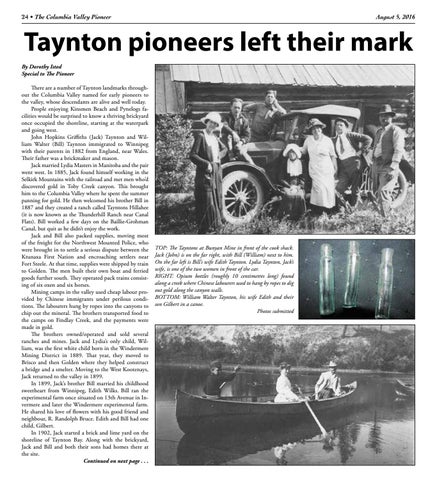
TOP: The Tayntons at Bunyan Mine in front of the cook shack. Jack (John) is on the far right, with Bill (William) next to him. On the far left is Bill’s wife Edith Taynton. Lydia Taynton, Jack’s wife, is one of the two women in front of the car. RIGHT: Opium bottles (roughly 10 centimetres long) found along a creek where Chinese labourers used to hang by ropes to dig out gold along the canyon walls. BOTTOM: William Walter Taynton, his wife Edith and their son Gilbert in a canoe. Photos submitted