BUSINESS
B1
WEDNESDAY, SEPT. 9, 2015
Volatility discouraging ECONOMISTS EXPECT BANK OF CANADA TO HOLD ITS KEY RATE AT 0.5 PER CENT BY THE CANADIAN PRESS
INTEREST RATES
OTTAWA — The Bank of Canada is expected to keep its key interest rate on hold Wednesday following a string of better than expected economic data. However, the continued weakness in oil prices and the turmoil on the global markets amid fears about the Chinese economy are expected raise concerns for the central bank, economists say. Benjamin Tal, deputy chief economist at CIBC World Markets, said he’ll be watching to see what the Bank of Canada highlights in its rate announcement. “It will be very interesting to see what the focus is,” Tal said. Oil prices are lower than the Bank of Canada forecast in its July monetary policy report and Chinese economic weakness is expected to hurt commodity prices. So, while the third quarter has been shaping up to show growth, the Canadian economy still faces challenges, Tal noted. “They definitely will talk about the recovery in
the third quarter, but I think that they probably won’t be as optimistic about the fourth quarter,” he said. The central bank has cut the rate twice this year, most recently in July when it also downgraded its outlook for the Canadian economy. Since then, Statistics Canada has reported that the economy contracted at an annual pace of 0.5 per cent in the second quarter, in line with the Bank of Canada’s expectations. There has also been better than expected trade results for July and stronger than expected job numbers for August, pointing to an economy that has pulled out of the slump it had been in for the first half of the year. The data adds up to expectations that the Canadian economy will grow in the third quarter after contracting for the first two quarters of the year, putting the country into a recession.
However, BMO senior economist Benjamin Reitzes said the volatility in financial markets in recent weeks “is hardly an encouraging sign for global growth.” “The knock-on effect of China’s weakness on emerging markets and the resulting impact on commodity prices will be significant concerns for the Bank of Canada,” Reitzes wrote in a report. “Look for the statement to highlight increased downside risk coming from emerging markets.” Meanwhile, Tal also noted that the Bank of Canada’s core inflation rate has been above the two per cent for 12 straight months. In its last monetary policy report, the central bank attributed it to “transitory effects” including the drop in the loonie compared with the U.S. dollar and some sector specific factors. However, Tal said at some point it will be a concern. “Since then the dollar went down and it might go down even more, especially with the Bank of Canada’s policy relative to the Fed,” Tal said.
Pension managers must weather climate-change risk: study
HONOUR & RESPECT
BY THE CANADIAN PRESS
File photo by THE CANADIAN PRESS
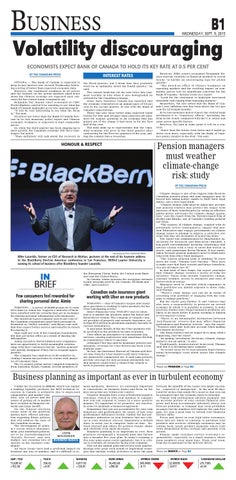
Mike Lazaridis, former co-CEO of Research in Motion, gestures at the end of his keynote address to the BlackBerry DevCon Americas conference in San Francisco. Wilfrid Laurier University is naming its school of business after BlackBerry founder Lazaridis. the European Union, India, the United Arab Emirates and the United States. In Canada, Aimia operates the Aeroplan customer loyalty program used by Air Canada, TD Bank and CIBC, and retailers.
IN
BRIEF
Canadian auto insurance giant working with Uber on new products
Few consumers feel rewarded for sharing personal data: Aimia TORONTO — A survey of 20,000 people in 11 countries done by Aimia Inc. suggests a minority of them were satisfied with the rewards they get in exchange for sharing personal information with businesses. The Montreal-based company said 31 per cent of the Canadian respondents rated their personal information as “highly valuable” and 26 per cent said that they expect better service and benefits in return for sharing it. Only eight per cent of the Canadian respondents felt they get better offers as a result of sharing the information. Aimia executive David Johnson says companies have an opportunity to build meaningful relationships with their customers but the “golden moment” will quickly disappear if they fail to respond appropriately. The company has employees in 20 countries including Canada and provides its clients with analytics of consumer data. The 11-country global survey compiled responses from Australia, Brazil, Canada, several members of
TORONTO — One of Canada’s largest auto insurance providers is working to tailor products for the Uber ridesharing service. Intact Financial Corp. (TSX:IFC) says its intention is to market the products under the Intact and Belairdirect brands. The company is Canada’s largest provider of property and casualty insurance, collecting $7.5 billion in premiums annually through its various subsidiaries. It says more details of the the Uber products will be provided as the products become available. Uber offers an alternative to conventional taxi services, causing controversy and sometimes friction in communities where it operates. Although Uber has said its insurance policies are adequate, coverage for Uber drivers has been a contentious issue. In July, the Insurance Bureau of Canada said drivers who work for Uber should verify their vehicles are insured for commercial use. It said some policies provide coverage for only personal automobile use and insurers could reject a claim if the vehicle is used to generate income.
Climate change is one of the biggest risks faced by Canadian pension plans and plan managers may be forced into taking public stands to fulfil their legal duties, says a new legal study. “Climate change risks must be taken into account, and pension trustees may protect the longer term interests of their beneficiaries by acting as effective public-policy advocates for climate change regulation,” says the report from the Toronto-based firm of Koskie and Minsky, one of Canada’s leading pension law firms. “The urgency of climate change, coupled with its potentially severe consequences, suggest that pension fiduciaries may engage governments on climate change issues to attempt to achieve a collective outcome that they are incapable of achieving alone.” The report was commissioned by Shareholder Association for Research and Education (SHARE), a non-profit environmental investing consultancy that advises clients with a total of about $14 billion in assets, said spokesman Kevin Thomas. It was undertaken because pension managers need to think more long-term than other fund managers. “The typical pension plan is thinking 70 years down the road,” Thomas said Tuesday. “They have to make sure that their current and future beneficiaries are all taken care of.” In that kind of time frame, the report concludes that climate change creates a series of risks for investors. Those risks include regulatory change, extreme weather, access to resources and costs of factors such as energy. Managers need to consider which companies in their portfolios are unduly exposed to those risks, said Thomas. “There’s some things you can do in terms of screening your portfolio or engaging with the company to change practices.” But the report goes further. It says trustees may also have a responsibility to preserve an overall economy in which it is possible to prosper. It notes previous studies have found balanced portfolios are likely to do much better if global warming is limited to two degrees Celsius. “There is no meaningful distinction between ’non-financial’ criteria that may affect financial performance and financial criteria,” says the report. “Trustees must take both into account when making investment decisions.” One thing trustees can no longer do is deny what’s happening, says the report. “In making investment decisions, climate change denial is not an option,” it says. Traditionally, trustees haven’t been vocal, Thomas said. But it is becoming more common. “In recent years we’re seen pension fund trustees being increasingly vocal about issues like climate change.”
Please see PENSION on Page B2
Business planning as important as ever in turbulent economy Unlike the recession in 2008-09, which was mainly a banking liquidity problem, the 2015 technical recession in Canada is primarily due to depressed commodities and market volatility. Low oil prices and the issues of getting oil to market have resulted in financial cutbacks and large layoffs. On the federal election scene, none of the political parties have offered information regarding future policies that will address the state of the Canadian economy. The Government of Alberta’s recent deficit announcement, plus undefined policies, JOHN yet to be started/completed MACKENZIE ‘Royalty Review’ and late budget, are creating lots of BUSINESS BASICS anxiety in the business community. All these issues have had a profound impact on business one way or another, and it’s difficult to re-
S&P / TSX 13,630.67 +152.36
▲
TSX:V 556.62 +4.01
▲
main optimistic. However, it’s extremely important to concentrate on business basics and focus on the keys areas that are within your control. Negative thoughts have a way of fostering negative outcomes. Check in with your mindset to consider how you can respond to issues in a more positive manner. It’s important to be proactive, not reactive, in order to maintain a balanced approach. Remember that you are accountable for your own behaviour and performance. Be aware of how your performance influences results. Update the key performance indicators in your business that are critical to your business’ success. Implement a default diary to assist you to complete tasks on time. Reward yourself and others for positive results. Share and celebrate even small successes. Business planning is as important as ever. Best practices recommend a 12-month plan that factors into a broader five year plan. In today’s economy a five-year plan seems overly optimistic, but it is critical to evaluate all scenarios facing your company. Pull out the annual plan and review each quarter. Realign your goals each month to implement strategies that include weekly activities to move the plan
NASDAQ 4,811.93 +128.01
▲
DOW JONES 16,492.68 +390.30
▲
forward. Be mindful of the issues you might encounter – expected or unexpected – in the next 90 days. Look for niches that might fill a need so that you can be prepared once the economy starts to rebound. Consult with professional advisors regularly. Get an accurate picture of your current financial situation and keep accountants informed where you forecast problems. A company may seem profitable on paper but the numbers will indicate the cash flow gaps. It’s also a good time to refresh your financial literacy skills. Focus and invest in your high-value customers, those that are likely to continue to purchase your products and services. Although customers may be cutting back, target product segments where your value proposition drives revenue and possibly even growth. Finally, make customer service everyone’s responsibility, especially in a small business where team members wear many hats. Train your team, from the receptionist to the delivery driver.
Please see BASICS on Page B2
NYMEX CRUDE $45.94US -0.11
▼
NYMEX NGAS $2.693US -0.017
▼
CANADIAN DOLLAR ¢75.73US +0.34
▲