A6
FOCUS
» SEE MORE ONLINE AT WWW.REDDEERADVOCATE.COM
Saturday, June 15, 2013
Nelson Mandela’s democratic legacy As I write this Nelson Mandela is still with us. He may even still be living at the end of this year. But this is his fourth hospitalisation in six months, and the prognosis for 94-year-old men with persistent lung infections is not good. How will South Africa do without him? Wrong question, actually. In practice, South Africa GWYNNE has been doDYER ing without him for more than a decade already – but psychologically, it is just now getting to grips with the reality that he will soon be gone entirely. For all its many faults and failures, post-apartheid South Africa is a miracle that few expected to happen. Although Mandela retired from the presidency in 1999, fourteen years later he is still seen as the man who made the magic work, and somehow the guarantor that it will go on working. If only in some vague and formless way, a great many people fear that his death will remove that safety net. Just in the past two weeks, however, the tone of the discussion has begun to change. On hearing that Nelson Mandela had been admitted to hospital yet again, Andrew Mlangeni, one of his dearest friends and once a fellow-prisoner on Robben Island, said simply: “It’s time to let him go. The family must release him, so that God may have his own way with him... Once the family releases him, the people of South Africa will follow.” That one comment opened the floodgates, for it had a strong resonance in traditional African culture, which holds that a very sick person cannot die until his family “releases” him. They have to give him “permission” to die, by reassuring him that his loved ones will be fine when he’s gone. So South Africans must now accept that they can get along without Nelson Mandela, and then he will be free to go. It’s not that everybody really believes in this tradition, but it frames the conversation in more positive and less distressing way. People can argue about whether or not South Africa is doing as well as it
INSIGHT
Photo by Advocate news services
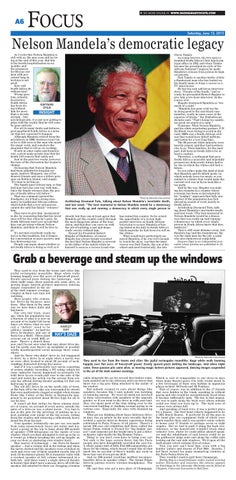
Archbishop Desmond Tutu, talking about Nelson Mandela’s inevitable death, said last week: “The best memorial to Nelson Mandela would be a democracy that was really up and running: a democracy in which every single person in should, but they can at least agree that Mandela got the country safely through the most dangerous phase of the transition, and that they can carry on with the job of building a just and democratic society without him. Except for President Robert Mugabe of Zimbabwe, of course. Mugabe has always deeply resented the fact that Nelson Mugabe is revered as the father of his nation while he himself is seen as a vicious tyrant who
has ruined his country. So he seized the opportunity of a recent highprofile interview on South African television to accuse Mandela of having failed in his duty to South Africa’s black majority: he had been too soft on the whites. What would have particularly annoyed Mandela, if he was well enough to watch the show, was that the interviewer was Dali Tambo, the son of his oldest and most trusted ally, the late
Oliver Tambo. As young lawyers, the two men cofounded South Africa’s first black-run legal office in 1952, and when Tambo became the president-in-exile of the African National Congress he made Mandela’s release from prison its highest priority. Dali Tambo is another kettle of fish: a flamboyant man who has traded on his family name to forge a career as a TV interviewer. He has his own soft-focus interview show, “People of the South,” and recently he persuaded Robert Mugabe to give him a two-hour interview. In the course of it, Mugabe dismissed Mandela as “too much of a saint.” “Mandela has gone a bit too far in doing good to the non-black communities, really in some cases at the expense of blacks,” the Zimbabwean dictator said. “That’s being too saintly, too good, too much of a saint.” Nonsense. What Nelson Mandela and his white negotiating partner, F.W. De Klerk, were trying to avoid in the early 1990s was a South African civil war that would have killed millions and lasted for a very long time. The 20 percent white minority were heavily armed, and they had nowhere else to go. Their families, for the most part, had been in South Africa for at least a century. Therefore, a settlement that gave South Africa a peaceful (and hopefully prosperous) democratic future had to be one in which the whites still had a future. So you either make the kind of deal that Mandela and De Klerk made, in which nobody loses too much, or you submit to a future that would make the current civil war in Syria look like a tea party. And by the way, Mugabe was making his remarks in a country whose economy has been so devastated by his “tougher” approach that fully onequarter of the population has fled abroad in search of work, mostly to South Africa. Archbishop Desmond Tutu, talking about Mandela’s inevitable death, said last week: “The best memorial to Nelson Mandela would be a democracy that was really up and running: a democracy in which every single person in South Africa knew that they mattered.” That is still some distance away, but Mandela has laid the foundations. He was the right man for the job: a saint who also understood realpolitik. Gwynne Dyer is an independent journalist whose articles are published in 45 countries.
Grab a beverage and steam up the windows They used to rise from the towns and cities like joyful rectangular monoliths. Huge white walls looming happily over flat acres of fenced-off gravel. Evenly spaced posts dotting the landscape. And when night came, these passion pits came alive, as moving magic lantern pictures appeared, dancing images suspended in the air of the dark summer evenings. Couples in their cars busy not watching. Most people who remember Drive-In theaters miss them. Miss them in the same way we miss dance halls and Dayliners. Our own fair town, years ago, when the population was a fraction of what it is now on account of we hadn’t hit boom times yet where what we now HARLEY call a “deficit” used to be HAY called a “surplus”, we had two Drive In theaters, and one of them was a Multi. Three giant screens out on south 40th avenue. There’s a church there now, and I’m not sure what that says about drive-ins, but I’m pretty sure there’s an insightful or possibly wildly misinterpreted social message there somewhere. And for those who didn’t drive in, but happened to drive by a drive in at night when a movie was on were often treated to about 20 seconds of neckcranking, distracted-driving free movie. And if it was a particularly racy movie consisting of scenes slightly exceeding a PG rating (which for some unknown reason happened occasionally I’m told) drive by-ers would pull over to the side of the road and watch the action (on the screen) from outside the official driving theater parking lot that you had to pay to get into. The old 2/11 Drive In on the north side of town, at the turn off to the lake was surrounded by streets that were particularly clogged on nights when steamy flicks like Valley of the Dolls or Barbarella happened to be projected about 30 feet high for all to see for free. It wasn’t all that stellar for these cinema stealers of course, on account of every movie outside the gates of a drive-in was a silent movie. You had to pay at the gate for the privilege of pulling up to a post, pointing your jalopy at the big screen, rolling down the window and removing a ridiculously heavy metal box from the post. Your speaker, technically one per car, was made from some mysteriously heavy pot metal and featured a prong at the top to hang about 300 pounds of speaker (1700 kilograms) on the inside of your window which you then attempted to roll up as far as it would go without breaking the roll-up handle on your car door, or shattering your window itself. This marvel of technology — the Drive-In theater speaker — had a volume dial at the bottom and when the movie started and the speakers were switched on each and every one of them sounded exactly like a 6 inch (15 decimeter) plastic RCA transistor radio with a cracked speaker at full volume submerged in a bath tub. And there wasn’t a single drive-in theatre in history that didn’t have someone drive off with the speaker still attached to their car. Dragging a broken
HAY’S DAZE
Photo by Advocate news services
They used to rise from the towns and cities like joyful rectangular monoliths. Huge white walls looming happily over flat acres of fenced-off gravel. Evenly spaced posts dotting the landscape. And when night came, these passion pits came alive, as moving magic lantern pictures appeared, dancing images suspended in the air of the dark summer evenings. cable alongside the car for several days before somebody pointed out to the oblivious drive-in driver that there was a big grey thing attached to the inside of his window. But nobody seemed to care about things like speakers, because like I said, nobody was watching or listening anyway. We were all much too involved in deep conversation with members of the opposite gender, or if you went to the drive in with your buddies, you spent most of the time hiking over to the concession building or skulking around spying in on various cars. Especially the ones with steamed up windows. What got me thinking about those delirious drivein days was an article in the news recently that described a special drive-in theatre experience being celebrated in Paris, France, of all places. There’s a lavish 100 year old exhibition hall there called the Grand Palais (which is French for “big honkin’ palace”) and someone got the bright idea to put a drivein theatre right inside the Big Honkin’ Palace. Thing is, you don’t even have to bring your car! Not only is the huge screen there, but the Paris people also have thoughtfully provided the cars too. A whole palace full of little Fiat 500 automobiles are there for the taking, which doesn’t sound like all that much fun on account of there’s hardly any room in those tiny cars if you get my drift. And no 300 pound crackling muffled incomprehensible drive-in speaker either. The Grand Palais drive-in patrons receive wireless headphones. The wimps. Oh, and they also get a nice glass of Champaign.
Which is sort of comparable to our drive-in days when many theater-goers (I’m told) would sneak in a few beverages of their own, hidden in ingenious places in their ’58 Fords and ’63 Pontiacs. This of course, was in addition to the 17 friends that were hidden in the trunk, sneaking in without paying and who would be surreptitiously freed when it became sufficiently dark. The key to that maneuver was to park along the back rows where nobody could see what you were up to. The back rows of course, were always full. And speaking of back rows, it was a perfect place for a hearse. Our first band vehicle happened to be a 1951 Buick Hearse. It perfectly fit all the guys in the band plus our equipment (both of which were much smaller then) and it was perfect venue vehicle to house your 17 friends or perhaps seven or eight couples. But we had to park it along the back row, sideways, so the monstrosity wouldn’t block other vehicles’ view, where we could utilize about 6 speakers and the inhabitants of said hearse could sit on the pallbearer jump seats and along the coffin rails looking out the vast side windows. We’d open all the dark purple velvet curtains first of course. Now you just can’t beat that, even with a big honkin’ palace and dozens of Fiat 500s. Besides, I bet there weren’t too many steamed-up windows at the Paris Palais Drive-In. They wouldn’t want to spill their Champaign. Harley Hay is a local freelance writer, award-winning author, filmmaker and musician. His column appears on Saturdays in the Advocate. His books can be found at Chapters, Coles and Sunworks in Red Deer.