by Michael Forbes Smith, President, KHS Southern
Pilgrimage to Rome by the Knights & Dames of the Holy Sepulchre of Jerusalem
In October 2025, over 20 knights and dames of the Equestrian Order of the Holy Sepulchre of Jerusalem from our Diocese of Arundel and Brighton joined nearly 3,700 of our peers from all corners of the world to make a pilgrimage to Rome for the Jubilee and Holy Year of 2025.
Our Chivalric Order, with roots stretching back to the 11th Century, is now tasked by the Holy See to support the spiritual and material welfare of the Latin Patriarchate of Jerusalem and the Christian “living stones” of the Holy Land (including the Holy Family parish in Gaza). It is also our duty to nurture our own spiritual development, hence the decision of our own “Grand Magisterium” to lead nearly 10% of our total membership in celebrating the 2025 Jubilee Holy Year.
Just a quick word on history! The first Jubilee Year in the Christian era was celebrated by Pope Boniface VIII in AD1300. Since then, Jubilee Years have been celebrated at varying intervals. The first “Holy Door’ was opened in the Basilica of
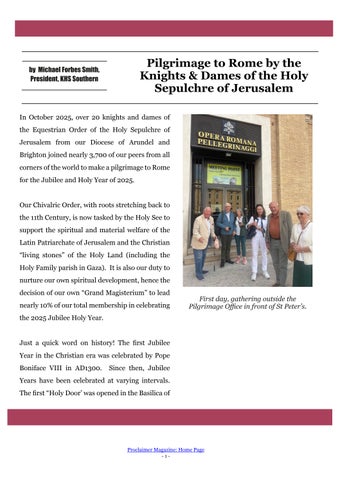
First day, gathering outside the Pilgrimage Office in front of St Peter’s.
St John Lateran (the Cathedral of Rome and thus of the Pope) by Martin V in 1425 and the current 25-year cycle was first introduced by Pope Paul II in the 15th Century. The programme outlined by the Magisterium was to pass through the “Holy Doors” of the four great Roman Basilicas – St Paul’s Outside the Walls, where the apostle is buried, St John Lateran, Santa Maria Maggiore where Pope Francis is buried, and finally, after an audience with Pope Leo XIV, St Peter’s itself.
So after some of us had met over a delicious supper in Trastevere, we began the pilgrimage on Tuesday 21st October. A great convoy of coaches took us to St Paul Outside the Walls, where the organisation can only be described as exquisitely Italian bordering on chaos. But, being in Italy, and we pilgrims being in the appropriate frame of mind, it all worked.
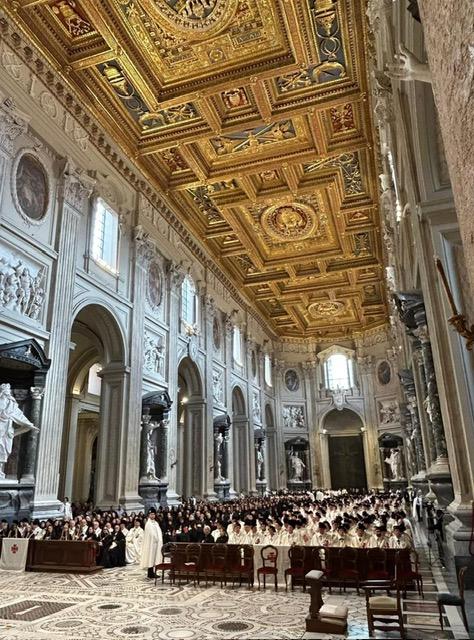
We donned our cloaks and processed through the Holy Door into the magnificent church, founded in AD 325 over the grave of St Paul, though much of the current building was re-built following a disastrous fire in 1823. Cardinal Filoni, our Grand Master, celebrated Mass before we returned, in our case, to the Ergife Palace Hotel, on the outskirts of Rome from where we soon found a favourite trattoria to which we returned several times. And two days later, HM The King also visited the Basilica, where he was created a “Royal Confrater” both as a gesture of Christian unity, but also remembering the connections between England and the Basilica since the sixth century, the year St Augustus arrived in England, when the Wessex royal family helped fund its re-building.
The following day, once again our cavalcade took us, more centrally, first to St John Lateran where we processed through the Holy Door and again our senses were overawed by this sumptuous and ancient Basilica. Following Mass celebrated again by Cardinal Filoni, we then had some time to find a trattoria for lunch before walking the quite short distance to the Basilica of St Mary Major, and time for private prayer and a pause before the icon of Our Lady cradling Our Lord called “Salus Populi Roma” – traditionally painted by St Luke, and which Romans say has saved the City, on one occasion from the plague. Pope Francis had a particular devotion to her which is why he chose to be buried there.
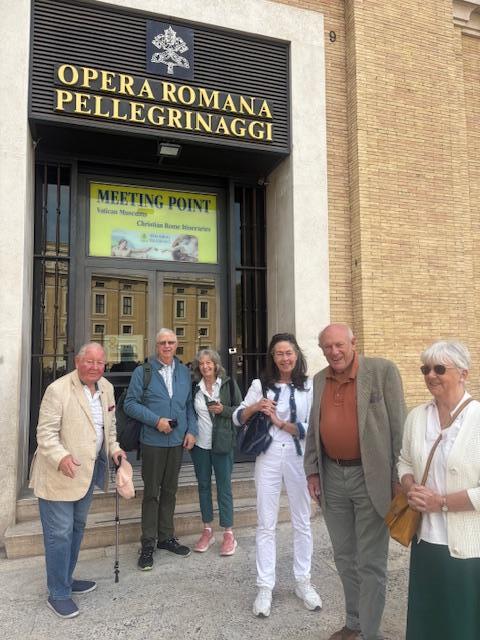
Our concluding day, Thursday 23rd October, began with all 3,700 of us assembling at the Vatican in the vast Paul VI Audience Hall, for our audience with the Holy Father. This was such a moving occasion, and Pope Leo spoke so warmly about the Order and its work: that today we are not merely preserving a piece of heritage, “but supporting a Church made of living stones which was born around it
and still lives today, as an authentic sign of Easter hope”. He emphasised three dimensions of hope to us: of trusting expectation; of service, like the women who went to the tomb; and of the goal to which we strive – “ pilgrimage … [symbolising]… the ultimate meaning of life”. He enjoined us to continue our work with his blessing “from my heart.” As Pope Leo departed, to join HM The King in the Sistine Chapel, we processed
Audience with Pope Leo
through our fourth and final Holy Door to celebrate our culminating Holy Mass with Cardinal Filoni and, meditating on the gifts given us, of indulgence but as important the sense of joyous community and fellowship, we went on our way.
Our small group arranged two separate visits – in fact two of each, remarkably, for myself and a few others - as a result of the noble efforts by myself, Patrick Burgess, Peter Williams and the former head of the English Lieutenancy, HE Michael Byrne to cut through the holy bureaucracies of Rome. We went twice: on Monday and Thursday afternoon, to the Necropolis beneath St Peter’s. St Peter was buried around 64AD in a simple earthen grave beside Nero’s Circus where he had been crucified. Some fifty years later, “house tombs” of wealthy Roman merchants began to be built nearby. In the early 4th Century, these mausoleums were buried
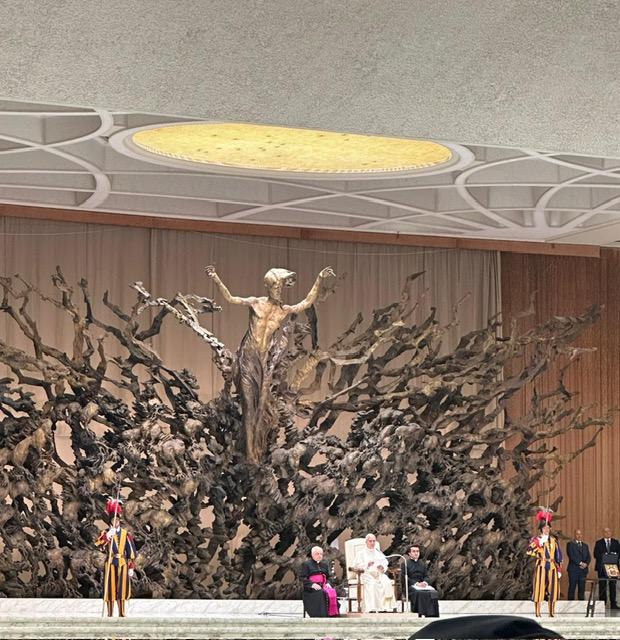
when the hillside was levelled so that Constantine could build the first Basilica, with its High Altar directly above the apostle’s grave. In the 16th Century some of them were revealed when the foundations of the new Basilica, and Bernini’s baldacchino, were being laid. But it was Pius XII who encouraged the archaeological excavations
Mass at St Peter’s
which began in 1939. So in October, we lucky pilgrims were able to walk along the 2nd Century path, some 10m beneath the floor of today’s Basilica, between the well-preserved pagan and early Christian tombs to the site of Peter’s burial, where “almost certainly” according to the archaeologists, some of his bones remain tucked in a cervice under the High Altar. We were overwhelmed!
And finally, the “Venerabile” – the Venerable English College: the only Catholic institution in Rome awarded that title by the Vatican, in memory of its antiquity and importance, in descent
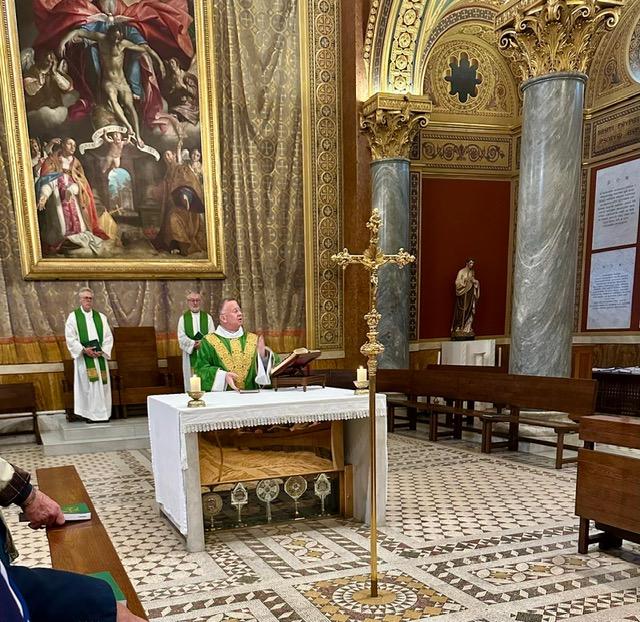
Mass at the English College with Canon Mark Madden
from the “Schola Saxonum” probably the earliest pilgrims’ hospice in Rome most probably founded by King Ina of Wessex, who abdicated in 726AD and travelled to Rome where he was buried. The hospice was situated just to the East of the Basilica near today’s Via del Conciliazione. In 1362 a group of lay merchants purchased the site in Via di Montserrato, dedicated as today to St Thomas of Canterbury as a pilgrims’ lodging. It became a very important part of the Roman scene, and the English Embassy to the Holy See (the effigy of the last Catholic Ambassador, a bishop appointed by Henry VII, remains in the church). The “VEC” was established by Bull of Pope Gregory XIII in 1579. The ordained students returned to England where 44 were martyred between1581 and the early 17th Century. Today’s church is the third on the site, following devastation by Napoleon and subsequent decay. But the recent restoration has given us an absolutely spellbinding memorial,
The main emblem of the Knights of the Holy Sepulchre is the Jerusalem Cross
glistening with gold leaf and marble – but also a vibrant home for today’s seminarians. It must have been rather more chilling for their 16th Century forebears to celebrate Mass while looking at the graphic frescoes of their peers being hanged drawn and quartered in their homeland to which they were about to return.
My own favourite memory, as a Scot, is to see the
coat of arms of Henry, Cardinal Duke of York – every English cardinal’s coat of arms is displayed in the College; Henry’s carries the Royal Stuart shield and crown! And so, quite overwhelmed yet again, at almost a loss for words, we departed the College, for a magnificent Roman lunch before preparing for our return to the UK.
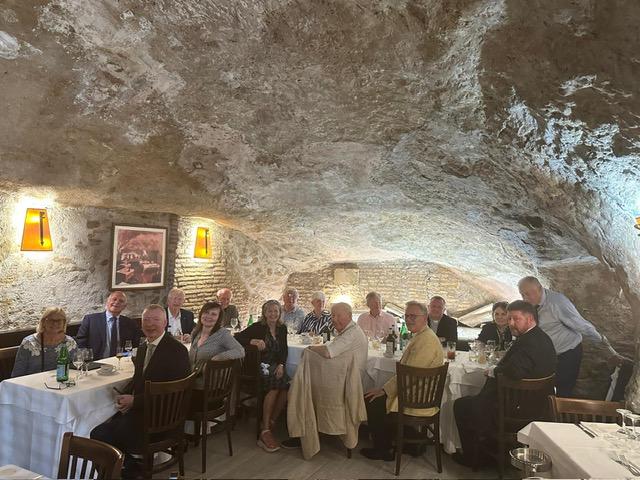
Final lunch together