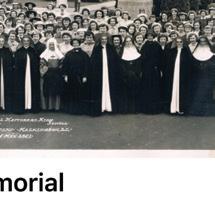
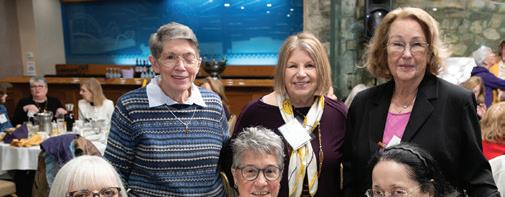
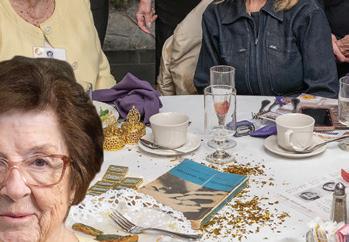
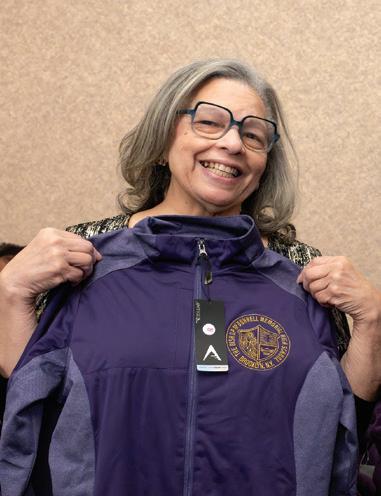
Paula Geiger Conway ’45, celebrating 80 years, at this year's Legacy Brunch.
2025
ADMINISTRATION
Brother Dennis Cronin, FSC ı President
Edward A. Bolan ’78 ı Principal
Cecilia Gottsegen ı Assistant Principal
Luis Montes ı Dean of Students
Elisa D. Randall ‘10 ı Dean of Students
BOARD OF GOVERNORS
Lenue H. Singletary ’87 ı Chair
Robert A. McRae ’03 ı Vice Chair
Frank K. Cheswick ’66 ı Secretary
Paul J. Camilleri ’64
Brian C. Connolly ‘73
Kimberly Council ’90
Rev. Alonzo Cox
HIGH SCHOOL
Brother Dennis Cronin, FSC ı President — ex officio
Ja’von T. Delgado (Jones) ’01
Robert Gore ’94
Kenneth Lewis ‘87
Mary Collins Macchiarola ’58 ı Bishop McDonnell
Maureen Moss McInerney ‘66 ı Bishop McDonnell
Hal Nichter ‘64
Brother Edward Shields, FSC
Benjamin Ventresca
BISHOP McDONNELL ALUMNAE COMMITTEE
DONNELL
Kathleen Carney DeVito ‘62
Mary Collins Macchiarola ‘58
Stephanie Cyrus '73, ’75
Catherine Diehl Palladino ‘60
Margaret Dougherty Russo ‘69
Roberta M. Eisenberg ‘58
Mary Ellen Lavelle Murphy ‘59
Kathleen J. McCarthy ‘58
Phyllis Murphy Howell ‘67
Maryann Stahl DeMaso ‘60
Tanya Curbin Kennedy ‘02 — Committee Liaison
DEPARTMENT OF INSTITUTIONAL ADVANCEMENT & ALUMNI RELATIONS
Andrew Leary ı Vice President
Tanya Curbin Kennedy ‘02 ı Associate Director
Tiffany Perkins P’25 ı Associate Director
Mitch Turner ı Database Manager
Madison Bonnick ’22 ı Assistant
DESIGN
EP Graphic Design & Marketing Services ı epgraphicdesign.com
Memorial is published by the Bishop Loughlin Memorial High School Office of Institutional Advancement. Please send correspondence and address changes to: BLMHS Office of Institutional Advancement, 357 Clermont Avenue – Brooklyn, NY 11238, 718.857.2700 ext 2250 or tkennedy@blmhs.org
2026 marks the 100th anniversary of Bishop McDonnell Memorial High School.
Join us September 26, 2026 at St. Francis de Sales School for the Deaf formerly, Bishop McDonnell Memorial High School. Exciting events and special moments are on the way. Stay tuned!
SEPTEMBER 26, 2026
FROM THE PRESIDENT
The strength of Loughlin’s legacy lies in the courage, dedication, and unwavering support of its community— especially the generations of women who have shaped its history and continue to inspire its future.
Dear Bishop Alumna,
As seasons change, I find myself reflecting on how your unwavering support helps make Bishop Loughlin such a special place. Today, Loughlin fills the void left by the closure of a school as accomplished as Bishop's. This year is particularly significant as we celebrate 50 Years of Women at Loughlin, honoring the generations of trailblazers who have shaped our institution with resilience, faith, and excellence. It was young women from McDonnell who first graced our corridors with their spirit and vibrancy.
In this issue of Memorial, we highlight the incredible impact of women— past and present. You’ll read about Jeanne Marie Fastook, MD ’60, a devout Catholic who left a legacy gift in support of the Bishop McDonnell Scholarship Fund and the insights shared with students by our women's panel at one of this year's Breakfast With… events. You will learn more about your current scholarship recipients whose dreams are made possible through the Bishop McDonnell Scholarship Fund. Their accomplishments and strength will make you proud.
I am particularly moved by the stories of our young women excelling in academics, athletics, and service —like Mercedez McCray ’27, a sophomore gymnast with a 90 average and our dedicated girls’ basketball manager, Morgan Neish ’27, who keeps our teams running smoothly. Their success is a testament to the strength and dedication developed in Loughlinites over the course of four memorable years.
We also take a moment to remember those who have gone before us— Sr. Leo Francis Monaghan, OP, a cherished figure in McDonnell’s history, and Geraldine Growney-Treyman ’46—whose story continues to inspire.
This issue is more than just a collection of memories; it is a celebration of the enduring legacy of Bishop's. As we look ahead, we ask for God’s grace and blessings that the next generation of young women will share the opportunities to lead, learn, and serve that the young women of Bishop's experienced, and that Loughlin women experience today.
Thank you for being part of this incredible journey. Your continued support fuels the mission of Bishop Loughlin, and for that, we remain deeply grateful.
Live Jesus in our hearts. Forever.
Bro. Dennis Cronin, FSC President
Alumnae Committee members at Graziella's in Clinton Hill.
Seated, from left, Kathy DeVito ’62, Kathy McCarthy ’58, Mary Collins Macchiarola ’58, and Cathy Diehl ’60. Standing, from left, Andrew Leary, Tanya Kennedy ’02, Tiffany Perkins P’25, Josie Santos McKenna ’90 P’28, Maryann Stahl DeMaso ’60, Margie Dougherty Russo ’69, Phyllis Murphy Howell ’67, and Mitch Turner.
FROM THE ALUMNAE COMMITTEE
We had a wonderful time at the Bishop McDonnell Legacy Reunion Luncheon on April 12. It is amazing how time passes as we think back to our years at Bishop’s or the Annexes we came from. We have been so blessed! The five orders of religious nuns were outstanding teachers, but more importantly, they instilled in us faith and a love of Christ.
We remember with love one of our favorite teachers, Sr. Leo Francis Monaghan, OP—whose humor and protection we all valued —who was called home by God in February. How blessed we were to have had her as our guide and excellent teacher of science. (Read the Sisters of St. Dominic of Amityville's tribute to Sister on page 9).
The world has changed so much since we first entered Bishop's.
The world has changed so much since we first entered Bishop’s. Today, for those who were not excited by math, we have calculators to figure out the things we worked out on paper. Essay writing has taken on a new dimension with AI editing, rewriting, and making our simple phrases seem genius. In science, reaching and exploring Mars is but a breath away in achievement. STEM (science, technology, engineering, and mathematics) is the latest “buzz” word in schools, giving students the ability to expand their love of learning more than we could ever imagine. Pennies are soon to be eradicated from our monetary system and our vocabulary. Electric cars are here and everyone owns a cell phone. Our parents worked hard as blue-collar workers, but today robots have replaced many of their jobs. Robotics is a keyword for schools to include in their admissions brochures. All these fantastic things we used to watch on Flash Gordon, Star Trek , and other futuristic fantasies with our mouths open in disbelief. Now they are realities.
With all the aforementioned, Catholic school education has stayed true to the tenets of our faith. Faith and morals are instilled in today’s students—bucking the tide of a hard secular world. Our youth are attending the annual National Catholic Youth Conference (NCYC) and the international pilgrimage, World Youth Days. We have seen a new resurgence of faith and love of God in our young ones.
Giving to the Bishop McDonnell Scholarship Fund is a wise investment in our future.
How have Catholic schools done this on such meager budgets— and done it so well? In part, it is because of alumnae like us, who donate and help parents afford a Catholic education. Currently, tuition at Loughlin is more than $12,000 a year—with an actual cost of $16,000+ per student. This is why each year the Bishop McDonnell Alumnae Association gives deserving, smart young women entering the freshman class at Bishop Loughlin a scholarship. Bishop McDonnell alumnae give at least three deserving women scholarships to Bishop Loughlin each year in the name and dignity of Bishop McDonnell. We follow these young women and see that they are fulfilling their promise to work hard and achieve high standards. We are so proud that many of our scholarship recipients attend top Ivy League universities and are working in research, science, business, law, medicine, and more. The reward is amazing when you help others to achieve. Giving to the Bishop McDonnell Scholarship Fund is a wise investment in our future and the future of our country as well. Please consider doing the same.
Thank you to all who attended the Legacy Reunion Luncheon at Gargiulo’s Restaurant. Meeting up with old friends and having a wonderful afternoon was our wish for you.
MY CRUSADE CONVENTION
UNIVERSITY OF NOTRE DAME, 1956
by Rosemary McCabe Travis ’59
In the summer of 1956, I was a freshman at Bishop's and quite lucky to be selected to attend the 20th National Catholic Students Mission Crusade Convention at the University of Notre Dame in South Bend, Indiana. The sisters were in charge of our local Sanctus Carolus Crusade school unit—housed in the school basement next to the Mitre office and Little Theater. Monsignor Asip was the diocesan mission director.
Our Bishop’s Crusade unit raised more money for the missions than any other unit in the nation! The convention was an inspirational visit to the campus in South Bend, especially the Grotto of Our Lady of Lourdes (which is a one-seventh replica of the famous grotto in Lourdes, France where the Virgin Mary appeared to St. Bernadette on 18 occasions in 1858) and the Basilica of the Sacred Heart.
"A new spirit for a new age."
—the 1956 Catholic Students Mission Crusade Convention theme.
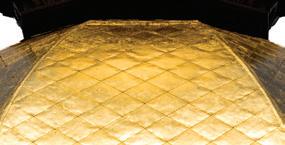
A statue of Mary atop the Golden Dome of the University of Notre Dame Main Admin Building.
Students, along with Sr. Alice Marie, Sr. Grace Rosaire, and Msgr. James Asip in from of the Rockne Memorial Gym.
DID YOU KNOW?
The 1956 convention, hosted by the University of Notre Dame, was held August 23-26, 1956.
The crusade conventions were held every two years (except for during World War II) for local 'units' (chapters of the Catholic Students Mission Crusade) throughout the country from 1918-1970.
Naturally, I did not think I would have any further connections to the school because in 1956 only young men were admitted to the university!
After graduating from Bishop’s, I accepted a scholarship to Marymount College in Tarrytown, NY—a Catholic women’s college. I married a Bishop Loughlin grad in 1966 and we have three children.
Fast forward to 1987 when our son, Matthew, became a Notre Dame freshman. Once again, I was connected to the university. Visits to the campus included football games, tailgating parties, Mass, and of course, visits to the Grotto of Our Lady of Lourdes. Matthew graduated in 1991.
Then, in 2024—68 years after my first visit to the Notre Dame campus, I was, once again, at the Grotto. This time with my husband, son, and grandson. We were happy to attend Mass at the Basilica of the Sacred Heart to celebrate the son of a Marymount College friend, Fr. John DeRiso, CSC —the Director of the Office of Vocations at the University of Notre Dame. I have been truly blessed!
The Catholic Students Mission Crusade was a mission organization founded in 1918 with the intention of promoting "missions at home and abroad." The conventions hosted missionary talks and spiritual services "aimed at inspiring young people to read and support" missionary work and mission vocations. Local 'units' brought the spirit of mission to their own school communities through education and projects.
The Catholic Students Mission Crusade ended in 1972 with "new understandings of mission" from the Second Vatican Council. Following Vatican Council II, "social and political issues of the 1970s directed the attention of the U.S. Catholic youth elsewhere."
The Rockne Memorial Gym mentioned here opened in 1937 and was named after Knute Rockne, considered to be "America's mostrenowned football coach." He coached the University of Notre Dame's football team for 13 seasons—with three national championships and five undefeated seasons.
Rosemary with family in front of The Grotto of Our Lady of Lourdes, University of Notre Dame.
GERALDINE GROWNEY TREYMAN ’46
1928 - 2024
by Phyllis Murphy Howell ’67
In 2007, I started a journey of compiling information on Bishop McDonnell Memorial High School to use for upcoming reunions. I began by contacting as many alumnae as possible, to get information from as far back as possible. This is when I first came in contact with Geraldine, who enthusiastically shared stories of her days at Bishop's from 1942 -1946.
We hit it off instantly, but little did I know that we would form a bond that would last 17 years.
Geraldine Growney graduated in January, 1946. She was president of the senior class and known throughout Bishop's as the girl with "personality—plus"—in addition to an excellent scholastic record.
After graduating from Bishop McDonnell, she married Eugene Treyman in 1948.
Geraldine Growney, President of 312
Sweet and lovely, Geraldine Growney has won the hearts of the girls of 312. Gerry is known throughout Memorial as the girl with personality—plus! She has set a fine example for her fellow classmates by her excellent scholastic record and her school spirit. The memory of the happy-go-lucky and lovable Gerry will forever linger in our memory.
They raised two sons (Eugene, Jr. and Paul) and three daughters (Karen, Janet, and Ellen). The family lived in Windsor Terrace, Brooklyn.
Geraldine lost her husband of 39 years in 1987 and she also suffered the loss of three children—her son Eugene, Jr. and two daughters, Karen and Ellen ’69 (BMD). She was blessed to have 11 grandchildren and 15 great grandchildren—one even living upstairs from her.
Most of the time, Gerry was able to attend the annual reunions and enjoyed them immensely, and I enjoyed reconnecting in-person in addition to our phone conversations. A few summers ago, Geraldine fell in her home and was transferred to a rehabilitation center in Lynbrook on Long Island. I visited
Left, Geraldine (seated far right) with other 'senior' alumnae, including Sr. Maria Carmel ’47 (far right) and Virginia Balluff Firestone ’37 (bottom left), at the 2016 Bishop McDonnell reunion and right, Geraldine with Andrew Leary at a past reunion.
her there, and found her to be in great spirits, and anxious to return to her home in Brooklyn.
Once home, she called me and mentioned that while reading an issue of Memorial, she came upon a post from Sharon, the daughter of Claire Repogle-McKenna ’46, asking if anyone remembered her mom. Claire was Geraldine's classmate; she knew her well! I suggested that she write a letter to Sharon. Only a short time passed before I received Geraldine's letter and gladly forwarded it. Sharon was so happy to find someone who knew her mom and was able to provide some insight of her teenage years. Claire passed away at the young age of 33 when Sharon was only five, so the information she had was very limited.
I cannot recall a conversation with Gerry where she wasn't positive and laughing. Her mind was sharp and her memories of Bishop's front and foremost in her mind. She was already making plans to sing Memorial once again at the next reunion. But that was not to be. Gerri passed away at the age of 95 on August 27, 2024.
Gerry, a faithful parishioner of Immaculate Heart of Mary Church, attended Mass almost daily and had a strong belief in saying the rosary. It was Gerry’s mission to spread the Word through the rosary. She wanted 100 purchased and distributed at her wake. Her granddaughter Laurie did just that. When a priest was called to give her last rites, she told him she was afraid she hadn’t done enough to get to heaven. You did enough Gerry, you certainly did enough. Rest peacefully my friend.
REMEMBERING SR. LEO FRANCIS, OP
from the Sisters of St. Dominic of Amityville
"The joy of the Lord is your strength."
Nehemiah 8:10b
On Tuesday, February 18, 2025, our beloved Sister M. Leo Francis went to dance with the God she so lovingly had served for over 80 years as a Sister of St. Dominic of Amityville. Sister Leo was 98 years young and enjoyed a long and happy life as a Dominican.
On September 1, 1926, Leo and Mary (nee Brady) Monaghan welcomed their daughter Marie into their home in Flushing, NY. Marie attended St. Luke School where she met the Dominican sisters. At an early age, Marie knew she wanted to be “like them.” Shortly after graduating from St. Agnes High School, she entered the Sisters of St. Dominic at Amityville in 1945 and received the religious name, Sister M. Leo Francis. She professed first vows in 1946 and final vows in 1949. Sister earned her Bachelor of Science degree, as well as her Master of Science degree, at St. John’s University. She taught at St. Pancras School in Glendale for nine years, followed by 14 years in the Science department of Bishop McDonnell Memorial High School in Brooklyn. She was an excellent teacher and very willing to provide extra help for her students. In 1968, Sister Leo was assigned as an assistant professor at Molloy College, Rockville Centre. One could say that Sister Leo Francis “bloomed where she was planted.” Whenever she was asked what she taught, she always answered, “I teach students.” Sister remained living on the campus of Molloy College (now University) for 43 years. She served as chairperson of the Science department for 25 years and as moderator of the Glee Club for at least 20 years. Sister received the Charitas Award at the President’s Convocation in 1982. In 2003, a scholarship was started in Sister Leo’s name at Molloy. The scholarship is meant to alleviate some of the financial stress that is felt by many students.
Sister taught a course in microbiology and during a sabbatical, she condensed the 300-page textbook into a pamphlet—saving students the expense of purchasing the book. This pamphlet still is used today at Molloy University.
Sister Leo loved to travel and to meet people. Her kindness, support, and love were freely given to her family and friends. Sister will be missed by her good friends as well as by the sisters and staff of the Motherhouse community. Services for Sister M. Leo Francis took place at Queen of the Rosary Motherhouse in St. Albert Chapel. Interment was in St. Dominic Cemetery, located on the Motherhouse grounds.
50 YEARS OF WOMEN AT LOUGHLIN BREAKFAST WITH
It was the women from Bishop McDonnell who changed the all-male Bishop Loughlin to a co-ed high school in 1973. As the school celebrates 50 Years of Women at Loughlin, they hosted an all-female panel featuring Bishop Loughlin alumnae from the 1990s and 2000s—including one of the first Bishop McDonnell scholarship recipients. The Breakfast With... panelists included:
• Kimberly Council ’90, Brooklyn Deputy Borough President and member of Loughlin Board of Governors.
• Josephine Santos McKenna ’90 P ’28 , Director of Admissions, Bishop Loughlin
• Tanya Curbin Kennedy ’02 , Associate Director of Institutional Advancement, Bishop Loughlin
• Falasha Delimon ’04 , Independent Consultant—Certified Public Accountant (CPA)
• Tatiana Marshall ’10, Student Life Coordinator, Icahn School of Medicine at Mount Sinai
Six alumnae met with Loughlin students in a conversation about their personal journeys and time at Bishop Loughlin. From public service and healthcare to finance and research, the diversity of career fields highlight the breadth of opportunities these women have pursued, as well as the invaluable experiences they gained at Loughlin.
pivotal role in preparing them for the challenges they faced in their professional lives.
Tatiana Marshall ’10, shared, "I will always cherish my years at Bishop Loughlin. It was an extension of the values instilled in me at home—the importance of community service, and collaboration. Most importantly, Bishop Loughlin taught me the significance of always putting God first.
Throughout the Breakfast With..., panelists discussed how the education at Loughlin provided academic knowledge, critical life skills, and confidence—pointing out how the school’s emphasis on leadership, community, and resilience played a
I quickly realized entering college, society, and the workforce, that the outside world did not compare to the beauty of the Loughlin community. Everything I learned helped me successfully navigate college and graduate school. High school shaped my leadership skills, concern for others, and a willingness to advocate for change.
Looking back, my experience at Bishop Loughlin profoundly shaped who I am today. These values of community, service, and faith have guided me throughout my academic and professional journey. The lessons I learned enhanced my ability to lead and instilled a strong sense of responsibility to uplift others.
As I continue to navigate the challenges and opportunities in my life, I carry the spirit of Loughlin with me, committed to making a positive impact and fostering a sense of community wherever I go."
From left, Rev. Kimberly Council ’90, Falasha Delimon ’04, Tanya Curbin Kennedy ’02, Tatiana Marshall ’10, Josie Santos McKenna ’90, and Aria Niles ’11.
THE BISHOP M c DONNELL SCHOLARSHIP FUND GROWS JEANNE MARIE FASTOOK, MD ’60
by Andrew Leary
We are blessed every day at Loughlin, and the students we serve are a daily reminder of that gift. On occasion, a different kind of blessing is so surprising and significant that it knocks us off our feet. This was the case when we received notice of a significant bequest made to support the Bishop McDonnell Scholarship Fund last year.
We knew Dr. Jeanne Marie Fastook ’60 for only a short while. A long time supporter of Bishop Loughlin, we did not know her well. From conversations, we did understand that supporting Catholic education was very important to her. She knew that Bishop Loughlin was continuing the work of Bishop McDonnell Memorial High School.
Her bequest of $450,000 in support of the Bishop McDonnell Scholarship Fund shocked us all. Her gift is at the heart of the growing Bishop McDonnell Scholarship Fund that supports our young women each year, and will continue to support them for many years to come.
Her gift is at the heart of the growing Bishop McDonnell Scholarship Fund that supports our young women each year, and will continue to support them for many years to come.
The obituary for this generous soul:
Dr. Jeanne Marie Fastook passed away peacefully on Monday, October 3, 2022, at her home in Manhattan. She was 79. The daughter of Josephine and Theodore Fastook, Jeanne was born in Brooklyn on November 3, 1942, and grew up on Clinton Street in Cobble Hill with her sister Mary Ann. She attended grammar school at St. Charles Borromeo Catholic School in Brooklyn Heights and remained at the parish for many decades until moving to Manhattan in 2013.
A bright and motivated young woman, Jeanne graduated from Marymount College after her years at Bishop McDonnell Memorial High School. Later, she attended the Women's Medical College of Pennsylvania, the world's first medical school for women (now part of Drexel University). After graduating with a medical degree, she became a physician at St. Luke's Roosevelt Hospital in Manhattan, where she specialized in general medicine until retiring in 2006.
One of Jeanne's most defining attributes was her devotion to the Catholic faith, which informed much of her life and commitment to charitable causes. She was also an ardent reader, museum-goer, and traveler—visiting London, Paris, Sicily, Italy, Egypt, Greece, and the Holy Land, among many other places. As her mobility decreased in her later years, Jeanne was content to venture to nearby Carl Shultz Park, where she would read on a bench and observe the city around her.
Jeanne valued longtime friends and, above all, family. Jeanne is at peace now, but she will be greatly missed by all those who had the pleasure of knowing her.
Thank you Dr. Fastook.
Jeanne Marie Fastook ’60. While at Bishop McDonnell, Jeanne was involved in the Leo Honor Society, Student Council, and The Mitre.
THE FIRST LOUGHLIN GRADUATION OF BISHOP M c DONNELL GIRLS—1974
by Phyllis Murphy Howell ’67 — reprinted from Memorial, Memorial, the History of Bishop McDonnell Memorial High School
At Bishop Loughlin, every day starts with a prayer. Holy days are remembered. Retreat programs are a part of every school year. Students visit nursing homes and hospitals, and do volunteer work. Everyone wears a uniform, and there is a tremendous sense of school spirit. Almost 100% of the graduating class goes on to continuing education. Important assemblies begin with a display of colors, a salute to the flag and the singing of the Star Spangled Banner. It is very similar to the way things were done at Bishop’s, but it was not Bishop's.
Memorialites who chose to transfer to Bishop Loughlin faced many changes in their daily school lives. Young, and through no fault of their own, they were thrown into a new school where they would begin to make new friends and forge new traditions. Luckily for the incoming students, it was easy to acquire new friends when there were so many boys and a comparatively few girls at the school. They learned to adapt, and Bishop Loughlin did its best to ease the transition for the new students. At assemblies, after singing the Loughlin school song, the girls from Bishop’s were happy to sing their former school's song, Memorial, which had always meant so much to them.
of the schools, she confessed that she still sings Memorial when driving past the building that formerly housed Bishop's.
The first co-ed graduating class at Loughlin (Class of 1974) had only 34 Memorialites because so many had chosen the accelerated program or, had enrolled at other schools. The junior class (Class of 1975) and the sophomore class (Class of 1976) consisted of 97 and 88 girls, respectively.
The 1974 yearbook featured both school rings on the inside cover, as well as another page featuring two interlocking hands, one sporting a Loughlin ring and the other wearing a Bishop McDonnell ring. It included a quote from Tennyson, "I am a part of all I have met."
The Bishop McDonnell students attending Loughlin became aware that there was no special Ring Day ceremony, as had been established at Bishop's. Students at Loughlin simply picked up their rings in their homerooms. So, the girls from Bishop's banded together and lobbied for Loughlin to create a special day when rings would be distributed—with fanfare. Loughlin still carries on that tradition today. Nor did Loughlin sponsor any class trips, and again, it was the Bishop's girls who persuaded Loughlin to establish its own tradition of going to Rye Beach. According to one alumna, who transferred to Loughlin at the start of her junior year and graduated in 1975, she recalled how she resisted going to an all-girls school, but now remembers it as the best two years of her life. She noted class structure was different—Bishop's girls had far more credits than the male students from Loughlin. For her senior year, she was required to take only three classes. Though she spent two years at each
The activities and clubs at Loughlin were relatively similar to those at Bishop's, and transferees participated in Varsity basketball and language clubs. Others were involved with publishing the Laurel. Mrs. Gruschow, a PE teacher from Bishop's, said she has always carried the education, the manners, discipline, and friendliness that she received while at Bishop's with her. Loughlin maintained separate basketball teams for the boys and the girls, and of course, the school now had its own cheerleaders. Along with Bishop's girls, six faculty members, and the school nurse also made the transition to Loughlin.
In 2007 (time of Memorial, Memorial's publication), Bro. Dennis Cronin, FSC, President, noted 18 of the prior valedictorians were women so, if some feared that transforming Loughlin into a co-ed school would diminish its educational standards, they obviously had nothing to fear. Note: Since 2007, 15 valedictorians have been women and 12, salutatorian!
Tuition has increased significantly. In 2010, it was the contributions from alumni that bridged the gap between the actual tuition ($9,500) and the amount charged for each student ($7,300). Note: Today, the actual cost per student is $16,269 and tuition is $12,090. The $4,179 gap is bridged by contributions from alumni/alumnae and friends.
MARISA RIVERA, Ph.D. ’74
A
BISHOP'S
GIRL REFLECTS ON BEING IN THE FIRST GROUP OF WOMEN AT BISHOP LOUGHLIN
Back then, we had 'sisters'. As a freshman, an upperclassman would ask you to be their sister. These young women looked out for you.
When I learned that Bishop McDonnell would close, I was shocked. I had no idea a school with students could close. I remember my mom and I picketing with other students. I asked a teacher why we
had to close; she didn't know (and if she did, she did not tell me).
I felt such stress at the thought of being around boys. Raised in a strict Puerto Rican family, I was shy and sheltered—not even allowed to leave our apartment without a chaperone. How does one behave in front of boys? And, oh, the thought of not wearing a uniform after wearing one since first grade. What would I wear? What was I expected to wear? Needless to say, those first few months were stressful.
A core group of my friends chose to graduate, and not go to Bishop Loughlin—including my best friend Miriam Rosario Lopez ’73. I had underclass friends but wanted to be with the group of students I started with. The emotions between the closing of the school and the summer were difficult. The unknown was hard.
I survived! I have many fond memories of my time at both Bishop McDonnell and Bishop Loughlin—the best memories are the friends I met at each school.
A favorite memory of mine at Bishop McDonnell was my 'sister'. As a freshman, an upperclassman asked you to be their 'sister'. These young women looked out for you. They were someone that you could hang out with or go to with a problem. I felt special (and of course, cool) when a senior asked me to be her freshman sister.
c DONNELL SCHOLARS
Bishop McDonnell Scholar
Elizabeth Charles ‘25
Elizabeth is a step dancer and hopes to study biology and pursue a career in the medical fi eld. She off ers “a sincere thank you to the alumnae of Bishop McDonnell for their constant support and commitment.”
ELIZABETH CHARLES ’25
"Attending Loughlin opened me up to many opportunities in, and outside, the classroom. My family and I knew that it was the best choice for me. I have been educated with my peers and also able to express my Christian faith openly. I have grown as a person and have created lifelong relationships. This is where I was meant to be.
I have been on the step team and in both regular band and advanced band. I am an Advancement Ambassador, member of the National Honor Society (this year as vice president), and participated in the Arthur Ashe Institute for Urban Health Science Academy. It may sound like a lot, but I have found a balance between life, activities, and taking rigorous classes—all honors and advanced placement courses. I know these classes and hard work have prepared me for college.
I am grateful for my experience at Loughlin. In college, I plan to study biology and pursue a career in the medical field. Thank you for allowing me the opportunity to attend Bishop Loughlin—without the Bishop McDonnell scholarship, my education at Loughlin would not have been possible."
Elizabeth will be attending the University of Connecticut next year.
Bishop McDonnell Scholar Joli Pierre ‘25
Joli, the Class of 2025 salutatorian , says “all I have accomplished might not have been possible without my Bishop McDonnell scholarship.”
Bishop McDonnell Scholar Morgan Neish ‘27
Morgan, the girls basketball and JV softball manager, wrote, "With the support of my Bishop McDonnell scholarship, I am encouraged to make my mark.”
JOLI PIERRE ’25
"Throughout my four years at Loughlin, I have grown as a student, friend, and person.
Without the Bishop McDonnell scholarship, my family could not have afforded Bishop Loughlin, and for this reason, I am deeply thankful.
Adjusting to life at Loughlin was a challenge, but it quickly became a place where I felt at home. The supportive teachers, friendships, and endless opportunities have shaped me into the person I am today. From my days as a freshman to now, I have used Loughlin as an outlet to push myself academically and socially. The rigorous coursework in honors and AP classes has helped me to develop a stronger love for learning and work ethic. Outside of the classroom, I am a National Honor Society member and officer, in band, House Dance, and Latino Dance. I have had the opportunity to lead, collaborate, and give back.
Sometimes it was difficult to balance all my in-school and out-of-school activities along with my workload, but I wouldn’t change a thing. It taught me the importance of balance and knowing how to prioritize.
I love Loughlin and the opportunities I experienced are because of the Bishop McDonnell scholarship—all I have accomplished might not have been possible.
I am proud to say I am Bishop Loughlin’s Class of 2025 salutatorian. Even though it is bittersweet to be graduating, Loughlin has given me lessons, values, and memories that I will cherish for the rest of my life. Next year, I plan on majoring in Nursing at St. John's University. I know Loughlin has prepared me as a student and as a person to succeed.
Thank you for investing in my future and for giving me and many others the
Without the scholarship, my family could not have afforded Bishop Loughlin—and the supportive teachers, friendships, and endless opportunities have shaped me into the person I am today.
opportunity to be part of such a special community."
MORGAN NEISH ’27
"As the girls sole basketball manager for the past two years, my job is to support the team and the staff in various ways, including handling equipment, managing game stats, assisting with practice setup, coordinating logistics, and sometimes, even filming games. I'm essentially the behind-the-scenes force that keeps things running smoothly.
Women in roles like this challenge stereotypes and pave the way for more inclusion and diversity in sports. It allows for different perspectives, encourages equal opportunities, and proves that anyone, regardless of gender, can excel in sports management. Representation matters, and having more women in these spaces helps break barriers and inspire others to pursue roles they might not have considered before.
I am a Silver Honor student with a 92 average and am enrolled in the Project Lead the Way (PLTW) program. With the support of the Bishop McDonnell scholarship, I am determined to make my mark in this male-dominated field."
AN INTERVIEW WITH A BISHOP McDONNELL SCHOLAR
MERCEDEZ M c CRAY ’27
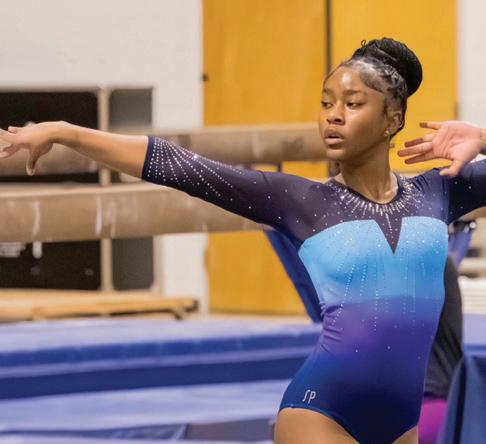
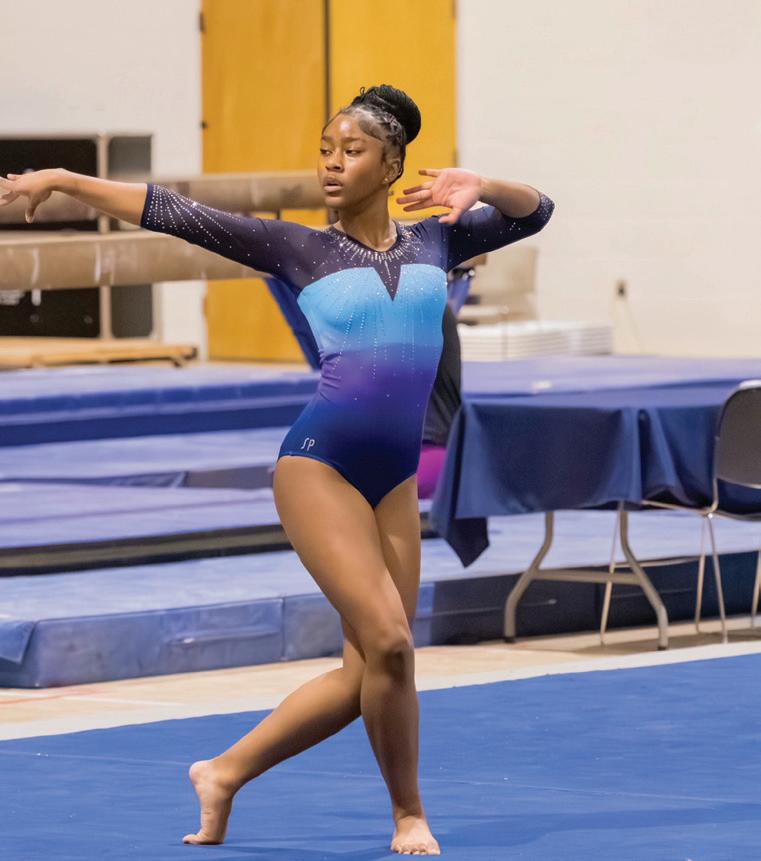
Bishop McDonnell scholar Mercedez McCray is a sophomore honor student, band and house dance member, volleyball player, and cheerleader. She also happens to be an outstanding gymnast. She tells us a bit more about her gymnastics journey in this interview.
When did you get started?
I became involved in gymnastics when I was fi ve-years-old. I loved watching gymnastics and doing flips around the house, so my mom signed me up for classes at The Little Gym in Manhattan. Then, we switched to a more competitive gym. I began competing when I was nine with Gotham Gymnastics in Brooklyn, going to meets almost every month.
What inspired you?
I loved watching Olympic gymnastic team members Gabby Douglas and Simone Biles. Little fi ve-year-old me wanted to do cool flips and compete in the Olympics like they did.
How do you maintain balance?
Sometimes it’s really hard to balance, but I do it—because I love it. Most days, I get home around 9:30 p.m., still having to shower, do homework, etc. I typically end up getting to bed between 11 p.m. and 12 a.m. I am up between 5:30 a.m. and 6:30 a.m. Maintaining a 99-100 average with long practice hours can be challenging at times, but discipline and determination get me through it. I definitely sleep-in on the weekends to make up for it though!
What are you are most proud of?
My biggest achievement in gymnastics so far has definitely been getting a 9.900 on vault at my most recent competition.
That’s the highest anyone on my team has ever scored on any event, and it demonstrates how hard I've worked to get to where I am today.
What motivates you?
My motivation for doing well in school and gymnastics is definitely my mom. She has sacrificed so much for me to be successful both athletically and
academically, and I just want to be able to repay her in the future.
Any long-term goals?
To be recruited for a Division 1 university gymnastics team with a full scholarship— preferably an Ivy like Brown, Yale, or even Stanford. Going to the Olympics is not a major goal for me, but I would love to have the option. Ultimately, I want to have my own gym and coach gymnastics.
Mercedez competing at LIU Gold Medal Invitational in 2024. She placed first on vault, floor, beam, and allaround! Wow!
BISHOP LOUGHLIN
530
STUDENTS 84 COURSES off ered with 5 AP COURSES
ACTUAL COST PER STUDENT FAMILY CONTRIBUTION (TUITION)
$12,090 $4,179 $16,269
OUR STUDENTS ARE
145
STUDENTS enrolled in PLTW / STEM courses 14:1
STUDENT / TEACHER RATIO
CELEBRATING YOUR CONTRIBUTION
THE BISHOP M c DONNELL SCHOLARSHIP
OFFICIALLY ESTABLISHED 2011
When you were at Bishop McDonnell, you banded together each March to raise money for the Lenten Mission drive —contributing to the CRUSADE. This was done in various, creative ways. The total amount raised was sent to missions to provide food for orphans in poverty stricken areas here and abroad. In 1964, Bishop’s contribution to the CRUSADE topped every other school in the Diocese. What a generous school spirit!
The Bishop McDonnell Scholarship is a modern day CRUSADE drive. It is the gift of a diocesan education to a Bishop Loughlin young woman. It is our way of keeping the name of your beloved school alive.
BISHOP McDONNELL SCHOLAR
SPOTLIGHT
JIAQUI LIU ’19
Jiaqi Liu ‘19 has shared her powerful story of resilience, family, and love in her newly published book, 70 Journeys: Healing in the Asian Community. Jiaqi, along with more than 70 authors have compiled their stories in the book.
She speaks of her journey from a tiger parent upbringing to finding understanding and connection with her mother, discovering an unspoken love in small gestures. Then, she faced an unexpected battle when her mother was diagnosed with cancer. Jiaqi's story is a testament to strength, healing, and the importance of expressing love.
OVER 13,404 GIFTS HUNDREDS OF YOUNG WOMEN RECIPIENTS TO DATE
1.6+ MILLION DOLLARS DONATED
$4,300 AVERAGE YEARLY SCHOLARSHIP PER STUDENT
Your gifts continue to enhance the Bishop McDonnell Scholarship Fund. Thank you to all who have made contributions this year. You can donate online at loughlin. org/giving/donate or send your gift to the school.
Jiaqi Liu ’19.
AN ALUMNA POSTED A QUESTION ON FACEBOOK...
Georgette Cook Sinclair
Didn't mind wearing a uniform—'67.
Kate Graves Mentlik
I loved the fashion shows of plaids before we picked and voted! ’65
Barbara Bank
I was in the class of '63, and liked the uniforms—especially the McDonnell plaid. However, the first day of senior year, I arrived in my own clothes. We were measured for the uniforms which were sent to us over the summer. The hem of the skirt I received was six inches above my knee. I returned it, and waited for a new one to arrive.
Michelle Himes
I graduated in June of 1962, so never wore the uniform, but we had a pretty strict dress code. I did get to vote for the uniform, and we really did choose the best of all the choices.
Alice Legg Shea
The incoming class in fall of 1962 was the first class to have uniforms. Having come from a small, private Catholic girls school, I was a used to wearing a uniform. No big deal for me. I loved plaid so it worked.
Mary Forde
I never minded the uniform plus, it was simple to roll the skirt to make shorter… until a nun came up behind you and yanked the skirt down!! I remember summer uniform dresses. I totally did not like them and the gym uniforms were awful!
Rose Graziano Lermer
I came from a Catholic grammar school and wore a uniform so had no problem with wearing one in high school…the gym uniform was another story.
Mary Lou Klenner
Loved the uniforms although at first; it was a fi tted vest with the skirt but that got voted down and then in came the westkit! '64
Teresa Michele
Never minded the uniform. I was one of the lucky ones. When I was fi tted, they measured me incorrectly so I never had to roll up the skirt. I also had some handme-down uniforms from girls I knew that graduated and they where shorter then me, so I never got in trouble for rolling my skirt I didn't have to.
Dee Lozada
Since I wore uniforms at IHM (we switched from blue jumpers to maroon weskits and maroon/grey/white plaid skirts), just a continuation of school. Switching to no uniforms at Bishop Loughlin for my senior year did put me in a tailspin.
Phyllis Howell
I didn’t mind the uniforms at all. I barely had time to get dressed, walk to the bus, catch the train, transfer to the shuttle, and run to the school before the bell rang.
Joyce Terlizzi Birnbaum
We were the class (’65) that voted on the uniforms. Most of us chose the McDonnell plaid! The shoes were the worst ever. I could never understand why we had to wear orthopedic style shoes. The Spring dresses were an improvement to woolen skirts in warm weather. We had a choice of pastel-colored seersucker shirtwaist dresses (pale pink,pale blue and pale yellow). Overall, I think they were more flattering than the bulky wool pleated skirts and boxy vest. I embraced the idea of a uniform. No decision as to what to wear every day. We all commuted via bus or subway, and the uniform made it easier for us to get out the door on time.
Maureen Murphy
I remember the fashion show as some girls modeled the different choices. At first being part of the discussion, the freshmen, sophomores, and juniors objected to allowing the seniors to vote on the uniform, so we did not get to express our opinion as to which uniform would be worn.
Kathleen Mannion Donovan
It was easier than trying to figure out what to wear. I wore uniforms in grammar school and didn’t have to think about it once we got to high school. My commute was long enough without worrying what to wear.
Anne Burke Lynch
I graduated in ‘63 so my senior year was the first year of a uniform. After eight years of grade school uniforms, two years of black / white at St. Bart’s, and one year of no uniform, wearing a uniform was an easy transition. There was a pages long list of rules when we weren’t wearing a uniform. The uniform made things easier.
Dianne Besunder
They started in my senior year and I was not thrilled.
Carolyn Sliwinski Musmacher
I wore a uniform in grammar school, high school, then nursing school with uniforms; as a nurse, I worked for 43 years in a uniform or scrubs, sometimes white jeans and a t-shirt!
Karen DeVora
Loved the winter uniform, hated the summer one; they were either beige (called sand) or light blue (called aqua)
Marianne Mancini Seibel
I came to Bishop’s from the St. Bart’s Annex in 1962 and loved the McDonnell plaid skirts and weskit—which I believe was introduced that year. Although the pleated skirt wasn’t the most attractive on this pleasantly plump 15-year-old, it was different from the generic black skirt and white blouse requirement at St. Bart’s. I even took it to college with me in 1964. Of course I rolled the waistband up then! Years later, I saw that plaid in a Benetton ad. We certainly were trendsetters at Bishop’s!
Phyllis Howell
I believe we got a form in the mail to order our uniforms before starting school. They certainly were a type of one size fi ts most—the skirts were shapeless, and long. The pleats were difficult to iron and there was hardly any time to have them dry cleaned. The weskits were also shapeless and the shoes were horrible. Very stiff and seems heavy. When we finally got to change the shoes to penny loafers, they managed to find the ugliest ones.
Patricia Hurley Pagano
I’m glad we wore uniforms because, as a single mom, my mother would never have been able to keep up with what clothes I would have wanted. I absolutely hated the summer uniforms. They were difficult to iron, and I actually needed underarm shields because I perspired so profusely.
Rose Lombardo Guerin
Uniforms kept us all equal.
Colleen Clark-Edmondson
I was very happy. As the oldest of seven, it helped with the cost. I always felt proud to wear it and belong to such an incredible school community. The summer dresses were a disaster however…impossible to iron!
Agatha Napoli Barone
Uniforms were a great idea. I always thought my clothes were not as nice as others and that I didn't have enough different outfi ts. We did not have a uniform in grade school, so I was happy to comply. My class was the first to wear uniforms—in the fall of 1962. I graduated in 1963. We had a fashion show and were asked our opinions from what we saw. I thought it was a nice uniform, except for the hat, which I really don't remember wearing.
Patricia Dean Moores
I didn't mind the uniforms—of course the wide waist-band was convenient for rolling-up the skirt. My little group, JoAnn Cusimano and Jean Coppinger were frequently instructed to roll it down. The worst was trying to get away with teased hair. My sister, Gayle Dean ’67, never got in trouble.
CONNECT WITH OVER 1.2K MEMORIALITES!
SEARCH
THE BISHOP MCDONNELL MEMORIAL DIOCESAN HIGH SCHOOL
MEMORIAL, MEMORIAL
THE BISHOP M c DONNELL LEGACY BRUNCH
On April 12, the spirit of sisterhood and shared history filled the room at Gargiulo’s Restaurant, Coney Island, as Bishop McDonnell alumnae gathered for the second annual Legacy Brunch—a heartfelt celebration of lasting bonds, educational impact, and pride.
Maryann Stahl DeMaso ’60 served as the emcee, warmly guiding guests down memory lane. With joyful voices, the room united in singing Memorial, Memorial —a true reminder of the rich traditions that continue to shape generations.
Bishop Loughlin students also attended—bridging past and present. Among them was Joli Pierre ’25, proud Bishop McDonnell scholar and this year's salutatorian. Joli spoke of her gratitude and the life-changing opportunities made possible through the generosity and support of the women of Bishop McDonnell.
As always, the strength and hard work of the Bishop McDonnell Alumnae Committee was evident throughout the day. Their dedication, love, and commitment to honoring the school’s legacy inspire and uplift. Truly, they keep the spirit of Bishop McDonnell alive. Thank you!
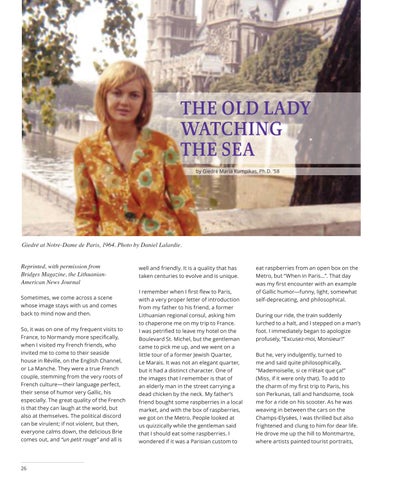
at Notre-Dame de Paris, 1964. Photo by Daniel Lalardie.
Reprinted, with permission from Bridges Magazine, the LithuanianAmerican News Journal
Sometimes, we come across a scene whose image stays with us and comes back to mind now and then.
So, it was on one of my frequent visits to France, to Normandy more specifically, when I visited my French friends, who invited me to come to their seaside house in Réville, on the English Channel, or La Manche. They were a true French couple, stemming from the very roots of French culture—their language perfect, their sense of humor very Gallic, his especially. The great quality of the French is that they can laugh at the world, but also at themselves. The political discord can be virulent; if not violent, but then, everyone calms down, the delicious Brie comes out, and “un petit rouge” and all is
WATCHING THE SEA
by Giedrė Maria Kumpikas, Ph.D. ’58
well and friendly. It is a quality that has taken centuries to evolve and is unique.
I remember when I first flew to Paris, with a very proper letter of introduction from my father to his friend, a former Lithuanian regional consul, asking him to chaperone me on my trip to France. I was petrified to leave my hotel on the Boulevard St. Michel, but the gentleman came to pick me up, and we went on a little tour of a former Jewish Quarter, Le Marais. It was not an elegant quarter, but it had a distinct character. One of the images that I remember is that of an elderly man in the street carrying a dead chicken by the neck. My father’s friend bought some raspberries in a local market, and with the box of raspberries, we got on the Metro. People looked at us quizzically while the gentleman said that I should eat some raspberries. I wondered if it was a Parisian custom to
eat raspberries from an open box on the Metro, but “When in Paris…”. That day was my first encounter with an example of Gallic humor—funny, light, somewhat self-deprecating, and philosophical.
During our ride, the train suddenly lurched to a halt, and I stepped on a man’s foot. I immediately began to apologize profusely, “Excusez-moi, Monsieur!”
But he, very indulgently, turned to me and said quite philosophically, “Mademoiselle, si ce n’était que ça!” (Miss, if it were only that). To add to the charm of my first trip to Paris, his son Perkunas, tall and handsome, took me for a ride on his scooter. As he was weaving in between the cars on the Champs-Elysées, I was thrilled but also frightened and clung to him for dear life. He drove me up the hill to Montmartre, where artists painted tourist portraits,
Giedrė
and we sat at a famous café called “Les Cadets de Gascogne” after the famous play Cyrano de Bergerac. My escort ordered my first glass of wine in Paris, a Brouilly. Today, when I taste it, the involuntary memory of my initial visit to Paris floods over me, as in the Proust episode of the tea cake, la Madeleine
My father’s friend suggested that I should not just stay in Paris but take the train south to his villa in Villefranche-surMer where his wife was hosting the son of a well-known artist, Picabia. Having overcome my initial goraphobia, I ventured south by train.
It is difficult to describe anything as beautiful as the Mediterranean—the perfectly blue water, the white and pink villas with their red slate roofs, the exotic vegetation, the houses, perched, some quite precariously, atop hills. There is great beauty in the world, but for me, it was, and still is, the most beautiful place I have ever seen.
Now, just to backtrack a little, ever since I was a little girl, I loved French. The language, the sound, the flow of beautiful words. Everything sounded better in French, whether one said, “Sit down on the bench”, which became “Assieds-toi sur le banc," or “le petit chien,” or “un bon-bon” which really meant “a goodgood.” So, when I was accepted at Hunter College, because I had an excellent high school average, and Hunter was free for qualifying students, I immediately declared my major—French! All my immigrant friends enrolled in practical courses, which assured them jobs— biology and chemistry for the girls, engineering for the boys. But French? I heard constantly: “What are you going to do with French?” “How are you going to earn a living?” My answer usually was, “I don’t know, but that is the only subject that I like, more precisely, love.” I also liked and excelled in Latin, but I would never be a true Classicist, it was too dry, too old. I had dreams of becoming a
simultaneous translator for the UN, but the studies were expensive, requiring a year in Switzerland.
And so, I took wonderful literature courses with extraordinary professors who were from the Sorbonne; I went with other French students to see French films at the Paris Theater, eating French pastries bought on Lexington Avenue and laughed at the subtitle translations, while other spectators shushed us. Oh, those young carefree days. French became such an integral part of my life. My best friend was a beautiful French Moroccan girl, who helped my fluency, “untied my tongue” as they say, and I began to speak quite freely. With great regret, my studies ended. I attended two years of summer school to be able to graduate in three years so that I could get a job and help my parents. Life had been hard for them—having come from prosperity, then losing everything, their country, their language, their profession, their family.
I was very dutiful and caring, and an only child.
My first job at the age of twenty was in a French bank as a typist-translator. I was not a good typist, only thirty words a minute, but I knew French, I was young and decorative. However, when I was told that I would have only two weeks for vacation, it seemed totally insufficient. I was a summer child, the beach, the sand, the water. I complained to my friend who suggested that I take the required education courses, thirteen credits at night, and then apply for a teaching position. I did as she suggested, and after ten months at the bank, I resigned my position without regret, because I learned that office work and office intrigues and politics were not for me.
My French Moroccan friend had begun teaching in a high school on Long Island a half-year earlier and suggested that I apply for a teaching position in her school.
And then, a miracle! Without any experience, I was hired as a French, German, Latin teacher in a Senior High School.
Those were wonderful years. I was young, my students barely a few years younger; there were quite a few crushes from the boys, but I took myself very seriously. I accepted their admiration but was always very proper. I subsequently earned my master’s degree in French and even a Ph.D. It has been a rewarding, pleasurable profession, and it has never disappointed me.
And now, back to the title of this small essay of reminiscence. About ten years ago, I went to Normandy to visit a couple whom I had hosted in New York. They lived in a charming small town called St. Lô, which had been almost destroyed by Allied bombings, except for the church steeple. My young friends, quite the atheists, said that it was just a coincidence. I did not wish to argue with my hosts. They took me to a place that I had always wanted to see—Le MontSt. Michel, an abbey built on a craggy mount in the ocean between Brittany and Normandy. It was a spiritual and beautiful place surrounded by water. How the monks and people were able to haul those boulders up and build such a structure was astonishing. We heard a young woman playing the cello in one of the upper chambers, the sound reverberating throughout the abbey, the evening light streaming beams of the setting sun through the chamber. As we left the abbey and watched the tide slowly moving in to separate the abbey from the mainland, and as we turned back to look at the abbey, majestic, mysterious, resplendent, and silhouetted in the twilight, my friend said, “I wonder what one could call that?” I answered without hesitation— “A homage to God.”
On that trip, they introduced me to their friends, an older couple, Jean-Paul
and Sylvine. They had a charming small country house on a large property. Jean-Paul grew all kinds of tomatoes and vegetables and flowers. There was a chicken coop, so an abundance of fresh eggs. That evening, the wine and conversation flowed, the dinner was French and delicious. I truly believe that there is no bad food in France, except, of course, now there is that invasion of American fast food.
My acquaintance with Jean-Paul and Sylvine developed into a warm relationship. I visited them again the year after, and they visited me in New York the following year. They fell in love with the wild nature of Montauk and lobsters and East Hampton. I took them to the ballet, at the Met, we drove up to Boston, to the Norman Rockwell Museum. (The French have a fascination with Norman Rockwell).
I went back again the following year, and my friends drove me to see the home of
Claude Monet at Giverny where I saw the famous water lily pond. It was as perfect as if Monet had just painted it. The colors of this famous artist’s home were the classical yellow and blue, which we call French blue, but in France, it is simply “bleu-gris” or blue gray.
The year after, they surprised and charmed me with a monumental treat: a stay at the Château de Miromesnil, the birthplace of my favorite author, Guy de Maupassant, the subject of my Doctoral thesis. I had never slept in a château, and as I walked up the polished winding wooden creaking stairs I wondered if I would be sleeping in the famous author’s bedroom. I was told that I would not, but I still chose to imagine the possibility. The rooms had retained their nineteenthcentury authenticity, whitewashed walls, small windows overlooking the grounds. And the grounds—they were extraordinarily lush and beautiful. I had not slept in the author’s bedroom, but I
did walk the magnificent grounds where he had played as a child.
I am so indebted to this wonderful couple. They showed me the windswept coast of Normandy and Gallic Brittany, the imposing medieval fortress city of Carcassonne; the slow, poetic meandering Loire River with its lovely châteaux. So much beauty; so much history; so much culture. Oh, mes amis, mes amis, I will always be grateful to you for sharing your beautiful country with me.
I believe it was in 2014 that I went with them to their house in Réville. It was a charming, small row house decorated with numerous nautical objects and had a huge, long garden. Jean-Paul had the proverbial green thumb. Here as well, there were so many beautiful trees, bushes, flowers, and exotic vegetation. I tried to ask him the names, but there were so many that I could not remember them. Our breakfast was always café au
Mont St. Michel, Normandy, France.
lait , fresh croissants, or pain beurré with confiture, homemade of course. Every morning Jean-Paul would drive to the local Boulanger to buy fresh bread and croissants or brioches.
After breakfast, we would go to la plage, a short walk through a narrow passage between other seaside houses. As we neared the Channel beach, we passed a house with a small garden, the second from the end and the beach, and we saw an elderly lady standing there looking at the sea. She heard us, looked in our direction, and said sweetly “Bonjour.”
We all answered “Bonjour, Madame.”
We went to the beach, and what a lovely beach, so calm, so quiet, no radios, no barbecues, no food vendors, just people on blankets or chairs, and children playing in the sand or building sandcastles. What a cultural difference between our beaches, where you have loud music blaring, people yelling, children screaming, and those infernal smelly barbecues surrounded by not-sothin people.
The water of the Manche is quite cold, but it is not as rough as our Atlantic
coast. The French are very structured as well as aesthetically oriented. Everything is regulated: breakfast, lunch, and dinner, no snacking in between. I suppose it is a good method not to gain weight, but for me, it was difficult, having bad snacking habits.
Towards evening, on the way back, we passed the house with the garden, and I saw that the lady was still standing there, quietly looking at the sea. We again exchanged our polite “Bonjour” but I was curious about her, why she was standing there almost all day just looking at the sea.
Jean-Paul explained to me that her seaman husband had never returned from his fishing trip and that the year after, her son had also not returned.
It gripped my heart to see this lovely old lady, standing there facing those engulfing waters, so serene, so alone, against all hope, and yet still hoping for their return. I suppose that just by standing and watching the water, she felt that she had a connection with her loved ones. And thus, it is that sometimes an image can stay with us and evoke different associations, and emotions.
As Victor Hugo wrote in his immortal poem Oceano Nox :
Oh! How many sailors, how many captains Who set out joyfully for distant voyages, Vanished on this gloomy horizon! How many have disappeared, hard and sad fortune!
In a bottomless sea, on a moonless night, Burrowed forever beneath the blind ocean!
Garden at Château de Miromesnil (Tourville-sur-Arques, France).
Menhirs, Brittany.
ı CLASS NOTES ı
THE 50s
Barbara DiGregorio Riddle ’53 has lived in Danbury, CT since 1965 and worked in many areas of nursing since graduating from the Bellevue School of Nursing program in NYC. She has fi ve children, nine grandchildren, and seven greatgrandchildren—with two more on the way. She remembers all the great times at Bishop’s and is grateful for those four years and the many friends. “Such fond memories of Sr. Mary Vincent who taught me Latin.”
Rita Minary Hesse ‘54 is enjoying over 70 years of wonderful friendships of the gals met at Bishop McDonnell.
Roberta Paul Molaro 1955 remembers being a freshman at Bishop’s in January 1951. "We had no uniform. There were many things we could not wear but, we had to wear nylons—or bobby socks over our hose with loafers or saddle shoes. Those who have never experienced torture of the garter belt, needed to hold up our stockings before the advent of pantyhose, can never understand the discomfort! In the event a nun suspected we weren’t wearing the required hosiery, and didn’t believe us when we said they were seamless, we had to pull the stocking away from our leg to prove compliance. One winter day, I had no nylons on and knew my chalk-white legs would never look properly covered, so I took an eyebrow pencil out and drew lines up the back of my legs. During that day, more than one nun suspected me of an infraction, but was satisfied when I showed them my (not so straight) seam. Of course, this only worked if we were wearing socks. I did wear the proper nylons most of the time, but the eyebrow pencil was kept handy for emergencies. And, before long, there were others withpencil seams when their stockings were not available."
SISTER JOAN LOSSON, OP ’52 from an interview by Maryann Stahl DeMaso ’60
"When I think of Bishop’s there are so many happy, friend-making, and fun times to remember. Traveling to and from school was exciting on the B54 bus to the wooden train, the Metropolitan EL to Wyckoff Avenue, and the Franklin Avenue shuttle to school. At each stop we picked up one Bishop’s girl at a time until there were about ten of us chitchatting and laughing. Many of these girls became lifelong friends. There was Dolores Zeni ’52, Dorothy Wade ’52, Patricia Renzulli ’52, Marilyn Green ’52, and Lucille Arnold ’52 to name a few. Pat and I stayed close friends, and she even was at my shower when I entered the Dominican order.
Classrooms were always fun. I remember some of my teachers. Sr. Edward Joseph, whom we called Eddie Joe, was a fantastic math teacher. Sr. Thomas Aquin known as Tommy Aquin, was a great science teacher. In Sr. Thomas' class there were times when, no matter how hard she tried, the science experiments would not work as planned. Her favorite phrase was, ”I do not know why it doesn’t work. It worked yesterday! Who touched it?” We would all sit there and hope for her sake the experiments would finally work. Sr. Margaret was the best foreign language teacher ever. She would find a play in German, and we would be given parts to learn and perform. We loved it and our German improved. Sr. Dennis, a Sister of Mercy, taught music. Her voice was beautiful and her tone impeccable. So, the first week of class she stood up, and said, “I am going to give you a tone. Listen to me, you all can do it.” Each of us got a chance. When it was my turn, I blasted out what I thought was the best ever. She gasped and said, “Everyone can do that, but I am sorry to say, not you.” I decided not to join the choir. I have never sung again. Life at Bishop’s was academically rigorous and rewarding thus providing me with the best education ever. I loved Bishop’s!"
Dorothy Lavelle Specht ‘55 moved to Pennsylvania in 1979. "I'm a widow with fi ve sons, 10 grandchildren, and fi ve great-grandchildren. I used the skills learned from my commercial classes at Bishop McDonnell and spent most of my career as a secretary starting on Fifth Avenue, New York City in 1955—one week after graduation."
Carol Callahan Comando ‘56 shares, "In honor of Women’s History Month, my daughter submitted the following in my honor. Liz Comando shares the woman who has inspired her most: Although there are
many women who have inspired, mentored, and coached me throughout my life, the woman who has inspired me most is my mom, Carol Comando. The epitome of service and perseverance, my mom is the hardest working person I know. Growing up, my mom always put the needs of our family before her own. She is my morale compass, the first to teach me honesty, integrity and respect. To give you a sense of the level of service she provides to her community (all volunteer positions), here are just a few…volunteered at my kindergarten and grammar school (including class trips and as a library mom), was a Girl Scout
leader (including camping trips), a board member of Hemlock Farms Community Association (and on too many committess to list), in numerous garden clubs, board member of the Conservancy, charter member and board member of the League of Women Voters of Pike County, PA, and board member of Pike County Scenic Rural Character Preservation Program (president since 2021). I cannot remember a time in my life when my mom wasn’t actively serving her community in some leadership capacity. Prior to having children, my mom worked for the FBI and a law firm."
Kathleen Donovan ’56 writes, “I met Helen McMahon ’56 on the subway the first day of school. She was with two classmates from St. Pascal’s and I was with a classmate Ellen from St. Catherine of Sienna. We both had older sisters who showed us the ropes so we knew to board the last car or two of the train where all the commuters in route to school in Brooklyn would be. We soon befriended Maureen Dorer ’56 and Terry Mulvaney ’56. Over the first weeks we ended up in classes together, volunteered in activities, and meet up on weekends for adventures such as inexpensive concerts at the Brooklyn Paramount with up and comers such as Patti Paige and Tony Bennett. Helen, Ellen, Maureen, Terry, and I went to the senior prom together with our handsome dates. Mine from Bishop Loughlin—my future husband. Helen and I went to college together at SUNY, Farmingdale, LI, and still keep in touch. She and I would love to know where the others are!"
Elizabeth (Betty) Trust Conlon ‘56 continues to celebrate each summer with classmates at a luncheon at her home in Breezy Point, NY. "While our numbers dwindle, the stories, memories, and laughter remain as we give a fullthroated rendition of Memorial ! Thanks, Bishop McDonnell for all you gave to us."
Honora Nolty ‘57 lives in New Providence, NJ and is retired from
RENEW International, not religious life. She writes, "Loving retirement and still busy with issues of social justice that were planted in my heart during my years at Bishop's—great experiences and wonderful memories. So grateful, would love to hear from classmates."
Sr. Phylis, aka Peggy O’Dowd ’57 writes, "I work at St. Anthony Parish in Rocky Point, NY as the Director of Religious Education (DRE). I’m hoping to retire soon."
Maureen Derwin Moreau ‘58 spends eight months of the year in Naples, FL and four in Manhattan. "My joy is volunteering about three days a week."
Margaret Candia McDonald ’58 attended two years at Little Bishop’s Annex in Flushing and two years at Bishop McDonnell. She played varsity basketball at both schools and traveled to both via subway. She says, "These were the best four years. I met and made many friends from the Brooklyn diocese and was taught by the best teachers that came from different religious orders. It educationally prepared me and also taught me the meaning of my Roman Catholic faith. At 83-years-old, I treasure those four years. I have been married for 61 years and am the mother of five sons."
Anne Cunningham Egan ’58 often thinks of Bishop McDonnell and Queen of All Saints—the great teachers, friends, and memories. She stays active with family, grandchildren, golf, bowling, volunteering, and "taking one day at a time. High school was a great time."
Elaine Biondini Carreras Miressi ’58 writes, "My husband, Lou, and I moved to New Windsor in the Hudson Valley’s West Bank in June, 2019—just in time for the Covid lockdown! We’re happy to be in a townhouse community where everything on the outside is done by others! We live close to our youngest daughter, her husband, and their 19-year-old
triplets! I also have two sons and another daughter. A grandson (one of eight) and wife are expecting a set of triplets. You can find me on Facebook, so please contact me."
Patricia Corrigan Koppinger ’59 says "Even after graduating more than 60 years ago, I delight in meeting other Bishop’s girls! On a recent pilgrimage to France, I met two fellow pilgrims whose mothers went to Bishop’s. We are always connected. It was an honor to go to St. Bartholomew’s in Elmhurst for my first two years and then to actually enter the huge building on Eastern Parkway to complete high school. All the teachers and all the girls were such a positive influence on my life. I became a teacher— my childhood dream—and hope that I have influenced others as Bishop’s did me. I am sincerely grateful for the scholarship opportunity that I received.”
THE 60s
Nancy Reilly Seklir ’61 is retired and fully enjoying her four children and seven grandchildren, "as I take advantage of the amazing art, music, restaurants, and diverse culture in New York City, I would love to hear from anyone who used to commute on the #7, 7:34 a.m. train out of Main St. Flushing!"
Connie Mitchell ’62 graduated from SJU In 1966 and went on the earn a both Masters and PhD degrees in Psychology. "I moved to Long Island, met and married a great guy, worked at the New York Foundling Hospital, and then for the New York State Office of Mental Health (Creedmoor Psychiatric Center) until 2010. We spend half our year in Florida, but continue to call Westbury our home. I'm in touch with a couple of our old SJU co- grads an would love to hear from others."
Diane Stover ’62 spent her entire career as a pulmonary doctor at Memorial Sloan Kettering (MSK). She was division head
A BLESSED LIFE
by MARY ANNE SEIDL ’54 I SR. AMELIA SEIDL, RSM
I attended St. Barbara's Annex for two years before attending Bishop's—I loved every minute of high school. After graduating in January, 1954, I worked at NY Life. That was not enough. I wanted to enter religious life. God heard my heart and on September 8, 1955, I entered the Sisters of Mercy. Why the Sisters of Mercy? They had just what I wanted, orphanages! To work in an orphanage was a dream. Our time of prayer reflection was three years, but the time passed quickly before my profession of vows. I then worked with babies at Angel Guardian Home in Manhattan. On the day I was measured for my white habit, the superior asked me to fill-in for the sister that cooked, as she was sick...it would only be for six months (ugh, I thought). My dreams were on hold. The cook did come back, but I was asked to teach fi fth grade so no orphanage work.
I loved the kids. God knew what was best for me. Unfortunately, I became severely ill with a kidney disease and spent many months in bed—I even made my final vows in bed! The Sisters were great and loving. They prayed for me and against all odds, I got better. The doctor told me there was no medical reason for my survival as my kidneys had shut down. God's hand was once again touching me just when I needed it. Recovery was long; I had to learn to walk again. Getting back to the classroom was my goal and it took a long time, but I returned to teaching for several years.
One day I noticed that my voice was foggy. Back to the doctor. I had an atrophied vocal cord. Once again, I had to give up teaching. I became a school librarian—less talking but still with the children I loved. They never questioned a foggy-sounding librarian. They assumed that is the way you are supposed talk in a library. One first-grader pulled on my sleeve and said, "Sister, you better never get mugged because you can't scream and run fast enough to get away." Out of the mouth of babes! Surgery was possible, but with no guarantee. Back to God and asking my sisters to pray that I would speak again. Soon my voice and speech returned. Today, they probably wish that I would be quiet.
I did not go back to teaching. I worked for a dentist for some time. I had nightmares about mistakes I might make like mixing the wrong cement and patients not being able to open their mouths! I loved the job.
I did continue work in schools—as a secretary, tuition coordinator, principal, and CCD Director until the school closed. I am retired now. I enjoy hosting and living with International Sisters who have come to America to learn. Their goals are to bring the skills and knowledge they learn back to their countries. It's been happy and fulfilling.
Today, I work towards my PHD— Peaceful and Happy Death. My life has had many bumps, twists, and turns, but I have been very blessed. Trust God and pray always. The path He has destined for each of us will happen and it will be the best!
of the General Medicine Department and Chief of the Pulmonary Division for many years, retiring two years ago. "I continue to teach at MSK, write in medical journals, and do clinical research. I have much gratitude to Bishop McDonnell for the wonderful education I received while there!"
Jo Ann Kocher ’63 was honored with the Women's Achiever Award for accomplished women in March 2024, recognizing her service in federal law enforcement, from her alma mater St. John’s University. She writes, "In 1972, I was sworn in as the first woman Special Agent in the Bureau of Alcohol, Tobacco and Firearms (ATF). I later became ATF’s first woman supervisor, despite opposition from some that a woman should never be allowed to supervise male Special Agents."
Theresa Oropallo ’63 shares, "One of my fondest memories of my days at Bishop's was Ring Day. I remember being so proud of receiving my Bishop's ring and our trip into the city to celebrate. I still smile today when I see my 1963 ring in my jewelry box."
Fran Boccella ’64 says, "I went from Brooklyn to New Jersey; then to Ft. Lauderdale, FL, and finally Cumming, GA. I would love to hear from anyone who attended St. Barbara's Annex or Bishop's—homeroom 317!"
Mary Ellen McGowan O'Boyle ’65 "Celebrated her granddaughter's graduation from James Madison University (her son was class of 2000). I hosted Christmas Eve with 28 adults and six children. We enjoyed a Brooklyn Blackout cake!"
Rose Guerin ’66 shares, "My education and experiences at Bishop's gave me a foundation for life and some interesting stories. I am grateful for
Sr. Amelia Seidl ’54, September, 1955.
WE REMEMBER RITA MONAGHAN MALONEY ’59
October 23, 1942 - April 12, 2025
Rita Monaghan ’59 first entered Bishop McDonnell’s halls in 1955 as a freshman and graduated in 1959. She pursued various occupations, and subsequently returned to Brooklyn College for a Bachelor of Arts degree, followed by a Master of Arts in Theology from Fordham University. During this period, she married and had two children, Kathryn and Matthew.
Rita taught religion at Bishop Loughlin for 19 years before retiring.
Soon after her retirement, Rita received a phone call from Bishop Loughlin asking her to return to the school to work with the alumnae of Bishop McDonnell and establish Bishop's reunions.
It was Rita Memorialites spoke to when they contacted the school—
with questions or regarding the reunions. Numerous individuals expressed their appreciation for speaking with someone from Bishop's. Rita consistently demonstrated patience, even during the hectic days leading up to the event. She thoroughly enjoyed engaging in conversations with each alumna, sharing cherished memories of the school. She served as the first editor of the
Memorial magazine that continues to be cherished by all.
In 2018, Rita retired once more and was able to spend time with her children and fi ve grandchildren. Rita loved Scrabble and was an avid enthusiast of Irish culture, particularly its musical heritage. She was often found attending theatrical performances, entertaining friends, and spending time with her family. Seeking a closer connection with her family, Rita relocated from her beloved Brooklyn to Illinois, where she found solace. Her family brought her back to Brooklyn for a Memorial Mass on April 28.
Sister Concepta who led me to a career in nursing, the Vatican II changes with Father Mondell, the variety of nuns, and (of course) all my classmates and faculty."
Sr. Maryann Lopiccolo, SC '66 continues her ministry in the Diocese of Brooklyn as Delegate for Religious. She writes, "In my years, I have seen the demographics shift from many communities of American Sisters, like many we had at Bishop's, to a growing number of International Sisters coming from many countries in Africa, Asia, Latin and South America. They are a good match for the changing face of the Church in Brooklyn and Queens."
Alice Legg Shea ’66 is happy to announce that her son Michael was ordained a deacon for the Archdiocese of Newark in May, 2025.
Joan M. Klimski, OP ’66 teaches at St. John’s University in the theology department.
Shirley Santangelo Bove ’67 welcomed the birth of a grandson, Sebastian, in November. He joins his cousin Olivia.
Janice Comiskey-Morrissey ’67 moved three years ago to Methuen, MA after her husband, Tom, passed away several years ago. Her youngest recently married. She has two grandchildren. She writes, "Getting to this age has its challenges—eyes, hearing, and joints have all had a beating, but I'm still here! My most fond memories of Bishop's are the wonderful women who taught me and friends I made."
Diane Grannum ’69 was an educator for 30 years and retired as Regional Director of Early Childhood for the City of New York Districts 1, 2, 4, and 7. "Since
While Rita is deeply missed by her friends at Bishop Loughlin, her absence will be profoundly felt by her devoted family.
—Phyllis Murphy Howell ’67
retirement from the Department of Education, I have been a realtor with EXIT Realty Premier in Massapequa Park, LI, NY and was honored by The BestAgent as a 2024 Top Agent."
In December, 2024, Diane published the book, Creating The Universe: Universal Pre-Kindergarten in The New York City Public School System 1995-2007. She was a featured author at the LA Festival of Books 2025 (held this April). "I have a husband Michael and a son Sean, who has passed."
Frances Lee Chan ’69 became a grandmother on December 21, 2024. the Department
was honored by
HHo
THE 70s
Marchelle Minerve ’70 writes, "Nothing beats a Catholic school education. The memories I made at Bishop's are priceless. I would not trade them for any amount of money. The values have carried me in all my affairs and interactions with people and helped me in all aspects of my life and career as an educator. If you can make a reunion, please do.”
Mary Ellen Horan Borgia ’70 is a graduate of Kings County Hospital Center School of Nursing and Chamberlain University (BSN). She worked at New York Presbyterian / Weill Cornell Medical Center as an operating room nurse. She works part-time now.
Cynthia Cummings ’71 says, "My fondest Bishop McDonnell memory was being a member of the BMD dance group. So dedicated was I to the routines, I even broke a front tooth at a rehearsal— resulting in a permanent cap! I actually
began ballet training, earlier on. Ballet bridged my curiosity to modern dance and after graduation from BMD, I furthered my interest in dance and performed with the Cornell Dance Group. I married, brought two daughters into the world, and continued to study with choreographers and with other dance companies of the modern genre. I am a founding member of MoJazz Dance. We are preparing for our 30th anniversary as a company for 'women of a certain age' who love to dance, irrespective of their level of professional training. As the adage goes, you lose it if you don’t use it!"
Elvira Tortora ’72 starred and performed in a one-woman cabaret show and began a singing career at 68-years-old. She won a Bistro Award—which celebrates cabaret, jazz, and comedy artists—for the show and was nominated for a MAC (Manhattan Association of Cabarets & Clubs) Best Debut Show award.
Patricia A. Cronin Connors ’73 "Greetings all! After 41 years of teaching elementary school, I retired fi ve years ago. It is wonderful. I enjoy gardening, biking, and the beach—and am looking forward to more traveling. Bishop's was a special place."
Lorraine McDonnell ’73 enjoyed every minute of her days at Bishop’s and loves catching up with other Memorialites.
Taryn Lewis Siddiq ’73 has recently written a booklet End of Life: Having the Difficult Conversations. This 38-page booklet "hopes to spark meaningful conversation and encourage intentional action around end-of-life planning."
This year's Thank-a-thon brought the spirit of appreciation to life as we give a heartfelt thanks to our Bishop McDonnell supporters. Students made phone calls to alumnae letting them know how much their contributions mean to our community. These simple, meaningful calls also gave current students an opportunity to personally express gratitude to you.
Class of 1967 members Carolyn Sliwinski Musmacher, Elizabeth Manning Mancini, Georgette Cook Sinclair, Elaine Kelly Thompson, and Laura Hinkson meet up at the Dublin Deck in Patchoque, NY in September, 2024.
2025 THANK-A-THON
MEMORIAL, MEMORIAL
DON'T MISS OWNING A PIECE OF HISTORY
Phyllis Murphy Howell ’67, a founding member of the Bishop McDonnell Alumnae Committee, published a remarkable book titled Memorial, Memorial —The History of Bishop McDonnell Memorial High School. This comprehensive and heartfelt tribute captures the rich legacy, traditions, and impact of the school through the decades. The book is available for purchase.
Those interested in obtaining a copy can reach out directly to Phyllis Howell at howelldogs@ aol.com or 718-627-2145, or contact Tanya Kennedy ’02, Associate Director, Institutional Advancement and Alumni Relations, at 718-857-2700, x 2250.
"It's more than a documentation of events; it's a celebration of the individuals who dedicated themselves to transforming young lives and shaping the community."
WELCOMING
"There are detailed narratives, photographs, and personal testimonies that chronicle the school's illustrious history, making it a valuable keepsake."
TANYA KENNEDY ’ 02
Josephine Santos McKenna ’90 P’28 worked for four years with the alumnae of Bishop McDonnell, where she played a pivotal role in fostering alumnae relations. Her dedication, combined with her warm, approachable leadership style, quickly made her a beloved figure on campus. This year, she embraced a new challenge— becoming the school's Director of Admissions, where she now works to guide prospective families through the enrollment process and share the school's mission with a new generation of students.
Josie has passed the torch to fellow alumna Tanya Curbin Kennedy ’02, who now steps into the position she once held. Tanya brings a strong sense of school pride, a deep understanding of the McDonnell spirit, and a fresh perspective to the role. “I have big shoes to fill,” she says. “I am excited to work with the Bishop McDonnell ladies.” Her enthusiasm is matched by a commitment to building meaningful connections with alumni/alumnae and continuing the school's legacy of excellence and sisterhood.
Together, Josephine and Tanya embody the sisterhood that made Bishop McDonnell special. They look forward to bringing that same spirit to Loughlin while honoring its rich history.
IN MEMORIAM
THE 40 s
Rita McCabe Buckley '41
Martha Arnold Zimmerly '42
Catherine Hanley Brethel '44
Catherine Leahy Walsh '44
Marjorie McAllister Toner '44
Therese Dart McNeill '45
Rose Mikowski '45
Maureen Morris DeGeorge '45
Regina A. Coll ’46
Eileen Greely Phillips '46
Geraldine Growney Treyman '46
Dolores Puydak Daly '46
Marie Grimaldi Cannizzaro '49
Magdalene Kasper Vogric '49
THE 50 s
Marie Gaudiello Shotland '50
Patricia Gray '50
Claire Schaedler McMahon '50
Judith Wieman '50
Joan Andren '51
Dolores Bodee Maza '51
Elizabeth Gaitings Piche '51
Sr. Lucille E. Arnold, OP '52
Mary Bianchi '52
Nancy Caballero Galante '52
Constance Darnowski Stoll '52
Anne McArdle Brush '52
Grace M. Angelillo '53
Barbara Banks Morant '53
Anne Byrne-Kuhn '53
Sr. Mary James (Eleanor) Cline, RGS ’53
Moira F. Duffy Whelan '53
Dorothy Henshaw Schaedtler '53
Ada Lobosco Feffer '53
Kathleen McPhillips Fornatora '53
Doreen Mullarkey O'Hara '53
Robert Hargreaves
Antoinette Silvestro Casiano '53
Ann White Sweeney '53
Eileen Connolly Palmer '54
Patricia Riordan Molinari '54
Anne Weiss Murray '54
Anne Curry Byrne '55
Patricia Lake '55
Patricia Murphy '55
Kathleen O'Brien Judge '55
Rosalie Horak Cook '56
Marilyn Klika Gazzara '56
Sr. Anne Marie Liston, SJC '56
Florence Casey Flynn '57
Sr. Loretta Ann Devoy, OP '57
Barbara Guidorizzi Knechtel '57
Margaret Herzner Sullivan '57
Sr. Margaret M. Lynch, OP '57
Ann McDonough O'Connor '57
Dolores McGrath '57
Joan Monford Taylor '57
Anne Oswald Bosnack '57
Dolores Seagrave Heintz '57
Eleanor Balaker Curran '58
Ann Boyle Langley ’58
Elizabeth Backiel Grabowski ’58
Rita Cassidy Forsyth '58
Eileen Dlyne Barry ’58
Maureen T. Scanlan ’58
Helen Smith Reyes '58
Sr. Margaret Sprague, CSJ '58
Helen T. Babb-Lo Ricco '59
Sr. Virginia Baeder, RSM '59
Maureen Gribbin Dean '59
Loretta Hutt '59
Carol McCormack Bamonte '59
Rita Monaghan Maloney '59
Rose Marie Weber Kinik '59
THE 60 s
Dolores DeVito '60
Sr. Ursula Sheridan, OP '60
Gabrielle Whelan Karas '61
Sr. Jane Fritz, CSJ '62
Philomena Maltese Adessa '62
Rhonda T. Bagarozzi '63
Teresa Navarro Nasif '63
Autilia De Vivo Pearlman '65
Lucille DeMaria Rauff '67
Margarita Fuentes Hawk ’67
THE 70 s
Lynne A. Grigalunas '71
Dolores Sullivan '71
FRIENDS / FORMER FACULTY
Sr. Helen McTaggart, SC
Sr. Leo Francis Monaghan, OP
Sr. Barbara A. Shea, OP
This memorial listing includes notifications of alumna deaths the school received up to April, 2025. Some deaths are not recent. If we have failed to include an alumna or have made an error, please contact Tanya Curbin Kennedy ’02 at tkennedy@blmhs.org.
THE McDONNELL SOCIETY is named for the beloved Bishop Charles McDonnell, the second Bishop of Brooklyn. McDonnell was zealous in establishing religious schools and Bishop Thomas Molloy believed that naming the school was an appropriate recognition for his efforts. The Society was created to celebrate the generous friends who have made planned or estate gifts to Loughlin in support of Catholic education in Brooklyn.
INFORMATION YOUR FINANCIAL OR LEGAL ADVISOR WILL NEED Legal Name : Bishop Loughlin Memorial High School Tax ID: 11-2294328 Incorporated in: Brooklyn, NY
AN INVITATION TO JOIN THE
McDONNELL SOCIETY @ BISHOP LOUGHLIN
Help Loughlin maintain its commitment to affordable excellence. Estate gifts are an integral part in assuring that a Lasallian education remains accessible to all qualified students, regardless of family means. If you have included Loughlin in your charitable plans, or intend to do so, or would like to find out about the benefits of giving wisely, please let us know. We’re happy to speak with you and welcome you to the Society. Sharing your designation with us will ensure your gift is used as you intend, and your recognition may inspire others to do the same. Contact Andrew Leary, Vice President of Institutional Advancement, at 718-857-2700 ext. 2251 or aleary@blmhs.org.
I would like to learn more about joining the McDonnell Society.
I would like to become a recognized member of the McDonnell Society.
I would like to remain an anonymous member of the McDonnell Society.
I haven’t made plans for Loughlin in my estate, but I am considering it.
I AM MOST INTERESTED IN SUPPORTING
The Bishop McDonnell Scholarship Fund A specific program
Where need is greatest/unrestricted
Detach here and return to Bishop Loughlin. Thank you!
BISHOP LOUGHLIN MEMORIAL HIGH SCHOOL I 357 CLERMONT AVENUE I BROOKLYN, NY 11238