Aol. wallpaper (pg 40) by Wolff Olins, 2009
DNA of the IDTV identity (pg 54)
The Google Doodle formula
by Lava, 2007
by mwmgraphics, 1998
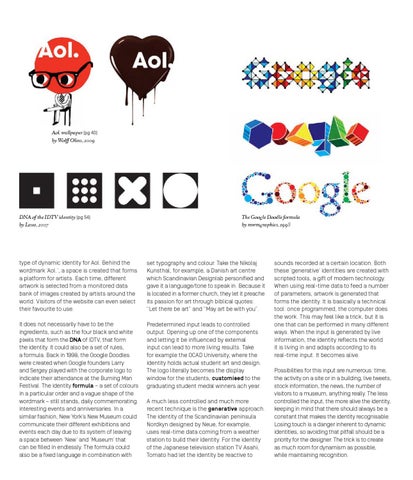
type of dynamic identity for Aol. Behind the wordmark ‘Aol.’, a space is created that forms a platform for artists. Each time, different artwork is selected from a monitored data bank of images created by artists around the world. Visitors of the website can even select their favourite to use.
set typography and colour. Take the Nikolaj Kunsthal, for example, a Danish art centre which Scandinavian Designlab personified and gave it a language/tone to speak in. Because it is located in a former church, they let it preache its passion for art through biblical quotes: “Let there be art” and “May art be with you”.
It does not necessarily have to be the ingredients, such as the four black and white pixels that form the DNA of IDTV, that form the identity. It could also be a set of rules, a formula. Back in 1998, the Google Doodles were created when Google founders Larry and Sergey played with the corporate logo to indicate their attendance at the Burning Man Festival. The identity formula – a set of colours in a particular order and a vague shape of the wordmark – still stands, daily commemorating interesting events and anniversaries. In a similar fashion, New York’s New Museum could communicate their different exhibitions and events each day due to its system of leaving a space between ‘New’ and ‘Museum’ that can be filled in endlessly. The formula could also be a fixed language in combination with
Predetermined input leads to controlled output. Opening up one of the components and letting it be influenced by external input can lead to more living results. Take for example the OCAD University, where the identity holds actual student art and design. The logo literally becomes the display window for the students, customised to the graduating student medal winners ach year. A much less controlled and much more recent technique is the generative approach. The identity of the Scandinavian peninsula Nordkyn designed by Neue, for example, uses real-time data coming from a weather station to build their identity. For the identity of the Japanese television station TV Asahi, Tomato had let the identity be reactive to
sounds recorded at a certain location. Both these ‘generative’ identities are created with scripted tools, a gift of modern technology. When using real-time data to feed a number of parameters, artwork is generated that forms the identity. It is basically a technical tool: once programmed, the computer does the work. This may feel like a trick, but it is one that can be performed in many different ways. When the input is generated by live information, the identity reflects the world it is living in and adapts according to its real-time input. It becomes alive. Possibilities for this input are numerous: time, the activity on a site or in a building, live tweets, stock information, the news, the number of visitors to a museum, anything really. The less controlled the input, the more alive the identity, keeping in mind that there should always be a constant that makes the identity recognisable. Losing touch is a danger inherent to dynamic identities, so avoiding that pitfall should be a priority for the designer. The trick is to create as much room for dynamism as possible, while maintaining recognition.