typo
colour
typo
system
logo
imagery
system
logo
language
graphic elements
colour
language
imagery graphic elements
typo
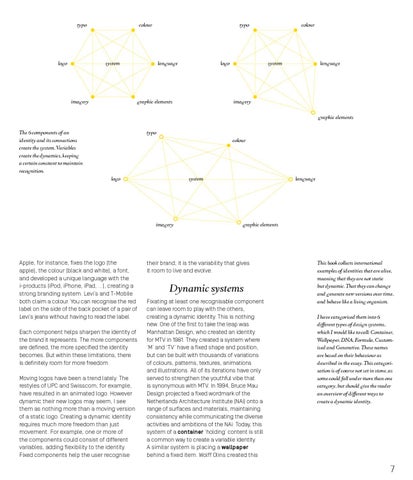
The 6 components of an
colour
identity and its connections create the system. Variables create the dynamics, keeping a certain constant to maintain recognition. system
logo
imagery
Apple, for instance, fixes the logo (the apple), the colour (black and white), a font, and developed a unique language with the i-products (iPod, iPhone, iPad, …), creating a strong branding system. Levi’s and T-Mobile both claim a colour. You can recognise the red label on the side of the back pocket of a pair of Levi’s jeans without having to read the label. Each component helps sharpen the identity of the brand it represents. The more components are defined, the more specified the identity becomes. But within these limitations, there is definitely room for more freedom. Moving logos have been a trend lately. The restyles of UPC and Swisscom, for example, have resulted in an animated logo. However dynamic their new logos may seem, I see them as nothing more than a moving version of a static logo. Creating a dynamic identity requires much more freedom than just movement. For example, one or more of the components could consist of different variables, adding flexibility to the identity. Fixed components help the user recognise
language
graphic elements
their brand; it is the variability that gives it room to live and evolve.
Dynamic systems Fixating at least one recognisable component can leave room to play with the others, creating a dynamic identity. This is nothing new. One of the first to take the leap was Manhattan Design, who created an identity for MTV in 1981. They created a system where ‘M’ and ‘TV’ have a fixed shape and position, but can be built with thousands of variations of colours, patterns, textures, animations and illustrations. All of its iterations have only served to strengthen the youthful vibe that is synonymous with MTV. In 1994, Bruce Mau Design projected a fixed wordmark of the Netherlands Architecture Institute (NAi) onto a range of surfaces and materials, maintaining consistency while communicating the diverse activities and ambitions of the NAi. Today, this system of a container ‘holding’ content is still a common way to create a variable identity. A similar system is placing a wallpaper behind a fixed item. Wolff Olins created this
This book collects international examples of identities that are alive, meaning that they are not static but dynamic. That they can change and generate new versions over time, and behave like a living organism. I have categorised them into 6 different types of design systems, which I would like to call: Container, Wallpaper, DNA, Formula, Customised and Generative. These names are based on their behaviour as described in the essay. This categorisation is of coarse not set in stone, as some could fall under more than one category, but should give the reader an overview of different ways to create a dynamic identity.
7