D e l f t D e s i g n G u i dE — 4 3
discover
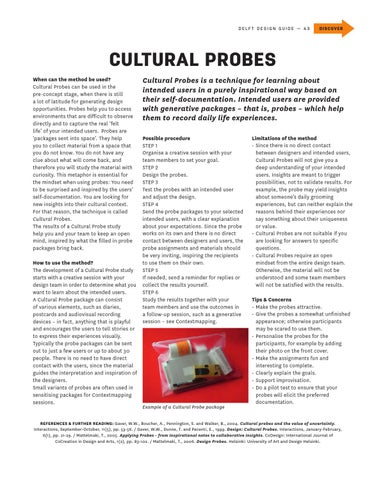
Cultural Probes When can the method be used? Cultural Probes can be used in the pre-concept stage, when there is still a lot of latitude for generating design opportunities. Probes help you to access environments that are difficult to observe directly and to capture the real ‘felt life’ of your intended users. Probes are ‘packages sent into space’. They help you to collect material from a space that you do not know. You do not have any clue about what will come back, and therefore you will study the material with curiosity. This metaphor is essential for the mindset when using probes: You need to be surprised and inspired by the users’ self-documentation. You are looking for new insights into their cultural context. For that reason, the technique is called Cultural Probes. The results of a Cultural Probe study help you and your team to keep an open mind, inspired by what the filled in probe packages bring back. How to use the method? The development of a Cultural Probe study starts with a creative session with your design team in order to determine what you want to learn about the intended users. A Cultural Probe package can consist of various elements, such as diaries, postcards and audiovisual recording devices – in fact, anything that is playful and encourages the users to tell stories or to express their experiences visually. Typically the probe packages can be sent out to just a few users or up to about 30 people. There is no need to have direct contact with the users, since the material guides the interpretation and inspiration of the designers. Small variants of probes are often used in sensitising packages for Contextmapping sessions.
Cultural Probes is a technique for learning about intended users in a purely inspirational way based on their self-documentation. Intended users are provided with generative packages – that is, probes – which help them to record daily life experiences. Possible procedure Step 1 Organise a creative session with your team members to set your goal. Step 2 Design the probes. Step 3 Test the probes with an intended user and adjust the design. Step 4 Send the probe packages to your selected intended users, with a clear explanation about your expectations. Since the probe works on its own and there is no direct contact between designers and users, the probe assignments and materials should be very inviting, inspiring the recipients to use them on their own. Step 5 If needed, send a reminder for replies or collect the results yourself. Step 6 Study the results together with your team members and use the outcomes in a follow-up session, such as a generative session – see Contextmapping.
Example of a Cultural Probe package
Limitations of the method • Since there is no direct contact between designers and intended users, Cultural Probes will not give you a deep understanding of your intended users. Insights are meant to trigger possibilities, not to validate results. For example, the probe may yield insights about someone’s daily grooming experiences, but can neither explain the reasons behind their experiences nor say something about their uniqueness or value. • Cultural Probes are not suitable if you are looking for answers to specific questions. • Cultural Probes require an open mindset from the entire design team. Otherwise, the material will not be understood and some team members will not be satisfied with the results. Tips & Concerns • Make the probes attractive. • Give the probes a somewhat unfinished appearance; otherwise participants may be scared to use them. • Personalise the probes for the participants, for example by adding their photo on the front cover. • Make the assignments fun and interesting to complete. • Clearly explain the goals. • Support improvisation. • Do a pilot test to ensure that your probes will elicit the preferred documentation.
References & Further Reading: Gaver, W.W., Boucher, A., Pennington, S. and Walker, B., 2004. Cultural probes and the value of uncertainty. Interactions, September-October, 11(5), pp. 53-56. / Gaver, W.W., Dunne, T. and Pacenti, E., 1999. Design: Cultural Probes. Interactions, January-February, 6(1), pp. 21-29. / Mattelmaki, T., 2005. Applying Probes - from inspirational notes to collaborative insights. CoDesign: International Journal of CoCreation in Design and Arts, 1(2), pp. 83-102. / Mattelmaki, T., 2006. Design Probes. Helsinki: University of Art and Design Helsinki.
DEF_DDG1C.indd 43
12-07-13 16:24