D e l f t D e s i g n G u i dE — 1 9
Models, approaches & perspectives
Basic Design Cycle What is the purpose of the model? The model describes the different stages a designer goes through when solving a design problem. Theoretically you can go through just a single cycle, but usually you will perform many iterations.
The Basic Design Cycle is a model that represents the trial-and-error process of design. It consists of a sequence of empirical cycles. The knowledge of both the problem and the solution increase with each cycle. Process description The model describes five stages, each with a related outcome/result. Analyse In this stage you analyse aspects related to your design goal or a design problem. The processed information will yield the design criteria. For example, when thinking about what to wear, you consider the weather and the social context.
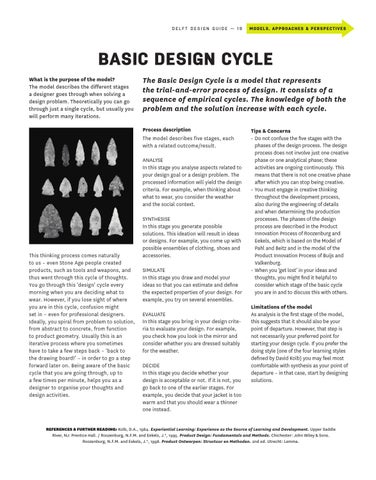
This thinking process comes naturally to us – even Stone Age people created products, such as tools and weapons, and thus went through this cycle of thoughts. You go through this ‘design’ cycle every morning when you are deciding what to wear. However, if you lose sight of where you are in this cycle, confusion might set in – even for professional designers. Ideally, you spiral from problem to solution, from abstract to concrete, from function to product geometry. Usually this is an iterative process where you sometimes have to take a few steps back – ‘back to the drawing board!’ – in order to go a step forward later on. Being aware of the basic cycle that you are going through, up to a few times per minute, helps you as a designer to organise your thoughts and design activities.
Synthesise In this stage you generate possible solutions. This ideation will result in ideas or designs. For example, you come up with possible ensembles of clothing, shoes and accessories. Simulate In this stage you draw and model your ideas so that you can estimate and define the expected properties of your design. For example, you try on several ensembles. Evaluate In this stage you bring in your design criteria to evaluate your design. For example, you check how you look in the mirror and consider whether you are dressed suitably for the weather. Decide In this stage you decide whether your design is acceptable or not. If it is not, you go back to one of the earlier stages. For example, you decide that your jacket is too warm and that you should wear a thinner one instead.
Tips & Concerns • Do not confuse the five stages with the phases of the design process. The design process does not involve just one creative phase or one analytical phase; these activities are ongoing continuously. This means that there is not one creative phase after which you can stop being creative. • You must engage in creative thinking throughout the development process, also during the engineering of details and when determining the production processes. The phases of the design process are described in the Product Innovation Process of Roozenburg and Eekels, which is based on the Model of Pahl and Beitz and in the model of the Product Innovation Process of Buijs and Valkenburg. • When you ‘get lost’ in your ideas and thoughts, you might find it helpful to consider which stage of the basic cycle you are in and to discuss this with others. Limitations of the model As analysis is the first stage of the model, this suggests that it should also be your point of departure. However, that step is not necessarily your preferred point for starting your design cycle. If you prefer the doing style (one of the four learning styles defined by David Kolb) you may feel most comfortable with synthesis as your point of departure – in that case, start by designing solutions.
References & Further Reading: Kolb, D.A., 1984. Experiential Learning: Experience as the Source of Learning and Development. Upper Saddle River, NJ: Prentice Hall. / Roozenburg, N.F.M. and Eekels, J.*, 1995. Product Design: Fundamentals and Methods. Chichester: John Wiley & Sons. Roozenburg, N.F.M. and Eekels, J.*, 1998. Product Ontwerpen: Structuur en Methoden. 2nd ed. Utrecht: Lemma.
DEF_DDG1C.indd 19
12-07-13 16:24