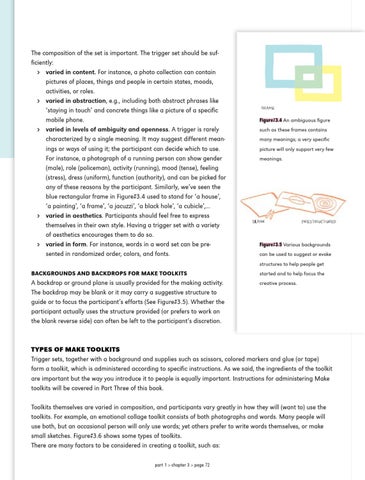
The composition of the set is important. The trigger set should be sufficiently: > > varied in content. For instance, a photo collection can contain pictures of places, things and people in certain states, moods, activities, or roles. > > varied in abstraction, e.g., including both abstract phrases like ‘staying in touch’ and concrete things like a picture of a specific mobile phone. > > varied in levels of ambiguity and openness. A trigger is rarely characterized by a single meaning. It may suggest different meanings or ways of using it; the participant can decide which to use. For instance, a photograph of a running person can show gender (male), role (policeman), activity (running), mood (tense), feeling (stress), dress (uniform), function (authority), and can be picked for any of these reasons by the participant. Similarly, we’ve seen the blue rectangular frame in Figure#3.4 used to stand for ‘a house’, ‘a painting’, ‘a frame’, ‘a jacuzzi’, ‘a black hole’, ‘a cubicle’,... > > varied in aesthetics. Participants should feel free to express themselves in their own style. Having a trigger set with a variety of aesthetics encourages them to do so. > > varied in form. For instance, words in a word set can be presented in randomized order, colors, and fonts. 
frame
Figure#3.4 An ambiguous figure such as these frames contains many meanings; a very specific picture will only support very few meanings.
blank
prestructured
Figure#3.5 Various backgrounds can be used to suggest or evoke structures to help people get
Backgrounds and backdrops for Make toolkits
started and to help focus the
A backdrop or ground plane is usually provided for the making activity. The backdrop may be blank or it may carry a suggestive structure to guide or to focus the participant’s efforts (See Figure#3.5). Whether the participant actually uses the structure provided (or prefers to work on the blank reverse side) can often be left to the participant’s discretion.
creative process.
Types of Make toolkits Trigger sets, together with a background and supplies such as scissors, colored markers and glue (or tape) form a toolkit, which is administered according to specific instructions. As we said, the ingredients of the toolkit are important but the way you introduce it to people is equally important. Instructions for administering Make toolkits will be covered in Part Three of this book. Toolkits themselves are varied in composition, and participants vary greatly in how they will (want to) use the toolkits. For example, an emotional collage toolkit consists of both photographs and words. Many people will use both, but an occasional person will only use words; yet others prefer to write words themselves, or make small sketches. Figure#3.6 shows some types of toolkits. There are many factors to be considered in creating a toolkit, such as: part 1 > chapter 3 > page 72