Say, Do, and Make tools and techniques There are dozens of techniques and hundreds of tools to work with the techniques. Techniques can be classified by different criteria, e.g., the way they depend on a theory about the topic being investigated, the type of data that they deliver, or the level of academic rigor, training or financial investment they require. In our experience, the most helpful perspective from which to organize tools and techniques is people-centered, focusing on the activities of the participants rather than those of the researcher or the data. One can look at what people do, what they say, and what they make. Many studies (particularly in market research applications) include only Say techniques, but it is becoming increasingly common to find combinations of Say and Do techniques being used. As you might expect from reading Chapter Two, it is the latter category, what people make, on which we lay the most emphasis in this book. That is in part because it’s the newest in the context of research techniques, as it borrows from design. It’s also because the Make category provides more opportunities for exploring experience at a deep level. But as we will explain later, Make tools and techniques should not be used in isolation. A generative study almost always has elements of all three: Say, Do, and Make.
say
do
make
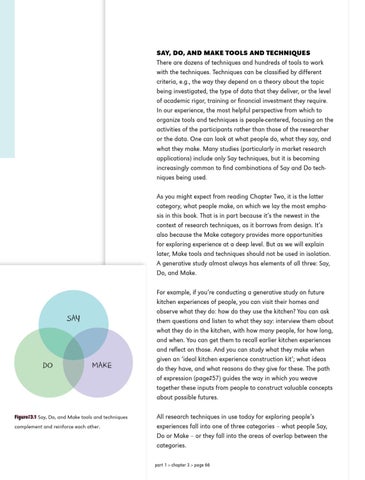
Figure#3.1 Say, Do, and Make tools and techniques complement and reinforce each other.
For example, if you’re conducting a generative study on future kitchen experiences of people, you can visit their homes and observe what they do: how do they use the kitchen? You can ask them questions and listen to what they say: interview them about what they do in the kitchen, with how many people, for how long, and when. You can get them to recall earlier kitchen experiences and reflect on those. And you can study what they make when given an ‘ideal kitchen experience construction kit’; what ideas do they have, and what reasons do they give for these. The path of expression (page#57) guides the way in which you weave together these inputs from people to construct valuable concepts about possible futures. All research techniques in use today for exploring people’s experiences fall into one of three categories – what people Say, Do or Make – or they fall into the areas of overlap between the categories. part 1 > chapter 3 > page 66