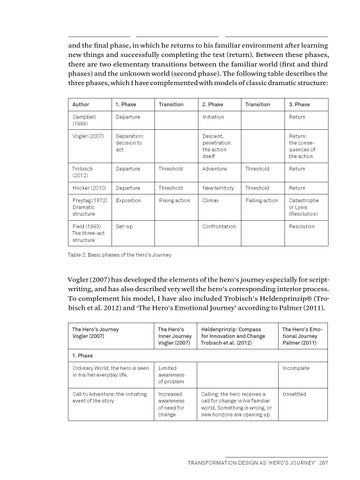
and the final phase, in which he returns to his familiar environment after learning new things and successfully completing the test (return). Between these phases, there are two elementary transitions between the familiar world (first and third phases) and the unknown world (second phase). The following table describes the three phases, which I have complemented with models of classic dramatic structure: Author
1. Phase
Transition
2. Phase
Transition
Campbell (1999)
Departure
Initiation
Return
Vogler (2007)
Separation: decision to act
Descent, penetration: the action itself
Return: the consequences of the action
Trobisch (2012)
Departure
Threshold
Adventure
Threshold
Return
Höcker (2010)
Departure
Threshold
New territory
Threshold
Return
Freytag (1872) Dramatic structure
Exposition
Rising action
Climax
Falling action
Catastrophe or Lysis (Resolution)
Field (1993) The three-act structure
Set-up
Confrontation
3. Phase
Resolution
Table 2: Basic phases of the Hero’s Journey
Vogler (2007) has developed the elements of the hero’s journey especially for scriptwriting, and has also described very well the hero’s corresponding interior process. To complement his model, I have also included Trobisch’s Heldenprinzip® (Trobisch et al. 2012) and ‘The Hero’s Emotional Journey’ according to Palmer (2011). The Hero’s Journey Vogler (2007)
The Hero’s Inner Journey Vogler (2007)
Heldenprinzip: Compass for Innovation and Change Trobisch et al. (2012)
The Hero’s Emo tional Journey Palmer (2011)
1. Phase Ordinary World: the hero is seen in his/her everyday life.
Limited awareness of problem
Call to Adventure: the initiating event of the story
Increased awareness of need for change
Incomplete
Calling: the hero receives a call for change in his familiar world. Something is wrong, or new horizons are opening up.
Unsettled
TRANSFORMATION DESIGN AS ‘HERO’S J OURNEY’ 267