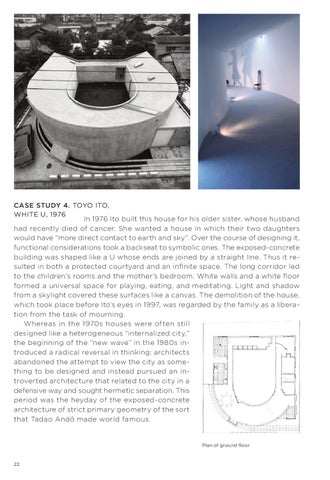
case study 4. Toyo ito, white U, 1976 In 1976 Ito built this house for his older sister, whose husband had recently died of cancer. She wanted a house in which their two daughters would have “more direct contact to earth and sky”. Over the course of designing it, functional considerations took a backseat to symbolic ones. The exposed-concrete building was shaped like a U whose ends are joined by a straight line. Thus it resulted in both a protected courtyard and an infinite space. The long corridor led to the children’s rooms and the mother’s bedroom. White walls and a white floor formed a universal space for playing, eating, and meditating. Light and shadow from a skylight covered these surfaces like a canvas. The demolition of the house, which took place before Ito’s eyes in 1997, was regarded by the family as a liberation from the task of mourning. Whereas in the 1970s houses were often still designed like a heterogeneous “internalized city,” the beginning of the “new wave” in the 1980s introduced a radical reversal in thinking: architects abandoned the attempt to view the city as something to be designed and instead pursued an introverted architecture that related to the city in a defensive way and sought hermetic separation. This period was the heyday of the exposed-concrete architecture of strict primary geometry of the sort that Tadao Ando ¯ made world famous.
Plan of ground floor
22