A∂ Linear spatial expansion
∫ All design tools in A∂ can be combined with – – – – – – – – A3.∂ Closable access A5.∂ Underwater steps A5.2 Boulders and stepping stones A5.3 Foreshores A6.∂ Floating jetties A6.3 Moored ships
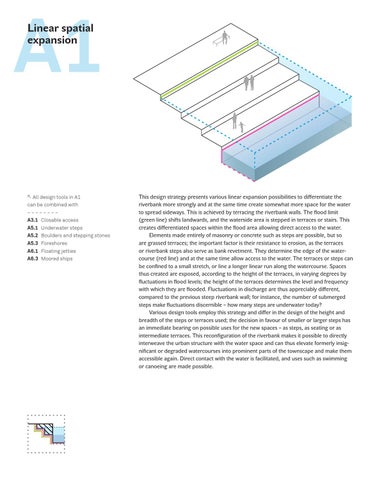
This design strategy presents various linear expansion possibilities to differentiate the riverbank more strongly and at the same time create somewhat more space for the water to spread sideways. This is achieved by terracing the riverbank walls. The flood limit (green line) shifts landwards, and the waterside area is stepped in terraces or stairs. This creates differentiated spaces within the flood area allowing direct access to the water. Elements made entirely of masonry or concrete such as steps are possible, but so are grassed terraces; the important factor is their resistance to erosion, as the terraces or riverbank steps also serve as bank revetment. They determine the edge of the watercourse (red line) and at the same time allow access to the water. The terraces or steps can be confined to a small stretch, or line a longer linear run along the watercourse. Spaces thus created are exposed, according to the height of the terraces, in varying degrees by fluctuations in flood levels; the height of the terraces determines the level and frequency with which they are flooded. Fluctuations in discharge are thus appreciably different, compared to the previous steep riverbank wall; for instance, the number of submerged steps make fluctuations discernible – how many steps are underwater today? Various design tools employ this strategy and differ in the design of the height and breadth of the steps or terraces used; the decision in favour of smaller or larger steps has an immediate bearing on possible uses for the new spaces – as steps, as seating or as intermediate terraces. This reconfiguration of the riverbank makes it possible to directly interweave the urban structure with the water space and can thus elevate formerly insignificant or degraded watercourses into prominent parts of the townscape and make them accessible again. Direct contact with the water is facilitated, and uses such as swimming or canoeing are made possible.