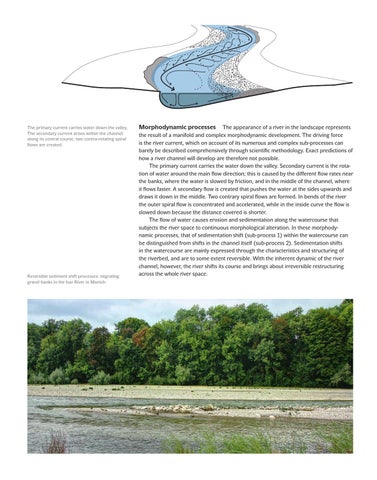
The primary current carries water down the valley. The secondary current arises within the channel: along its central course, two contra-rotating spiral flows are created.
Reversible sediment shift processes: migrating gravel banks in the Isar River in Munich
Morphodynamic processes The appearance of a river in the landscape represents the result of a manifold and complex morphodynamic development. The driving force is the river current, which on account of its numerous and complex sub-processes can barely be described comprehensively through scientific methodology. Exact predictions of how a river channel will develop are therefore not possible. The primary current carries the water down the valley. Secondary current is the rotation of water around the main flow direction; this is caused by the different flow rates near the banks, where the water is slowed by friction, and in the middle of the channel, where it flows faster. A secondary flow is created that pushes the water at the sides upwards and draws it down in the middle. Two contrary spiral flows are formed. In bends of the river the outer spiral flow is concentrated and accelerated, while in the inside curve the flow is slowed down because the distance covered is shorter. The flow of water causes erosion and sedimentation along the watercourse that subjects the river space to continuous morphological alteration. In these morphodynamic processes, that of sedimentation shift (sub-process 1) within the watercourse can be distinguished from shifts in the channel itself (sub-process 2). Sedimentation shifts in the watercourse are mainly expressed through the characteristics and structuring of the riverbed, and are to some extent reversible. With the inherent dynamic of the river channel, however, the river shifts its course and brings about irreversible restructuring across the whole river space.