6.1
Self-contained and interconnected configurations If a two-directional structure is based on repeat units that are exclusively composed of modules, additional connector elements are required to establish coherence in the lateral direction. In structures with laterally connectable units, this is not the case. However, connector elements in a lateral direction can be employed as re inforcing elements. 6.2
Number of connector types Connectors in the lateral direction can be designed as a second type of connector in addition to those that establish connectivity in the direction of the span. Alternatively, a single type of connector that is able to f ulfill both functions is conceivable. Each approach has implications for the assembly procedure and sequence.
6.3
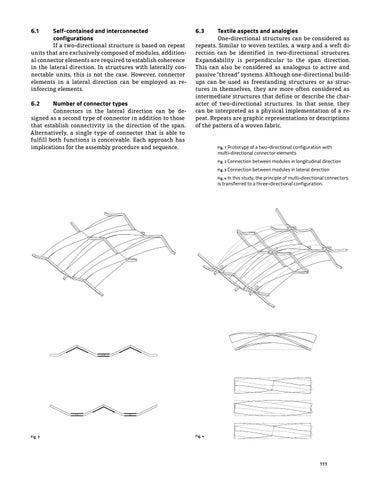
Textile aspects and analogies One-directional structures can be considered as repeats. Similar to woven textiles, a warp and a weft direction can be identified in two-directional structures. Expandability is perpendicular to the span direction. This can also be considered as analogous to active and passive “thread” systems. Although one-directional buildups can be used as freestanding structures or as structures in themselves, they are more often considered as intermediate structures that define or describe the character of two-directional structures. In that sense, they can be interpreted as a physical implementation of a repeat. Repeats are graphic representations or descriptions of the pattern of a woven fabric. Prototype of a two-directional configuration with multi-directional connector elements
Fig. 1 Fig. 2
Connection between modules in longitudinal direction
Fig. 3
Connection between modules in lateral direction
Fig. 4 In this study, the principle of multi-directional connectors is transferred to a three-directional configuration.
Fig. 3
Fig. 4
111