SMART CYCLING
T
he seaside city of Portland, Maine — population 66,000 — has become home to thousands of immigrants from all over the world. During the past four decades, waves of refugees and other immigrants have arrived from Vietnam, Cambodia, Bosnia, Sudan, Somalia and many other countries. About a third of the students in the city's public schools now speak a language other than English at home. Among the most recent arrivals are people fleeing repression and violence in central Africa. Many come to the United States on temporary visas and then seek asylum. They are not allowed to work for at least six months as they await initial processing of their cases. Some asylum seekers live in shelters, and most scrape by on very little money.
Over past decades, waves of refugees and other immigrants have arrived from Vietnam, Cambodia, Bosnia, Sudan, Somalia and many other countries... Last year, the coalition partnered with local organizations serving immigrants to launch a pilot project called Bikes for New Mainers.
Two years ago, the Bicycle Coalition of Maine began receiving requests to donate bikes left over from its annual swap to asylum seekers and other so-called "New Mainers." Nancy Grant, the coalition's executive
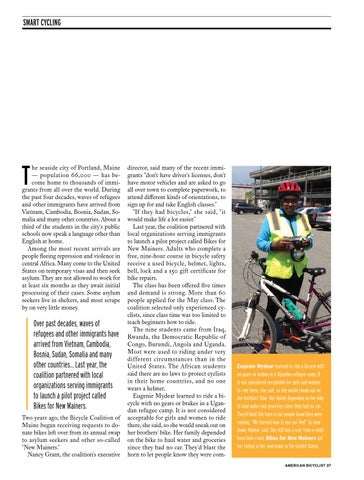
director, said many of the recent immigrants "don't have driver's licenses, don't have motor vehicles and are asked to go all over town to complete paperwork, to attend different kinds of orientations, to sign up for and take English classes." "If they had bicycles," she said, "it would make life a lot easier." Last year, the coalition partnered with local organizations serving immigrants to launch a pilot project called Bikes for New Mainers. Adults who complete a free, nine-hour course in bicycle safety receive a used bicycle, helmet, lights, bell, lock and a $50 gift certificate for bike repairs. The class has been offered five times and demand is strong. More than 60 people applied for the May class. The coalition selected only experienced cyclists, since class time was too limited to teach beginners how to ride. The nine students came from Iraq, Rwanda, the Democratic Republic of Congo, Burundi, Angola and Uganda. Most were used to riding under very different circumstances than in the United States. The African students said there are no laws to protect cyclists in their home countries, and no one wears a helmet. Eugenie Mydear learned to ride a bicycle with no gears or brakes in a Ugandan refugee camp. It is not considered acceptable for girls and women to ride there, she said, so she would sneak out on her brothers' bike. Her family depended on the bike to haul water and groceries since they had no car. They'd blast the horn to let people know they were com-
Eugenie Mydear learned to ride a bicycle with no gears or brakes in a Ugandan refugee camp. It is not considered acceptable for girls and women to ride there, she said, so she would sneak out on her brothers’ bike. Her family depended on the bike to haul water and groceries since they had no car. They’d blast the horn to let people know they were coming. “We learned how to use our feet” to slow down, Mydear said. She still has a scar from a childhood bike crash. Bikes for New Mainers got her rolling in her new home in the United States. AMERICAN BICYCLIST 37