engineering Complete Streets
cellent way to start the conversation. For Sheree Davis, of New Jersey, the focus was to reduce traffic fatalities. “Averaging around 100 pedestrian and 20 cyclist deaths means something has to change, but how were we going to do it?” said Davis. “The deaths woke our department up. This just makes sense.”
Win Over Transportation Engineers
“One of the goals of the Complete Streets movement is about winning over the engineering profession and showing them a vision of streets for everyone,” said McCann of the Complete Streets Coalition. Appealing to the problem-solving side of engineers has yielded great results. “In our workshops, there is at least one engineer sitting in the back of the room, skeptical, with his arms folded. Throughout the day you can see the light bulb go off, and by the end, not only are they attentive, they are among the most engaged.” The Institute of Transportation Engineers is supportive of Complete Streets. Davis has had similar experience in New Jersey. “In order to sell it, you need to bring in the experts that can lay out what complete streets mean – there is often a misconcep-
Our Complete Streets policy has “been a big game changer for New Jersey.” - Sheree Davis, State Bicycle Coordinator for NJDOT
tion of what they look like,” she said. Good design guidance and training is crucial. “Once it is explained how some paint and small adjustments can be inexpensive, safe solutions to the problem, they get it.”
Not one-size-fits -all
While there are lots of great examples, there isn’t just one complete street. For example, St. Louis’ Complete Streets plan components include street and sidewalk lighting; pedestrian and bicycle safety improvements; access improvements, including compliance with the Americans with Disabilities Act; public transit facilities accommodation, including pedestrian access improvement to transit stops and stations; street trees and landscaping; drainage; and other street amenities. “Our policy is implemented in a project by project approach,” said Kohler. During the planning phase, the city will conduct a study and analysis to see how best to integrate these elements into the project. “We
recently completed a road diet that included the addition of bike lanes as part of a resurfacing project on South Broadway, a major north-south arterial road running through downtown. Cyclists were ecstatic about the road and how it offered an improved option to commute to work, exercise or visit downtown sites.” Charlotte uses a six-step planning process in all of their road projects that defines current land and transportation use, as well as the planned future use and context. This process has been so successful that it has been integrated into the Complete Streets Coalition training workshops. Many agencies enjoy the expanded toolbox that that Complete Streets gives them. “In Seattle, their ordinance is very well thought out. City staff learns by doing, by experimentation, and then they codify what works,” said Barbara McCann. Such flexible approaches serve to alleviate transportation agencies’ fears that their hands will be tied to include all modes, regardless of need or of context. The most effective
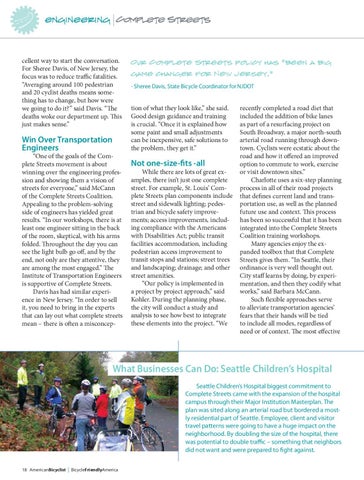
What Businesses Can Do: Seattle Children’s Hospital Seattle Children’s Hospital biggest commitment to Complete Streets came with the expansion of the hospital campus through their Major Institution Masterplan. The plan was sited along an arterial road but bordered a mostly residential part of Seattle. Employee, client and visitor travel patterns were going to have a huge impact on the neighborhood. By doubling the size of the hospital, there was potential to double traffic – something that neighbors did not want and were prepared to fight against. 18 AmericanBicyclist
| BicycleFriendlyAmerica