I
am on a journey that began when I was just a boy, amazed at how many stars I could see at the Vanderbilt Planetarium and curious why I couldn’t see them in the real sky of my New York City suburb. I lost astronomy for a long time, but got it back in 2001 when I returned to the U.S. after a stint in the Peace Corps. By then I had worries that hadn’t troubled that wide-eyed boy years ago, and astronomy seemed to offer a calming perspective. Bicycles had caught my eye by then, too, as something more than just a fun way to get around. It was
just a matter of time before I looked at my telescope and my bicycle, sharing space in my increasingly crowded garage, and an idea was sparked. I ride out of my driveway at 4 a.m. Under the glare of the streetlights, I can see only the brightest stars and planets, hinting at my destination. A fox crosses the road ahead of me. I pass the strip malls and the sky above me is completely obscured by the pink glow of light pollution. I turn left down a country road and reach escape velocity. All of a sudden I am in dark farm fields, and the universe has opened above me. The bright stars Vega, Deneb and Altair are setting in the west, a
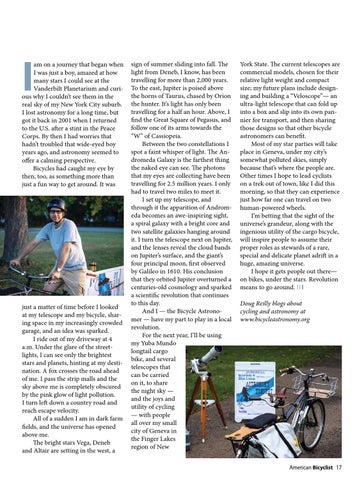
sign of summer sliding into fall. The light from Deneb, I know, has been travelling for more than 2,000 years. To the east, Jupiter is poised above the horns of Taurus, chased by Orion the hunter. It’s light has only been travelling for a half an hour. Above, I find the Great Square of Pegasus, and follow one of its arms towards the “W” of Cassiopeia. Between the two constellations I spot a faint whisper of light. The Andromeda Galaxy is the farthest thing the naked eye can see. The photons that my eyes are collecting have been travelling for 2.5 million years. I only had to travel two miles to meet it. I set up my telescope, and through it the apparition of Andromeda becomes an awe-inspiring sight, a spiral galaxy with a bright core and two satellite galaxies hanging around it. I turn the telescope next on Jupiter, and the lenses reveal the cloud bands on Jupiter’s surface, and the giant’s four principal moon, first observed by Galileo in 1610. His conclusion that they orbited Jupiter overturned a centuries-old cosmology and sparked a scientific revolution that continues to this day. And I — the Bicycle Astronomer — have my part to play in a local revolution. For the next year, I’ll be using my Yuba Mundo longtail cargo bike, and several telescopes that can be carried on it, to share the night sky — and the joys and utility of cycling — with people all over my small city of Geneva in the Finger Lakes region of New
York State. The current telescopes are commercial models, chosen for their relative light weight and compact size; my future plans include designing and building a “Veloscope”— an ultra-light telescope that can fold up into a box and slip into its own pannier for transport, and then sharing those designs so that other bicycle astronomers can benefit. Most of my star parties will take place in Geneva, under my city’s somewhat polluted skies, simply because that’s where the people are. Other times I hope to lead cyclists on a trek out of town, like I did this morning, so that they can experience just how far one can travel on two human-powered wheels. I’m betting that the sight of the universe’s grandeur, along with the ingenious utility of the cargo bicycle, will inspire people to assume their proper roles as stewards of a rare, special and delicate planet adrift in a huge, amazing universe. I hope it gets people out there— on bikes, under the stars. Revolution means to go around. Doug Reilly blogs about cycling and astronomy at www.bicycleastronomy.org
American Bicyclist 17