9
JULY 2015 | University Hospitals Birmingham NHS Foundation Trust
CH NEWS
ght into work
RESEARCH NEWS The National Institute for Health Research Surgical Reconstruction and Microbiology Research Centre (NIHR SRMRC) is a national centre for trauma research, bringing together the pioneering advances in surgery and infection control made by military and civilian scientists and medics working together. news@QEHB looks at some of the latest work which is helping to make a difference to care delivery
Lung cancer project
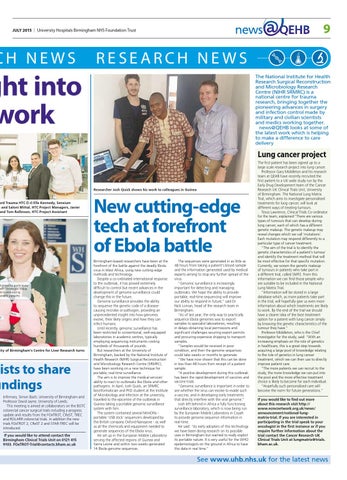
Researcher Josh Quick shows his work to colleagues in Guinea
ard Trauma HTC (l-r) Elle Kennedy, Sensium s and Saloni Mittal, HTC Project Managers, Javier and Tom Rollinson, HTC Project Assistant
elighted to participate arch Showcase today. ects embracing benefit patients
sity of Birmingham’s Centre for Liver Research turns
lists to share findings Infirmary, Simon Bach; University of Birmingham and Professor David Jayne; University of Leeds. This meeting is aimed at collaborators on the BiSTC colorectal cancer surgical trials including a progress update and results from the FOxTROT, CReST, TREC and ROLARR colorectal trials. In addition the new trials FOxTROT 2, CReST 2 and STAR-TREC will be introduced. If you would like to attend contact the Birmingham Clinical Trials Unit on 0121 415 9103. FOxTROT-Trial@contacts.bham.ac.uk
New cutting-edge tech at forefront of Ebola battle Birmingham-based researchers have been at the forefront of the battle against the deadly Ebola virus in West Africa, using new cutting-edge methods and technology. Despite a co-ordinated international response to the outbreak, it has proved extremely difficult to control but recent advances in the development of genome surveillance could change this in the future. Genome surveillance provides the ability to sequence the genetic code of a diseasecausing microbe or pathogen, providing an unprecedented insight into how genomes evolve, their likely origins and how they can infect humans. Until recently, genomic surveillance has been restricted to conventional, well-equipped laboratories in academic centres, typically employing sequencing instruments costing hundreds of thousands of pounds. But researchers at the University of Birmingham, backed by the National Institute of Health Research (NIHR) Surgical Reconstruction and Microbiology Research Centre (SRMRC), have been working on a new technique for portable, real-time surveillance. The aim is to improve the medical services’ ability to react to outbreaks like Ebola and other pathogens. In April, Josh Quick, an SRMRC bioinformatician and PhD student at the Institute of Microbiology and Infection at the university, travelled to the epicentre of the outbreak in Guinea taking a portable genomic surveillance system with him. The system contained several MinIONs portable ‘USB stick’ sequencers developed by the British company Oxford Nanopore - as well as all the chemicals and equipment needed to generate sequences of the Ebola virus. He set up in the European Mobile Laboratory serving the affected regions of Guinea and Sierra Leone and within two weeks generated 14 Ebola genome sequences.
The sequences were generated in as little as 48 hours from taking a patient’s blood sample and the information generated used by medical experts aiming to stop any further spread of the virus. “Genomic surveillance is increasingly important for detecting and managing outbreaks. We hope the ability to provide portable, real-time sequencing will improve our ability to respond in future,” said Dr Nick Loman, head of the research team in Birmingham. “As of last year, the only way to practically sequence Ebola genomes was to export samples to specialist laboratories, resulting in delays obtaining local permissions and significant challenges securing export permits and procuring expensive shipping to transport samples. “Samples would be received in poor condition, and then the genome sequences could take weeks or months to generate. “We have now shown that this can be done in less than 48 hours from receipt of a patient sample. “A positive development during this outbreak has been the rapid development of vaccines and vaccine trials. “Genomic surveillance is important in order to see whether the virus can evolve to evade such a vaccine, and in developing early treatments that directly interfere with the viral genome.” Josh left behind in Africa a fully functioning surveillance laboratory, which is now being run by the European Mobile Laboratory in Coyah to provide genome sequence information in real-time. He said: “As early adopters of this technology we have been doing research on its possible uses in Birmingham but wanted to really exploit its portable nature. It is very useful for the WHO epidemiologists on the ground in Africa to have this data in real time.”
The first patient has been signed up to a large scale research project into lung cancer. Professor Gary Middleton and his research team at QEHB have recently recruited the first patient to a UK wide study run by the Early Drug Development team of the Cancer Research UK Clinical Trials Unit, University of Birmingham. The National Lung Matrix Trial, which aims to investigate personalised treatments for lung cancer, will look at different ways of treating tumours. Tessa Lawrence, Clinical Trials Co-ordinator for the team, explained:“There are various types of tumours that can develop during lung cancer, each of which has a different genetic makeup. The genetic makeup may reveal changes which we call ‘mutations’. Each mutation may respond differently to a particular type of cancer treatment. “The aim of the trial is to identify the genetic characteristics of a patient’s tumour and identify the treatment method that will be most effective for that specific mutation. Currently, we screen the genetic makeup of tumours in patients who take part in a different trial, called SMP2. From this information we can find those people who are suitable to be included in the National Lung Matrix Trial. “Information will be stored in a large database which, as more patients take part in the trial, will hopefully give us even more information about which treatments are likely to work. By the end of the trial we should have a clearer idea of the best treatment option for a patient with lung cancer simply by knowing the genetic characteristics of the tumour they have.” Professor Middleton, who is the Chief Investigator for the study, said: “With an increasing emphasis on the role of genetics in healthcare, this is a great step towards acquiring a large pool of knowledge relating to the role of genetics in lung cancer treatment, which we can then use to directly improve patient care. “The more patients we can recruit to the study, the more knowledge we can put into the pool and the more effective treatment choice is likely to become for each individual. “Hopefully such personalised care will become the norm for future generations.” If you would like to find out more about this research visit http:// www.ecmcnetwork.org.uk/news/ announcement/national-lungmatrix-trial. If you are interested in participating in the trial speak to your oncologist in the first instance or if you require further information about the trial contact the Cancer Research UK Clinical Trials Unit at lungmatrix@trials. bham.ac.uk.
See www.uhb.nhs.uk for the latest news