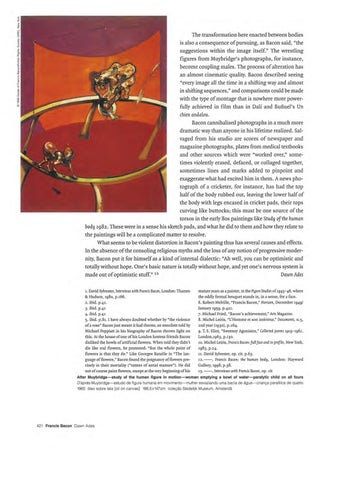
The transformation here enacted between !1odies is also a consequence of pursuing, as Bacon said, "the suggestions within the image itsel(" The wrestling figures fram Muybridge's photographs, for instance, become coupling males. The pracess of alteration has an almost cinematic quality. Bacon described seeing "every image all the time in a shifting way and almost in shifting sequences," and comparisons could be made with the type of montage that is nowhere more powerfully achieved in film than in Dalí and Bunuel's Un chíen andalou. Bacon cannibalised photographs in a much more dramatic way than anyone in his lifetime realized. Salvaged fram his studio are scores of newspaper and magazine photographs, plates fram medical textbooks and other sources which were "worked over," sometimes violently erased, defaced, or collaged together, sometimes lines and marks added to pinpoint and exaggerate what had excited him in them. A news photograph of a cricketer, for instance, has had the top half of the body rubbed out, leaving the lower half of the body with legs encased in cricket pads, their tops curving like buttocks; this must be one source of the torsos in the early 80S paintings like Study ofthe human body I982. These were in a sense his sketch pads, and what he did to them and how they relate to the paintings will be a complicated matter to resolve. What seems to be violent distortion in Bacon's painting thus has several causes and effects. ln the absence of the consoling religious myths and the loss of any notion of pragressive mo dernity, Bacon put it for himself as a kind of internal dialectic: "Ah well, you can be optimistic and totally without hope. One's basic nature is totally without hope, and yet one's nervous system is made out of optimistic stuf(" 13 Dawn Ades I.
David Sylvester, Interviews with Francis Bacon, London: Thames
& Hudson, 1980, p.166.
2. ibid. P.41. 3. ibid. P·4 1 4. ibid. P·4 1 5. ibid. p.81. I have always doubted whether by "the violence of a rose" Bacon just meant it had thornsj an anecdote told by Michael Peppiatt in his biography of Bacon throws light on this. At the house of one ofhis London hostess friends Bacon disliked the bowls of artificial flowers. When told they didn' t die like real flowers, he protested: "But the whole point of flowers is that they die." Like Georges Bataille in "The language offlowers," Bacon found the poignancy offlowers precisely in their mortality ("tatters of aerial manure") . He did not of course paint flowers, except at the very beginning ofhis
mature years as a painter, in the Figure Studies of1945-46, where the oddly formal bouquet stands in, in a sense, for a face. 6. Robert Melville, "Francis Bacon," Horizon, December 19491 January 1959, P·4 21. 7. Michael Fried, "Bacon's achievement," Arts Magazine. 8. Michel Leiris, "L'Homme et son interieur," Documents, n.s , 2nd year (1930), P.264. 9. T. S. Eliot, "Sweeney Agonistes," Collected poems 19°9-1962, London,1963, P·13 0. 10. Michel Leiris, Francis Bacon:fullface and in profíle, New York, 19 8 3, P·24· .II. David Sylvester, op. cito p.63. 12. - - , Francis Bacon: the human body , London: Hayward Gallery, 1998, P.38. 13. - - , Interviews with Francis Bacon, op. cit
After Muybridge-study of the human figure in motion-woman emptying a bowl of water-paralytic child on ali fours O'apres Muybridge- estudo de figura humana em movimento-mulher esvaziando uma bacia de água-criança paralítica de quatro 1965 óleo sobre tela [oil on canvas] 198,5x147cm coleção Stedelijk Museum , Amsterdã
421 Francis Bacon Dawn Ades