a loyal following of fans who will be excited for new offerings [in the category].” Henry also said that the product line is designed to match what customers currently drink in Dunkin’ restaurants. “Dunkin’ RTD coffee will be marketed to the general population as a rich, smooth RTD coffee beverage that can be enjoyed throughout the day,” he said. By expanding the brand’s penetration into conventional groceries and convenience stores, Dunkin’ is solidifying its position as an overall leader in the coffee category. But even in partnering with the world’s largest beverage company, the brand will face the daunting challenge of knocking Starbucks from its perch at the top of the RTD coffee market. The PepsiCo/Starbucks North American Coffee Partnership, which has been selling bottled products like Starbucks Frappuccino and Doubleshot since 1994, holds a 97 percent share of the category. Starbucks cited high income from the Partnership as a primary driver of higher operating margins in its Q4 2016 earnings report. Nicole Regan Miller, a managing director and senior research analyst at Piper Jaffray who covers Starbucks, said that Dunkin’s management structure has made its ability to catch up with its rival in the RTD category more challenging. As part of the agreement, CocaCola will pay Dunkin’ a fee that will be divided between the corporation and the individual franchisees that operate its retail stores in order to cover potential sales lost to bottled products. “The reason that Dunkin’s time frame is different is its operating model is different,” Miller told BevNET. “With a 100 percent franchise model, there’s a lot more things that have to be worked out. That is your partner that you have to go and promote to them how it’s not going to cannibalize anything they are doing and that they work hard for day in and day out in the stores they are running.” Sean Naughton, a senior research analyst in the consumer sector at Piper Jaffray, said Dunkin’s strong brand loyalty would translate well into the RTD market. “Another brand with high affinity with consumers, coming in there with backing from Coke, I think is going to be mildly disruptive,” Naughton said. “Dunkin’ clearly has a very strong brand. Starbucks is really the 800 lb. gorilla in that particular segment, but I think Dunkin could have an impact.”
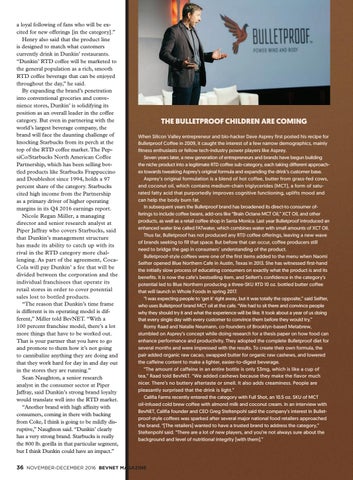
THE BULLETPROOF CHILDREN ARE COMING When Silicon Valley entrepreneur and bio-hacker Dave Asprey first posted his recipe for Bulletproof Coffee in 2009, it caught the interest of a few narrow demographics, mainly fitness enthusiasts or fellow tech-industry power players like Asprey. Seven years later, a new generation of entrepreneurs and brands have begun building the niche product into a legitimate RTD coffee sub-category, each taking different approaches towards tweaking Asprey’s original formula and expanding the drink’s customer base. Asprey’s original formulation is a blend of hot coffee, butter from grass-fed cows, and coconut oil, which contains medium-chain triglycerides (MCT), a form of saturated fatty acid that purportedly improves cognitive functioning, uplifts mood and can help the body burn fat. In subsequent years the Bulletproof brand has broadened its direct-to consumer offerings to include coffee beans, add-ons like “Brain Octane MCT Oil,” XCT Oil, and other products, as well as a retail coffee shop in Santa Monica. Last year Bulletproof introduced an enhanced water line called FATwater, which combines water with small amounts of XCT Oil. Thus far, Bulletproof has not produced any RTD coffee offerings, leaving a new wave of brands seeking to fill that space. But before that can occur, coffee producers still need to bridge the gap in consumers’ understanding of the product. Bulletproof-style coffees were one of the first items added to the menu when Naomi Seifter opened Blue Northern Cafe in Austin, Texas in 2013. She has witnessed first-hand the initially slow process of educating consumers on exactly what the product is and its benefits. It is now the cafe’s bestselling item, and Seifert’s confidence in the category’s potential led to Blue Northern producing a three-SKU RTD 10 oz. bottled butter coffee that will launch in Whole Foods in spring 2017. “I was expecting people to ‘get it’ right away, but it was totally the opposite,” said Seifter, who uses Bulletproof brand MCT oil at the cafe. “We had to sit there and convince people why they should try it and what the experience will be like. It took about a year of us doing that every single day with every customer to convince them before they would try.” Romy Raad and Natalie Neumann, co-founders of Brooklyn-based Metabrew, stumbled on Asprey’s concept while doing research for a thesis paper on how food can enhance performance and productivity. They adopted the complete Bulletproof diet for several months and were impressed with the results. To create their own formula, the pair added organic raw cacao, swapped butter for organic raw cashews, and lowered the caffeine content to make a lighter, easier-to-digest beverage. “The amount of caffeine in an entire bottle is only 53mg, which is like a cup of tea,” Raad told BevNET. “We added cashews because they make the flavor much nicer. There’s no buttery aftertaste or smell. It also adds creaminess. People are pleasantly surprised that the drink is light.” Califia Farms recently entered the category with Full Shot, an 10.5 oz. SKU of MCT oil-infused cold brew coffee with almond milk and coconut cream. In an interview with BevNET, Califia founder and CEO Greg Steltenpohl said the company’s interest in Bulletproof-style coffees was sparked after several major national food retailers approached the brand. “[The retailers] wanted to have a trusted brand to address the category,” Steltenpohl said. “There are a lot of new players, and you’re not always sure about the background and level of nutritional integrity [with them].”
36 NOVEMBER-DECEMBER 2016 BEVNET MAGAZINE