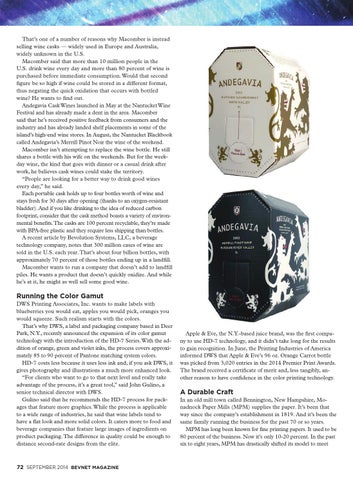
That’s one of a number of reasons why Macomber is instead selling wine casks — widely used in Europe and Australia, widely unknown in the U.S. Macomber said that more than 10 million people in the U.S. drink wine every day and more than 80 percent of wine is purchased before immediate consumption. Would that second figure be so high if wine could be stored in a different format, thus negating the quick oxidation that occurs with bottled wine? He wants to find out. Andegavia Cask Wines launched in May at the Nantucket Wine Festival and has already made a dent in the area. Macomber said that he’s received positive feedback from consumers and the industry and has already landed shelf placements in some of the island’s high-end wine stores. In August, the Nantucket Blackbook called Andegavia’s Merrill Pinot Noir the wine of the weekend. Macomber isn’t attempting to replace the wine bottle. He still shares a bottle with his wife on the weekends. But for the weekday wine, the kind that goes with dinner or a casual drink after work, he believes cask wines could stake the territory. “People are looking for a better way to drink good wines every day,” he said. Each portable cask holds up to four bottles worth of wine and stays fresh for 30 days after opening (thanks to an oxygen-resistant bladder). And if you like drinking to the idea of reduced carbon footprint, consider that the cask method boasts a variety of environmental benefits. The casks are 100 percent recyclable, they’re made with BPA-free plastic and they require less shipping than bottles. A recent article by Bevolution Systems, LLC, a beverage technology company, notes that 300 million cases of wine are sold in the U.S. each year. That’s about four billion bottles, with approximately 70 percent of those bottles ending up in a landfill. Macomber wants to run a company that doesn’t add to landfill piles. He wants a product that doesn’t quickly oxidize. And while he’s at it, he might as well sell some good wine.
Running the Color Gamut DWS Printing Associates, Inc. wants to make labels with blueberries you would eat, apples you would pick, oranges you would squeeze. Such realism starts with the colors. That’s why DWS, a label and packaging company based in Deer Park, N.Y., recently announced the expansion of its color gamut technology with the introduction of the HD-7 Series. With the addition of orange, green and violet inks, the process covers approximately 85 to 90 percent of Pantone matching system colors. HD-7 costs less because it uses less ink and, if you ask DWS, it gives photography and illustrations a much more enhanced look. “For clients who want to go to that next level and really take advantage of the process, it’s a great tool,” said John Gulino, a senior technical director with DWS. Gulino said that he recommends the HD-7 process for packages that feature more graphics. While the process is applicable to a wide range of industries, he said that wine labels tend to have a flat look and more solid colors. It caters more to food and beverage companies that feature large images of ingredients on product packaging. The difference in quality could be enough to distance second-rate designs from the elite.
72 SEPTEMBER 2014 BEVNET MAGAZINE
Apple & Eve, the N.Y.-based juice brand, was the first company to use HD-7 technology, and it didn’t take long for the results to gain recognition. In June, the Printing Industries of America informed DWS that Apple & Eve’s 96 oz. Orange Carrot bottle was picked from 3,020 entries in the 2014 Premier Print Awards. The brand received a certificate of merit and, less tangibly, another reason to have confidence in the color printing technology.
A Durable Craft In an old mill town called Bennington, New Hampshire, Monadnock Paper Mills (MPM) supplies the paper. It’s been that way since the company’s establishment in 1819. And it’s been the same family running the business for the past 70 or so years. MPM has long been known for fine printing papers. It used to be 80 percent of the business. Now it’s only 10-20 percent. In the past six to eight years, MPM has drastically shifted its model to meet