million barrels, compared to 2018, according to the Beer Institute (BI), which cited unofficial estimates of domestic tax paid shipments from the Alcohol and Tobacco Tax and Trade Bureau (TTB). The slowdown had already steered many craft brewers toward “authentic alternatives” to their core offerings, as The Lost Abbey’s Tomme Arthur called it during last year’s Brewbound Live business conference. For Arthur, that alternative was a line of canned live sour beers called Tiny Bubbles. “We cannot for a moment think there’s enough white space to innovate our way out of this funk,” he said at the time. “If we’re going to turn the proverbial corner, we’re going to need new consumers. I’m doubtful that this is news to any of you.” For hundreds of craft brewers that search has transformed their portfolios beyond beer alone in an effort to capture a piece of the hard seltzer category, which has been projected to top $4 billion in 2020. Nevertheless, more than 75% of the
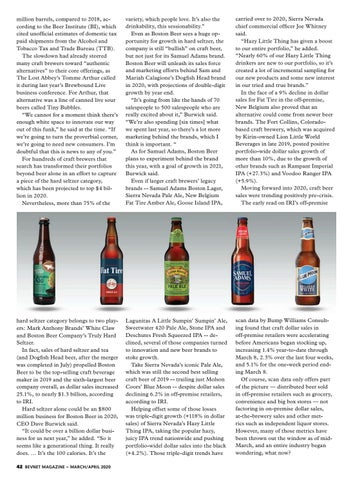
variety, which people love. It’s also the drinkability, this sessionability.” Even as Boston Beer sees a huge opportunity for growth in hard seltzer, the company is still “bullish” on craft beer, but not just for its Samuel Adams brand. Boston Beer will unleash its sales force and marketing efforts behind Sam and Mariah Calagione’s Dogfish Head brand in 2020, with projections of double-digit growth by year end. “It’s going from like the hands of 70 salespeople to 500 salespeople who are really excited about it,” Burwick said. “We’re also spending [six times] what we spent last year, so there’s a lot more marketing behind the brands, which I think is important. “ As for Samuel Adams, Boston Beer plans to experiment behind the brand this year, with a goal of growth in 2021, Burwick said. Even if larger craft brewers’ legacy brands -- Samuel Adams Boston Lager, Sierra Nevada Pale Ale, New Belgium Fat Tire Amber Ale, Goose Island IPA,
carried over to 2020, Sierra Nevada chief commercial officer Joe Whitney said. “Hazy Little Thing has given a boost to our entire portfolio,” he added. “Nearly 60% of our Hazy Little Thing drinkers are new to our portfolio, so it’s created a lot of incremental sampling for our new products and some new interest in our tried and true brands.” In the face of a 9% decline in dollar sales for Fat Tire in the off-premise, New Belgium also proved that an alternative could come from newer beer brands. The Fort Collins, Coloradobased craft brewery, which was acquired by Kirin-owned Lion Little World Beverages in late 2019, posted positive portfolio-wide dollar sales growth of more than 10%, due to the growth of other brands such as Rampant Imperial IPA (+27.3%) and Voodoo Ranger IPA (+5.9%). Moving forward into 2020, craft beer sales were trending positively pre-crisis. The early read on IRI’s off-premise
hard seltzer category belongs to two players: Mark Anthony Brands’ White Claw and Boston Beer Company’s Truly Hard Seltzer. In fact, sales of hard seltzer and tea (and Dogfish Head beer, after the merger was completed in July) propelled Boston Beer to be the top-selling craft beverage maker in 2019 and the sixth-largest beer company overall, as dollar sales increased 25.1%, to nearly $1.3 billion, according to IRI. Hard seltzer alone could be an $800 million business for Boston Beer in 2020, CEO Dave Burwick said. “It could be over a billion dollar business for us next year,” he added. “So it seems like a generational thing. It really does. … It’s the 100 calories. It’s the
Lagunitas A Little Sumpin’ Sumpin’ Ale, Sweetwater 420 Pale Ale, Stone IPA and Deschutes Fresh Squeezed IPA -- declined, several of those companies turned to innovation and new beer brands to stoke growth. Take Sierra Nevada’s iconic Pale Ale, which was still the second best selling craft beer of 2019 -- trailing just Molson Coors’ Blue Moon -- despite dollar sales declining 6.2% in off-premise retailers, according to IRI. Helping offset some of those losses was triple-digit growth (+118% in dollar sales) of Sierra Nevada’s Hazy Little Thing IPA, taking the popular hazy, juicy IPA trend nationwide and pushing portfolio-widel dollar sales into the black (+4.2%). Those triple-digit trends have
scan data by Bump Williams Consulting found that craft dollar sales in off-premise retailers were accelerating before Americans began stocking up, increasing 1.4% year-to-date through March 8, 2.3% over the last four weeks, and 5.1% for the one-week period ending March 8. Of course, scan data only offers part of the picture — distributed beer sold in off-premise retailers such as grocery, convenience and big box stores — not factoring in on-premise dollar sales, at-the-brewery sales and other metrics such as independent liquor stores. However, many of those metrics have been thrown out the window as of midMarch, and an entire industry began wondering, what now?
42 BEVNET MAGAZINE – MARCH/APRIL 2020