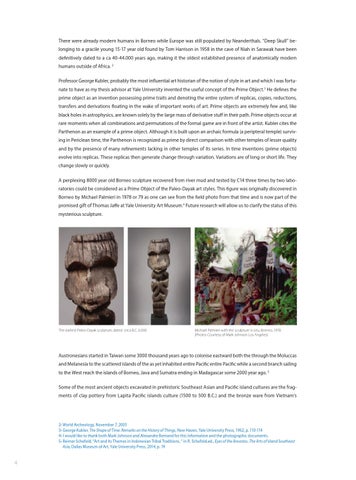
There were already modern humans in Borneo while Europe was still populated by Neanderthals. “Deep Skull” belonging to a gracile young 15-17 year old found by Tom Harrison in 1958 in the cave of Niah in Sarawak have been definitively dated to a ca 40-44.000 years ago, making it the oldest established presence of anatomically modern humans outside of Africa. 2 Professor George Kubler, probably the most influential art historian of the notion of style in art and which I was fortunate to have as my thesis advisor at Yale University invented the useful concept of the Prime Object. 3 He defines the prime object as an invention possessing prime traits and denoting the entire system of replicas, copies, reductions, transfers and derivations floating in the wake of important works of art. Prime objects are extremely few and, like black holes in astrophysics, are known solely by the large mass of derivative stuff in their path. Prime objects occur at rare moments when all combinations and permutations of the formal game are in front of the artist. Kubler cites the Parthenon as an example of a prime object. Although it is built upon an archaic formula (a peripteral temple) surviving in Periclean time, the Parthenon is recognized as prime by direct comparison with other temples of lesser quality and by the presence of many refinements lacking in other temples of its series. In time inventions (prime objects) evolve into replicas. These replicas then generate change through variation. Variations are of long or short life. They change slowly or quickly. A perplexing 8000 year old Borneo sculpture recovered from river mud and tested by C14 three times by two laboratories could be considered as a Prime Object of the Paleo-Dayak art styles. This figure was originally discovered in Borneo by Michael Palmieri in 1978 or 79 as one can see from the field photo from that time and is now part of the promised gift of Thomas Jaffe at Yale University Art Museum.4 Future research will allow us to clarify the status of this mysterious sculpture.
The earliest Paleo-Dayak sculpture, dated circa B.C. 6.000
Michael Palmieri with the sculpture in situ, Borneo, 1978. (Photos Courtesy of Mark Johnson Los Angeles)
Austronesians started in Taiwan some 3000 thousand years ago to colonise eastward both the through the Moluccas and Melanesia to the scattered islands of the as yet inhabited entire Pacific entire Pacific while a second branch sailing to the West reach the islands of Borneo, Java and Sumatra ending in Madagascar some 2000 year ago. 5 Some of the most ancient objects excavated in prehistoric Southeast Asian and Pacific island cultures are the fragments of clay pottery from Lapita Pacific islands culture (1500 to 500 B.C.) and the bronze ware from Vietnam’s
2• W orld Archeology, November 7, 2003 3• George Kubler, The Shape of Time. Remarks on the History of Things, New Haven, Yale University Press, 1962, p. 110-114 4• I would like to thank both Mark Johnson and Alexandre Bernand for this information and the photographic documents. 5• R eimar Schefold, “Art and its Themes in Indonesian Tribal Traditions, “ in R. Schefold,ed., Eyes of the Ancestos. The Arts of Island Southeast Asia, Dallas Museum of Art, Yale University Press, 2014, p. 19
4