THREE STUDENT ACTION FIGURES
FAST FORWARD “T
here is much optimism to be divined from Tunisia,” says Riddhi Sohan Dasgupta ’16. Gregarious and thoughtful, Dasgupta is the very person you’d want to speak with about the budding democracy that gave the first hints of Arab Spring. While completing his doctorate in international law at Cambridge in 2013, Dasgupta was tapped to be senior advisor to the Wilberforce Society, a student-run political think tank. At age 28, he led 35 lawyers, politicians, social scientists, and other stakeholders in drafting a proposed constitutional framework for Tunisia and submitting it to the nation’s Constituent Assembly. “We had this extraordinary team striving in unison to contribute to Tunisia,” Dasgupta says. “Many team members suspended their lives, took risks on their careers, and lived apart from their families for months for that far-from-certain prospect.” Dasgupta met with representatives of Tunisian politics and civil society, including the Constituent Assembly’s president. Last year, the country finalized and adopted its constitution, which has been hailed as a model for other transitional democracies. It features progressive provisions codifying equal rights for
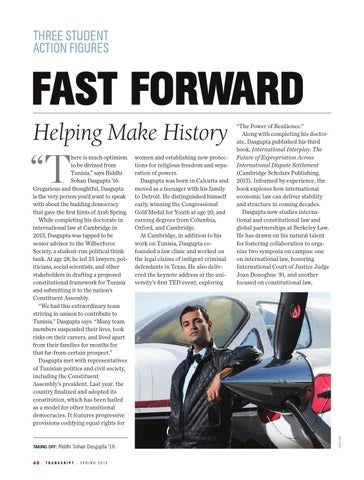
TAKING OFF:
46
Riddhi Sohan Dasgupta ’16
| TRANSCRIPT | SPRING 2015
women and establishing new protections for religious freedom and separation of powers. Dasgupta was born in Calcutta and moved as a teenager with his family to Detroit. He distinguished himself early, winning the Congressional Gold Medal for Youth at age 20, and earning degrees from Columbia, Oxford, and Cambridge. At Cambridge, in addition to his work on Tunisia, Dasgupta cofounded a law clinic and worked on the legal claims of indigent criminal defendants in Texas. He also delivered the keynote address at the university’s first TED event, exploring
JIM BLOCK
Helping Make History
“The Power of Resilience.” Along with completing his doctorate, Dasgupta published his third book, International Interplay: The Future of Expropriation Across International Dispute Settlement (Cambridge Scholars Publishing, 2013). Informed by experience, the book explores how international economic law can deliver stability and structure in coming decades. Dasgupta now studies international and constitutional law and global partnerships at Berkeley Law. He has drawn on his natural talent for fostering collaboration to organize two symposia on campus: one on international law, honoring International Court of Justice Judge Joan Donoghue ’81, and another focused on constitutional law,