University School of Law, where she also served as associate dean for research. Her current scholarship focuses on the legal design of proprietary entitlements and their distributional effects. “What are the factors behind who becomes included and excluded from law-related protections?” she says, explaining her interests. “In examining gender, sexuality, and other social justice issues, how do these areas intersect with technology and property frameworks, including intellectual and cultural property law?” Katyal comes to Berkeley Law through a national search conducted by the Haas Institute for a Fair and Inclusive Society LGBTQ Cluster. She will teach courses on gender and sexuality, trademark law, property law, and international intellectual property. Her scholarly work focuses on intellectual property, civil rights, artistic freedom, advertising, and innovation. Katyal’s past projects have studied the relationship between copyright enforcement and privacy as applied to new media, and the intersection between civil disobedience and innovation in property and intellectual property frameworks. Some of her honors include winning the Dukeminier Award, which recognizes the best legal scholarship on sexual orientation, and Yale’s Cybercrime Writing Competition. She also won the Andy Warhol Foundation’s Creative Capital Award—the first law professor to receive a grant devoted to writing on the visual arts and law. “As a woman of color, I know firsthand how important it is to have accessible faculty, so I try to be available to my students as much as possible,” she says. “They inspire me to get up every morning—to write, teach, and share ideas— and it’s an honor to support their work in return.”
Dylan C. Penningroth — Increasingly heated
discussions about race in America over the past year are no surprise to Penningroth, who specializes in African-American and U.S. socio-legal history. “Issues of race, rights, and unequal treatment have long been simmering in this country,” he says. “As a historian, it’s my job to take the long view. And with respect to African-American experiences in the courts, the way people talk about these issues is deeply influenced by a legal language that goes back centuries.” A history professor at Northwestern University since 2003, Penningroth will have
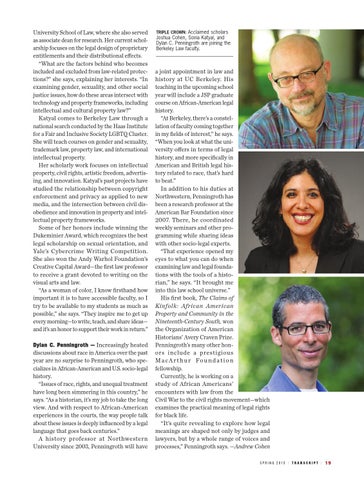
Acclaimed scholars Joshua Cohen, Sonia Katyal, and Dylan C. Penningroth are joining the Berkeley Law faculty.
TRIPLE CROWN:
a joint appointment in law and history at UC Berkeley. His teaching in the upcoming school year will include a JSP graduate course on African-American legal history. “At Berkeley, there’s a constellation of faculty coming together in my fields of interest,” he says. “When you look at what the university offers in terms of legal history, and more specifically in American and British legal history related to race, that’s hard to beat.” In addition to his duties at Northwestern, Penningroth has been a research professor at the American Bar Foundation since 2007. There, he coordinated weekly seminars and other programming while sharing ideas with other socio-legal experts. “That experience opened my eyes to what you can do when examining law and legal foundations with the tools of a historian,” he says. “It brought me into this law school universe.” His first book, The Claims of Kinfolk: African American Property and Community in the Nineteenth-Century South, won the Organization of American Historians’ Avery Craven Prize. Penningroth’s many other honors include a prestigious M a c A r t h u r Fo u n d a t i o n fellowship. Currently, he is working on a study of African Americans’ encounters with law from the Civil War to the civil rights movement—which examines the practical meaning of legal rights for black life. “It’s quite revealing to explore how legal meanings are shaped not only by judges and lawyers, but by a whole range of voices and processes,” Penningroth says. —Andrew Cohen S P R I N G 2015 | T R A N S C R I P T |
19