12
ENGINEERING A FIRST WORLD
Introduction
13
INTRODUCTION
A TRADITION of NOBILITY
T
hree years after landing in Singapore, Thomas Stamford Raffles appointed Philip Jackson as Singapore’s first official engineer in 1822 to remodel and rebuild the island. Construction of a town by the Singapore River began in earnest soon afterwards and among those built by 1827 was the courthouse. It became Parliament House in 1959 before it was converted into The Art House in 2004. This national monument, one of the earliest buildings still standing today, showcases the enduring work of engineers in transforming Singapore from a colonial outpost into an urban nation.
IES Book_20180302_bookblock_FA.indd 12-13
The early years also saw engineers developing a world-class harbour that transformed the island into a global seaport. Telephones were installed in 1879, followed by electrical power 27 years later in 1906. They also ensured water supply was sufficient for a growing population through the construction of MacRitchie and Peirce reservoirs between 1860 and 1910. After the Causeway was built in 1927, pipes were laid on it to give Singapore access to water from Johor. The transformation of the island through daring and innovative engineering went on unabated into the 20th and 21st centuries.
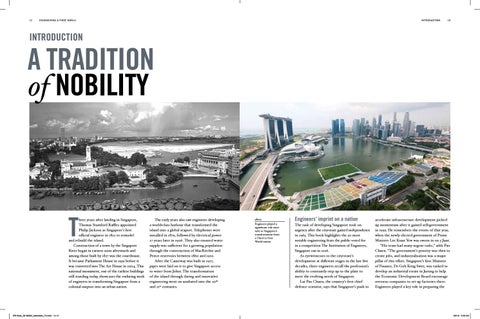
above: Engineers played a significant role since 1965 in Singapore’s transformation from a Third to First World nation
Engineers’ imprint on a nation The task of developing Singapore took on urgency after the city-state gained independence in 1965. This book highlights the 50 most notable engineering feats the public voted for in a competition The Institution of Engineers, Singapore ran in 2016. As eyewitnesses to the city-state’s development at different stages in the last five decades, three engineers recall the profession’s ability to constantly step up to the plate to meet the evolving needs of Singapore. Lui Pao Chuen, the country’s first chief defence scientist, says that Singapore’s push to
accelerate infrastructure development picked up momentum after it gained self-government in 1959. He remembers the events of that year, when the newly elected government of Prime Minister Lee Kuan Yew was sworn in on 5 June. “His team had many urgent tasks,” adds Pao Chuen. “The government’s priority was then to create jobs, and industrialisation was a major pillar of this effort. Singapore’s first Minister of Finance, Dr Goh Keng Swee, was tasked to develop an industrial estate in Jurong to help the Economic Development Board encourage overseas companies to set up factories there. Engineers played a key role in preparing the
3/3/18 9:20 AM