PEST PLANT OF THE MONTH: WOOLLY NIGHTSHADE
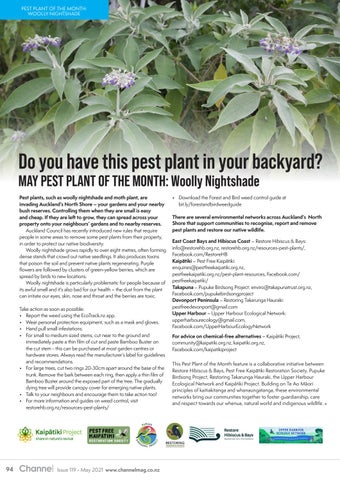
Do you have this pest plant in your backyard? MAY PEST PLANT OF THE MONTH: Woolly Nightshade Pest plants, such as woolly nightshade and moth plant, are invading Auckland’s North Shore – your gardens and your nearby bush reserves. Controlling them when they are small is easy and cheap. If they are left to grow, they can spread across your property onto your neighbours’ gardens and to nearby reserves. Auckland Council has recently introduced new rules that require people in some areas to remove some pest plants from their property, in order to protect our native biodiversity. Woolly nightshade grows rapidly to over eight metres, often forming dense stands that crowd out native seedlings. It also produces toxins that poison the soil and prevent native plants regenerating. Purple flowers are followed by clusters of green-yellow berries, which are spread by birds to new locations. Woolly nightshade is particularly problematic for people because of its awful smell and it's also bad for our health – the dust from the plant can irritate our eyes, skin, nose and throat and the berries are toxic. Take action as soon as possible: • Report the weed using the EcoTrack.nz app. • Wear personal protection equipment, such as a mask and gloves. • Hand pull small infestations. • For small to medium sized stems, cut near to the ground and immediately paste a thin film of cut and paste Bamboo Buster on the cut stem - this can be purchased at most garden centres or hardware stores. Always read the manufacturer’s label for guidelines and recommendations. • For large trees, cut two rings 20-30cm apart around the base of the trunk. Remove the bark between each ring, then apply a thin film of Bamboo Buster around the exposed part of the tree. The gradually dying tree will provide canopy cover for emerging native plants. • Talk to your neighbours and encourage them to take action too! • For more information and guides on weed control, visit restorehb.org.nz/resources-pest-plants/
94
Issue 119 - May 2021 www.channelmag.co.nz
• Download the Forest and Bird weed control guide at bit.ly/forestandbirdweedguide There are several environmental networks across Auckland’s North Shore that support communities to recognise, report and remove pest plants and restore our native wildlife. East Coast Bays and Hibiscus Coast – Restore Hibiscus & Bays: info@restorehb.org.nz, restorehb.org.nz/resources-pest-plants/, Facebook.com/RestoreHB Kaipātiki – Pest Free Kaipātiki: enquiries@pestfreekaipatiki.org.nz, pestfreekaipatiki.org.nz/pest-plant-resources, Facebook.com/ pestfreekaipatiki/ Takapuna – Pupuke Birdsong Project: enviro@takapunatrust.org.nz, Facebook.com/pupukebirdsongproject Devonport Peninsula – Restoring Takarunga Hauraki: pestfreedevonport@gmail.com Upper Harbour – Upper Harbour Ecological Network: upperharbourecology@gmail.com, Facebook.com/UpperHarbourEcologyNetwork For advice on chemical-free alternatives – Kaipātiki Project, community@kaipatiki.org.nz, kaipatiki.org.nz, Facebook.com/kaipatikiproject This Pest Plant of the Month feature is a collaborative initiative between Restore Hibiscus & Bays, Pest Free Kaipātiki Restoration Society, Pupuke Birdsong Project, Restoring Takarunga Hauraki, the Upper Harbour Ecological Network and Kaipātiki Project. Building on Te Ao Māori principles of kaitiakitanga and whanaungatanga, these environmental networks bring our communities together to foster guardianship, care and respect towards our whenua, natural world and indigenous wildlife.