for art’s sake
an inside job The restoration of historic Bendigo Town Hall wasn’t a job for the faint-hearted. - Ken Turnbull
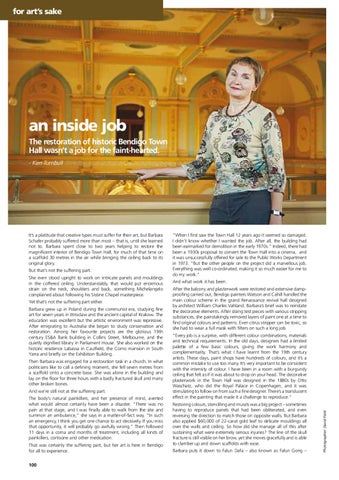
But that’s not the suffering part. She even stood upright to work on intricate panels and mouldings in the coffered ceiling. Understandably, that would put enormous strain on the neck, shoulders and back, something Michelangelo complained about following his Sistine Chapel masterpiece. Yet that’s not the suffering part either. Barbara grew up in Poland during the communist era, studying fine art for seven years in Wroclaw and the ancient capital of Krakow. The education was excellent but the artistic environment was repressive. After emigrating to Australia she began to study conservation and restoration. Among her favourite projects are the glorious 19th century ES&A Bank building in Collins Street, Melbourne, and the quietly dignified library in Parliament House. She also worked on the historic residence Labassa in Caulfield, the Como mansion in South Yarra and briefly on the Exhibition Building. Then Barbara was engaged for a restoration task in a church. In what politicians like to call a defining moment, she fell seven metres from a scaffold onto a concrete base. She was alone in the building and lay on the floor for three hours with a badly fractured skull and many other broken bones. And we’re still not at the suffering part. The body’s natural painkillers, and her presence of mind, averted what would almost certainly have been a disaster. “There was no pain at that stage, and I was finally able to walk from the site and summon an ambulance,” she says in a matter-of-fact way. “In such an emergency, I think you get one chance to act decisively. If you miss that opportunity, it will probably go awfully wrong.” Then followed 11 days in a coma and months of treatment, including all kinds of painkillers, cortisone and other medication. That was certainly the suffering part, but her art is here in Bendigo for all to experience. 100
“When I first saw the Town Hall 12 years ago it seemed so damaged. I didn’t know whether I wanted the job. After all, the building had been earmarked for demolition in the early 1970s.” Indeed, there had been a 1930s proposal to convert the Town Hall into a cinema, and it was unsuccessfully offered for sale to the Public Works Department in 1973. “But the other people on the project did a marvellous job. Everything was well co-ordinated, making it so much easier for me to do my work.” And what work it has been. After the balcony and plasterwork were restored and extensive dampproofing carried out, Bendigo painters Watson and Cahill handled the main colour scheme in the grand Renaissance revival hall designed by architect William Charles Vahland. Barbara’s brief was to reinstate the decorative elements. After doing test pieces with various stripping substances, she painstakingly removed layers of paint one at a time to find original colours and patterns. Even citrus stripper can be toxic, so she had to wear a full mask with filters on such a long job. “Every job is a surprise, with different colour combinations, materials and technical requirements. In the old days, designers had a limited palette of a few basic colours, giving the work harmony and complementarity. That’s what I have learnt from the 19th century artists. These days, paint shops have hundreds of colours, and it’s a common mistake to use too many. It’s very important to be consistent with the intensity of colour. I have been in a room with a burgundy ceiling that felt as if it was about to drop on your head. The decorative plasterwork in the Town Hall was designed in the 1880s by Otto Waschatz, who did the Royal Palace in Copenhagen, and it was stimulating to follow on from such a fine designer. There’s a translucent effect in the painting that made it a challenge to reproduce.” Restoring colours, stencilling and murals was a big project – sometimes having to reproduce panels that had been obliterated, and even reversing the direction to match those on opposite walls. But Barbara also applied $60,000 of 22-carat gold leaf to delicate mouldings all over the walls and ceiling. So how did she manage all of this after sustaining what were extremely serious injuries? The line of the skull fracture is still visible on her brow, yet she moves gracefully and is able to clamber up and down scaffolds with ease. Barbara puts it down to Falun Dafa – also known as Falun Gong –
Photographer: David Field
It’s a platitude that creative types must suffer for their art, but Barbara Schafer probably suffered more than most – that is, until she learned not to. Barbara spent close to two years helping to restore the magnificent interior of Bendigo Town Hall, for much of that time on a scaffold 30 metres in the air while bringing the ceiling back to its original glory.