EXPOSITION
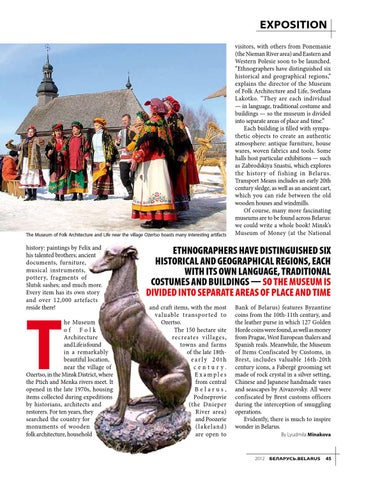
The Museum of Folk Architecture and Life near the village Ozertso boasts many interesting artifacts
history: paintings by Felix and his talented brothers; ancient documents, furniture, musical instruments, pottery, fragments of Slutsk sashes; and much more. Every item has its own story and over 12,000 artefacts reside there!
T
he Museum of Folk Architecture and Life is found in a remarkably beautiful location, near the village of Ozertso, in the Minsk District, where the Ptich and Menka rivers meet. It opened in the late 1970s, housing items collected during expeditions by historians, architects and restorers. For ten years, they searched the country for monuments of wooden folk architecture, household
visitors, with others from Ponemanie (the Nieman River area) and Eastern and Western Polesie soon to be launched. “Ethnographers have distinguished six historical and geographical regions,” explains the director of the Museum of Folk Architecture and Life, Svetlana Lakotko. “They are each individual — in language, traditional costume and buildings — so the museum is divided into separate areas of place and time.” Each building is filled with sympathetic objects to create an authentic atmosphere: antique furniture, house wares, woven fabrics and tools. Some halls host particular exhibitions — such as Zabrodskіya Snastsi, which explores the history of fishing in Belarus. Transport Means includes an early 20th century sledge, as well as an ancient cart, which you can ride between the old wooden houses and windmills. Of course, many more fascinating museums are to be found across Belarus: we could write a whole book! Minsk’s Museum of Money (at the National
Ethnographers have distinguished six historical and geographical regions, each with its own language, traditional costumes and buildings — so the museum is divided into separate areas of place and time and craft items, with the most valuable transpor ted to Ozertso. The 150 hectare site re cre ates vi l lages, towns and farms of the late 18thearly 20th c e ntu r y. Examples from central Belarus, Podneprovie (the Dnieper River area) and Poozerie ( l a ke l an d ) are open to
Bank of Belarus) features Byzantine coins from the 10th-11th century, and the leather purse in which 127 Golden Horde coins were found, as well as money from Prague, West European thalers and Spanish reals. Meanwhile, the Museum of Items Confiscated by Customs, in Brest, includes valuable 16th-20th century icons, a Fabergé grooming set made of rock crystal in a silver setting, Chinese and Japanese handmade vases and seascapes by Aivazovsky. All were confiscated by Brest customs officers during the interception of smuggling operations. Evidently, there is much to inspire wonder in Belarus. By Lyudmila Minakova
2012 беларусь.belarus
45