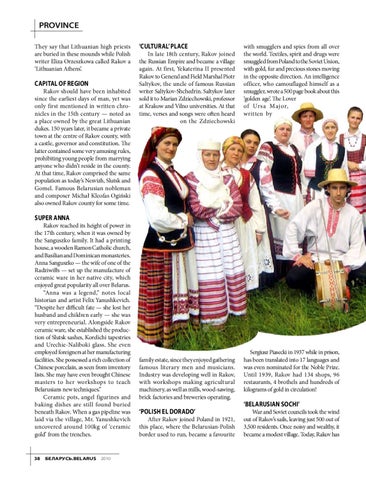
Province They say that Lithuanian high priests are buried in these mounds while Polish writer Eliza Orzeszkowa called Rakov a ‘Lithuanian Athens’.
Capital of region
Rakov should have been inhabited since the earliest days of man, yet was only first mentioned in written chronicles in the 15th century — noted as a place owned by the great Lithuanian dukes. 150 years later, it became a private town at the centre of Rakov county, with a castle, governor and constitution. The latter contained some very amusing rules, prohibiting young people from marrying anyone who didn’t reside in the county. At that time, Rakov comprised the same population as today’s Nesvizh, Slutsk and Gomel. Famous Belarusian nobleman and composer Michał Kleofas Ogiński also owned Rakov county for some time.
‘Cultural’ place
In late 18th century, Rakov joined the Russian Empire and became a village again. At first, Yekaterina II presented Rakov to General and Field Marshal Piotr Saltykov, the uncle of famous Russian writer Saltykov-Shchedrin. Saltykov later sold it to Marian Zdziechowski, professor at Krakow and Vilno universities. At that time, verses and songs were often heard on the Zdziechowski
with smugglers and spies from all over the world. Textiles, spirit and drugs were smuggled from Poland to the Soviet Union, with gold, fur and precious stones moving in the opposite direction. An intelligence officer, who camouflaged himself as a smuggler, wrote a 500 page book about this ‘golden age’. The Lover of Ursa Major, written by
Super Anna
Rakov reached its height of power in the 17th century, when it was owned by the Sanguszko family. It had a printing house, a wooden Ramon Catholic church, and Basilian and Dominican monasteries. Anna Sanguszko — the wife of one of the Radziwiłłs — set up the manufacture of ceramic ware in her native city, which enjoyed great popularity all over Belarus. “Anna was a legend,” notes local historian and artist Felix Yanushkevich. “Despite her difficult fate — she lost her husband and children early — she was very entrepreneurial. Alongside Rakov ceramic ware, she established the production of Slutsk sashes, Korelichi tapestries and Urechie-Naliboki glass. She even employed foreigners at her manufacturing facilities. She possessed a rich collection of Chinese porcelain, as seen from inventory lists. She may have even brought Chinese masters to her workshops to teach Belarusians new techniques.” Ceramic pots, angel figurines and baking dishes are still found buried beneath Rakov. When a gas pipeline was laid via the village, Mr. Yanushkevich uncovered around 100kg of ‘ceramic gold’ from the trenches.
38
беларусь.belarus 2010
family estate, since they enjoyed gathering famous literary men and musicians. Industry was developing well in Rakov, with workshops making agricultural machinery, as well as mills, wood-sawing, brick factories and breweries operating.
‘Polish El Dorado’
After Rakov joined Poland in 1921, this place, where the Belarusian-Polish border used to run, became a favourite
Sergiusz Piasecki in 1937 while in prison, has been translated into 17 languages and was even nominated for the Noble Prize. Until 1939, Rakov had 134 shops, 96 restaurants, 4 brothels and hundreds of kilograms of gold in circulation!
‘Belarusian Sochi’
War and Soviet councils took the wind out of Rakov’s sails, leaving just 500 out of 3,500 residents. Once noisy and wealthy, it became a modest village. Today, Rakov has