n Europe fennel is grown for the bulb (also called “grumolo”) that is formed by the basal portion of the leaves (the sheaths) while in India and the Middle East they use the fennel seeds. Most breeding work in Europe is focused only on the bulb and not for seed production. Italy is by far the largest producer of fennel, mainly producing the type called ‘Florence fennel’, which is grown for its full whitish crispy bulb. European Seed asked several of the European breeding companies working on this crop what the main breeding targets are for fennel in Europe.
BREEDING TARGETS Je a n-M a r ie Bou s s a c, fen nel breeder at HM.CLAUSE indicates that his company works
europeanseed
primarily on selection specifically for this market. “Our program began in the 1970s. In 1985, we were the first company to introduce a hybrid variety (Carmo F1). Today, we cover all market segments, which requires trialling different varieties in different growing conditions – cycles from 65 days to 190 days and with or without tolerance to bolting as appropriate. Our main selection criteria are: a) physiological adaptation; b) quality of bulb scales; c) bulb shape and d) yield.” Alessandro Schiappa, fennel breeder for Enza Zaden adds that in the past, fennel was considered a vegetable for autumn/winter consumption, but that recently things have rapidly changed: “The consumer demand has now increased to 12 months a year, a reason why seed companies have started very specialised research programs in order to respond to this new market need with a product that is able to face different types of weather conditions and which gives the grower a good yield, all bearing in mind that the quality is what really counts at the end when the consumer decides to keep on buying this product or not.” Klaus Zutt, crop research manager for Bejo Zaden, says the main breeding target for ‘Florence fennel’ and other types of fennels is to develop an assortment that enables production of a high-quality fennel crop throughout the year. “Bejo breeders are constantly working to develop varieties for different seasons and specific areas. High resistance to diseases and high productivity are important criteria for the market introduction of a new variety. Other important characteristics are whiteness of colour, round shape and bolting tolerance,” says Zutt. Luc a Pa l lot t i n i , fen nel br e e der at Monsanto, states that the main traits in their breeding work are: yield, bulb shape, rusticity (in Italy the main part of fennel is grown in the winter time, so the variety needs to show a good health both for plant and bulb also after many months with low temperature and heavy rains), sheaths overlapping (the bulb needs to be well closed, the overlapping of the sheaths has to be tight), bulb colour (white with small shades of green in the upper part), cold tolerance (mainly for Italy), bolting tolerance (mainly for North Europe), field holding ability (the ability to stay in field also after to have reached the commercial maturity stage some weeks keeping the marketable of the product) and disease resistances. As with most crops, yield and disease resistance are among the most important targets. Arlindo Salvado, product manager roots and bulbs at HM.CLAUSE confirms that performance is certainly an important criteria, which has already progressed significantly with the arrival of hybrids. However, they consider product quality to be just as important, and their company has contributed significantly to progress in this area. “HM.CLAUSE redefined the concept of bulb quality with our variety Tiziano F1. This hybrid has very quickly become the leading variety for the Italian winter segment for its great tortoiseshell quality: white, smooth, and firm, it has a round shape with a small core and good adaptability for extended use. This success story was possible only with the effective contribution of other services: marketing, communication, production, processing and quality control.”
Yield is an important breeding target in most crops, and a certain percentage of yield increase is usually achieved over the years. On average, yield increase in most crops has been around one per cent per year. Fennel seems to be somewhat different from that pattern. “Over the past 20 years, there has not actually been an increase in yields in terms of tons per hectare, but rather an increase in terms of consistency and bulb quality,” says Boussac. “With these improvements, farmers have seen positive impacts upon harvesting and profitability.” Pallottini adds that today 95 per cent of the cultivated fennel varieties are hybrids, with an average production of 40 tons of rough bulb per hectare. After cleaning a good hybrid gives around 18 tons of net product per hectare. In the past the OP varieties were showing an average production of only 35 tons of rough bulb per hectare. “The main change caused by the introduction of hybrids has been the uniformity of the crop and less variation in maturity. The biggest improvement was the percentage of product classified as first and second choices, which are the ones most required by the Italian market and better paid,” says Pallottini.
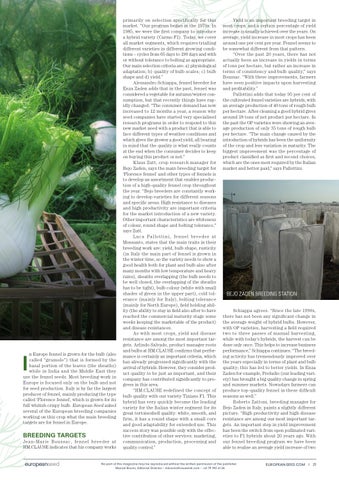
BEJO ZADEN BREEDING STATION Schiappa agrees. “Since the late 1990s, there has not been any significant change in the average weight of hybrid bulbs. However, with OP varieties, harvesting a field required two to three passes of manual harvesting, while with today’s hybrids, the harvest can be done only once. This helps to increase business performance,” Schiappa continues. “The breeding activity has tremendously improved over the years especially in terms of plant and bulb quality; this has led to better yields. In Enza Zaden for example, Preludio (our leading variety) has brought a big quality change in spring and summer markets. Nowadays farmers can produce top-quality fennel in these difficult seasons as well.” Roberto Zattoni, breeding manager for Bejo Zaden in Italy, paints a slightly different picture. “High productivity and high disease resistance are among our most important targets. An important step in yield improvement has been the switch from open pollinated varieties to F1 hybrids about 20 years ago. With our fennel breeding program we have been able to realise an average yield increase of two
No part of this magazine may be reproduced without the written permission of the publisher. Marcel Bruins, Editorial Director • mbruins@issuesink.com • +41 79 192 41 26
EUROPEAN-SEED.COM I 21