A GLIMPSE OF RI’S PAST
h i s t o r y w i t h d o n d ’a m at o
PEOPLE AND PLACES
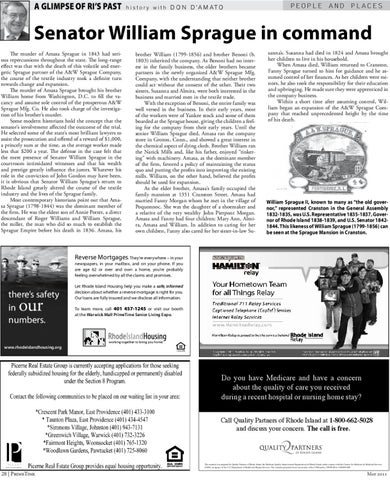
Senator William Sprague in command The murder of Amasa Sprague in 1843 had serious repercussions throughout the state. The long-range effect was that with the death of this volatile and energetic Sprague partner of the A&W Sprague Company, the course of the textile industry took a definite turn towards change and expansion. The murder of Amasa Sprague brought his brother William home from Washington, D.C. to fill the vacancy and assume sole control of the prosperous A&W Sprague Mfg. Co. He also took charge of the investigation of his brother’s murder. Some modern historians hold the concept that the senator’s involvement affected the outcome of the trial. He selected some of the state’s most brilliant lawyers to assist the prosecution and offered of a reward of $1,000, a princely sum at the time, as the average worker made less that $200 a year. The defense in the case felt that the mere presence of Senator William Sprague in the courtroom intimidated witnesses and that his wealth and prestige greatly influence the jurors. Whatever his role in the conviction of John Gordon may have been, it is obvious that Senator William Sprague’s return to Rhode Island greatly altered the course of the textile industry and the lives of the Sprague family. Most contemporary historians point out that Amasa Sprague (1798-1844) was the dominant member of the firm. He was the eldest son of Annie Potter, a direct descendant of Roger Williams and William Sprague, the miller, the man who did so much to establish the Sprague Empire before his death in 1836. Amasa, his
brother William (1799-1856) and brother Benoni (b. 1803) inherited the company. As Benoni had no interest in the family business, the older brothers became partners in the newly organized A&W Sprague Mfg. Company, with the understanding that neither brother could act without the consent of the other. Their two sisters, Susanna and Almira, were both interested in the business and married men in the textile trade. With the exception of Benoni, the entire family was well versed in the business. In their early years, most of the workers were of Yankee stock and some of them boarded at the Sprague house, giving the children a feeling for the company from their early years. Until the senior William Sprague died, Amasa ran the company store in Groton, Conn., and showed a great interest in the chemical aspect of dying cloth. Brother William ran the Natick Mills and, like his father, enjoyed “tinkering� with machinery. Amasa, as the dominant member of the firm, favored a policy of maintaining the status quo and putting the profits into improving the existing mills. William, on the other hand, believed the profits should be used for expansion. As the elder brother, Amasa’s family occupied the family mansion at 1351 Cranston Street. Amasa had married Fanny Morgan whom he met in the village of Poquonnoc. She was the daughter of a shoemaker and a relative of the very wealthy John Pierpont Morgan. Amasa and Fanny had four children: Mary Ann, Almira, Amasa and William. In addition to caring for her own children, Fanny also cared for her sister-in-law Su-
sanna’s. Susanna had died in 1824 and Amasa brought her children to live in his household. When Amasa died, William returned to Cranston. Fanny Sprague turned to him for guidance and he assumed control of her finances. As her children were minors, he also took the responsibility for their education and upbringing. He made sure they were apprenticed in the company business. Within a short time after assuming control, William began an expansion of the A&W Sprague Company that reached unprecedented height by the time of his death.
William Sprague II, known to many as “the old governor,� represented Cranston in the General Assembly 1832-1835, was U.S. Representative 1835-1837, Governor of Rhode Island 1838-1839, and U.S. Senator 18421844. This likeness of William Sprague (1799-1856) can be seen at the Sprague Mansion in Cranston.
Reverse Mortgages. They’re everywhere – in your
newspapers, in your mailbox, and on your phone. If you are age 62 or over and own a home, you’re probably feeling overwhelmed by all the claims and promises.
there’s safety in numbers.
our
Let Rhode Island Housing help you make a safe, informed decision about whether a reverse mortgage is right for you. Our loans are fully insured and we disclose all information. To learn more, call 401 457-1245 or visit our booth at the Warwick Mall PrimeTime Senior Living Expo.
www.rhodeislandhousing.org
4.75 x 2.75
Do you have Medicare and have a concern about the quality of care you received during a recent hospital or nursing home stay? Call Quality Partners of Rhode Island at 1-800-662-5028 and discuss your concern. The call is free.
This material was prepared by Quality Partners of Rhode Island, the Medicare Quality Improvement Organization for Rhode Island, under contract with the Centers for Medicare & Medicaid Services &06 DQ DJHQF\ RI WKH 8 6 'HSDUWPHQW RI +HDOWK DQG +XPDQ 6HUYLFHV 7KH FRQWHQWV SUHVHQWHG GR QRW QHFHVVDULO\ UHĂ HFW &06 SROLF\ 62: 5,
28 | PrimeTime
May 2011