october
10, 2012 |
academic symposium
sesquicentennial speaker/medal award
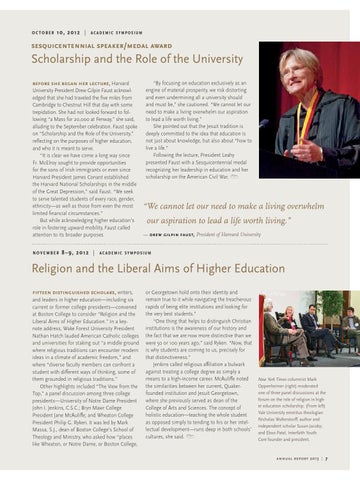
Scholarship and the Role of the University before she began her lecture, Harvard University President Drew Gilpin Faust acknowl edged that she had traveled the five miles from Cambridge to Chestnut Hill that day with some trepidation. She had not looked forward to fol lowing “a Mass for 20,000 at Fenway,” she said, alluding to the September celebration. Faust spoke on “Scholarship and the Role of the University,” reflecting on the purposes of higher education, and who it is meant to serve. “It is clear we have come a long way since Fr. McElroy sought to provide opportunities for the sons of Irish immigrants or even since Harvard President James Conant established the Harvard National Scholarships in the middle of the Great Depression,” said Faust. “We seek to serve talented students of every race, gender, ethnicity—as well as those from even the most limited financial circumstances.” But while acknowledging higher education’s role in fostering upward mobility, Faust called attention to its broader purposes. november
8–9, 2012 |
“By focusing on education exclusively as an engine of material prosperity, we risk distorting and even undermining all a university should and must be,” she cautioned. “We cannot let our need to make a living overwhelm our aspiration to lead a life worth living.” She pointed out that the Jesuit tradition is deeply committed to the idea that education is not just about knowledge, but also about “how to live a life.” Following the lecture, President Leahy presented Faust with a Sesquicentennial medal recognizing her leadership in education and her scholarship on the American Civil War. b
“ We cannot let our need to make a living overwhelm our aspiration to lead a life worth living.” — drew gilpin faust, President of Harvard University
academic symposium
Religion and the Liberal Aims of Higher Education fifteen distinguished scholars, writers, and leaders in higher education—including six current or former college presidents—convened at Boston College to consider “Religion and the Liberal Aims of Higher Education.” In a key note address, Wake Forest University President Nathan Hatch lauded American Catholic colleges and universities for staking out “a middle ground where religious traditions can encounter modern ideas in a climate of academic freedom,” and where “diverse faculty members can confront a student with different ways of thinking, some of them grounded in religious traditions.” Other highlights included “The View from the Top,” a panel discussion among three college presidents—University of Notre Dame President John I. Jenkins, C.S.C.; Bryn Mawr College President Jane McAuliffe; and Wheaton College President Philip G. Ryken. It was led by Mark Massa, S.J., dean of Boston College’s School of Theology and Ministry, who asked how “places like Wheaton, or Notre Dame, or Boston College,
or Georgetown hold onto their identity and remain true to it while navigating the treacherous rapids of being elite institutions and looking for the very best students.” “One thing that helps to distinguish Christian institutions is the awareness of our history and the fact that we are now more distinctive than we were 50 or 100 years ago,” said Ryken. “Now, that is why students are coming to us, precisely for that distinctiveness.” Jenkins called religious affiliation a bulwark against treating a college degree as simply a means to a high-income career. McAuliffe noted the similarities between her current, Quakerfounded institution and Jesuit Georgetown, where she previously served as dean of the College of Arts and Sciences. The concept of holistic education—teaching the whole student as opposed simply to tending to his or her intel lectual development—runs deep in both schools’ cultures, she said. b
New York Times columnist Mark Oppenheimer (right) moderated one of three panel discussions at the forum on the role of religion in higher education scholarship. (From left) Yale University emeritus theologian Nicholas Wolterstorff; author and independent scholar Susan Jacoby; and Eboo Patel, Interfaith Youth Core founder and president.
annual report 2013 | 7