We are entering our fourth year of pumpkin production and have been enjoying it tremendously. Each year our production has nearly doubled. When the third generation entered the farm, we began searching for an alternative high-value crop to potatoes. We realized that, having four managers, we had the capacity to expand into a crop that requires a lot of management and attention. Pumpkins was the imminent answer. We have worked with a few local and national distributors to sell our pumpkins. They are sold to large grocery store chains throughout the Midwest, and a small amount is sold to our local grocery store and businesses to satisfy their needs. Are you still growing red kidney beans for Chippewa Valley Bean Co.? How many acres, and how is that endeavor? Four years ago, we resumed a relationship that my grandpa, Pete, and Russ Doane of Chippewa Valley Bean had at the beginning of their careers. We are currently growing about 250 acres of dark-red kidney beans (150 organically) for C.V. Bean. This puts our combine at about 80 percent capacity of what we feel we can comfortably harvest in a year with the bean equipment. We are beginning to experiment with direct-combining kidney beans to increase the number of acres we
can grow and harvest under optimal conditions. Kidney bean production for Chippewa Valley Bean was a natural fit for our farm and crop rotation. The early harvest compared to soybeans gives us much more flexibility with cover crop choices and practices to ensure our soil health and setup for next year’s crops. Are you growing vegetables for the process market? Who are your general vegetable customers? Historically, most of our vegetables that we grew went to the processing markets, but with changes in our crop mix, an increased amount is going to market without processing. Our snap beans and sweet corn contracts are still for processing. They are through wholesale purchasers who, in turn, sell to the canning company. Pumpkins are shipped either directly to the store or to a
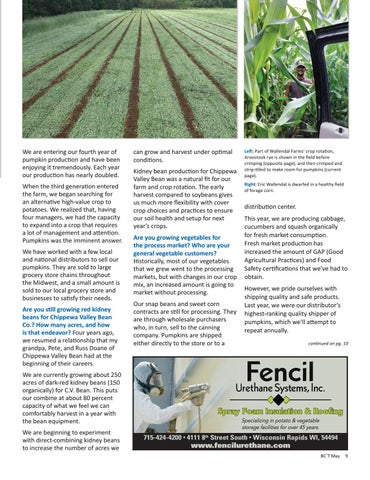
Left: Part of Wallendal Farms’ crop rotation, Aroostook rye is shown in the field before crimping (opposite page), and then crimped and strip-tilled to make room for pumpkins (current page). Right: Eric Wallendal is dwarfed in a healthy field of forage corn.
distribution center. This year, we are producing cabbage, cucumbers and squash organically for fresh market consumption. Fresh market production has increased the amount of GAP (Good Agricultural Practices) and Food Safety certifications that we’ve had to obtain. However, we pride ourselves with shipping quality and safe products. Last year, we were our distributor’s highest-ranking quality shipper of pumpkins, which we’ll attempt to repeat annually. continued on pg. 10
Spray Foam Insulation & Roofing Specializing in potato & vegetable storage facilities for over 45 years.
715-424-4200 • 4111 8th Street South • Wisconsin Rapids WI, 54494
www.fencilurethane.com
BC�T May
9