Interview. . . continued from pg. 9
open-top flat-bottom or live-bottom trailers. We clean and size the beets in the field to cater to the customer’s needs. We can also wash and pack the beets in 2,000-pound cardboard bins, and in the past, we have had them packed in 50-pound potato bags. We are always willing to do what it takes to satisfy the customer! Are they all for processing? And who are your customers or where do your vegetables go? Most of our crops are for processing. We grow for Seneca Foods, Del Monte, Bonduelle North America and Lakeside Foods. Besides the larger canning companies, we also sell some of the beets for
10 BC�T May
fresh market and to other smaller processors around the country. Do you enjoy farming in the Central Sands/Central Wisconsin, and why or why not? This is a great area to farm in. We are centrally located among most of the canneries. There are a lot of great suppliers of fertilizers, chemicals, equipment and anything else we need to keep our operation going. We have relationships with a lot of businesses that go back several generations. Do you hope to pass the farm on to your own kids, and if so, why is this important to you? I do hope to pass
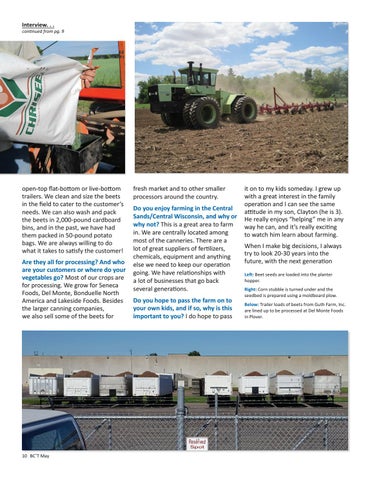
it on to my kids someday. I grew up with a great interest in the family operation and I can see the same attitude in my son, Clayton (he is 3). He really enjoys “helping” me in any way he can, and it’s really exciting to watch him learn about farming. When I make big decisions, I always try to look 20-30 years into the future, with the next generation Left: Beet seeds are loaded into the planter hopper. Right: Corn stubble is turned under and the seedbed is prepared using a moldboard plow. Below: Trailer loads of beets from Guth Farm, Inc. are lined up to be processed at Del Monte Foods in Plover.