update magazine July/August 2013
Health & Safety
35
in the workplace
MEMBERCENTRED AND PROACTIVE NEW ENHANCED DISABILITY MANAGEMENT PROGRAM SUPPORTS NURSES STRUGGLING WITH ILLNESS OR INJURY
EDMP is currently available for nurses under the NBA, including RNs and RPNs. EDMP has recently been negotiated for LPNs and the union is working to implement the program for LPNs at the earliest opportunity.
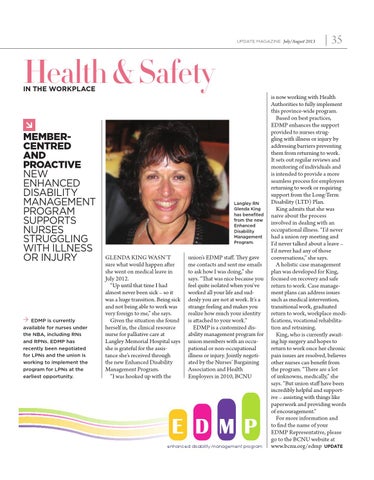
Langley RN Glenda King has benefited from the new Enhanced Disability Management Program.
Glenda King wasn’t sure what would happen after she went on medical leave in July 2012. “Up until that time I had almost never been sick – so it was a huge transition. Being sick and not being able to work was very foreign to me,” she says. Given the situation she found herself in, the clinical resource nurse for palliative care at Langley Memorial Hospital says she is grateful for the assistance she’s received through the new Enhanced Disability Management Program. “I was hooked up with the
union’s EDMP staff. They gave me contacts and sent me emails to ask how I was doing,” she says. “That was nice because you feel quite isolated when you’ve worked all your life and suddenly you are not at work. It’s a strange feeling and makes you realize how much your identity is attached to your work.” EDMP is a customized disability management program for union members with an occupational or non-occupational illness or injury. Jointly negotiated by the Nurses’ Bargaining Association and Health Employers in 2010, BCNU
enhanced disability management program
is now working with Health Authorities to fully implement this province-wide program. Based on best practices, EDMP enhances the support provided to nurses struggling with illness or injury by addressing barriers preventing them from returning to work. It sets out regular reviews and monitoring of individuals and is intended to provide a more seamless process for employees returning to work or requiring support from the Long-Term Disability (LTD) Plan. King admits that she was naive about the process involved in dealing with an occupational illness. “I’d never had a union rep meeting and I’d never talked about a leave – I’d never had any of those conversations,” she says. A holistic case management plan was developed for King, focused on recovery and safe return to work. Case management plans can address issues such as medical intervention, transitional work, graduated return to work, workplace modifications, vocational rehabilitation and retraining. King, who is currently awaiting hip surgery and hopes to return to work once her chronic pain issues are resolved, believes other nurses can benefit from the program. “There are a lot of unknowns, medically,” she says. “But union staff have been incredibly helpful and supportive – assisting with things like paperwork and providing words of encouragement.” For more information and to find the name of your EDMP Representative, please go to the BCNU website at www.bcnu.org/edmp update