update magazine December 2012
the union this October. When LPNs employed by healthcare affiliates also vote to join BCNU, it’s expected almost 10,000 LPNs will be in the nurses’ union by next spring. Over the long term, bringing all nurses into one strong organization will build the union’s capacity to improve practice conditions and negotiate better contracts. And better practice conditions for nurses means better healthcare for British Columbians.
17
More than 7,200 health authority-employed LPNs move to BCNU
Working hard and not giving up on unity
Braiden clearly remembers the tentative first steps of the LPN movement almost eight years ago. During one of their initial discussions they met with a Victoriabased labour lawyer who had helped other healthcare employees change unions. “I clearly remember our lawyer’s words during our first meeting with him in 2006,” says Braiden. “He told us that BC healthcare labour legislation is complex and he wasn’t optimistic we’d ever be successful in moving LPNs to BCNU. He said if we were successful we’d forever change the face of BC labour.” Braiden, Anderson and Fleming knew they were advancing an idea that was popular with LPNs. Bringing all nurses into the same union makes sense and advances common sense solutions to improve BC healthcare. And it adds to the list of nurses’ unions in other provinces that represent RNs and LPNs alike. “Our initial discussion with the labour lawyer could have caused us to give up,” says Braiden. “But we kept on going until our vision for a united nursing profession took hold with LPNs. Our next step is to bring affiliate LPNs into BCNU then move LPNs into the Nurses’ Bargaining Association.” “I’ll be retiring soon,” says Braiden. “My desire in the campaign is for younger LPNs to have a great career as BCNU members. “And I feel totally comfortable now moving into the sunset because so many great nurse activists have come forward in the campaign and they’re ready to move our profession forward at BCNU.” update
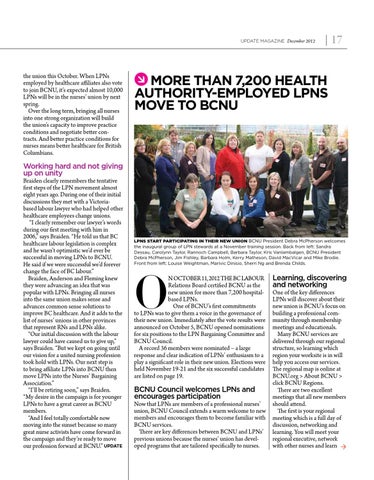
LPNs start participating in their new union BCNU President Debra McPherson welcomes the inaugural group of LPN stewards at a November training session. Back from left: Sandra Dessau, Carolynn Taylor, Rannoch Campbell, Barbara Taylor, Kris Vanlambalgen, BCNU President Debra McPherson, Jim Fishley, Barbara Holm, Kerry Matheson, David MacVicar and Mike Brodie. Front from left: Louise Weightman, Marivic Dinisio, Sherri Ng and Brenda Childs.
O
n October 11, 2012 the BC Labour Relations Board certified BCNU as the new union for more than 7,200 hospitalbased LPNs. One of BCNU’s first commitments to LPNs was to give them a voice in the governance of their new union. Immediately after the vote results were announced on October 5, BCNU opened nominations for six positions to the LPN Bargaining Committee and BCNU Council. A record 36 members were nominated – a large response and clear indication of LPNs’ enthusiasm to a play a significant role in their new union. Elections were held November 19-21 and the six successful candidates are listed on page 19.
BCNU Council welcomes LPNs and encourages participation
Now that LPNs are members of a professional nurses’ union, BCNU Council extends a warm welcome to new members and encourages them to become familiar with BCNU services. There are key differences between BCNU and LPNs’ previous unions because the nurses’ union has developed programs that are tailored specifically to nurses.
Learning, discovering and networking One of the key differences LPNs will discover about their new union is BCNU’s focus on building a professional community through membership meetings and educationals. Many BCNU services are delivered through our regional structure, so learning which region your worksite is in will help you access our services. The regional map is online at BCNU.org > About BCNU > click BCNU Regions. There are two excellent meetings that all new members should attend. The first is your regional meeting which is a full day of discussion, networking and learning. You will meet your regional executive, network with other nurses and learn