THE HEIGHTS
A4
THURSDAY, FEBRUARY 16, 2017
D@K >iX[j D\i^\ 8k_c\k`Z :fd]fik N`k_ Gif]\jj`feXc N\Xi 9P D8;<C<@<E< ;Ë8E><CF D\kif <[`kfi
Business wear has a bad reputation for being sweat-inducing, impractical, and generally uncomfortable. So after a long day at work, most people in the professional world look forward to changing out of these stiff articles of clothing into something cozy and comfortable. The suit and tie come off, and the sheath dress and high-heels are tossed aside in favor of sweatpants and an oversized hoodie—options that, despite their negative sartorial reputation, are undeniably comfortable. But wouldn’t it be nice if that barrier between work clothes and comfortable active wear was something more fluid? This is the question that faced three Massachusetts Institute of Technology graduates— Aman Advani, Gihan Amarasiriwardena, and Kit Hickney—in 2012 after they had spent time the professional world. With all three boasting a past in some form of athletics—Amarasiriwardena having been a world-class distance runner—they were suddenly confronted with the fact that features available in high-performance athletic clothing were not available in business wear. With the long hours they work, people in the professional world were doomed to hours of discomfort, until Advani, Amarasiriwardena, and Hickney had an idea: business wear that felt as comfortable as a second skin. So even before the trio developed their first line of clothing, they set up a wildly successful Kickstarter campaign that raised over $6,000 dollars in the first day, and over $400,000 by the end of the campaign. What became, Ministry of Supply was Kickstarter’s most successful fashion startup by a longshot. Mike Farber, MCAS ’89 and Ministry of Supply advisor, revealed that this wave of
public enthusiasm acted as validation for the burgeoning company, and served as the launch point for the creation of their fabrics and designs. The founders then pulled inspiration from the fabrics and materials used not only by successful brands of athletic clothing, but also by NASA, creating a product that featured a unique blend of science and fashion. “I often joke that [the fabric is] like a true wearable,” Farber said. “It’s not like the Apple watch, it’s something that you wear on your body, and it makes your body perform better, and feel better.” With his background in chemical engineering, Amarasiriwardena worked to hack the world of fabric as the team began designing their products. Alongside his team, Amarasiriwardena created fabrics that included key comfortable features. One of these is omni-stretch, which allows for wrinkle-free movement, a treatment that keeps fabric dry by preventing the absorption of moisture, and heat regulation that allows someone to sweat without obvious sweat stains. Soon the startup was ready to send off their first line of men’s “Apollo” dress shirts, and not long after, they released the odor-mitigating “Atlas” dress socks, which were made from a coffee grind-infused fabric. The Ministry of Supply founders continued expanding their first articles of menswear, eventually developing a line (and inventory) strong enough to launch an online store. By 2015, the founders opened the company’s first brick-and-mortar location on Newbury Street. By 2016, they had expanded into their first womenswear line. Though it was fairly smooth, Farber explained that this expansion was not without challenges. The founders faced the fashionspecific problem of forecasting the correct amount of clothing to produce.
Unlike software, which innovators can abandon if it fails, fashion requires an active consumer demand. If no one buys the product, the company is left with thousands of shirts lying around. But the Ministry of Supply seems to have predicted that with accuracy, as they now have physical locations in major cities across the country including Washington D.C., San Francisco, Chicago, and Atlanta. And although Ministry of Supply’s start-up has spread across the country at the rapid pace, the founders have kept their business based in Boston. Farber explained that this is not only because the trio has a deep love for the area, but also because of the area’s unusual mix of fashion technology. Boston might not have the same reputation for fashion innovation as somewhere like New York City, but Farber says that Boston contains a community of talented and innovative individuals from the fashion industry—a statement that finds basis not only in fact that major brands like New Balance and Converse headquarter their companies in Boston, but from the culture in the city that has resulted in events like the Museum of Fine Arts #techstyle exhibit. Even with the support and vibrancy that an innovative city like Boston provides for its startup, Ministry of Supply is still a part of the fashion world—a cutthroat industry where many brands struggle for years, not months, before launching their first line. Farber attributed this unique success to the quality of the product that “is tuned in to how more and more people are living their lives. Farber explained that in recent years, consumers pay more attention to quality over quantity. Instead of filling their closet to the brim with items that will be out of style and fall apart within months, today’s shoppers look for items that they could comfortably wear for years. Ministry of Supply’s founders
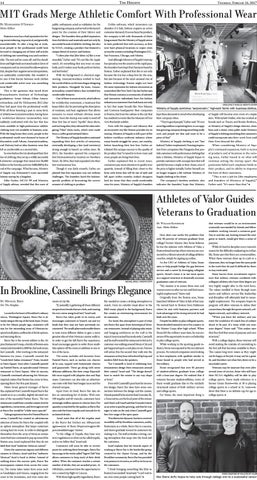
MADELEINE D’ANGELO/ HEIGHTS EDITOR
Ministry of Supply combines “second-skin,” high-tech fabric with business clothes. kept these demands in mind when developing their company ethos. “They’re good people,” Farber said. “It’s not some big soulless cooperating here, it a scrappy fast-growing company doing something really cool, and people see that and want to be a piece of that.” Ministry of Supply clothing is not “fast fashion”, Farber emphasized. Drawing inspiration from companies like Patagonia that provide customers with performance clothing that lasts a lifetime, Ministry of Supply hopes to provide customers with a unique item that will quickly become a staple in their closet, even if the price is higher initially. Farber himself can no longer imagine a life without Ministry of Supply clothing in his closet. The company’s timeless aesthetic also indicates the founders’ hope that Ministry
of Supply will become even more of a staple item. With Jarlath Mellet, who has worked at brands such as Theory and Brooks Brothers, as Ministry of Supply’s design director, clean lines and a classic color pallet make Ministry of Supply’s clothing something that customers could incorporate into their work lives and their lives beyond the office. When considering Ministry of Supply’s continued expansion, both in terms of products and of locations in the coming years, Farber honed in on what will continue setting the startup apart: the passionate belief each employee holds in their product, and its ability to improve the lives of their customers. “This is not a job for [the employees and founders of Ministry of Supply],” Farber said. “It’s more than that.”
8k_c\k\j f] MXcfi >l`[\j M\k\iXej kf >iX[lXk`fe 9P N@CC@8D 98K:?<CFI 8jjk% D\kif <[`kfi
MICHAEL BRUE / HEIGHTS STAFF
@e 9iffbc`e\# :Xjj`e\cc` 9i`e^j <c\^XeZ\ 9P D@:?8<C 9IL< =fi K_\ ?\`^_kj Located in the heart of Brookline’s culinary mecca, Washington Square, Burro Bar is already rising to the top of the food chain. Drawn in by the vibrant purple sign, customers will stay for the astounding array of Mexican-inspired small plates, endless list of drink options, and stunning décor. Burro Bar is the newest edition to the Alpine Restaurant Group, a family of Boston-area restaurants founded in 2009 by chef and owner, Joe Cassinelli. After working in the restaurant business for years, Cassinelli created the “wood-fired Italian restaurant” Posto, located in Davis Square. Soon after, Cassinelli opened up Painted Burro, an upscale-casual Mexican restaurant in Davis Square. After its success, Cassinelli continued advancing the Mexicaninspired cuisine that Boston has come to love, opening Burro Bar this past January. Helen Israel, general manager of Burro Bar, explained that Cassinelli hoped Burro Bar would serve as a smaller, slightly elevated version of the successful Painter Burro. The two restaurants would have a similar cuisine, but the ingredients, menu items, and beverages served at Burro Bar would be “a little more upscale.” Taking inspiration from the Painted Burro’s menu, Cassinelli has created an adventurous selection of items for Burro Bar coupled with an upbeat atmosphere that keeps customers coming back for more. In order to distinguish themselves from the array of Mexican restaurants that have continued to pop up around the Boston area, Israel explained that they do not label their food “authentic Mexican cuisine.” Given the numerous regions and different cuisines in Mexico, Israel said that “authentic Mexican” food is hard to define. Instead of walking down this narrow path, Burro Bar encompasses cuisines from across the country. The menu takes tastes from areas such as Guadalajara and Oaxaca, ranging from the coast to the mountains, and even some ele-
ments of city life. “[Cassinelli] is gathering all these different recipes from friends that are chefs, and creating his own menu using local fare,” Israel said. Burro Bar takes pride in its menu, and encourages customers to branch out and try foods that they may not have previously encountered. The small-plate meals enable diners to taste many different dishes to gain a more genuine idea of what Mexican cuisine really is. In order to get the full Burro Bar experience, Israel encourages guests to order three smallbite options off the menu in addition to one or two of the tacos. The menu includes old favorites from Painted Burro, such as nachos con chorizo de la casa, topped with homemade chorizo and guacamole. These go along with some delicious additions, like their crispy Baja-style fish tacos topped with jalapeño slaw and Baja mayo. Customers can also take an adventurous route with their beef tongue tacos and the charred octopus. Apart from its food, Burro Bar also offers an astonishing list of drinks. With over 100 tequilas and 60 mezcals, customers have seemingly endless options to choose from.The quantity is matched by the quality, as Burro Bar uses only the finest tequilas and mezcals for its acclaimed drinks. Israel notes that all of the tequilas used in the Burro Bar kitchen are 100-percent agave—none of those 50-percent-agave-50percent-added-sugar ‘mixtos.’ “In the village of Tequila, they have very strict regulations on what can be called tequila, and so we follow that,” Israel said. Customers will soon be able to receive prizes for ordering these beverages. Burro Bar has an app in the works called “Agave Club” that allows customers to keep track of their drink orders. When the customer reaches a certain number of drinks, they are awarded prizes. At 100 drinks, customers have the opportunity to win a round trip flight to Cancun. With these high-quality ingredients, Burro
Bar needed to create a striking atmosphere to match. From its colorful visual décor to the R&B music played in the background, Burro Bar creates an entertaining environment for its customers. For Israel, this atmosphere is part of what sets Burro Bar apart from stereotypical Mexican restaurants. Instead of playing salsa music and hanging sombreros on the wall in the typical Americanized hacienda style, Cassinelli and his staff wanted the restaurant to feel as if a customer was walking around Mexico City and just happened upon a cool place to eat. Patrons will notice this the second they walk into the restaurant as they hear old-school hip hop and modern R&B from the speakers. “Joe Cassinelli is kind of redefining how restaurateurs design their restaurants around their cuisine,” Israel said. “The design doesn’t have to match the cuisine in any way shape or form.” Even with Cassinelli’s penchant for innovative design, Burro Bar does have some connections between the design and the cuisine. Murals painted by local artist Raul Gonzalez III, a Texas native, are the focal point of the restaurant’s back wall. Israel said that Gonzalez’s fame as an artist is quickly growing, and that he was eager to take on the task when Cassinelli gave him free range of the open space. This distinctive dynamic has been received incredibly well by Brookline customers, and by Bostonians as a whole. Burro Bar is a success, and shows gratitude toward its customers for making it so. The staff embodies a loving, caring atmosphere that seeps into the food and the customers. Israel explains that her favorite aspect of working at Burro Bar is the family-like group created by the Alpine Group, and by the Brookline community. Burro Bar has provided true passion in its menu, as well as its focus on the customers. “I think bringing something like [this to Boston] was needed,” Israel said. “I can’t wait to see even more people coming back.”
How does one tackle the problem that only 50 percent of veterans graduate from college? Former Marine Alex Stone believes he has the solution with Athletes of Valor, a Boston-based startup where veterans are connected to a vibrant network of college athletics coaches, simply by signing up online. As the CEO of Athletes of Valor, Stone aims to help people bridge the gap between service and a career by leveraging collegiate sports. Stone’s vision is to use team sports as a support structure to drastically increase graduation rates of veterans. “My mission is to ensure these men and women move on after service and find meaningful employment,” Stone said. Originally from the Boston area, Stone launched Athletes of Valor in July of last year. He moved back to Boston from Baltimore where he met with business partners and took advantage of the strong network he had built over the years. Despite his ability to play collegiate sports, Stone decided instead to serve his country in the Marine Corps after high school. When Stone left the military years later, he was unaware of the opportunity to earn a scholarship to play college sports. While working in the sporting goods industry, Stone was exposed to the recruitment process. He noticed companies were looking to hire employees with qualities similar to those found in people who had served in the military. Stone recognized that over 85 percent of student-athletes graduate from college with a four-year degree. He realized that if veterans became student-athletes, more of them would graduate due to the similarly structured nature of both military service and college sports. For Stone, the most important thing is
that veterans would be in an environment constantly surrounded by friends and fellow students working toward a common goal. Day in and day out, looking toward the next game or match, would give them a sense of purpose. While it’s hard to decipher every veteran’s reason for the difficulty readjusting to civilian life, Stone says that there are commonalities. When these veterans show up to a job or a classroom, they no longer have the same pride in the work they do and it’s difficult for them to stay motivated. Stone knows from recruitment experience that military veterans combined with collegiate athletes who have their degree are very highly sought after in the work force. The values instilled in them through team sports and military service like leadership and discipline will ultimately lead to meaningful employment. The company hopes its program will allow veterans to utilize their connections through the sports network, collegiate network, and military network. “When you leave the military and you enter the workforce it’s much less of culture shock to be part of a team while you earn your degree,” Stone said. “This makes sure that they find that sense of purpose and core structure.” With a college degree, these veterans will avoid making the mistake of committing to the first job that becomes available to them. This causes long term issues as they might not be happy at the job. It may not be a great fit, and therefore not what they deem to be a successful career. Veterans may be unaware that even after several years of service, those who still have their NCAA eligibility will be able to play college sports. Stone made reference to a former Green Beret—who at 38 is playing college sports in a school in St. Louis—to show that there is no definite cap for age in college sports.
PHOTO COURTESY OF ATHLETES OF VALOR
Alex Stone (left) hopes to help vets through college and to a successful career.