these communities also provide us with glimpses of what U.S. Catholicism will look like in vast regions of the country in the near future. The first summary report has been released and is available at the Boston College School of Theology and Ministry website. A number of specialized reports looking more closely at parish dynamics and pastoral leadership will follow. The following are some preliminary observations based on data collected from responding parishes. Upcoming articles will address other areas of parish life in communities doing Hispanic ministry throughout the country. Look south and west Most Catholic parishes (61 percent) in the United States are in the Northeast and the Midwest. These are the regions that have experienced most of the parish closings and mergers. Only 39 percent of all parishes are in the South and the West. Yet, it is in these regions where the vast majority of parishes with Hispanic ministry (approximately 61 percent) are located; only 15 percent are in the Northeast and 24 percent in the Midwest. The geographical distribution of parishes with Hispanic ministry is consistent with the distribution of the Hispanic Catholic population in the United States. From a historical perspective, it is worth noting that the strong Catholic presence in the Northeast and Midwest led to the establishment of very important structures such as parishes, schools, universities, social service institutions and networks. For many decades these structures served not only the Catholic population in these regions, but also allowed Catholicism to exercise an influential voice in the immediate social context where those structures thrived. A good number of these Catholic institutions will remain in these regions. However, given the current demographic changes, their future will largely depend on how Hispanic Catholics — and Catholics from other ethnicities — benefit from them and eventually are invited to lead them. In the South and the West, however, the existence of similar structures and networks is not as strong as in the Northeast and Midwest. But this might change in light of the increasing growth of the Catholic population in these regions, mainly due to the Hispanic presence. For this to happen, Catholics need to invest in the emerging communities with a spirit of solidarity, build necessary and efficient structures to continue the work of evangelization and remain open to shifting understandings of what it means to be Catholic in the United States.
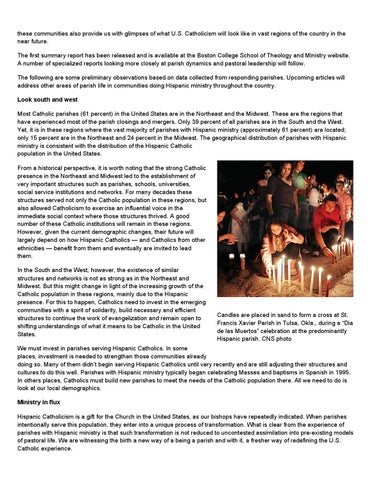
Candles are placed in sand to form a cross at St. Francis Xavier Parish in Tulsa, Okla., during a “Dia de las Muertos” celebration at the predominantly Hispanic parish. CNS photo
We must invest in parishes serving Hispanic Catholics. In some places, investment is needed to strengthen those communities already doing so. Many of them didn’t begin serving Hispanic Catholics until very recently and are still adjusting their structures and cultures to do this well. Parishes with Hispanic ministry typically began celebrating Masses and baptisms in Spanish in 1995. In others places, Catholics must build new parishes to meet the needs of the Catholic population there. All we need to do is look at our local demographics. Ministry in flux Hispanic Catholicism is a gift for the Church in the United States, as our bishops have repeatedly indicated. When parishes intentionally serve this population, they enter into a unique process of transformation. What is clear from the experience of parishes with Hispanic ministry is that such transformation is not reduced to uncontested assimilation into pre-existing models of pastoral life. We are witnessing the birth a new way of a being a parish and with it, a fresher way of redefining the U.S. Catholic experience.