Boston Common, now cigarette-free, was once a smokers’ haven How does society feel about smoking? Just see what’s legal in the city center. By Marilynn S. Johnson
| GLOBE CORRESPONDENT
JANUARY 05, 2014
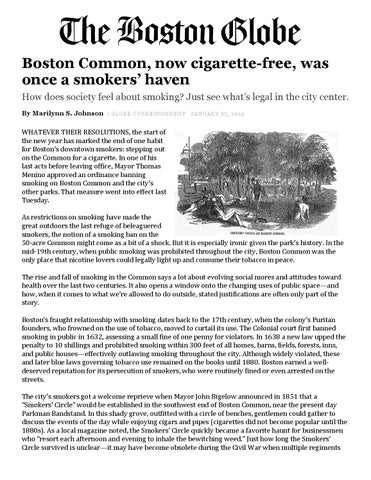
WHATEVER THEIR RESOLUTIONS, the start of the new year has marked the end of one habit for Boston’s downtown smokers: stepping out on the Common for a cigarette. In one of his last acts before leaving office, Mayor Thomas Menino approved an ordinance banning smoking on Boston Common and the city’s other parks. That measure went into effect last Tuesday. As restrictions on smoking have made the great outdoors the last refuge of beleaguered smokers, the notion of a smoking ban on the 50-‐acre Common might come as a bit of a shock. But it is especially ironic given the park’s history. In the mid-‐19th century, when public smoking was prohibited throughout the city, Boston Common was the only place that nicotine lovers could legally light up and consume their tobacco in peace. The rise and fall of smoking in the Common says a lot about evolving social mores and attitudes toward health over the last two centuries. It also opens a window onto the changing uses of public space—and how, when it comes to what we’re allowed to do outside, stated justifications are often only part of the story. Boston’s fraught relationship with smoking dates back to the 17th century, when the colony’s Puritan founders, who frowned on the use of tobacco, moved to curtail its use. The Colonial court first banned smoking in public in 1632, assessing a small fine of one penny for violators. In 1638 a new law upped the penalty to 10 shillings and prohibited smoking within 300 feet of all homes, barns, fields, forests, inns, and public houses—effectively outlawing smoking throughout the city. Although widely violated, these and later blue laws governing tobacco use remained on the books until 1880. Boston earned a well-‐ deserved reputation for its persecution of smokers, who were routinely fined or even arrested on the streets. The city’s smokers got a welcome reprieve when Mayor John Bigelow announced in 1851 that a “Smokers’ Circle” would be established in the southwest end of Boston Common, near the present day Parkman Bandstand. In this shady grove, outfitted with a circle of benches, gentlemen could gather to discuss the events of the day while enjoying cigars and pipes (cigarettes did not become popular until the 1880s). As a local magazine noted, the Smokers’ Circle quickly became a favorite haunt for businessmen who “resort each afternoon and evening to inhale the bewitching weed.” Just how long the Smokers’ Circle survived is unclear—it may have become obsolete during the Civil War when multiple regiments