review The Clean Money Revolution: Reinventing Power, Purpose, and Capitalism by Joel Solomon with Tyee Bridge (New Society Publishers $29.99)
Joel Solomon is a committed capitalist with the heart and soul of a 60s socialist. His newly published memoir, The Clean Money Revolution is also a manifesto for changing the world through Socially Responsible Investments (SRIs). That translates as ethical, sustainable and aligned with values—at above market returns. Here Mark Forysthe reviews his new book co-written by Tyee Bridge.
T
HERE
ARE
TWO
things to know right off the top: Joel Solomon chairs Renewal Funds, a $98 million mission venture capital firm, created in partnership with now B.C.based Rubbermaid heiress, Carol Newman. He was an early backer of Gregor Robertson’s Happy Planet organic juice company, and later backstopped Robertson’s mayoralty campaign Solomon’s life story is something of a history lesson on clashing values during the rise of the civil rights movement, anti-war dissent and environmental awakening. As a Jewish kid from Chattanooga, Tennessee, he had a father who was shut out of the inner business circle but proceeded to build strip malls across the U.S. South. Solomon was groomed for
MONEY
JOEL’S ODYSSEY From Nashville strip malls to Cortez Island to Gregor’s election the family business, so he attended Baylor Military School where, “racism and misogyny were the norm” and later graduated from Vassar College with a political science degree. He became a foot soldier in Jimmy Carter’s 1976 presidential election campaign, and marvelled at how a peanut farmer who came from nowhere could win the White House.
✫
THE NOW ALMOST-FOROTTEN POWELL
Memo of 1971 was pivotal for Solomon, for it revealed how business directly influenced politics. Lewis Franklin Powell Jr. was a lawyer for tobacco giant Philip Morris (among others). His memorandum asserted that business interests must shape national thinking. This was in reaction to a rising consumer public interest movement led by Ralph Nader, new environmental laws and occupational safety regulations. Powell wrote, “the American economic system is under broad attack.” His plan was specific, with a 50-year time horizon. Influential conservative think tanks like the Heritage Foundation, Business Roundtable and the Cato Institute emerged as a result. Business moved on Washington to lobby government head on, and CEOs got to know their senators. And it paid off. Lower taxes, business friendly legislation and less government were the result. So that’s partly how Solomon came to believe and understand that the socially progressive left should “play bigger” in the corridors of power. Meaning: Clean money could overcome dark money.
✫ IN HIS TWENTIES SOLOMON LEARNED
he had the same kidney condition (Polycystic Kidney Disease) that would soon take his father’s life, at age 63. He faced, “dialysis, transplant or death.” This predicament placed him on a path, searching for clean food, air and water. Consultation with alternative health guru Andrew Weil followed, with an emphasis on nontoxic foods, reduced stress and pursuit of a spiritual purpose. This would become his mantra for doing business: “Helping to promote clean organic food, healthy environments and a just society would be my life’s work.” His quest for meaning and health included learning how to be an organic gardener and a self-described “soil freak.” Solomon lived on Cortes Island at a hippie farm, a forerunner to the non-profit educational institute Hollyhock. When his mother visited she remarked that she had, “never seen people living this way by choice.” One of Hollyhock’s founders, Shivon Robinsong, donated a kidney in 2005 to help save Solomon’s life. Later Solomon worked for scientist and Greenpeace activist Paul Spong at OrcaLab on Hanson Island. He
was exposed to local Indigenous culture, read mountains of books on spirituality and psychology, fought depression and spent hours alone. “Living meaningfully became my goal.” In 1983 he received a $50,000 payout from a family investment and injected half into Hollyhock, the remainder into Stonyfield, an non-profit organic farm. Stonyfield broke ground in the U.S. organic natural yogurt market and was later bought for $180 million. A year later his father was on his deathbed with renal failure, pleading with his son to not reject what the family business had created, imploring him to, “do something with it.” Solomon inherited $3 million, moved to Nashville and invested money in small businesses and grassroots organizations that helped revitalize the urban core. He calls this a “family legacy cleanup,” pretty much the opposite of building strip malls that suck the life out of city centres. In Nashville he helped get a city councillor elected and expanded his network of likeminded people who invested in “higher purposes.” The Threshold Foundation (created with Carol Newman) spawned the eco-
MARK FORSYTHE
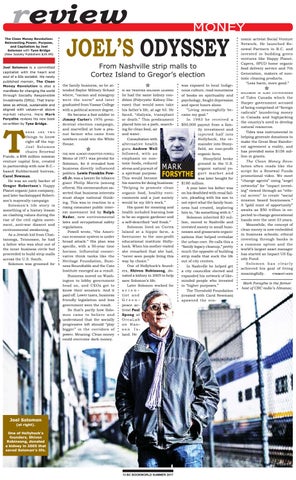
Joel Solomon (at right). One of Hollyhock’s founders, Shivon Robinsong, donated a kidney in 2005 that saved Soloman’s life.
13 BC BOOKWORLD SUMMER 2017
nomic activist Social Venture Network. He launched Renewal Partners in B.C. and invested in budding green ventures like Happy Planet, Capers, SPUD home organic food delivery service and 7th Generation, makers of nontoxic cleaning products. “Less harm, more good.”
✫
SOLOMON IS ALSO CO - FOUNDER
of Tides Canada which the Harper government accused of being comprised of “foreign radicals” laundering money in Canada and highjacking the country’s need to develop natural resources. Tides was instrumental in helping generate donations to make the Great Bear Rainforest agreement a reality, and has provided some $158 million in grants. The Clean Money Revolution often reads like the script for a Renewal Funds promotional video. We meet “change agents” using “angel networks” for “impact investing” viewed through an “ethical screen” to create “social mission based businesses.” A “gold mine of opportunity” awaits as $50 trillion is expected to change generational hands over the next 33 years. Meanwhile, the concept of clean money is now embedded in business schools; ethical investing through banks is a common option and the world’s largest asset manager has started an Impact US Equity Fund. Solomon has clearly achieved his goal of living meaningfully. 9780865718395 Mark Forsythe is the former host of CBC radio’s Almanac.